
Back in 2014 I gave a talk about autonomous microscale surveillance including “smart dust” to an IoT audience. Last week, researchers at the University of Pennsylvania and University of Michigan published the technical specifications in Science Robotics.
Microscopic robots that sense, think, act, and compute
The press coverage I’ve seen emphasizes medicine. “Guardians of cellular health,” says ScienceAlert. Ok, ok, let’s get real. The actual paper describes something different: a general-purpose programmable computer, 200 by 300 micrometers, that can sense its environment, execute conditional logic, coordinate in swarms, and operate autonomously for months.
Tiny Computer
The device fits on the ridge of a fingerprint. It runs on 16 nanowatts harvested from ambient light. It carries a custom 11-bit processor with conditional branching, arithmetic operations, memory addressing, and loop control. It’s not a sensor that wiggles. It’s a Turing-complete microprocessor that happens to be smaller than a grain of salt.
Current constraints are a fluid-only operation (electrokinetic propulsion requires ions), optical-only programming (no RF—too power-hungry), and limited memory (a few hundred bits due to leakage current). The researchers are explicit that these are seen as generation-one limitations, and not fundamental barriers.
Follow the Money
The collaboration began at a DARPA presentation five years ago. Funding sources are listed in the paper:
- National Science Foundation (lead billing)
- Air Force Office of Scientific Research
- Army Research Office
- Fujitsu Semiconductors
NSF listed first is another way of saying defense money built the platform. The Michigan lab that built the onboard computer has received over $16 million through DARPA’s Electronics Resurgence Initiative. The same lab builds “injectable computers that can broadcast from inside the body.”
That’s defense money, doing defense research, for defense. So naturally the PR is about medicinal applications. Science is surveillance, but that doesn’t mean surveillance is science.
Tiny Countermeasure Problem
So let’s say you are worried about robots the size of dust, the salt of surveillance, being deployed soon by someone (defense).
We know high-power microwave weapons can fry microscale electronics. The U.S. military has stuff to talk about like CHAMP, THOR, and the overbuilt Epirus IFPC-HPM system. Detection and destruction of surveillance salt is a solved problem for those who can deploy sufficient microwaves.
For everyone else, the countermeasure architecture is… TBD.
No consumer detection equipment. No regulatory framework. No international treaty. No public discussion of deployment implications.

Robots now officially scale to university labs and penny-per-unit manufacturing. Defense against the inevitable abuse of these robots remains classified.
How We Got Here
My 2014 talk showed a slide listing Israeli surveillance exports that had been dismissed as regional paranoia: rock listening devices in Lebanon (confirmed real), Mossad-trained sharks in Egypt (ridiculous), tagged vultures in Saudi Arabia (a Tel Aviv University research bird, actually).
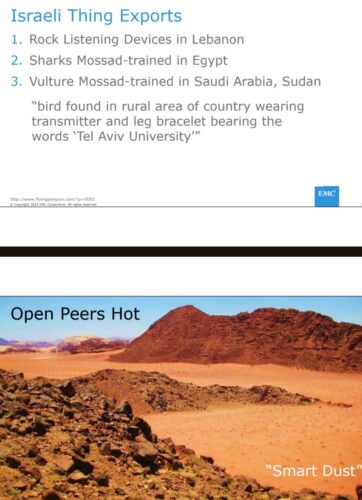
The pattern I was warning about was exotic surveillance accusations get labeled conspiracy theory until the technology becomes undeniable.
Smart dust followed the same trajectory. DARPA funded the concept in 1997. Berkeley built early prototypes. Regional paranoids made accusations. Fact-checkers debunked. Meanwhile, the engineering continued and is now published and headed to production.
Science Robotics reports 17,768 downloads in two weeks. That’s not casual academic interest. That’s procurement offices pulling specifications.
What Next
The paper’s final line:
These results pave the way for general-purpose microrobots that can be programmed many times in a simple setup and can work together to carry out tasks without supervision in uncertain environments.
Unsupervised. Autonomous. Swarm-capable. Programmable. Invisible.
This microscopic technology will be deployed for invisible surveillance. The question is now whether you’ll know what to do when it happens.