
Video evidence is being circulated of a plain clothes man who charged into a group of teenage girls to assault them and put one in a chokehold. The teenagers who tried to help victims of the man were then assaulted by uniformed officers who claimed the unidentified assailant was their Chief of Police.
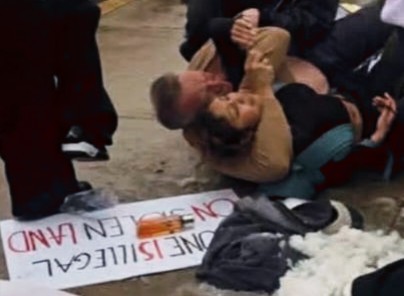
Suddenly, a man in a tan shirt, since identified as McElree, appears to charge into the group of kids and grab one who had been backing away, holding a phone.
[…]
In the chaos, some people had no idea who the man was, the student said, and started defending themselves against the unknown attacker.
[…]
One of the students who appeared to jump in to defend a classmate against the tan shirted man was then thrown to the ground by a uniformed officer. The officer can be heard on video telling the kid that the man he went after is the chief of police — Scott McElree.
“He didn’t even announce he was chief of police. We were confused,” the student said.
Students were put in detention overnight at the Bucks County Youth Center for defending themselves against an unidentified man who physically attacked them. A person wearing a vest with the word “police” on the back is seen running toward the frame and then out of the frame as the man in tan continues to hold a teen girl in a chokehold.
So uniformed officers were present, saw their chief battering and choking a teen girl, and their response was just to let it continue while they tackled the kids around her trying to help?
Fascism protest indeed.
These kids deserve a medal for exposing McElree.
A quiet consolidation of power is the institutional design that made this possible, with a single man holding police chief, borough manager, and records officer. McElree unilaterally controls the police, the administration, and the records about both. It’s highly unusual.
And the way McElree seized this power is notable.
He has been Quakertown’s police chief two decades, since 2004. In 2007 he grabbed the borough manager job after the previous manager’s “sudden departure”, initially claiming approval for the dual role would only be temporary. The council instead pivoted and approved him as permanent replacement within a month. He’s now 72 years old, sitting on a contract clause that protects him from “any adverse employment action” by council if he resigns from either position.
He’s structurally insulated from consequences, which could explain why he wore plain clothes to charge into a group of teens to grab, shove, batter and choke them while his officers protected him instead of the public.
So how did he end up seizing control over Quakertown? I’m glad you asked. He left a 29-year career at a department mid-scandal. That’s the fact. McElree left a Whitemarsh Township police department during a racial profiling case involving a fellow sergeant, a DA criminal investigation, a federal probe, and federal civil rights lawsuits. He was just a SWAT team lead who suddenly landed this police chief’s job within months of the huge racism controversy. The new town “vetted” him unilaterally saying “we investigated”. And where does the SWAT turned Chief live to this day? Not Quakertown, still in Whitemarsh.
As a historian, I noticed a curious footnote to his name from an infamous lynching. About 40 miles west of Whitemarsh in 1911 a violent white mob battered, tortured and publicly burned alive Black steelworker Zachariah Walker. The leading defense attorney for Walker’s suspected killers was Wilmer W. MacElree, referred to then as “the legal sage of Chester County.”
[White violent mobs claimed that Walker] fell from a tree and suffered severe head wounds. After being transported to the Coatesville Hospital and treated for head wounds and a broken jaw while shackled to his bed, a crowd estimated at 2,000 later marched on the hospital and seized Walker, carrying him on the bed from the hospital to Strode Avenue and preparing a large bonfire.
Walker was thrown into the fire three times but managed to escape. On the mob’s last attempt, they cut Walker’s foot off and tied a rope around him and held him in the inferno until he died.
“Don’t give me no crooked death because I’m not white,” Walker told the mob.
As he was burnt to death, a crowd estimated at several thousand looked on and some in the crowd collected his bones as souvenirs. Later that year, Coatesville Police Chief Charles Umsted was indicted for involuntary manslaughter for his failure to the stop the lynching.
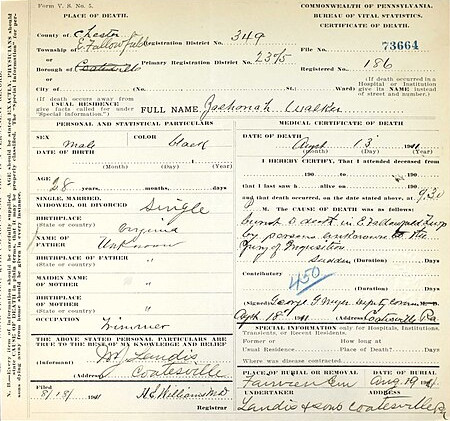
Umsted wasn’t merely indicted for failure to stop the lynching; he actively helped provoke it. A police chief who incites mob violence rather than preventing it. This led to passage of the Pennsylvania Anti-Lynching law in 1923, and yet by 1938 Black residents of Coatesville were organizing armed militias to prevent another lynching.