
A mayor and a governor propose a tax. I swear this is real, not a joke. The tax applies to homes in New York City worth more than five million dollars that are not the owner’s primary residence. The owner’s primary residence is somewhere else. That is the legal definition of a second home, so that is the simple condition for owing the tax.
The projected tax revenue is five hundred million dollars. The projected city deficit is five point four billion. The owners who owe the tax are, by the tax’s own definition, people who have multiple million dollar homes and live elsewhere. Palm Beach. Aspen. London. Riyadh. The apartment stays mostly vacant or holds a partial-year occupancy for a few weeks. The tax exists because the apartment is extra, waiting for someone who lives somewhere else.
A federal politician who is a billionaire, let’s just call him Trump, rants on his soapbox that this destruction of a city. But isn’t the reverse of what he says actually the case?
A Washington outlet prints the word destruction in its headline and supplies the billionaire’s quotes underneath. A finance outlet publishes a companion piece the next morning in which unnamed Wall Streeters say the city is cooked. Neither piece prints the revenue figure against the deficit figure. Neither piece explains that the taxed party is by definition a non-resident. Neither piece mentions Vancouver, Paris, or London, which have run versions of this tax for years and still stand, arguably among the most desirable cities.
Consider what the reader of these outlets now knows instead. The reader knows a particular Trump feeling. The reader knows a verb. The reader does not know the arithmetic. The arithmetic, if printed, would answer the feeling. Five hundred million dollars from a few thousand absentee owners, against a budget gap that otherwise falls on eight million residents. The tax either produces the revenue or moves the apartment to an occupant. The buildings remain where they are in either case. The tax is a win-win for the city.
So the arithmetic exists, and the outlets did not print it. This was a choice. Print the arithmetic and the story collapses, because destruction requires a mechanism and the mechanism cannot be produced. Omit it and the Trump supplied verb survives. The verb obviously was what the billionaire wanted reported. The outlets reported the verb.
This is an old disinformation trick.
In the 1920s the Ku Klux Klan operated two national papers, the Fiery Cross out of Indianapolis and the Imperial Night-Hawk out of Atlanta, which printed populist slogans against plutocrats while the Klan coalition pursued Prohibition and opposed progressive taxation at the state level.
Prohibition, the Klan-Protestant-nativist coalition’s product, was a racist platform to remove the liquor excise that had supplied part of the municipal tax base. Klan driven opposition to income tax prevented any replacement. The hole was filled by raising property taxes and sales taxes. Property tax landed on farmers. Sales tax landed on wage workers. While the rhetoric named Wall Street, the real cost arrived elsewhere.
The cost from tax opposition, by design, arrived most heavily at Black Americans.
Black landowning farmers in the 1920s South paid the same property tax rates as white farmers, on land they had fought to acquire and held under constant threat. The revenue those taxes raised funded segregated white schools. Black schools received token allocations or nothing. Oklahoma, Indiana, and the Deep South ran this pattern. The property tax hikes extracted capital from Black landowners through statute, sometimes to the point of forced sale.
Black wage workers paid the sales taxes that replaced the liquor excises. A domestic worker in Indianapolis paid the same sales tax rate on flour as the banker’s wife. The banker’s household paid no state income tax. The Klan coalition had opposed its introduction. The domestic worker’s grocery bill subsidized roads the wealthy drove on.
Where statute could not reach, the extraction ran through violence. Tulsa 1921 is the version everyone knew in 1921 and today, with a very suspicious silence in-between. Black Wall Street’s accumulated wealth transferred by firebomb and mass murder in a single night. Rosewood followed in 1923. The tax program and the racial violence were not separate patterns. They were the same extraction moving through different instruments. Violence where the statute would have drawn federal attention. Statute where the violence would have drawn it. The Klan coalition ran both.
The rhetoric again misleadingly pointed at Wall Street. The instruments landed on Black farmers, Black wage workers, and Black communities that had accumulated visible wealth. The contradiction was covered in white sheets, with X logos and swastikas.
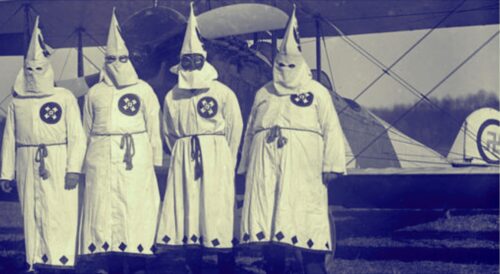
The Fiery Cross and the Imperial Night-Hawk printed the rhetoric and omitted the instruments. Mainstream Indiana and Oklahoma papers could transcribe Klan rallies as news and extend the effect. One paper chose differently, to report the truth. The Indianapolis Times under Boyd Gurley obtained D. C. Stephenson’s bribery ledger in 1927, printed the names of the officials on the Klan payroll, and won the 1928 Pulitzer for public service. The prize measured a specific editorial distance. The distance between printing what a powerful white supremacist said, and printing what his program did.
That distance is the core subject of this post.
Father Coughlin, speaking to tens of millions on radio in the 1930s, told his audience to drive the money changers from the temple while opposing every legislative proposal that would have taxed the money changers. Huey Long, in Louisiana, proposed actual taxation of actual wealth, and was shot in the state capitol. The pattern holds. Anti-plutocrat performance on the surface. Pro-plutocrat policy underneath. The revenue gap closed by taxing the people the performance claims to represent.
The Trump post attacks a tax. Blocking the second-home tax leaves five hundred million dollars with absentee owners and pushes the gap onto residents through service cuts or regressive taxes. The costume of populism wrapped around a donor-class outcome, exactly as Coughlin wrapped it, exactly as the Fiery Cross wrapped it.
The outlet that prints the verb without the arithmetic is doing the same work the Fiery Cross did. It is not neutral it is a megaphone, wind in the sails.
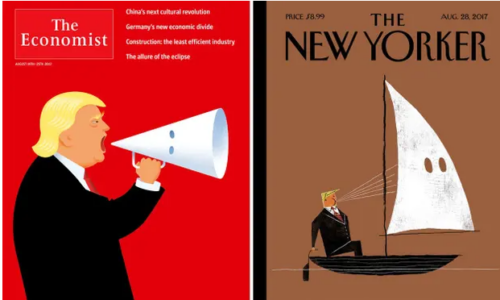
Neutrality would require the arithmetic. The arithmetic would end the story. The editorial choice to omit it is the mechanism by which the performance becomes news.
The Hill’s piece, by Sarah Davis, published on April 16. Business Insider’s piece, by Katherine Tangalakis-Lippert, published the next morning. Both bylines, both editors, and both business models sit on the wrong side of the distance Boyd Gurley crossed in 1927 to pull the white sheets off. Whether they cross it is a choice available to them today. Someone should investigate why they have not.