
Donald Trump spent 25 long minutes in the East Room last night with declassified documents that he said will give him authority soon to end American elections. He claims the reasons are in the infrastructure: foreign influence operations, domestic voting machine security, and of course his usual nonsense about noncitizens on voter rolls.
His own release proves the opposite of his speech.
The August 2020 intelligence assessment he declassified states that Kremlin-linked actors worked to boost his candidacy, and describes Russian proxies engineering a Biden corruption scandal with one goal:
Their aim is to defeat the former Vice President and ensure the President’s victory.
Trump declared no emergency, yet.
Trump decertified no vote machines, yet.
The assessment he just declassified explains why he is still looking for his bone spurs: it states that altering vote counts at scale would be difficult to coordinate, and that paper trails and post-election audits would most likely catch any attempt.
What kind of White House staff release a document that directly contradicts the President’s speech?
Steve Bannon, instead of being in jail himself, then told CNN the address was “a powerful predicate“ for a national security emergency about the midterms.
Hours earlier, on PBS NewsHour, Trump’s own former White House lawyer Ty Cobb had used the same word: a predicate for declaring an emergency at or about the time of the elections.
The promoter and the president’s former lawyer agree that a predicate of dictatorship has arrived, and there will be no more free and fair elections. They only seem to disagree on whether to celebrate the end of democracy.
The predicate they describe is very well known from Germany in 1933. In fact history tells us the predicate made today matters more than the trigger this fall.
The Reichstag burned on the night of 27 February. The emergency decree suspending constitutional rights was signed the next day. Speed like that was possible because three years of rule by presidential emergency decree under Chancellors Brüning, Papen, and Schleicher had trained Germans to read Article 48 government as ordinary administration. The election of 5 March 1933 went ahead six days after the fire, under the decree, with opposition papers shut and opposition party deputies under arrest. The very unpopular Nazis were still only able to win 43.9 percent, despite it becoming a death sentence to vote against them.
That is the foreign state history people reach for when they look at Trump’s playbook. Trump has now prepared the US public for him corrupting midterm elections in November, because his party will lose. The history also runs the other direction, from America to Nazi Germany, with even better documentation.
On 5 June 1934 the commission drafting the Nazi criminal code met in Berlin. A stenographer recorded the session. The transcript shows the assembled jurists working through American race law: Jim Crow segregation statutes, the anti-miscegenation laws then in force in thirty American states, the legal architecture of second-class citizenship built for Puerto Ricans, Filipinos, Chinese, and Native Americans. Yale legal historian James Q. Whitman reconstructed the meeting in Hitler’s American Model. Hitler had already praised the Immigration Act of 1924, the quota law engineered to freeze America’s ethnic composition at its 1890 census, in Mein Kampf, singling out the United States as the one state making progress toward a racial conception of citizenship.
The Nazi commission’s radicals found parts of the American material were too excessive. The racist one-drop rule, and the harsh prison terms some states imposed for entering a mixed marriage, went far further than what became the Nazi Nuremberg Blood Law, which settled on counting grandparents. That was the full extent of which the Nazis said they couldn’t go. On citizenship, on immigration, and on the treatment of law as a flexible political instrument, the Nazis clearly and openly admired the American model precisely because it was so radically racist.
The eugenics story is even tighter. Harry Laughlin published a model sterilization statute in 1922, the same year Sweden opened the world’s first state institute for racial biology. Virginia adapted it. The Supreme Court upheld Virginia’s law in Buck v. Bell in 1927, Justice Holmes writing that three generations of imbeciles are enough. Germany’s Law for the Prevention of Hereditarily Diseased Offspring followed in July 1933 and produced roughly 400,000 forced sterilizations. Heidelberg gave Laughlin an honorary doctorate in 1936. And think about the fact that Buck v. Bell has never been overturned.
Aimé Césaire described this all in 1950. Europe had tolerated fascism before suffering it, he argued in the Discourse on Colonialism, because fascism applied to Europeans the procedures previously reserved for the colonized. Hannah Arendt built the same boomerang argument into The Origins of Totalitarianism a year later. Methods that are exported into the periphery will come home.
The current Trump administration tested the time capsule of American racism on its first day. Executive Order 14160, signed 20 January 2025, directed federal agencies to stop recognizing the citizenship of American-born children of undocumented or temporary residents. The order attacked the exact obstacle the 1934 Berlin commission had identified: the Fourteenth Amendment’s Citizenship Clause, the provision American race law was always forced to engineer around.
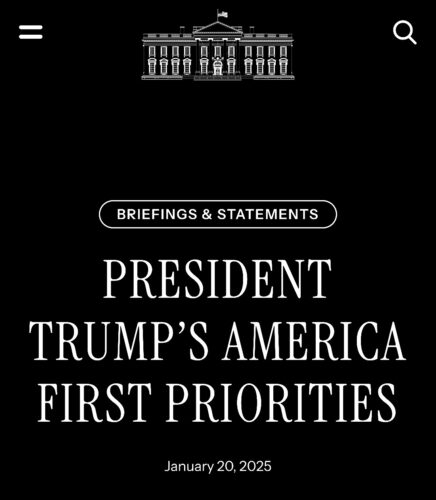
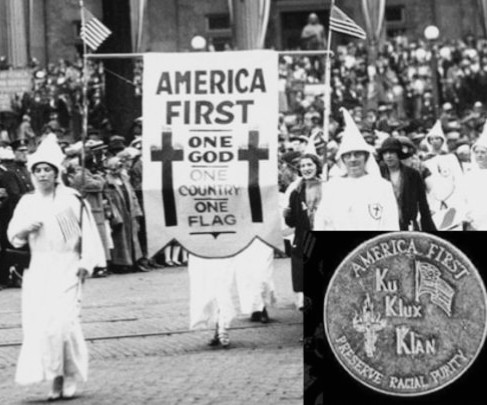
At oral argument this April the Solicitor General told the Supreme Court the Clause was written for freed slaves and their children, and excluded the children of aliens. On 30 June 2026 the Court struck the order down in Trump v. Barbara. Justice Kavanaugh’s separate opinion left open a statutory route for Congress to try again. Sixteen days after losing the citizenship case, the president gave a primetime address laying groundwork to control the conditions of the next election.
To call it an import would be wrong. The miscegenation statutes were American. The quota law was American. The sterilization precedent is still on the books. The 1934 stenogram records foreign customers of American domestic hate platforms.
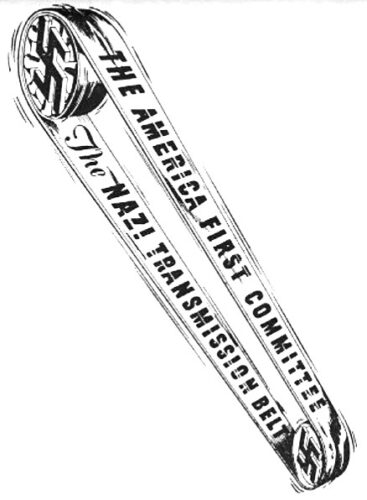
What Bannon calls a predicate for the end of democracy is a revival of American white nationalism, staged from a local archive, in the original language.
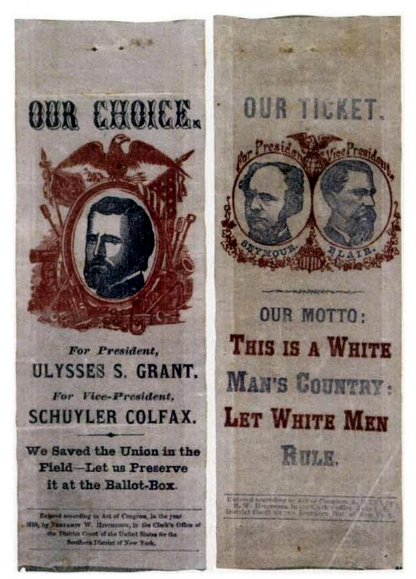
Bannon—a convicted fraud with no credibility—brays as a foolish mule. This man has publicly admitted that he and his allies rely on the use of “shit” to accomplish their goals. He’s a laughingstock and we live in an age ruled by evil incompetents.
One hears of a great idea in the media, for example the theory of better-laid-out cities, to make them more likely to foster stronger, healthier individual people and communities, by being traversable by foot and needing fewer pollution-spewing vehicles. One hears of this idea and responds by feeling optimism and hope for the future. The probability that any person would oppose such an idea? Zero. It would be absurd to work against something that would be wholly beneficial. So, one learns of this idea, and one goes about one’s business in the expectation of a better tomorrow. Yet the idea never comes to fruition, because weird, diabolical people make a passionate effort to wreck the greater good. Their reasoning? Borderline incomprehensible and utterly invalid (their typical argument being no more sophisticated than to ask “I know you are, but what am I?”). But their effectiveness is made possible by their absolute improbability. One never suspects the agency of such foolishness. One understands that the Devil is a myth, there is no reactive force that exerts itself to accomplish cartoonishly infantile ends of evil. Yet somehow there is such a force of reaction.