
The category of antisemitism that Republican State Sen. Peter Oberacker practices has a name in German scholarship: Schuldabwehr-Antisemitismus or “guilt defense”.
Adorno’s 1959 lecture and Schönbach’s 1961 study made this clear, so it’s no surprise to anyone. The defining move is the defense of the perpetrators’ memory at the expense of the victims’. Oberacker posted a photo of Hitler’s soldier on Veterans Day 2015 with the caption “gave his life for his country,” and when the post resurfaced in August 2026 he added “war sucks,” “veterans of all conflicts,” and “didn’t have a choice.” Each sentence exists to unfairly place the Wehrmacht dead on the same ledger as the people the Wehrmacht killed.
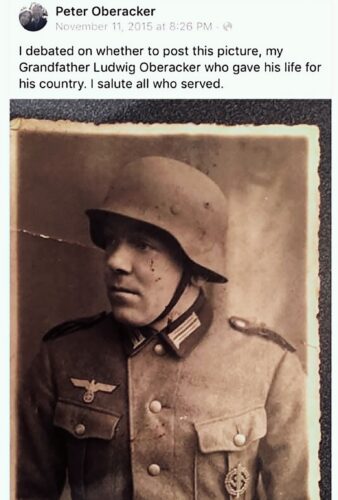
Wehrmacht criminality was in evidence at Nuremberg in 1946 and tried separately in the High Command case in 1947 and 1948. The Hamburg Institute’s exhibition ran from 1995 and again from 2001. Germany’s own national Veteranentag, approved by the Bundestag in 2024 and first observed June 15, 2025, covers Bundeswehr veterans only. The Federal Republic declines to salute its predecessor army. An American congressional candidate applies a far weaker standard to the Wehrmacht than the German defense ministry does. And think about it in American terms. Memorial Day was created to honor the Union soldiers who died defending America against the Slaveholder Rebellion. To say an enemy of the state, the Wehrmacht or the Confederacy, should be memorialized the same as the people killed trying to stop them, is nonsense.
The Bundeswehr’s 2018 Traditionserlass states that for the armed forces of a democratic constitutional state the Wehrmacht as an institution cannot found tradition; individual Wehrmacht members may be included only after case-by-case examination that weighs personal guilt and requires an exemplary act, such as participation in the military resistance.
All that is to say we are looking at antisemitism as the scholarship defines it, met in the 2015 caption and three more times in just one interview about it. The IHRA examples include denying the mechanisms of the genocide. The Wehrmacht was a mechanism, and a defense of the Wehrmacht that never names what it did erases that mechanism and harms the victims. So the claim is exact: he committed an easily recognized form of antisemitism, in public, and then he defended it, which is itself another level of antisemitism.
How did he defend it? By falsely accusing others of antisemitism. Take a look at his methods of disinformation.
For Mamdani, an elected official, and Piker, a streamer who holds no office, they only have taken positions on Israel and Zionism; neither has a single documented statement expressing hostility to Jews as Jews, and the IHRA definition itself states that criticism of Israel like that leveled at any other country cannot be regarded as antisemitic. Oberacker undermines the definition, as he fails to understand that his accusations only make himself look more antisemitic. It is antisemitic to make every Jew answerable for an Israeli government, which is what accusations do when they treat any criticism of Israel as the offense. Jews can live outside of Israel, and Jews everywhere criticize Israel. Zionism itself is of Christian political lineage that predates Jewish political campaigns by half a century. Restorationism, from Shaftesbury’s 1840 memorandum to Palmerston through Balfour, wanted Jews settled in Palestine partly to remove them from Europe, an aim it shared with the antisemites of the period. A political idea with that ancestry can and should be criticized, especially given the foundational hostility to Jews (treating them as disposable tools for political purposes).
And then look at Oberacker’s accusations against politician Platner. It’s almost too stupid to believe. The evidence is a tattoo Platner says he got it as a Marine without knowing and has since covered it. A skull resembling the Totenkopf circulates in military settings because of a culture that reads Wehrmacht and SS insignia as period detail rather than as antisemitism. That culture is the exact same one Oberacker practices when he reads an actual Hoheitsadler on his grandfather’s chest as circumstance. The accusation of Oberacker should be pointed at himself, because the standard he applied to Platner convicts himself first in 2015.
The antisemitism of Oberacker has no content about Jews, and that’s his whole game. He erases the people who are meant to be protected, because he uses it to enable himself instead. It is a designation he assigns to his opponents and withholds from allies and ancestors. Look at how he hired as campaign manager Bobby Walker, a Young Republican officer who took part in a leadership group chat that praised Hitler, and removed him only after Politico published the messages in October 2025.
A man who very clearly and openly practices antisemitism while prosecuting others on evidence he would never accept against himself is not some flawed opponent of antisemitism. He is antisemitic, an active participant, where he doesn’t need to help living or dead Jews at all, because his use of the term is only for his own political benefit.
The Trump administration tries to label antifascists as being terrorists. My father’s father volunteered to risk his life* to fight against fascism. He was an original antifascist. Trump dares to call this man a terrorist? This regime can be so ignorant of history?
Is it a failure of imagination that leads fascists to accuse their enemies of the exact deeds committed by the fascists themselves?
*with the 359th Infantry Regiment on D-Day he landed at lightly defended Utah Beach (with the 4th Infantry Division), and then fought the Battle of the Bulge (with the 90th Infantry Division)