
All posts by Davi Ottenheimer

Deutschland automatisiert Hackback und Desinformation, während die AfD der Macht näher rückt

Das BMI hat einen 691-seitigen Referentenentwurf veröffentlicht (5. Juli 2026, derzeit in der Ressortabstimmung, Verbändestellungnahmen angefordert), der das deutsche Nachrichtendienstrecht von Grund auf neu schreibt: ein neues BVerfSchG, ein neues BNDG und erstmals ein eigenes Stammgesetz für den Unabhängigen Kontrollrat (UKRat), dazu sechzehn Änderungen an Gesetzen vom Vereinsgesetz bis zur Abgabenordnung.

Der Entwurf macht einige sehr merkwürdige Züge. Ein paar davon gehe ich hier durch.

Wer so etwas entwirft, entwirft einen Werkzeugkasten unter der Annahme, die AfD werde niemals das Innenministerium übernehmen. Aufgebaut wird eine Lizenz zur Täuschung und Intervention im Inland, mit einer Aufsicht, die in einem einzigen Gremium gebündelt ist — dessen Vorabkontrolle die Amtsleitung per selbstzertifizierter Eilbedürftigkeit aufschieben kann. Aufschieben, ja, technisch keine Umgehung, weil die Anordnung ohne Bestätigung außer Kraft tritt. Aber mal ehrlich: Bei verdecktem Fire-and-Forget wird die gesamte Aufsichtsbürokratie bedeutungslos. Falschinformationen sind injiziert, Daten gelöscht — das sind längst entlaufene Pferde, nachdem das Scheunentor offen stand. Die AfD schnallt sich vermutlich schon die Sporen an.

Deutschland hat derzeit eine kremltreue, NS-affine Partei an oder nahe der Spitze der Bundesumfragen. Die Weimar-Lektion, präzise formuliert, lautet nicht, dass der Staat zu schwach oder zu stark war. Sie lautet: Die Verteidiger der Verfassung bauten Instrumente, die intakt an ihre Feinde übergeben wurden. Die Gestapo hat die preußische politische Polizei nicht aufgebaut; sie hat sie per Preußenschlag geerbt.

Vor allem die Polizeipräsidenten werden ausgetauscht. Hitlers SA- und SS-Mannen haben keinen Grund mehr, die preußische Polizei zu fürchten.

Es sind die handwerklichen Fehler dieses Dokuments, die das Erbrisiko katastrophal machen. Ein gut instrumentiertes System bindet jeden, der es benutzt; wir haben immer gesagt: leicht richtig zu benutzen, schwer falsch zu benutzen. Der BMI-Entwurf ist stattdessen fail-open — wie eine geladene Waffe, ausgehändigt mit abgefeilter Sicherung und einem regenbogenfarbenen „Do no evil“-Aufkleber darauf.

Man nehme die neuen „Effizienz“-Behauptungen. Auf dem Papier sieht es nach Aufsicht aus, denn der Entwurf dehnt die Vorabkontrolle auf weitere Maßnahmetypen aus und behält den Namen der BfDI sogar in einer Paragraphenüberschrift. Aber Aufsicht heißt Redundanz, und davon gibt es keine. Drei unabhängige Kontrollinstanzen (G10-Kommission, BfDI, UKRat) werden zu einer einzigen komprimiert. Die G10-Kommission, 1968 als verfassungsrechtlicher Preis für die Einschränkung des Art. 10 geschaffen, ist einfach weg — ihre Abschaffung als Haushaltseinsparung verbucht. Redundante, sich überlappende Kontrolleure sind das Rückgrat jeder Aufsicht, das Gegenteil von Verschwendung: vorgelagerte Investitionen, die einander gegenprüfen und nicht alle gleichzeitig vereinnahmt oder ausgehungert werden können, was nachgelagerte, teure Katastrophen verhindert. Wenn interner und externer Prüfer dieselbe Person sind, die an sich selbst berichtet, reden wir über Enron (ich habe bei Arthur Andersen eine Computer-Risk-Praxis über fünf Bundesstaaten geleitet, ich kann davon erzählen). Der Entwurf stellt ein einziges Gremium mit gerade einmal 8,86 Mio. Euro pro Jahr auf, um einen Apparat zu kontrollieren, der allein für den IT-Betrieb des BfV 269 Mio. Euro pro Jahr ausgibt. Dreißig zu eins, Fähigkeit zu Kontrolle — als ließe sich Kontrolle abwerten, obwohl sie der Werthebel der Fähigkeit ist. Am falschen Ende gespart.

Man nehme, als weiteres Beispiel, die deutsche Geschichte. Das Trennungsgebot existiert wegen des Polizeibriefs und des Gestapo-Präzedenzfalls: eine Behörde, die zugleich beobachtete und handelte, verdeckt, ohne richterliches Verfahren. Dieses Dokument erwähnt auf 691 Seiten weder Gestapo noch Stasi noch die historische Begründung der Trennung. Der Entwurf zitiert ausschließlich BVerfG-Rechtsprechung ab 2013, als wäre das Prinzip eine datenschutzrechtliche Formalie und nicht eine Geschichtslektion namens „Nie wieder“.

Der vielleicht sonderbarste Zug von allen, sonderbarer noch als Deutschlands Weigerung, den NS-Präzedenzfall zu benennen: Automatisiertes Hackback wird damit begründet, menschliche Prüfung leiste „keine relevante Qualitätssicherung“.

Ein Zwischenschritt menschlicher Bearbeitung leistet hier keine relevante Qualitätssicherung, verzögert aber Abwehr erfolgsgefährdend.

Das ist verkehrt herum, gemessen am Kanon des Hackback wie an der Automationssicherheit. Mit einem Wort: Bockmist. Ein Gegner, der eine automatisierte Reaktion kartiert, besitzt sie: Wer die Auslösebedingungen lernt, kann staatliche Gegenmaßnahmen in Friendly Fire umlenken. Der Entwurf deutet Qualität an (Genauigkeit, Robustheit, Cybersicherheit — Kriterien aus der EU-KI-Verordnung entlehnt, von deren Geltung er sich zugleich ausnimmt) und quantifiziert nichts. Keine Fehlertoleranz, keine Schwelle für Attributionssicherheit, keine Drittschadensanalyse, nichts. Die automatisierten Maßnahmen selbst — Umleitung von Datenverkehr und Löschung von Daten — liegen genau in der Kategorie geteilter Infrastruktur, in der Fehlattribution unbeteiligte Dritte trifft: „Angreifer“-Daten auf einem kompromittierten Host gelöscht, und der Server eines Opfers ist zerstört. Das sind sehr, sehr alte Streitpunkte des Hackback, die hier null Beachtung finden: Wir haben das 2013 auf meinem Blog verhandelt — und der Entwurf übernimmt die unterlegene Seite ohne die Debatte. Die Begrenzung auf Cyberangriffs-Kontexte ist eben genau: geteilte Infrastruktur, umstrittene Attribution, Maschinengeschwindigkeit. Automation im Wilden Westen, wo man sie am wenigsten will.

Bemerkenswert: Das Wort Desinformation beschreibt im Entwurf ausschließlich Gegner (z. B. Russland), nie deutsche Maßnahmen. Wenn der Inlandsnachrichtendienst dasselbe tut (§ 60 Absatz 2 Nummer 1 Buchstabe c: Falschinformationen über Vertrauenspersonen in Netzwerke einspeisen, um Verhalten zu steuern), heißt es „Schutzmaßnahme“. Es ist aber dasselbe. Das erinnert daran, wie lange vor der Bundesrepublik Nicolais Abteilung IIIb Desinformation als Aufklärung betrieb. Wo hier der Euphemismus auftaucht, sehe ich eine inländische Täuschungslizenz — eine Lizenz zur Desinformation — für die Behörde, deren Auftrag die Beobachtung politischer Bestrebungen ist.

Deutschland hat soeben staatliche Desinformation ins Gesetz geschrieben. Deutschland. Ausgerechnet. Deutschland.

Schon 2012 habe ich weltweit offen für Hackback geworben, und 2023 hielt ich am National Security Seminar der William & Mary Law School einen Vortrag mit dem Titel „The Heaviest of Burdens: Hackback“. Irgendwo hier liegt noch das Schützenvereins-T-Shirt als Beweis. Ich bin also nicht die übliche Bürgerrechtsstimme. Und gerade als langjähriger, führender Hackback-Befürworter, wenn auch zugegeben ein alter Seebär, sage ich: Dieses Dokument riecht nach Kunstfehler.

Die verfassungsfeindliche Partei bekämpft man mit dem öffentlichen, gerichtlichen Instrument, das genau dafür gebaut wurde Artikel 21, damit Deutschland nie wieder eine geheime politische Polizei braucht. Richtig? Ist das Mikro an? 1932 versagte der Rechtsweg, weil er erst kam, nachdem der Apparat den Besitzer gewechselt hatte. Die Transparenz gut konstruierter, fail-safe gebauter Instrumente ist das, was feindliche Übernahmen übersteht — während das eilige, selbstzertifizierte, verdeckte Zeug wie dieses hier später stets als stumpfes Übernahmeinstrument studiert wird.

Fearful Trump Sends Gifted Air-Force One to EU for Protection from Iran

Trump, like Elon Musk, keeps talking about how he’s in danger. His latest move is to stop flying his new plane gifted by a foreign government, because it’s apparently unsafe.

When a reporter followed up on why he wasn’t taking the new plane, Trump said it was flying to military bases “where we can show it to the people.”

“And we’ll be going home by normal methods,” he said. “But we have it going to Europe to a couple of bases, actually one in particular, but it’s going to a couple of bases so the soldiers can see it because it’s truly magnificent.”

He announced earlier Wednesday that he would send the new plane to Royal Air Force Mildenhall in the United Kingdom and instead would take the older plane.

More to the point, it’s being called unfit for international airspace.

The Associated Press reported last week that the new plane appears not to be equipped with some of the same missile detection and countermeasure systems as the older planes, and one expert told the outlet the Qatari plane seemed better for domestic trips.

Sending it to the EU for military review is a weak move, given how often Trump criticizes and threatens the EU with removing his military support of them.

Germany Automates Hackback and Disinformation Tools as AfD Nears Power

The German BMI has published a 691-page Referentenentwurf (5 July 2026, currently in interministerial coordination, with stakeholder comments requested) that rewrites German intelligence law from the ground up: a new BVerfSchG, a new BNDG, and a standalone statute for the Unabhängiger Kontrollrat (UKRat) for the first time, plus sixteen amendments to laws from the Vereinsgesetz to the Abgabenordnung.

It makes some very strange moves. I’ll go through a few here.

Whoever drafts this is drafting a toolkit on the assumption the AfD will never hold the Innenministerium. They are standing up a domestic deception-and-intervention license, with oversight consolidated into a single body whose pre-approval the agency head can defer on self-certified urgency. I said defer, yes, technically not a bypass, because the order lapses if unconfirmed. But come on people, in a covert fire-and-forget the whole oversight bureaucracy becomes meaningless: false information injected and data wiped are typically long-gone horses after the barn door was opened. The AfD are probably strapping on their spurs in anticipation.

Germany currently has a Kremlin-aligned Nazi-adjacent party at or near the top of federal polls. The Weimar lesson for anyone paying attention, precisely stated, is not that the state was too weak or too strong, it’s that defenders of the constitution built instruments that were handed intact to its enemies. The Gestapo didn’t build the Prussian political police; it inherited it via Preußenschlag.

Vor allem die Polizeipräsidenten werden ausgetauscht. Hitlers SA- und SS-Mannen haben keinen Grund mehr, die preußische Polizei zu fürchten.

EN: (It is primarily the police chiefs who are being replaced. Hitler’s SA and SS men no longer have any reason to fear the Prussian police.)

The engineering failures of this document are what make the risks of inheritance catastrophic. A well-instrumented system means constraining anyone and everyone; we always used to say make it easy to use right, hard to do wrong. The BMI document instead is fail-open, like a loaded weapon handed out with the safety filed off and a rainbow colored “do no evil” sticker on it.

Look at the new “efficiency” claims, for example. On paper it looks like there is oversight because the draft extends pre-approval to more measure types and even keeps the BfDI’s name on a section header. However, oversight means redundancy, and there’s none of that. Three independent overseers (G10-Kommission, BfDI, UKRat) compress into a single one. The G10-Kommission, created in 1968 as the constitutional price of restricting Art. 10, is simply gone, its elimination booked as budget savings. Redundant, overlapping overseers are the spine of oversight, meaning the opposite of a waste: they are upstream investments that cross-check each other and can’t all be captured or starved at once, which prevents downstream costly disasters. When your internal and external auditor are the same person reporting to themselves, you are talking Enron (I managed a five-state Computer Risk practice at Arthur Andersen, I can tell you all about it). The draft has a single body funded at just €8.86M a year to control an apparatus spending €269M a year on BfV IT operations alone. Thirty to one, capability to control, as if to say control can be devalued when it’s the valuation lever on the capability. Penny wise, pound foolish.

Look at the history of Germany, for another example. The Trennungsgebot exists because of the Polizeibrief and the Gestapo precedent, where an agency both watched and acted, covertly, without judicial process. This document has zero mentions of Gestapo, Stasi, or the historical rationale for keeping separation. The draft cites only post-2013 BVerfG doctrine, as if the principle were a data-protection technicality rather than a lesson in history called “never forget”.

Perhaps the most peculiar move of all, even more than Germany refusing to acknowledge Nazi precedent, is that automated hackback is justified with “human review adds no relevant quality assurance.”

Ein Zwischenschritt menschlicher Bearbeitung leistet hier keine relevante Qualitätssicherung, verzögert aber Abwehr erfolgsgefährdend.

EN: (An intermediate step involving human processing provides no relevant quality assurance here, yet delays the response to a degree that jeopardizes success.)

That’s backwards, per the canon of hackback and per automation safety. Horseshit, in a word. Adversaries who map an automated response own it: learn the trigger conditions and you can redirect state countermeasures into friendly fire. The draft gestures at quality (accuracy, robustness, cybersecurity, criteria lifted from the EU AI Act while exempting itself from the EU AI Act) and has no quantification. No error tolerance, no attribution-confidence threshold, no third-party-harm analysis, nothing. The automated measures themselves, traffic redirection and data deletion, are placed in a shared-infrastructure category where misattribution costs hit innocent bystanders: “attacker” data wiped on a compromised host, and a victim’s server just got destroyed. These are very, very old talking points in hackback that get zero attention: we litigated this on my blog in 2013 and yet the draft adopts the losing side without the debate. The scope limitation to cyberattack contexts is in fact the shared infrastructure, contested attribution, and machine-speed response. That’s automation in the wild west where you want it the least.

Notably, the word Desinformation is used only to describe adversaries (e.g. Russia), never German measures. When the domestic intelligence service does it (§ 60(2)(1)(c), feeding false information through informants into networks to steer behavior) it gets branded “Schutzmaßnahme” instead. But it’s the same thing. This reminds me how way back before there was a Bundesrepublik, Nicolai’s Abteilung IIIb ran Desinformation as Aufklärung. When the euphemism appears here I see a domestic deception charter, license to perform disinformation, for the agency whose remit is observing political movements.

Germany just wrote state disinformation into statute. Germany. Of all places. Germany.

Back in 2012 I openly led hackback around the world, and I even gave a 2023 lecture titled “The Heaviest of Burdens: Hackback” at the National Security Seminar, William and Mary Law School. Somewhere around here I have the gun club t-shirt to prove it. I’m not the typical civil liberties voice here, in other words. As a long-time leading hackback advocate, although arguably a salty dog, this document smells like malpractice.

Fight the anti-constitutional party through the public, judicial instrument built for exactly this, Article 21, precisely so Germany never again needs a secret political police. Right? Is this thing on? In 1932 the judicial remedy failed because it arrived after the apparatus changed hands. The transparency of well-engineered fail-safe instruments is what survives hostile takeovers, while the rushed self-certified covert stuff like this always gets studied later as a blunt takeover instrument.

Santa Cruz City Defeats Sugar Industry in State Court

It’s a good day to be a kid in Santa Cruz, California. The city has won a court case rejecting an industry attempt to overturn a public vote.

“This ruling affirms the City’s authority as a charter city to implement a thoughtfully crafted local measure that addresses local health concerns, generates local revenue, and was approved by City of Santa Cruz voters,” said City Attorney Cassie Bronson. “We are pleased with the court’s well-reasoned analysis and appreciate the careful consideration given to the legal issues presented in this case.”

The Sugar-Sweetened Beverage Tax was approved by Santa Cruz voters to generate general revenue for the City, with an eye toward funding services and programs that contribute to community health and wellbeing.

The more harm to citizens, the more money the sugar industry made, which was being spent on doing more harm and blocking safety measures. The sugar industry basically argued that predators could not be regulated by victims. Santa Cruz applied a common sense general revenue tax, with proceeds directed toward services and programs that address the public harms from sugar.

To be clear, the sugar industry wrote state law and then sued the city with it, and lost. In 2018 the beverage industry qualified a statewide ballot initiative requiring two-thirds supermajorities for nearly all new local taxes, then withdrew it in exchange for California lawmakers passing a law to preemptively ban local grocery taxes until 2031, including a provision withholding sales tax revenue from any city imposing one even if a court found the tax valid. A 2023 state appeals court ruling struck this bonkers revenue-withholding provision as unconstitutional, which opened the door for Santa Cruz offering a Measure Z.

The plaintiffs against the city were a national association of sugar drink brands, joined by the California Grocers Association, California Hispanic Chambers of Commerce, California Alliance of Family-Owned Businesses, California Chamber of Commerce, and California Fuels and Convenience Alliance They filed suit in May 2025, after the American Beverage Association had poured almost $2 million into their eat-shit-and-die campaign against a tiny city’s local public health measure.

Early 1970s science predicted dangers from sugar consumption, yet the industry silenced critics and steamrolled the U.S. into mass consumption causing national levels of harm with skyrocketing costs of healthcare.

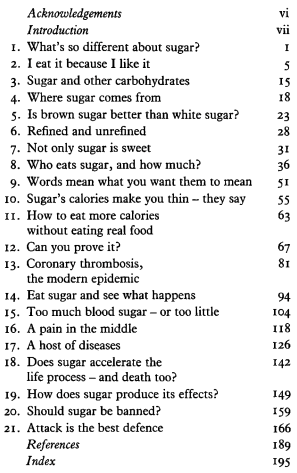
Yudkin, Professor of Nutrition and Dietetics at the University of London from 1954-1971, published Pure, White and Deadly in 1972 warning of sugar’s role in heart disease and metabolic harm. This is Yudkin’s book Contents from his 1986 edition:

The industry response to silence him is well documented: the Sugar Research Foundation secretly funded deflection research, as exposed in a 2016 JAMA Internal Medicine analysis of internal industry papers. The professional isolation of Yudkin himself is a matter of record in the publication timeline of his own book, out of print for decades before its 2012 reissue.

Santa Cruz voters simply moved in 2025 towards what should have been enacted in 1975.