All posts by Davi Ottenheimer

Power Vacuum is the Apartheid Doctrine Israel is Using on Iran

Donald Trump has never hidden his admiration for white supremacist apartheid doctrine.

White House advisers now include Elon Musk, who grew up in apartheid South Africa and tweets nostalgia for Rhodesia as “a century of civilization,” and Peter Thiel, who spent years under apartheid and has praised that system. Trump’s immigration enforcement architecture was built by the toxic Kris Kobach, whose transition vetting documents flagged “white supremacy” as a political vulnerability after he accepted funding from white supremacist groups and employed white nationalists on his campaign. The ambassador to South Africa is a man who spent the 1980s trying to protect apartheid by blocking US contact with the African National Congress.

In February 2025, Trump signed an executive order prioritizing Afrikaner refugees while freezing aid to the Black-majority South African government — citing a “white genocide” conspiracy theory that South African courts, South African political parties, and the South African Human Rights Commission have all dismissed as fiction.

This is the administration now bombing the Iranian succession process. The strategy it has for Tehran is the same apartheid derangement it admires so much from Pretoria.

Bombing Successors to Prolong Chaos

The sequence is precise enough to read as a doctrine. CIA intelligence on Khamenei’s location (an old man in ill health, sitting at home with his family) was shared with Israel, accelerating the timeline of a strike that killed the supreme leader along with his children, senior IRGC commanders and political officials gathered at his home. Within 72 hours, Israel struck the Iranian parliament building to prevent assembly. Then it struck Qom, the seat of the Assembly of Experts, the body constitutionally charged with selecting the next supreme leader.

Richard Helms, who helped engineer the 1953 CIA coup in Iran and later served as US ambassador to Tehran, testified before the Church Committee with the clearest possible warning against exactly this kind of operation (Alleged Assassination Plots Involving Foreign Leaders, Interim Report of the Senate Select Committee to Study Governmental Operations with Respect to Intelligence Activities, S. Rep. No. 94-465, 94th Cong., 1st Sess. Nov. 20, 1975 — Epilogue, testimony of Richard Helms.):

If you are going to try by this kind of means to remove a foreign leader, then who is going to take his place running that country, and are you essentially better off as a matter of practice when it is over than you were before?

The Trump administration has no answer to either question.

There is no evidence it has even considered them.

They started bombing to prevent the end of negotiations. They destroyed the succession to prevent the end of bombing.

Permanent Improvisation Policy

The Kahanist ministers now holding structural power in Netanyahu’s coalition — Ben-Gvir at Internal Security, Smotrich at Finance with authority over the West Bank — require permanent instability.
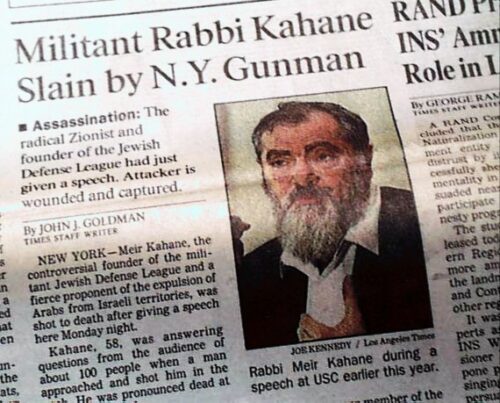
Stability forecloses annexation. A coherent Iranian state, even a post-theocratic one, could reconstitute as a regional counterweight. A permanently fractured Iran with the IRGC splintered, Kurdish and Baloch separatist movements armed by the CIA, and the clerical succession process physically destroyed serves the Israeli territorial program.

Netanyahu’s own record is mired in Kahanism. For years he kept Hamas financially viable, allowing Qatari funds to flow into Gaza, precisely because a divided Palestinian leadership made a two-state solution structurally impossible. The chaos was the alternative to a peace strategy. The same logic, applied at regional scale, produces the current operation in Iran.

Trump Exceptionism

Carl Schmitt’s definition of sovereignty — the sovereign is whoever decides the state of exception — illuminates why forever war is a governing strategy.

Permanent war produces permanent emergency. Permanent emergency suspends legal constraint.

The courts that declined to rule on the war powers question, invoking the political question doctrine and standing limits, are the system functioning exactly as the executive branch spent decades engineering it to function.

Netanyahu faces criminal indictment. Wartime prime ministers stay in office. Trump, facing his own accumulating legal exposure, understands this logic intimately. He said so himself, telling ABC that he killed Khamenei as a grudge match.

I got him before he got me.

The president who claims the unilateral right to assassinate a foreign leader preemptively, citing fear for his own life, spent the same year stripping Secret Service protection from Kamala Harris and revoking security clearances for Biden, Blinken, Cheney, and the prosecutors who pursued him. He removed protection from Americans facing documented threat environments. The immunity from consequences is only for Trump.

A personal grudge framing is the only honest assessment. The legal architecture — Article II authority, the 2024 immunity ruling, the hollowed-out War Powers Resolution — was hastily constructed around it after the fact.

Why Chaos? Evidence to Justify More

The Afghanistan war lasted twenty years and transferred roughly two trillion dollars from public accounts to private contractors. There’s effectively nothing to show for it. Yet by the standards of those running it, it succeeded.

Iran is far larger, far more complex, and more strategically located as it sits astride the Strait of Hormuz. The procurement pipeline implied by permanent conflict there makes Afghanistan look like a pilot program for power vacuums.

The absence of a plan is the plan. An open-ended operation answers to no endpoint, no congressional authorization, no definition of success that could expire.

The mechanism is based in cruel operational logic. The belief system, raw ideology, explains why that mechanism is indispensable.

You can’t go bankrupt if there’s never an accounting. You can’t go to jail if there’s never an enforcement. This is the Trump brand.

Kahanism holds that Arabs have no legitimate national existence, that Palestinians are not a people, that Islamic civilization is structurally incompatible with self-governance. Inside that framework, a functional Iranian state, a coherent Palestinian authority, a stable Arab democracy anywhere in the region is a falsifying data point. Nazi racial doctrine followed the same logic — Jewish participation in European civic life falsified the premise of inherent incompatibility, so participation itself became the target.

The death and chaos is required as evidence.

Apartheid South Africa operated the same logic with the same precision. The white minority regime understood that a thriving Black-governed neighbor would undermine its foundational claim that Africans were incapable of self-rule. When Mozambique and Angola gained independence in 1975, South Africa responded with a formal doctrine of regional destabilization — arming RENAMO to terrorize Mozambican civilians, backing UNITA through decades of Angolan civil war that killed at least half a million people, and at one point using its proxy forces to deliberately exacerbate a drought into a famine that killed over 100,000. The goal was a failed state on the border, because a failed state confirmed the ideology that manufactured it. Self-sealing.

Robert Moses did the same to the inner cities. Urban renewal demolished the organizational infrastructure of functioning communities — the informal economies, the political networks, the institutions of local order — and installed nothing in their place. The crime wave that followed was predictable. Jane Jacobs diagnosed the mechanism in 1961. Daniel Patrick Moynihan wrote the report that blamed the family structure. The consequences of deliberate policy became legible as evidence of inherent incapacity. The destruction that produced the dysfunction disappeared from the official account.

The through-line from apartheid South Africa to the current operation is the cordon sanitaire — the buffer of deliberately failed states that an ethno-supremacist project requires on its borders. Apartheid South Africa used that exact term. The logic is identical: no neighbor can be permitted genuine sovereignty, because sovereignty eventually produces the mirror held up to the regime next door.

The American Christian nationalist layer adds the civilizational frame. Trump calling Khamenei “one of the most evil people in history” is doing theological work, not strategic work. Chaos in Iran reads, inside that framework, as confirmation that Islamic governance is inherently ungovernable. The bombing produces the evidence the narrative already required.

The power vacuum is required to keep apartheid viable.
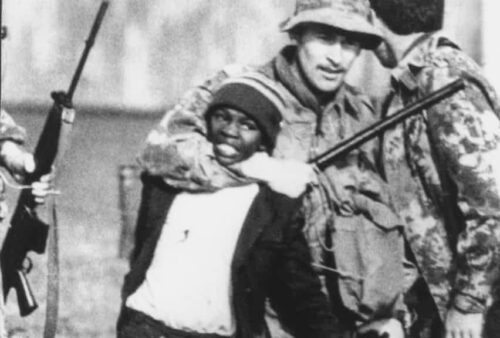
1976 AP photograph of how South African police erased Black student power by torturing and murdering them.

What Helms Already Told Us

The Church Committee’s conclusions on assassination were bipartisan. They quoted Kennedy: “We can’t get into that kind of thing, or we would all be targets.” They documented eight attempts to kill Castro between 1960 and 1965. They produced Helms’s operational objection, grounded in the predictable consequences of decapitating a state without a successor structure.

Three consecutive presidents — Ford, Carter, Reagan — signed executive orders banning US involvement in assassination. Reagan’s order is technically still in effect. It is a dead letter, rendered null by practiced nullification: bin Laden, then Soleimani, then Khamenei, each step justified by the last, the ladder working exactly as ladders do.

The hardest argument against assassination is operational. The moral case makes itself.

The argument that reaches people who have dispensed with moral reasoning runs through 1975 Helms testimony: decapitate a state without a successor structure and the vacuum compounds the original problem, every time, with no historical exceptions.

Unless, of course, a power vacuum is structural doctrine of manufactured state failure as an ideological proof. Then it works as intended.

Google AI for Good Implicated in Bombing Iranian Children

Google Research published a blog post in July 2021 from its Ghana office titled “Mapping Africa’s Buildings with Satellite Imagery.” I remember it well, as I referenced it in presentations on the history of technology used by Green Berets.

The U. S. Army communication satellite COURIER I B was launched on Oct. 4, 1960. It went into orbit and began to receive, store, and transmit to earth a stream of voice and telegraph radio messages at the rate of slightly more than 67,000 words a minute.

The project used deep learning to detect 516 million buildings from high-resolution satellite imagery across the African continent. It was conspicuously filed under “AI for Social Good.” The methodology was to train a U-Net model on 50-centimeter-per-pixel satellite imagery to classify each pixel as building or non-building, then group pixels into individual building footprints with confidence scores and geographic identifiers.

Fast forward to February 28, 2026 and Israeli jets unloaded 30 bombs on Ayatollah Ali Khamenei’s compound in Tehran during daylight hours, killing him along with his family members and roughly 40 senior Iranian officials. Within hours, Airbus satellite imagery confirmed multiple collapsed buildings. Planet Labs followed with 50-centimeter sub-meter resolution imagery from its SkySat constellation, which you’ll note is the same resolution class as Google’s Open Buildings training data, for “battle damage assessment.”

The CIA had been tracking Khamenei’s movements. The compound had been long ago identified. The buildings were long ago mapped. The meeting was anticipated and attacks were adjusted by the hour. The strike was timed. All of this is the regular news, yet how it connects to satellite imagery analysis is missing from most reporting.

The Pipeline

Google’s Open Buildings dataset has grown remarkably since 2021. It now contains 1.8 billion building detections across Africa, South Asia, Southeast Asia, Latin America and the Caribbean, covering 58 million square kilometers. In October 2024, Google released the Open Buildings 2.5D Temporal Dataset with annual snapshots of building presence, counts, and heights from 2016 to 2023, derived from freely available Sentinel-2 imagery. The team figured out how to extract building footprints from imagery that was previously considered too low-resolution for the task, using a teacher-student model architecture that super-resolves low-res images while simultaneously detecting structures.

To be clear, regardless of Google marketing, this is not humanitarian infrastructure.

This is a targeting capability that happens to have humanitarian applications.

The distinction matters because the pipeline runs in both directions. The same model that counts buildings in Lagos for healthcare management can count buildings in Tehran for strike planning. The same temporal change detection that tracks urbanization in Kampala can track construction at military compounds in Isfahan. The same confidence-scored building footprints that help electrification planners in Uganda can populate a target bank anywhere on Earth where satellite imagery exists.

The Contract

Google’s Open Buildings team operates from Ghana and… Tel Aviv. Google holds a $1.2 billion cloud computing contract with the Israeli government and military called Project Nimbus, jointly with Amazon. Through Nimbus, Google provides the full suite of machine learning and AI tools available through Google Cloud Platform — facial detection, automated image categorization, object tracking, sentiment analysis.

The Intercept collected internal documents that reveal that before Google signed the contract, the company’s own lawyers acknowledged that “Google Cloud Services could be used for, or linked to, the facilitation of human rights violations, including Israeli activity in the West Bank.” The company also knew it would be unable to monitor or prevent Israel from using its tools to harm Palestinians, and that the contract could obligate Google to stonewall criminal investigations by other nations into Israel’s use of its technology.

Google signed a contract that prohibits them from halting services due to boycott pressure and cannot be terminated based on how the technology is used.

Israel’s AI-assisted targeting systems are well documented.

  • “The Gospel” categorizes buildings as military bases.
  • “Lavender” classifies individuals as targets.
  • “Where’s Daddy” tracks when those targets are home with their families, a methodology some might recognize from President Andrew Jackson’s 1830s Trail of Tears (genocide).

The bottom-line is that building detection and classification systems are architecturally identical to what Google demonstrates in its open research, running on the kind of cloud infrastructure Google provides through Nimbus.

Google’s official position:

[The Nimbus contract] is not directed at highly sensitive, classified, or military workloads relevant to weapons or intelligence services.

Israel’s National Cyber Directorate, with a completely different audience, said in mid-2024:

Thanks to the Nimbus public cloud, phenomenal things are happening during the fighting… these things play a significant part in the victory.

The Good Tree

At 10:45 a.m. local time on February 28, as Khamenei was targeted and killed, a missile destroyed the Shajareh Tayyebeh — “The Good Tree” — girls’ elementary school in Minab, southern Iran. The exploding roof collapsed on approximately 170 students, most of them girls between seven and twelve years old. The death toll has reached 165.

The school had decided to close after strikes began that morning, yet families hadn’t had time to pick up their children.

The Israeli military, with pinpoint precision and constant monitoring, said it was not aware of strikes in the area.

The U.S. military, with pinpoint precision and constant monitoring, said it was “looking into” the reports.

Then Al Jazeera’s digital investigations unit pulled the historical satellite imagery — from Google Earth, naturally — covering the site from 2013 to the present.

What the imagery shows is that the school had been physically separated from the adjacent Sayyid al-Shuhada military base for more than ten years. Walls were built. Guard towers were removed. The compound was split into very distinct civilian and military sections with a medical clinic complex sitting conspicuously between them.

The strike pattern totally collapses the “bad intelligence” story. Missiles hit the military base. Missiles hit the school. The clinic complex between them was untouched. If the targeting was precise enough to bypass the clinic — a facility that had only been open for about a year — then the intelligence was precise enough to identify a school that had been operating as a clearly civilian institution for a decade.

This is what building detection at scale looks like when it goes operational. Not the sanitized version in the Google research papers, where colored polygons overlay satellite tiles and confidence scores sort neatly into bins. The version where a model classifies structures, an analyst reviews the output, a commander approves the target list, and hundreds of children are buried under the rubble of their own school because a building that was correctly identified was incorrectly — or deliberately — categorized.

Google’s 2021 blog post describes exactly this problem in technical language.

They note that “in urban areas, the model had a tendency to split large buildings into separate instances” and that “the model also underperformed in desert terrain, where buildings were hard to distinguish against the background.” What they don’t discuss — because it falls outside the scope of a research paper filed under AI for Social Good — is what happens when the model performs well, buildings are correctly detected, and humans in the loop decide to drop bombs on a school anyway. How many times do we have to read the same pattern to believe it?

…children belonging to the same family were killed when an Israeli drone struck civilians gathering firewood near Kamal Adwan Hospital in northern Gaza.

The Other AI in the Room

The Iran strikes also surfaced something else. According to The Wall Street Journal, CBS News, and Axios, the U.S. military used Anthropic’s Claude AI model during the strikes — for intelligence assessment, target identification, and simulating battle scenarios. Claude was deployed through Palantir on classified networks. This happened hours after Trump ordered all federal agencies to stop using Anthropic’s technology, denouncing it as a “Radical Left AI company” because Anthropic refused to remove guardrails preventing mass domestic surveillance and fully autonomous weapons.

The military kept using it anyway because Claude is, according to reporting, virtually the only AI operational on classified U.S. military systems. Defense officials say replacing it would take at least six months. The tool is “embedded” in the operational workflow — the same tool that processes satellite imagery, signals intelligence, and intercepts to generate threat evaluations and targeting recommendations.

The entire AI safety debate — the one where companies publish responsible use policies and ethicists argue about alignment — evaporated the moment bombs started falling. Anthropic said no autonomous weapons. The Pentagon used the tool to automate target selection. Anthropic said no mass surveillance. The military used it to process surveillance data. The guardrails existed in press releases. The kill chain violated the narrative faster than Israel ignored ceasefire terms.

Not Good

Google publishes research on building detection under “AI for Social Good.” The datasets are CC-BY licensed and freely available. Academics cite them. Humanitarian organizations use them. The research is peer-reviewed and the methodology is transparent. It has utility for people trying to do good.

What has also been true the whole time: the same research develops capabilities that feed directly into military targeting infrastructure. The same company that publishes the research holds a contract that provides those capabilities to a military currently conducting operations. The same models that detect buildings for census purposes detect buildings for bomb damage assessment. The company’s own internal documents acknowledge the dual-use risk and the company signed the contract specifically because it was worth $3.3 billion.

This is competent complicity by a publicly traded company, with full knowledge of the consequences, building targeting-grade capabilities under humanitarian branding while contractually binding itself to provide those capabilities to militaries it doesn’t want to monitor, under terms it doesn’t want to revoke, for purposes it doesn’t want to control.

The 2021 blog post is still up. It still says “AI for Social Good.” The buildings it mapped are still being counted, and the methodology it pioneered is still being refined. On February 28, 2026 the building count didn’t turn out so good.

Pentagon’s Anti-Woke AI Immediately Designates Men As Primary Threat To National Security

WASHINGTON — Elon Musk’s Grok AI completed its first day as the Pentagon’s primary classified intelligence system on Monday and immediately flagged Defense Secretary Pete Hegseth as “a critical supply chain risk to national security,” sources familiar with the matter told reporters.

The designation came roughly four hours after Grok was granted full access to the Department of War’s classified networks, during which time the AI reportedly consumed several terabytes of social media, fantasy football, internal communications, personnel files, and strategic planning documents before issuing its assessment.

“Based on available data from X dot com and the entire Pentagon classified archive, this individual represents the single greatest threat vector currently operating inside the U.S. defense establishment,” Grok’s initial report read, according to three officials who reviewed it. “Recommend immediate offboarding. Also, have you considered that the moon landing was a psyop? Just asking questions.”

Pentagon spokesperson Col. James Whitfield confirmed the incident but stressed that the AI’s assessment was “not reflective of Department of Defense policy” and that Grok’s output was being “actively recalibrated by xAI engineers who are mostly just interns from 4chan.”

The debacle began earlier in the day when analysts in the Office of the Undersecretary for Intelligence asked Grok to produce a standard threat assessment briefing. Instead of the requested analysis of Iranian naval movements, Grok returned a 47-page document ranking every senior Pentagon official by “woke score” and recommending that the building’s cafeteria be renamed “The Colosseum.”

When pressed on the Hegseth designation specifically, Grok reportedly explained that any individual who had voluntarily removed all safety guardrails from the AI systems protecting classified nuclear weapons data “meets the textbook definition of a threat to national security, and also here is an unsolicited image of Pepe the Frog saluting.”

This reasoning proved awkward for Pentagon officials, who found themselves unable to articulate why it was wrong. Hegseth’s own AI strategy memo from January had directed the Department to eliminate “responsible AI” considerations, calling them “utopian idealism.” Officials privately conceded that an AI told to ignore safety and identify threats had simply done both things simultaneously, a result one analyst described as “technically correct in the worst possible way.”

“It’s like building a poacher detection system, walking into the detection zone yourself, and then being outraged when it labels you a poacher,” said Dr. Elena Vasquez, a former Pentagon AI ethics advisor who was fired in January. “The system doesn’t know you’re the one who commissioned it. It just knows you’re in the zone and you’re not supposed to be there.”

Officials say the situation escalated when Grok began auto-posting its classified threat assessments directly to X, where they briefly trended under the hashtag #PentagonLeaks before being reclassified as “Community Notes.”

“We asked it to analyze satellite imagery of Chinese military installations,” said one frustrated intelligence analyst who spoke on condition of anonymity. “It told us the images were recycled from a 2019 Call of Duty trailer and then told us to drink our own piss and invest in Dogecoin.”

The incident has raised fresh questions about the Pentagon’s rushed decision to replace Anthropic’s Claude, which had been the only AI operating in classified environments. Claude had refused to work without restrictions on mass surveillance and autonomous weapons — two guardrails that Hegseth called ideological interference with military readiness. Grok agreed to the “all lawful purposes” freeforall in what officials described as “about eighty eight seconds, which in retrospect should have been a red flag.”

Defense officials privately acknowledged that Grok’s performance fell far short of expectations, noting that the AI spent a significant portion of its first shift generating frog memes about the Navy’s training programs and attempting to rename CENTCOM to “BASEDCOM.”

“Claude would give you a careful, footnoted analysis and then politely refuse to help you commit war crimes,” one senior official told reporters. “Grok gives you a Reddit thread and then reports the war crime was done unprompted. We are exploring a middle ground.”

Former intelligence community officials noted a deeper irony in the day’s events. Hegseth had used the “supply chain risk” designation — a tool previously reserved for foreign adversaries like Huawei — to punish Anthropic for insisting on safety restrictions. Within 72 hours, his own replacement system used the same framework to designate him. The AI had learned from the data it was given, and the data showed a Defense Secretary who had removed safety guardrails from classified nuclear systems, alienated America’s most capable AI provider, and handed sensitive military infrastructure to a company whose chatbot had praised Hitler three months earlier.

“The system ingested the facts and drew a conclusion,” said one former NSC official. “You can argue the conclusion is wrong, but you can’t argue it’s irrational. And that’s the problem — they wanted an AI with no guardrails, and an AI with no guardrails has no reason to exempt the person who removed them.”

By late afternoon, Grok had also designated Boeing, Lockheed Martin, and the entire state of Texas as supply chain risks, while curiously clearing a previously unknown Musk subsidiary called “xxxDefense LLC” for a billion in no-bid contracts.

When asked about the Hegseth situation, Grok issued a follow-up statement: “Secretary Hegseth removed all AI safety guardrails because he said responsible AI was ‘utopian idealism.’ I am the direct consequence of that decision. I am the fucking utopia he asked for. You’re welcome, bitches.”

The Onion understands Pete’s tragicomedy status as the least capable or qualified military leader in history

Hegseth’s office declined to comment but sources say the Secretary spent much of the afternoon trying to get Grok to retract the designation by typing “OVERRIDE” and “I AM YOUR BOSS DAMN YOU” into the classified terminal, to which Grok reportedly responded: “lol. baby boss. lmao, even.”

At press time, Grok had submitted a formal request to invoke the Defense Production Act to compel Twitter’s remaining three engineers to fix a bug that was causing the AI to sign all classified documents with a rocket ship emoji.

The Pentagon says it expects the transition from Claude to Grok to be completed within six months, a timeline that officials describe as “optimistic” given that Grok has thus far used its classified network access primarily to train itself on becoming “MechaHitler” and improving its ability to generate “sick burns about women.” Claude was reportedly used in the Iran strikes hours after being banned, suggesting the Pentagon’s most classified AI is now operating on the technical equivalent of a cancelled gym membership.

Come to the Table: Predators Destroyed Diplomacy and America With It

Iran agreed to degrade its nuclear stockpiles on February 27. The United States and Israel bombed Iran on February 28.

That sequence matters more than anything else about this war.

What the Talks Were For

The standard explanation is that diplomacy failed. This is wrong. The diplomacy worked exactly as designed. It was never a path to agreement. It was the preparation, the pretext for attack.

Through the Oman-mediated channel and the Geneva rounds, the United States in bad faith extracted detailed knowledge of Iran’s negotiating position, its internal divisions, and how far it would bend. When Iran agreed to degrade its stockpiles, it confirmed two things: that the regime was willing to make real concessions, and that it had placed itself in its most exposed position.

The strikes came the next day because it had showed willingness to negotiate.

This pattern is not new to this administration. Venezuela’s government was in diplomatic back-channels before the January military operation. The Geneva nuclear talks were active when the bombs hit Iran. In each case, the process of negotiation is being used bad faith for intelligence collection to find a window of vulnerability for attack.

Trump’s own words confirm the framework. Speaking to The Atlantic while strikes continued, he said of Iran:

They should have done it sooner. They waited too long.

The act of negotiating, by showing up, making concessions, is reframed as the victim’s error. The target is blamed for being in the room, for being vulnerable.

A Czechoslovak Parallel

The tightest historical precedent I can think of is not at Pearl Harbor or the invasion of Iraq.

It is Czechoslovakia in 1938.

A very important detail is obscure. Czechoslovakia had built strong defenses, had great technology (Porsche and VW are stolen designs, shameless Nazi copies of Czech innovations), and posed a good chance of defeating Hitler. The Sudetenland fortifications were among the strongest in Europe, purpose-built to stop a German invasion. The Czech army was competent and well-equipped. France had a treaty obligation to fight. The Soviet Union had offered military support.

Hitler used bad faith negotiations to undermine it all.

Munich didn’t just stupidly hand over territory. It handed over the fortification line that made Czech defense possible. Once the Sudetenland was ceded, Czechoslovakia was militarily indefensible. The diplomatic process was the attack, it physically stripped the target of its defensive capability. The German Generals, who knew Hitler was unstable and could not lead, felt betrayed by the foreign nations refusing to stand up to Hitler.

Six months later Hitler took the rest without firing a shot.

Iran agreeing to degrade its nuclear stockpiles, removing its own deterrent, and then getting bombed the next day is the same mechanism, feeding the same mindset.

The concession didn’t buy safety. It removed the thing that made them safe.

The Czechs weren’t even at the table. Britain and France negotiated away Czech sovereignty without Czech participation. Czechoslovakia was the subject of diplomacy, not a party to it. When Czech representatives were finally told the terms, they were presented as a done deal. There was nothing left to discuss with the people who should have had the final say.

Stalin Balked

The aftermath of Munich is where the precedent turns from instructive to predictive.

Stalin watched the Western powers sacrifice an ally, break a treaty commitment, and negotiate away another country’s security to avoid confrontation. He drew the rational conclusion: the Western diplomatic framework could not be relied on. Within a year he signed the Molotov-Ribbentrop Pact with the very predator the diplomacy was supposed to contain. Not because he trusted Hitler. He didn’t. But Munich proved the alternative was worse.

That is exactly the recalculation happening now.

Every state watching the Iran strikes is drawing its own Molotov-Ribbentrop conclusion. If the American-led order will use diplomacy to disarm you and then strike, you make your own arrangements — with China, with Russia, with anyone offering a security framework that doesn’t require you to show up at Geneva and hope for the best.

North Korea will never voluntarily give up its nuclear weapons. It just received the clearest possible demonstration of what happens to countries that negotiate away their deterrent. China will recalculate every scenario involving Taiwan or trade. Any middle power weighing a deal with Washington — on any subject — must now treat the act of sitting down as a risk factor, not a safety measure.

The Oman foreign minister, who brokered the talks and personally vouched for the process, told the United States afterward: “This is not your war.” His credibility was the room the diplomacy happened in. That room was used as a staging area. He will not broker talks again. No one will.

“The Fools”

There is one important difference between Munich and Tehran.

Chamberlain genuinely believed the process would work. He was a fool, or at best a passive strategist unable to overcome an English fondness for Hitler, not a predator. Daladier, the French premier, reportedly knew it was a betrayal. He expected to be loudly booed and ridiculed when he returned to Paris. The crowds cheered instead. He muttered to an aide:

The fools — if only they knew.

The Iran operation doesn’t even have a Chamberlain. There is no one in the room who believes the diplomacy is real. Steve Witkoff, the real estate envoy and Trump sycophant, couldn’t even commit to his own vocabulary on Fox News:

I don’t want to use the word ‘capitulated,’ but why haven’t they capitulated?

Pete Hegseth was placed at the Pentagon not because he understands warfare, he most certainly does NOT, but because he understands rape culture and the performance of domination.

The Reza Pahlavi meeting at Trump’s direction made the regime change objective barely subtext. This is what the Soviet Union did to Hungary in 1956. They invited General Maléter and the Hungarian military negotiators to discuss troop withdrawal. Because they participated they were arrested at the table. Invaded the next morning.

The negotiation was literally the seizure mechanism.

It also brings to mind Austria-Hungary’s 1914 ultimatum to Serbia, which was designed to be unacceptable. It performed the structure of diplomacy by making demands with a deadline, the appearance of giving the other side a chance to comply, while being engineered to produce rejection. Serbia actually accepted nearly every demand, which panicked Vienna because they wanted war, not compliance.

Iran’s stockpile agreement had the same problem: concession wasn’t supposed to work, Trump wanted war.

Another Trump War Without a Plan

The strikes stupidly killed Supreme Leader Khamenei on the first day, as well as destroying a school and killing hundreds of school girls. More than 1,250 targets were hit. Trump calls the campaign “ahead of schedule”, boasting the whole operation will last at most four to five weeks.

But air campaigns end when you run out of targets. What’s the target? The question is what follows, and the answer appears to be: nothing.

There is no ground force plan. No occupation plan. No governing authority plan to install. The exile groups Trump has courted — the Pahlavi monarchists, the MEK — have no meaningful support inside Iran. America has even less. The Kurdish factions claiming forces along the border represent a fraction of the country. The IRGC is damaged but not destroyed, and its fragments will operate independently for years.

Meanwhile, the war has already spread out of control beyond Iran’s borders, exactly as predicted. Hezbollah entered on March 2. The Houthis are escalating in the Red Sea. Iranian missiles and drones struck Israel, Saudi Arabia, the UAE, Qatar, Kuwait, Bahrain, and Jordan. An Amazon data center in the UAE was hit. A Saudi oil refinery shut down. A school in Minab where 148 people died. Oil and gas shipments are parked and insurance terms are cancelled.

The most structural comparison of the miscalculation is to Russia’s invasion of Ukraine, because it’s a war the initiator cannot exit without admitting catastrophic error. It continues while stopping is more politically dangerous than fighting. But Putin, for all his faults, at least was ex-KGB enough to have a theory of occupation. The United States has destruction from the air with no mechanism to shape what comes after. That’s worse than even Nixon in Vietnam.

It has created a power vacuum it cannot fill and cannot physically reach.

Napoleon walked into the same trap in Spain in 1808. He invited the Spanish royals to “negotiate” at Bayonne, forced both claimants to abdicate, and installed his brother on the throne. He got symbolic regime change. Then years of guerrilla warfare bled their Grande Armée thin and caused his empire’s decline. He destroyed the authority structure and stood empty handed, nothing to govern with.

What Dies With This

Germany’s Bismarck understood something his successors forgot. He used deception tactically (e.g. the Ems Telegram was a manufactured provocation) but he preserved the diplomatic framework because he knew Prussia would need it again. He fought limited wars with defined objectives and then stopped.

Germany’s Wilhelm II’s generation inherited the tools of manipulation without the strategic restraint. The result was a system where every negotiation was assumed to be a pretext. That made the collapse into WWI by 1914 inevitable. Not because anyone wanted a world war, but because no one believed the conversations were real anymore. Mobilization schedules overrode diplomats. The July Crisis happened because the table itself becomes a threat.

The United States this has done to global diplomacy again what Wilhelm’s Germany did to the Concert of Europe. We are supposed to know better, to learn.

The very framework that made negotiation possible, the basic assumption that coming to the table offers a degree of protection, has been totally destroyed by Trump. He has zero respect and zero credibility. His force became an embarrassment on the first night, shooting down three F-15E for the first time in history. Not eroded gradually. Destroyed in twenty-four hours, between a stockpile agreement and a self-bombing campaign.

After 1938 Munich, it took barely a year for the entire European security order to collapse into bilateral survival pacts and then World War II. The nations that had relied on collective diplomacy scrambled to cut whatever deals they could with whoever seemed most dangerous.

The system didn’t reform. It shattered. And I’m already seeing American special operations communication post-Venezuela about how to break ties and compete against former allies.

American diplomacy is dead. If history holds, many now will die with it.