Category Archives: Energy

Not Cool: Russia Out for Blood, Thaws Europe’s Fridges in Ten Countries

Russia is attacking Europe. If you balk at that phrase, instead of accepting it, the attack methods are working as designed. The infrastructure of refrigeration is in danger, which on the night of 1 to 2 November meant disruption directed at France’s blood supply.

Why blood? We could ask the same question of the “hospital trains” disrupted by Russia in the weeks after NATO announced they would roll from the Netherlands all the way to the Russian border as proof of wartime capabilities.

I think by now everyone knows about refrigeration controllers being warmed. Fridges and freezers at night, connected to networks, are being popped at supermarkets in Belgium, Luxembourg, the Netherlands, Germany, Sweden, Finland, Estonia, Ireland, Portugal and Italy. Danfoss confirmed its equipment was involved, just like it was in France on 11 October. But let’s talk for a moment about the refrigeration contractor for the Établissement français du sang, which lost control of cold rooms holding blood products.

Le Canard enchaîné reported on 3 November that the setpoint on containers maintained by Coolworld, including sites in Bourgogne-Franche-Comté, was changed from minus 30°C to 110°C. That’s a lot of Fahrenheit. A technician on night duty saw the temperature in the cold rooms rising. The Health Ministry says the simple detection prevented any operational consequence. The EFS first described the contents as donor samples kept for transfusion monitoring, then confirmed that frozen plasma for transfusion was among the products in the targeted units.

Again, that’s a specific target of Russia for a particular reason. Transfusion centers are one of the puzzle pieces of NATO defense capabilities.

The October post here had brought up ANSSI searching for other exposed companies before the attack spread, and it highlighted two gaps: scan history, and Danfoss sites outside France. I think we have answers now.

Country Company (stores)
Belgium, Luxembourg Delhaize (several dozen), Carrefour (15), Intermarché (10 to 15), Spar (5), IKEA Mons (1)
Netherlands 17 businesses including butchers
Germany Edeka Reisbach, stores in North Rhine-Westphalia
Sweden ICA (limited number), Coop (6 or 7 of about 800)
Finland Kesko (a few smaller stores)
Estonia Selver (1)
Ireland Musgrave SuperValu (13 of 223)
Portugal Intermarché (7)
Italy Coop, Radenza Group (at least 4, Sicily)

Answers? Let me be clear. Every country on that list supports Ukraine, and all but neutral Ireland send it weapons. The map of the second wave is the map of European support for Kyiv, minus France, hit three weeks earlier.

Reuters established in July 2025 that Elon Musk ordered Starlink coverage cut over part of Kherson in late September 2022, in the middle of Ukraine’s counteroffensive, which left units without communications and let Russian positions escape encirclement. Every day Russia holds Ukrainian ground is a day of Russian strikes on Ukrainian civilians, and every one of those strikes is a demand on a transfusion service. See the connection?

The attack method in question here is the one from France. Sabcobel, which runs refrigeration for Delhaize, said units were simply switched into a defrost mode. An ICA store in Sjöbo found its fridges and freezers set to 50°C. A Selver freezer in Estonia was set to 50°C on an older Danfoss controller and caught within ten minutes. A butcher in Hove near Antwerp found his fridges at 18°C and lost about 15,000 euros of meat.

The door was the one from France too, and it was a cheap door. Flimsy, weak, to a point we shouldn’t even call it a door. ANSSI director Vincent Strubel told the French Senate on 21 October that the agency’s assessment of the October cases pointed to exposed administration interfaces and trivial passwords, and that the vulnerabilities Claroty published earlier in the year were absent from the path. The October post spoke to those vulnerabilities and the firmware that fixed them. The attackers needed a login page on the public internet and a bad password that nobody changed. Danfoss told NOS the Dutch systems that were hit sat on open networks with default passwords, that most targets had locked down after the French attack, and that the few who had not were the ones hit. Sabcobel said many but not all of its customers had secured their connections. Selver said the store that was hit was the last one it had yet to move to a new system. Three weeks of public warning had sorted targets into two groups, meaning the victim list is a discrete second group. The breach-of-duty argument from October has a clear control group.

The vendor was well aware of this attack for at least the past four years. A Danfoss application note from 2022 documents attacks on sixteen Russian supermarkets and forty Israeli stores, and records that the Israeli installations lacked firewall or VPN protection.

I’ll say that again. Russian supermarkets are on the 2022 list.

The Danfoss security advisories page listed nothing about either 2026 wave as of 3 November. CERT-FR alert CERTFR-2026-ALE-012 was last updated on 16 October. It covers the Danfoss AK-SM and AK-SC series and the Copeland and Dixell xweb lines, says the campaigns are probably still underway, and advises operators to check their insurance contract before cutting the data feed to their refrigeration contractor.

The blood case is interesting because it differs from the stores in two ways.

The first is a degree. Every store that reported a setpoint had reported 50°C. Hot! But the EFS containers were set to 110°C, and that figure is a programmed instruction rather than a measured temperature. A different temperature ceiling points at a different controller, and the controller vendor in the Coolworld case is still unnamed.

The second is a detection. Most stores found out late, from staff opening doors in the morning or from alarms. The EFS found out during the early moves, because someone on night shift had a job to observe the thermometer.

The identical attack already carries a Russian name on a US indictment. The US Justice Department announced on 9 December 2025 charges against CyberArmyofRussia_Reborn and NoName057(16), alleged Russian government backing for both, and attributed to CARR a November 2024 intrusion at a Los Angeles meat-processing plant that spoiled the meat and caused an ammonia leak. The joint advisory published the same day by the FBI, CISA, NSA and allied agencies describes these groups selecting operational-technology victims on availability and existing exposure. A refrigeration controller on a public address with a default password is such an obviously bad idea, do I even have to say it fits? Eleven months later the Russian TTP ran across ten European countries in one night. EU Agriculture Commissioner Christophe Hansen called it a deliberate attempt to disrupt the food supply chain.

Food supplies, blood supplies. What do you think nations tell their citizens to have ready during a war? Not a coincidence that Britain has recently been telling people to stockpile food in case of… well, they haven’t said exactly.

The officials reading logs have chosen words carefully. Belgium’s Centre for Cybersecurity told reporters on 2 November that the identity of the attackers was unknown and “it may never be determined”, while the federal prosecutor opened a criminal investigation. Sweden’s National Cybersecurity Centre is sharing information with Nordic and European agencies. Danfoss said the Dutch attacks were the same kind as in France, Sabcobel said the same method was used in Belgium, and Kitman Coldtech said the method in Estonia was similar. A shared method across ten countries on one night, three weeks after a rehearsal in one country, is a campaign.

The lack of EU preparedness for integrity breaches is incredibly frustrating to me, as I’ve been banging the gong on this since at least 2012.

A Russian campaign of breaching integrity of control systems succeeds when the case stays open. The Belgian statement started out that way on day one. “May never be determined” is the Russian operational objective, as stated by the victim.

The same agencies attribute, so let’s think about the difference. The Dutch military intelligence service MIVD reported in April 2025 that a Russian hacker group had carried out a cyber sabotage attack on the digital control system of a public facility in the Netherlands, the first known case in the country, and that a second Russian operation against Dutch critical infrastructure looked like preparation for sabotage. Norway’s PST said in August 2025 that pro-Russian hackers had taken control of the Risevatnet dam in Bremanger in April through a weak password on a web-accessible control panel, opened a valve for four hours, and posted a video of the panel on Telegram the same day. A dam valve and a freezer setpoint belong to the same target class: an internet-facing industrial controller behind a weak credential, in a state that arms Ukraine.

The target class is Russian doctrine, to put it simply. Colonel Chekinov and Lieutenant General Bogdanov published a series in Military Thought from 2010 to 2017; their 2010 article on asymmetrical actions lists the civilian infrastructure where Russia should be able to inflict unacceptable damage in nonmilitary security areas, and their 2013 article on new-generation war names dams, nuclear plants and other infrastructure facilities as targets in the opening period of a conflict. UK Defence Intelligence read the strikes on Ukraine’s grid from October 2022 as the first attempt to run the Strategic Operation for the Destruction of Critically Important Targets, a doctrine built on hitting a state’s civilian infrastructure in place of its army to force its leaders to capitulate. The International Criminal Court issued warrants for Shoigu and Gerasimov in June 2024 for that same campaign, strikes on electric infrastructure from 10 October 2022 to at least 9 March 2023, as war crimes and the crime against humanity of inhumane acts. Food is absent from the target lists in the doctrine. Food is what spoils when the targets on the list go down, and a fridge controller is the shortest path to that result.

Food as the weapon itself was announced at the level of the Security Council. Medvedev wrote on 1 April 2022, five weeks into the invasion, that the food security of many countries depends on Russian supplies, that this is “a quiet but formidable weapon”, and that Russia would supply food and crops only to its friends. The Black Sea blockade followed, and the strikes on Ukrainian ports and grain storage after Russia left the grain deal in July 2023.

Logistics is where the Europeans get even more specific. Czech police concluded in April 2024 that officers of GRU Unit 29155 blew up the two ammunition depots at Vrbětice in October and December 2014, stock reported to be on its way to Ukraine. Polish prosecutors said in October 2024 that the parcels which ignited at the DHL hub in Leipzig on 20 July and the DHL warehouse near Birmingham on 22 July were sent to test a transfer channel for devices bound for the United States and Canada, and the head of MI5 described the GRU as on a sustained mission of arson and sabotage on British and European streets. That campaign ran on locally recruited disposable agents. A refrigeration campaign that needs a default password and a shopping list of exposed hosts runs on far less, and the December advisory says the groups pick targets exactly that way.

The threats we are talking about have a name in Russian military history. On 14 July 1943 the Central Headquarters of the Partisan Movement ordered Operation Rail War. It opened on the night of 3 August 1943 with tens of thousands of partisans striking the occupied rail network at once, which the Belarusian state war museum defines as simultaneous mass destruction of the enemy’s communications to disorganize his transport, timed to the Red Army offensive at the front. The second stage, Concert, began on 19 September and cut German rail transport in Belarus by 40 percent by the end of the year. The doctrine is one coordinated night, many cheap strikes, against supply, timed to something else. The night of 1 to 2 November has that shape across ten countries, and one of its strikes was aimed at a blood supply.

The evidence establishes a Russian state-aligned campaign against the civilian cold chain of states that are supporting survival of civilians in Ukraine.

The open question is the unit, and the agencies holding the logs will answer it when they decide the cost of saying so is lower than the cost of the next Russian victims. The October attack spoiled food. The November attack reached blood, although it was stopped by one technician who was awake. Or dare I say, woke.

Algeria Should Force Sahara Nuclear Cleanup With or Without France

France is getting itself in hot water because of its seventeen nuclear detonations in the Algerian Sahara.

More than scientific experiments or Cold War posturing, France’s nuclear tests in Algeria were a form of colonial risk externalization: the deliberate transfer of existential danger onto a colonized land and its people. The colonial administration exported the catastrophic potential of its nuclear program far from its own population, offloading the risks of fallout and long-term contamination onto a colony deemed expendable.

The controversy is now whether French colonial records are still meant to be a secret. The reality is that Algeria can and should force a cleanup forward regardless of what Paris declassifies or admits in the open.

Here are the four steps to a better world.

  1. Ratify the Treaty on the Prohibition of Nuclear Weapons. Algeria signed in 2017 and has yet to deposit ratification. Entry as a State Party places Reggane and In Ekker under Article 6, which obliges the affected state to remediate and entitles it to technical, material and financial assistance from every other party in a position to provide it. The Meeting of States Parties then becomes a standing forum where French failure is formally recorded year after year. Article 6(3) preserves every claim Algeria holds against France under general international law.
  2. Publish Algeria’s own baseline. The IAEA assessment of 2005 was released as preliminary, built on a single 1999 mission and on summaries France chose to supply. Algeria created a national agency for rehabilitation of the sites in 2021. That agency can commission an independent survey, publish its own coordinates and dose maps, and define in writing what remains unknown, despite France. A documented gap generates a demand France would need to answer. An undocumented one is what France toys with.
  3. Ask Paris for the Polynesia order. Macron ordered declassification of French nuclear archives in 2021 after the Toxique investigation. The same applies to the Sahara. Nine French deputies have already asked the Élysée to publish the burial maps. Algeria can put a dated request through the joint working group formed in 2008 and file the French answer, or their cynical refusal, as the public record.
  4. Invite the IAEA back with a mandate. The 2005 report recommended further study. A second mission, requested by Algeria as an IAEA member state and funded under Article 7, produces a current radiological map under international signature. French experts can join it or decline it. Either outcome will move the argument a step forward towards France being forced to account for their harms.

Each of these works without Paris being expected to end colonialism, as it should have decades ago. What time is it? Each step makes the next document that France fails to produce a matter of formal records. And Algeria can press forward with cleanup in a manner that France will have to answer for eventually.

Better Off Dead Than Red Diesel: Trump Fix is No Fix

Diesel is $6.30 a gallon and the White House answer to go dye.

The executive order lets highway truckers burn red-dyed off-road fuel without federal penalty.

The stupid. It burns.

Red dye is the same petroleum diesel with the tax marker removed. The federal excise is 24.4 cents a gallon, under 4 percent of the pump price, and the order only defers it to year end with a request that Treasury find a way to forgive it later. State excise averages 35.5 cents and stays. State troopers keep their authority over red fuel on the road.

The order literally adds zero gallons of supply. ZERO.

CNBC quotes Andy Lipow of Lipow Oil Associates saying every administration lacks good options because the bottleneck is refineries. His fix is to stop war.

A bit rich for an Oil man to say there should be no war.

The bottleneck is a choice, that’s for certain. Way back 21 years ago in October 2005, when a Gulf refinery outage spiked diesel, I wrote that Rudolf Diesel designed his engine to run without dependence on foreign petroleum and the corporations controlling it. Two weeks later I wrote that the military should field vehicles without vulnerable fueling convoys following them around, and then that Green Berets already preferred biodiesel, with Camp Pendleton running its fleet on mess-hall waste oil. In December 2005 a Special Forces source explained the reason: a biodiesel tank can not be weaponized by an IED. In 2006 I reported the Navy mandated diesel as the less dangerous fuel. In 2008 my own car ran six months on a field-scale plant. In 2010 Yahoo! converted its employee fleet to a biodiesel blend and I drove an entire year in Silicon Valley using its cafeteria waste oil.

Biodiesel never enters a refinery. Transesterification of soy, canola or waste oil happens in a plant with no hydrocracker and no crude feed. I used to run it in my garage. The Strait of Hormuz sets no price on it. Every gallon displaces a gallon of the refinery bottleneck the analysts call unsolvable.

Twenty-one years of documented warnings and the federal response to record diesel in a Gulf war is a tax IOU. I’m not going to dye for this administration and neither should you.

Lipow says end conflict. Rudolf Diesel ran his engine on peanut oil at the 1900 Paris Exposition and predicted vegetable oils would in time matter as much as petroleum.

For two decades I watched Washington let the biodiesel credit lapse, ignore Pentagon innovations, and hand refineries waivers from the blending mandate, while the engines stayed hostage to foreign crude.

Datacenter or Labor Camp? AI Floor Space Meets Trump’s 20 Million Deportation Target at ICE Density

ICE’s plan for Socorro, Texas puts 8,500 beds into 826,780 square feet of warehouse. Ninety-seven square feet per person, gross, in a standard design whose documents list holding areas, gyms, cafeterias and a gun range.

That’s big. Very big.

Now apply that same density to the floor space of the 474 AI data centers on Erin Brockovich’s community map and the buildings hold 8.7 million people. That is 63 percent of everyone living in the United States without status. Count only the floor space running today and the buildings hold 561,000 people, eight and a half times the number ICE had in custody at the last count.

Let’s be honest about history, as I didn’t go to LSE for nothing. If we know anything at all about President Jackson, Trump’s favorite, we should strip the word datacenter from the map and read the buildings as removal camps. Jackson’s genocidal Removal Act of 1830 gave the policy its word, and the stockades of 1838 cruelly held the Cherokee through a summer of disease before the trail of tears killed about a quarter of them, with as many again dead after arrival, by Russell Thornton’s reckoning.

Donald Trump’s favorite president: Andrew “white republic” Jackson. Historian Matthew Clavin says as terrible as Andrew Jackson was he likely would have despised Trump.

Seen as labor camps the major complaints the towns have been filing suddenly vanish, almost too easily.

The complaint The camp function
Too much water Deprivation
Too much energy Deprivation
Too few jobs Slave labor

The Map

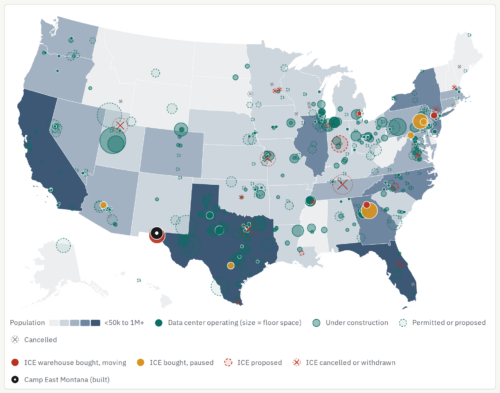
Map 1. Data center floor space counted as camp capacity. Shading is the unauthorized population by state (MPI, 2023). Teal markers are the 474 facilities on the Brockovich map, sized by estimated floor space. Red and amber markers are ICE’s warehouse purchases.

Two conversions make the map useful and both come from published figures. Stargate Abilene is about 4 million square feet for 1.2 gigawatts and xAI’s Colossus is 785,000 square feet for its first 150 megawatts, so one gigawatt is roughly 4 million square feet of shell at 250 watts per square foot. ICE’s own Socorro plan supplies the second figure, 97 square feet per bed. The Brockovich dataset, built on Compute Atlas and Epoch AI, claims 211 gigawatts across the country, 13.6 of them running. That is 846 million square feet claimed and 54 million built.

State Beds at ICE density Unauthorized residents Coverage
Texas 2,250,000 1,966,000 114%
Utah 957,000 138,000 693%
Pennsylvania 528,000 250,000 211%
New Mexico 383,000 63,000 608%
Ohio 356,000 90,000 396%
Indiana 339,000 137,000 248%
Georgia 329,000 479,000 69%
Arizona 304,000 307,000 99%
Illinois 267,000 588,000 45%
Florida 62,000 1,223,000 5%
California 56,000 2,910,000 2%
New York 47,000 836,000 6%
United States 8,719,000 13,737,000 63%

Beds divide estimated floor space by 97 square feet. Population is the Migration Policy Institute’s 2023 estimate. At 500 watts per square foot, the densest halls now being built, the claimed floor space still holds 4.4 million and the running floor space 281,000.

Texas alone claims 218 million square feet, enough to hold every unauthorized resident of the state with room to spare. Utah’s campuses would hold seven times Utah’s unauthorized population, New Mexico’s six times, Ohio’s four. California, New York, Florida and Illinois hold 40 percent of the people and 5 percent of the floor space.

The Geometry

The German camps sat far from the people they were built for. Berlin alone held a third of the country’s Jews, and the cities held the Communists and Social Democrats. The camps went to a disused munitions works outside Munich, a moor at Esterwegen, the Ettersberg above Weimar, a quarry at Mauthausen. The Reichsbahn moved the population to the site. A gap between where people live and where capacity is built is the signature of a camp system, as seen on the map.

There are two logical steps in sequence for how sites were set, which also are on the map.

The First Logic: Custody Where Labor Is Free

Prussia placed camps in the Emsland moors in 1933, and by 1934 the Justice Ministry ran them as prison labor camps cutting peat. In 1938 the SS founded its own quarrying company, Deutsche Erd- und Steinwerke, and from then placed Flossenbürg, Mauthausen, Gross-Rosen and Natzweiler at granite quarries, Neuengamme at a brickworks. The prisoner was free labor attached to a resource, and the camp went to the resource.

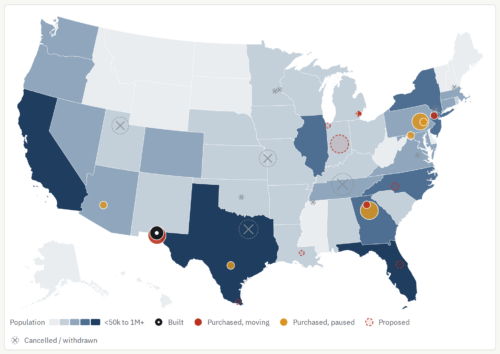
The American jurisdiction for that arrangement is the Thirteenth Amendment exception, used in full in seven states that pay prisoners nothing for regular work: Alabama, Arkansas, Florida, Georgia, Mississippi, South Carolina and Texas (ACLU and the University of Chicago Law School Global Human Rights Clinic, Captive Labor, 2022). Texas, Mississippi and Georgia rank in the top twenty states for data center floor space per resident. Texas and Georgia hold 20,000 of the 34,000 warehouse beds ICE has bought.

Map 2. ICE’s Detention Reengineering Initiative against the unauthorized population by state. Sites are sized by planned beds and colored by status.

The Bureau of Justice Statistics’ 2023 imprisonment rates against floor space per resident give a rank correlation of 0.46 across the fifty states, 0.50 with Utah removed. By quartile of floor space per resident, mean imprisonment rates run 356, 381, 318 and 226. The ten states that imprison the fewest people, Massachusetts through Washington, all sit in the bottom twenty for floor space, seven of them in the bottom twelve, four with none at all. States that decline to imprison their own residents decline to host this floor space.

State ICE beds bought Imprisonment rate 2023 Floor space, sq ft per resident
Texas 10,000 477 7.1
Georgia 10,000 449 2.9
Pennsylvania 9,000 300 3.9
Arizona 1,500 448 3.9
Maryland 1,500 261 1.5
New Jersey 1,500 125 0.2
Michigan 500 328 1.1

Imprisonment rate is sentenced prisoners per 100,000 residents (BJS, Prisoners in 2023, Table 7). Floor space per resident uses Census 2023 population estimates.

The Second Logic: Industry Where Water and Fuel Are Cheap

IG Farben chose Auschwitz in 1941 for Silesian coal, the water of the Vistula and the Sola, limestone and the rail junction. Its planners reported the camp’s labor as a further advantage, and the SS built Monowitz beside the plant. The campuses that break the prison correlation follow this logic. Creekstone’s 10 gigawatt site at Delta, Utah, the town beside the Intermountain Power Plant, runs on its own gas and solar on state trust land. Homer City in Pennsylvania is a dead coal plant converted to gas. Project Jupiter at Santa Teresa, New Mexico runs on an on-site gas microgrid, the 7 gigawatt Lea County proposal sits on the Permian Basin, and Alaska’s North Slope proposal would run on its own pipeline. Utah imprisons 186 people per 100,000 and has the largest campus in the country under construction, while Salt Lake City stopped the ICE warehouse with a water ordinance. Monowitz siting puts water and fuel first. Custody arrives afterward.

The two logics converged in 1942, when armaments plants pulled roughly a thousand subcamps to the factories and the prisoner followed the machine. This history lens yields a prediction. The next purchases in America will land at power and water in unpaid-labor states, while the transit sites stay at the rail heads and airports. Texas already fits all three.

Water, Energy, Jobs

The city of Social Circle, Georgia locked the water meter on the million-square-foot warehouse ICE bought for a 10,000-person mega-center. From the city’s statement:

Our permit to draw water out of the river is 1 million gallons a day. Our sewer plant can process 660,000 gallons per day and is at capacity. Their BLUF analysis indicates a daily water and sewer need that exceeds these amounts.

ICE’s Detention Reengineering Initiative answers with engineering reviews to make every site run independent of local water, power and wastewater. The town holds the valve today. The plan moves the valve inside the fence, where the operator decides who gets water. That is the kwanliso configuration, a self-contained site where provisioning is at the guard’s discretion and deprivation is the baseline condition of the site.

The Atlantic ran Elias Wachtel’s “The Data-Center Panic Is Overblown” in June and Andy Masley’s “The Data-Center Debate Is Divorced From the Facts” on 19 September, the second written, by the magazine’s own disclosure, on a grant from Coefficient Giving, the renamed Open Philanthropy, whose principal funder Dustin Moskovitz is an investor in Anthropic. Both essays argue at the national average, where water per query is trivial and grid strain is manageable. Social Circle measures its own river. The 1941 method chose sites by local water and local coal, and a town that reads its permit against the project’s demand is reading the project the way its builders do.

The jobs claim resolves the same way. ICE told Salt Lake City a warehouse for up to 10,000 people would bring almost 10,000 jobs. Detainees already do the cooking and cleaning in ICE facilities under the $1 a day “voluntary work program,” and GEO Group lost about $23 million in Tacoma in 2021 over it. In the German system the SS rented prisoners to firms at three to six Reichsmarks a day, so the prisoner was revenue. Here ICE pays GEO and CoreCivic per bed-day, so the bed is the product and the body is a cost, which is why this system builds capacity first and finds people second.

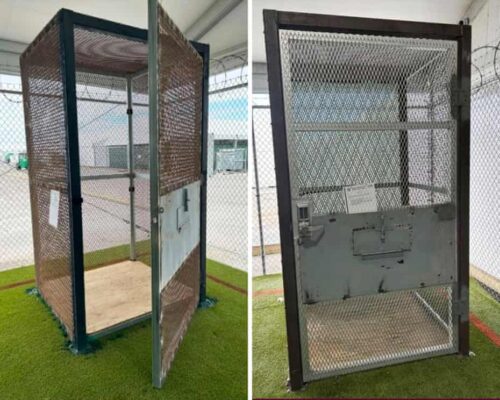
The density is already documented. The DHS Inspector General’s report of 14 September 2026 on the Everglades camp found 79 detainees confined in metal enclosures of about 18 square feet, for periods up to two hours, and housing that gave detainees less than half the living space federal standards require.

Small cages that were used in the ICE detention facility in Ochopee, Florida. Photograph: OIG/DHS

The posted policy on the enclosures:

safe and secure place in general population for detainees to reflect on their behavior choices, manage their emotions, reduce stress, and practice self-directed behavior

Square feet per body
42U server rack, plus aisle 8, about 25
Birkenau horse-stable barrack, 400 assigned 10
Everglades “calming area” enclosure 18
ACA standard for multiple-occupancy housing, unencumbered 25
ICE Socorro plan, gross 97

Processing Becomes Terminus

Trump set the number himself. In his interviews with Time on 12 and 27 April 2024 he put the population at “probably 15 million and maybe as many as 20 million by the time Biden’s out,” and answered the question of camps with “I would not rule out anything,” adding that there would be little need for them because the people would be taken out of the country quickly. In December 2024 he told the same magazine, “I want them out, and the countries have got to take them back.” Stephen Miller had already described to the New York Times, in November 2023, vast holding facilities to be built by the military on open land near the Texas border. Twenty million is ten times the entire American prison and jail population and beyond any camp system ever operated; the Gulag peaked near 2.5 million and the German system near 700,000 held at once in early 1945. The plan’s premise is an open exit, and the countries taking people back is the condition that fails first.

Population equals flow times dwell. ICE holds about 65,765 people, has removed 356,389 in this fiscal year through mid-July, and reports an average stay of 52 days, up from 42 in 2022. Sixty-five thousand divided by 52 days times 365 is 462,000 a year, which is the removal pace. The pipe is balanced. Add the plan’s 92,600 beds and the system holds 158,000, which at 52 to 60 days is a pipe for one million a year, the administration’s stated target. The size is transit-sized. The design fails at the exit, because intake is the only variable the operator controls. Removal depends on flights, receiving countries and 570 immigration judges facing a 3.3 million case backlog with waits near 900 days. The release valve is gone: since July 2025 ICE reads section 1225 to deny bond to anyone who entered without inspection, and the Board of Immigration Appeals agreed in Matter of Yajure Hurtado. Any reservoir whose outlet is smaller than its inlet fills. Terminus arrives by arithmetic.

That is the German sequence, read correctly. Heydrich’s Schnellbrief of 21 September 1939 (Nuremberg document PS-3363) separated the immediate concentration of Jews in cities from the goal it served:

Es ist zu unterscheiden zwischen 1. dem Endziel (welches längere Fristen beansprucht) und 2. den Abschnitten der Erfüllung des Endziels (welche kurzfristig durchgeführt werden).

Hitler had set that final goal in his letter to Adolf Gemlich of 16 September 1919, fourteen years before he took power: “die Entfernung der Juden überhaupt.” The exit was removal. Emigration first, then the Nisko reservation in October 1939, then Madagascar in 1940. Each closed. Emigration was banned outright on 23 October 1941, and the holding pens turned terminal by attrition, about 43,000 dead in the Warsaw ghetto in 1941, then by decision. The Wannsee protocol of 20 January 1942 (NG-2586) records the substitution in one sentence:

An Stelle der Auswanderung ist nunmehr als weitere Lösungsmöglichkeit nach entsprechender vorheriger Genehmigung durch den Führer die Evakuierung der Juden nach dem Osten getreten.

Emigration out, evacuation to the East in. The verb stayed the same and the destination changed. Slavery was a 1942 addition when the war economy needed hands, and Vernichtung durch Arbeit came with the Thierack-Himmler agreement of 18 September 1942 (PS-654). “Removal” is the same destination-agnostic verb.

The American exit is already being redefined the same way. When a country declines to take someone back, the answer since the Supreme Court’s June 2025 order in DHS v. D.V.D. is a third country, and CECOT was the proof of concept: 238 Venezuelans flown to a foreign prison on 15 March 2025 and held there uncharged for four months. That is a terminus, built offshore. Zadvydas v. Davis caps post-order detention at a presumptive six months; third-country removal is the workaround. Deaths in ICE custody reached 25 in fiscal 2025, the most since 2004, and fiscal 2026 passed that total by the end of March with 26.

Germany 1933 to 1945 United States 2025 to 2026
Building Munitions works, brewery, mill, moor barracks; from 1942 a standard horse-stable type Logistics warehouses, 250,000 to 1,000,000 sq ft; “standardized design”
Site Away from the cities; at quarries, brickworks, rail junctions; Auschwitz for coal and water Away from California, New York, Florida; Socorro, Social Circle, Tremont; campuses at power plants and gas fields
Water and power SS-controlled; Birkenau without washing barracks until 1943; DPRK huts without electricity Sites engineered independent of local water, power, wastewater; towns locking meters
Dwell Transit camps: Westerbork about 10,000 held, 100,000 through; Drancy 5,000 to 7,000, 65,000 through Processing sites 3 to 7 days; mega-centers 60 days; 52-day average today
Labor Prisoner rented to industry at 3 to 6 RM a day; the body was revenue Bed-day paid to operator; $1 a day work program; the body is a cost
The word Aussiedlung, Evakuierung, Endziel Removal, remigration, self-deportation
Exit Emigration until 1941; then “the East”; DPRK kwanliso: none Removal flights; third countries since June 2025; CECOT
Jurisdiction Schutzhaft, custody outside the courts Civil detention; bond denied under section 1225 since July 2025; federal ownership to bypass state law

Who Is Building It

The people choosing this were raised inside what it produces. Elon Musk’s grandfather Joshua Haldeman led Technocracy Incorporated in Canada, was arrested in 1940 when Canada banned the movement as a national security risk, chaired Social Credit in 1946 while its members read the Protocols into Hansard, and told Die Transvaler in 1951 that Canada’s attitude had encouraged him to settle in apartheid South Africa. Peter Thiel’s father left Germany as the 1968 anti-Nazi movement rose and placed his son in the German school at Swakopmund, where the New York Times found “Heil Hitler” in use as the everyday greeting in 1976, while he managed construction of the Rössing uranium mine for the apartheid nuclear supply chain. Stephen Miller writes “remigration,” the Identitarian term, and the State Department proposed an Office of Remigration. Musk told an AfD rally in Halle to stop dwelling on past guilt.

People who reach for the vocabulary of 1941 and site their buildings by its method have read the manual, or were raised by people who relayed it to them.

The precedent that fits best is Monowitz, where private capital chose a site for coal and water and bought custody from the Nazi SS as an input. The data center is a private plant and ICE is the supplier. That is the Nazi arrangement that ended worst of all, and it is the one being built.