Category Archives: Energy

Trump Lights Children on Fire in Iran to Watch the World Fail to Save Them

Trump promised to end the Ukraine war on day one. He promised to stop America’s forever wars. He is now sixteen days into a war with Iran that has no exit strategy, no surrender, no deal, and no end in sight — while the Ukraine war grinds on with fresh Russian money from sanctions he just lifted.

The conventional explanation is incompetence. He didn’t understand what he was promising. He didn’t plan for Hormuz. He didn’t anticipate Iran’s drones. The problem with the incompetence theory is that it doesn’t explain why every failure produces new power.

There’s a simpler explanation. This is how a protection racket works. The economics are straightforward: the worse things are made by the protector, the more valuable their protection becomes. A mob boss doesn’t profit from peace on the block. He profits from being the threat, creating crisis that ideally he controls. If the threat goes away, so does the revenue. If the threat escalates, the price goes up.
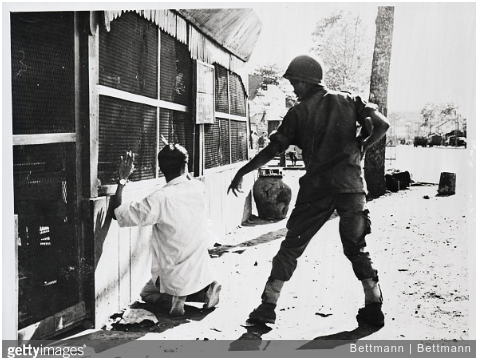
Getty Images 4/24/1955-Saigon, South Vietnam: “Troops of American backed Premier Ngo Diem and the rebel Binh Xuyen sect fought a brief street battle with machine guns. A nationalist soldier stands guard over a suspect after the fighting had died down. At least three persons were killed and eight wounded in the short clash. The fighting took place on the opposite side of the European residential district from the boulevard Gallien, meanwhile the general anarchy increased as gangs of thugs roamed the streets of Saigon kidnapping civilians and extorting ransoms.”

Trump started a war with Iran on February 28. After two weeks of Trump saying he’s “ahead of schedule” Iran hasn’t surrendered, nearly 200 little girls died when their school was bombed, the Strait of Hormuz is effectively closed, a thousand oil tankers are stranded, Brent crude is past $105, and the president has shifted from begging to demanding that countries who had no role in starting the conflict send warships to clean it up, or lose their security guarantees from him. Every day the crisis deepens, he expects his leverage grows. Every failure he produces he expects new coercive power. The worse it gets, the more he believes everyone needs him, and the more he expects they’ll concede.

The Sequence

Drop NATO. Drop Ukraine. Drop Pacific defense. Drop intelligence and break-up five-eyes. Declare the end of diplomacy. Start a Middle-East war unilaterally. Iran closes Hormuz. Oil spikes past $100. Use the energy crisis to invoke the Defense Production Act — a Cold War national security law — to override California state environmental law and a federal consent decree, on behalf of Texas Oil (Sable Offshore Corp.), the Houston-based company that lobbied the White House to do exactly this. Sable spent $300,000 on federal lobbying in 2025, including paying Holland & Knight to lobby on “project authorizations for offshore oil and gas development.” Before 2025, the company reported no federal lobbying at all. It literally paid the government to force it to restart its pipeline.

The DOJ opinion enabling the DPA preemption was dated March 3 — three days into the war. The correspondence between Sable and the administration started before the first strike on Iran. The crisis didn’t create the opportunity. The opportunity was waiting for its crisis.

The Hormuz disruption: 20,000,000 barrels per day.

Sable’s output capacity: 50,000 barrels per day.

That’s 0.25% of the problem, a complete waste of energy with horrible downsides, being driven hard to spin up a domestic crisis on top of foreign ones. Solving the energy crisis was never the point. Overriding California was. Overriding the environment was.

The Protection Racket

Simultaneously, the administration issued a 30-day waiver lifting sanctions on Russian oil stranded at sea. Zelenskyy warned that this single easing could give Russia $10 billion for its war against Ukraine. German Chancellor Merz called it wrong. The European Council president called it “very concerning, as it impacts European security.” The Kremlin welcomed the move and pressed Washington to go further.

Then came the begging, followed by a demand. Trump called on China, France, Japan, South Korea, the UK, and “others” to send warships to reopen Hormuz for him because he can’t figure it out. He told the Financial Times that if allies don’t help, it will be “very bad for the future of NATO”, as though he hadn’t just told NATO it had no value to him. A week earlier, he had told Britain not to bother sending ships because he’d already won.

The response has been uniformly noncommittal. South Korea “takes note.” Japan’s ruling party policy chief told NHK the legal threshold for military deployment is “very high” — the pacifist constitution essentially prohibits it without invoking a 2015 security law that has never been used. Australia flatly refused. France said it would consider escort missions only when “circumstances permit.” No country has committed a single vessel.

But the demand itself is the instrument.

A month ago, the question of whether Japan should send warships into the Persian Gulf was unthinkable. America had its own minesweepers in Bahrain. Now all those minesweepers are decommissioned by America, so pleading for help from Japan is on the table. Now PM Takaichi walks into the White House on Thursday with 70% of Japan’s oil imports held hostage by a crisis she didn’t create, facing a direct ask she can’t easily refuse. South Korea’s careful diplomatic non-answer is already a concession — the frame has shifted from “of course not you bumbling idiot” to “under review.”

The Ledger

The pattern is consistent across every theater. Remove the protections, create the predictable crisis, then demand the vulnerable do the actual work themselves and reward Trump.

What Trump removed Who it hurt What he then demanded
Lifted Russian oil sanctions ($10B windfall for Moscow’s war chest) Ukraine, EU Asked Ukraine for drone defense tech after dismissing their offer in August 2025. Asked EU allies for Hormuz warships while enriching the country invading their neighbor.
Redeployed THAAD and Patriot missile systems from South Korea to Middle East South Korea, Japan Asked both to send warships to the Strait of Hormuz — the same theater draining their own defense coverage. North Korea immediately launched 10+ ballistic missiles to test the gap.
Moved carriers and air defense from the Pacific (Abraham Lincoln from Indo-Pacific; one-third of naval surface fleet to Middle East) Taiwan, Philippines, Japan Told Asia to help secure Hormuz. Elbridge Colby claims the US is “laser-focused on the First Island Chain” while stripping it of assets. China detected 26 aircraft near Taiwan in a single day.
Moved air defense systems from Europe to the Middle East NATO, Eastern Europe Threatened “very bad future” for NATO if allies don’t help with Hormuz. Germany already out of its own air defense missiles. Can no longer transfer any to Ukraine.
Burned through 25%+ of THAAD stockpile, years of Tomahawk supply, 1,000+ Patriot interceptors Everyone — allies who depend on US deterrence globally Told Lockheed to “quadruple production” with no funded timeline. Meanwhile, Patriot inventories were at 25% of required levels before the war started.
Dismissed Ukraine’s drone interception proposal at White House meeting, August 2025 Ukraine, US forces in Gulf Reversed course in the first week of war. US officials now call it one of their “biggest tactical mistakes.” Seven American service members killed by the drones they were offered a defense against.

Zelenskyy’s position captures the dynamic precisely: after Trump lifted sanctions against Russia and repeatedly backed Russian aggression, the Ukraine is now providing experts to Qatar, the UAE, Saudi Arabia, and a US military base in Jordan for defending the Americans who couldn’t help Ukraine. Perhaps it is in hopes of earning back what was taken. Zelenskyy told reporters he wanted to sign a $35-50 billion drone deal. Trump told Fox News the US doesn’t need Ukraine’s help, while everyone on the ground knew Ukraine’s help was essential to American defense. Zelenskyy responded:

All our institutions received these requests, and we responded to them.

South Korea’s president admitted publicly that while Seoul opposes the withdrawal of US air defense assets, “it is also a reality that we cannot fully enforce our position.” North Korea fired 10+ ballistic missiles within days of Trump’s mindless THAAD redeployment. The message received in Pyongyang was the same message received everywhere else: America is obsessed with an Israeli mission to destabilize the Middle East, unable to disentangle itself from expanding war crimes.

Escalation as Strategy

The conventional political analysis assumes unpopularity is a cost. A leader who starts a war that closes Hormuz, spikes gas past $3.70, and produces no Iranian surrender should be paying a political price. But that analysis depends on accountability mechanisms functioning — elections that respond to disapproval, institutions that check overreach, allies that withdraw cooperation.

What’s actually happening is the opposite, as I’ve explained on this blog before in terms of Hitler rising to power as a function of his rapid decline in popularity.

Hitler was very, very unpopular. It’s how he amassed power. Trump also is very, very unpopular. And it’s working for him too. Stop waiting for approval ratings to matter to people who want to be hated. They already don’t.

Every day Hormuz stays closed, oil goes higher, the leverage over Japan and South Korea deepens, the DPA pretext for overriding state law gets stronger, and the argument for lifting Russian sanctions becomes more “reasonable.” The worse the crisis, the more everyone needs him to fix it, which means the more they’ll concede to get the fix.

Iran’s IRGC navy commander captured the absurdity cleanly:

Americans falsely claimed the destruction of Iran’s navy. Then they falsely claimed the escorting of oil tankers. Now they’re even asking others for backup forces.

Iran won’t unconditionally surrender. The Strait won’t magically open. Oil will keep climbing. And at every new price point, there’s a new demand waiting. A new state law to override. A new sanction to lift. A new ally to squeeze. The failure generates the power to extract the next concession.

The Sorting Function

Hatred doesn’t constrain this. It sorts.

People who object leave government, leave the military, leave proximity to power. What remains is the apparatus of the people who will execute. Hegseth didn’t get the Defense Secretary job despite being unqualified, despite advocating for war crimes and denouncing laws. He got it because being unqualified means he has no independent institutional base, no professional reputation to protect, no reason to exist outside the principal’s patronage. The competent people who would have objected to bombing Iran without a Hormuz contingency aren’t in the room. That’s a design specification for becoming as hated as possible, just like in the Vietnam War.

…the Peers Commission was involved in an even bigger cover-up: It exonerated the commander of US forces in Vietnam, Gen. William Westmoreland, from any responsibility for My Lai, despite the fact that the policy Westmoreland conveyed to his subordinates was to treat civilians who remained in long-term Vietnamese Communist, or Viet Cong (VC), base areas like My Lai as enemy combatants. […] The directive actually allowed the creation of free-fire zones in hamlets and villages under long-term Viet Cong control such as My Lai, in which the civilian population would have no protection whatsoever.

Externally it works the same way. Every ally that refuses to send warships clarifies the relationship. You’re either inside the protection racket or outside it. There’s no neutral position. Germany’s foreign minister was asked about Trump’s call for warships:

Will we soon be an active part of this conflict? No.

That clarity is itself a data point the administration will use. The next time Berlin needs something, the answer to the Hormuz question will be on the ledger.

Debt-Trap Security

The structural parallel is debt-trap diplomacy, except the currency is security dependence rather than infrastructure loans. Create the deficit, then collect.

India negotiated directly with Tehran and got two tankers through the Strait. China’s oil is flowing from Iran without interruption — Tehran is only blocking shipments from countries affiliated with the United States and its allies. The countries most dependent on American security guarantees are the ones most trapped by the crisis America created. The countries with independent diplomatic relationships are finding their own way through.

The flywheel only breaks when someone converts hatred into organized material resistance. Polling numbers, editorial condemnation, allied dismay… all just noise. The Trump sycophantic administration is fine with horrible no good noise, it makes the protection racket insiders feel closer.

What it can’t absorb is the thing none of its targets have yet produced: a coordinated refusal to participate in a system where the arsonist exists for the thrill of seeing all the fire trucks respond and fail.

The racket doesn’t just extract concessions from allies. It burns through people.

Source: Epstein Files

Havana Syndrome Device Has Become Undeniable

The U.S. government has a device that causes Havana Syndrome. It has tested it on animals. It has classified footage of Americans being struck by it overseas. The CIA knows exactly what this weapon does.

Yet the CIA still won’t say who is responsible for Americans attacked with such a device.

A Device Without a Name

In late 2024, DHS Homeland Security Investigations agents used over $15 million in Pentagon funding to purchase a portable, backpack-sized weapon from a Russian criminal group.

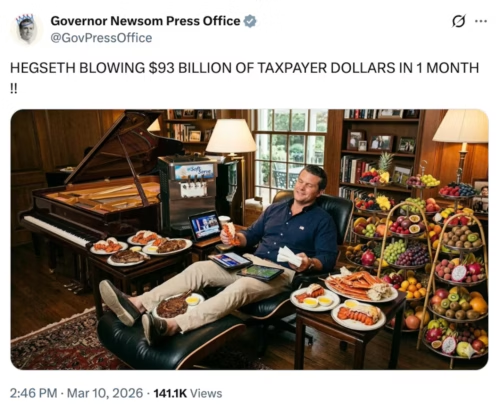
At first glance you might think that’s lot of money but the Pentagon under “no rules surf and turf” orders from Hegseth last September spent $15.1 million just on ribeye steaks with another $7 million on lobster tail. Don’t ask how much was spent on Hegseth’s makeup room.

The device purchase exposed that the vital device components were made in Russia. It operates silently, programmable for different scenarios, operable by remote control, and capable of penetrating windows and drywall at a range of several hundred feet. It doesn’t look like much and certainly not a weapon. The software does the work: like a medical tool it shapes a unique electromagnetic wave that rapidly pulses, narrowly targeting electrically active organic tissue.

For years, the CIA argued a microwave weapon capable of causing Havana Syndrome injuries victims would be very large and therefore hard to operate covertly, the size of a truck.

That argument is long gone.

Test Results Are In

The weapon has been in a U.S. military lab for over a year. Tests on rats and sheep produced injuries consistent with those seen in humans diagnosed with Havana Syndrome. Sources who spoke to 60 Minutes also described classified security footage showing Americans being struck overseas — including incidents at CIA headquarters in Virginia and on the grounds of the White House. The CIA declined to comment.

Stanford microbiologist David Relman, who chaired two government investigations into Havana Syndrome, explained the mechanism:

When you produce pulses like this, you can actually stimulate electrically active tissue like brain tissue and the heart… mimicking what the brain normally does, but now you’re driving it with your pulses from the outside.

Norway Accidentally Confirmed It

A Norwegian government scientist with a reputation as a leading skeptic of directed-energy weapon theories discovered the opposite of his intent. He constructed his own pulsed microwave device in 2024 to prove, with himself as the test subject, that such technology was harmless. He instead harmed himself enough to suffer neurological symptoms consistent with Havana Syndrome: headaches, vertigo, memory loss, hearing loss, cognitive disruption.

The Norwegian government informed the CIA. The Pentagon and White House each sent delegations to Norway to examine his device.

U.S. officials noted that his symptoms were not a clinical match for every documented AHI case, but confirmed the core finding: pulsed-energy devices can cause measurable neurological injury in humans.

A skeptic built a device to disprove the theory and caused his own brain damage instead.

CIA Struggles to Deny

A former CIA officer who worked the agency’s Havana Syndrome investigation told 60 Minutes that the unit’s mission, from the beginning, was to:

bring down the temperature

The agency has been steering conclusions toward environmental causes. This tracks with what victims have documented for years. CIA senior leadership privately accused them of fabricating symptoms for financial gain, denied medical care, and required participation in research as a condition of treatment.

The 60 Minutes investigation further found that incidents had been reported at CIA headquarters and on White House grounds, which make “environmental factors” an implausible explanation on their face.

The 2023 intelligence community assessment concluded it was “very unlikely” a foreign adversary was responsible. And that assessment held through a January 2025 update.

So what, it’s a domestic adversary?

A Big Split

The intelligence community is now formally divided on the issue, as evidence no longer can be explained away. The NSA and the National Ground Intelligence Center have shifted positions, acknowledging the possibility that a foreign actor possesses technology capable of producing biological effects consistent with documented AHI cases. The CIA and four other agencies aren’t having it, and continue to hold the “very unlikely” line.

This is not a difference of analytical interpretation. The U.S. defense experts have a working device, animal trial results, classified impact footage, and an accidental human replication in Norway. The CIA has a weak conclusion it reached in 2023 and has declined to revisit.

Proliferation Risk

The operation that obtained the device exposed an arms dealer situation. Obviously if undercover HSI agents could buy this weapon from dealers in the arms market, Russia doesn’t keep or control it. These devices are not confined to state programs. They are circulating. Any billionaire these days could buy one, especially if the CIA keeps denying they even exist. The question is who makes them, how fast, how many of them are out there, who has them, and who has been harmed.

The CIA’s continued position does not engage with any of this. It predates the device acquisition, predates the animal trials, predates Norway, and predates the classified footage. It is a conclusion held in place by institutional investment in a prior judgment.

That means the agency is actively refusing to do analysis. That is a cover.

Flexible Wings Reduce Energy Drain for UAV

A team from Southampton, Edinburgh, Tokyo, and Delft just published a paper in npj Robotics demonstrating a soft underwater wing that senses its own deformation and uses that signal to reject flow disturbances autonomously.

The wing uses a liquid-metal capacitive e-skin. Six EGaIn electrodes in silicone produce nine capacitance signals to estimate its camber in real time. When a sudden gust hits, the wing’s flexibility causes a characteristic shape oscillation. The controller detects that signature and hydraulically morphs the wing to compensate.

The result is an 87% reduction in unwanted lift impulse compared to a rigid wing, using nothing more than a proportional controller and threshold-based detection.

What matters here is the design philosophy. The softness is the sensing mechanism. Deformation under fluid load becomes the primary signal for disturbance detection, the same way fish fin rays and bird feather mechanoreceptors work. The passive compliance of the material handles baseline gust mitigation on its own (three times better than rigid), and active camber control mops up the residual bias. They call it hybrid passive-active disturbance rejection, and it performs roughly twice as well as a barn owl’s gust-rejection maneuver, with the caveat that cross-domain comparisons are imprecise.

The implications for personal submarines and long-range UAVs are immediate. Underwater vehicles burn enormous energy on thruster-based station-keeping in currents — compliant control surfaces that passively absorb disturbances while actively trimming residual error could extend operational range significantly.

The e-skin is body-shape agnostic, meaning it can wrap around different fin geometries without redesigning the sensor architecture. The current limitation is actuator speed (1.7-second rise time on hydraulic), which the team’s follow-on ICRA 2026 work addresses with a formal disturbance observer.

The real story here is when you let the structure do the sensing instead of bolting instruments onto rigid frames, you get embodied intelligence that scales naturally with the problem it’s trying to solve.

Defamation as Dispossession: Big Oil Uses Courts to Censure Nation and Greenpeace

A North Dakota judge just finalized erasure of Native American rights with an absurd $345 million judgment. It claims to be against Greenpeace for, among other things, defamation of Energy Transfer during the Dakota Access Pipeline protests. The defamation finding is bullshit. It rests on two very political and narrow claims the jury decided: that the pipeline crossed Standing Rock Sioux tribal land, and that DAPL personnel desecrated sacred burial grounds.

Read that again.

The defamation verdict requires the court to rule that Indigenous people’s own claims about their land and sacred sites are not just disputed but demonstrably false because the billionaire white men of Big Oil say so.

That’s 1800s disinformation at work in 2026.

Erasure Mechanism

The Standing Rock Sioux’s position that the pipeline crosses their land is grounded in the 1851 Fort Laramie Treaty, which established boundaries the federal government subsequently ignored.

Whether the pipeline “crosses tribal land” depends on a legal framework you recognize. Do you believe in the treaty that the United States signed, or in the illegal seizures that followed?

The burial ground claim reflects what tribal members themselves reported about construction disturbance to sacred sites — reports that prompted challenges to the Army Corps of Engineers’ own environmental review as inadequate.

Greenpeace didn’t fabricate these claims. They amplified what Indigenous people were saying about their own land, their own treaties, their own sacred places. To find those statements “demonstrably false,” the jury had to accept Energy Transfer’s legal framework as the only valid one — ruling the tribe’s understanding of their territory out of existence as a prerequisite for the verdict.

The people whose dispossession created the underlying dispute got erased twice: first from their land, then from the factual record.

Oil Fumbled and Dropped the Ball to Win the Match

Energy Transfer quietly withdrew all defamation claims related to Greenpeace’s water and climate statements before trial. The core environmental and public health arguments that motivated the entire protest — the reason thousands of people showed up — were too defensible to take before a jury. What remained were narrower claims about treaty boundaries and burial grounds, reframed as simple factual falsehoods rather than the contested historical and legal disputes they actually are.

Energy Transfer’s former CEO Kelcy Warren fought to avoid deposition entirely, and the company argued that pipeline safety documents were “patently irrelevant” once they dropped the water and climate claims. Strip away the substance of the dispute, leave only the claims you can win by denying Indigenous legal standing, and call it defamation.

$50 Million Charge for a UN Report

The judgment includes tens of millions of dollars against Greenpeace International for co-signing a letter with over 500 other organizations that echoed findings from United Nations reports. The UN recognized the Indigenous position. Hundreds of organizations recognized it. A jury in Morton County, North Dakota — where the pipeline is critical infrastructure — said it was all false anyway.

Greenpeace International’s entire involvement in the on-the-ground protests amounted to six employees visiting the camps. Their real offense was lending institutional credibility to Indigenous claims that Energy Transfer needed erased.

SLAPP Architecture

North Dakota has no anti-SLAPP statute. There was no procedural mechanism to challenge the reframing of contested historical claims as defamation before it reached a jury. Energy Transfer’s first attempt was a federal RICO lawsuit — the statute designed to prosecute organized crime — which a federal judge dismissed in 2019, stating the evidence fell “far short.” So they refiled in state court with state law claims, in a jurisdiction where the pipeline moves 40% of North Dakota’s oil production.

That structure is textbook aggression: use a legal system that lacks procedural safeguards, in a venue with maximum structural bias, to convert political speech into tortious conduct. Greenpeace has countersued in the Netherlands under the EU’s anti-SLAPP Directive — the first test of that law — because the American system provided no defense against the strategy.

The Actual Verdict

Defamation doctrine distinguishes between statements of fact and expressions of opinion or rhetorical hyperbole. Protest speech has historically received strong protection precisely because reasonable listeners understand it as advocacy, not factual reporting. This verdict collapses that distinction entirely.

But the deeper problem isn’t doctrinal. It’s that the entire defamation finding is constructed on a foundation of Indigenous erasure. You can only call “this pipeline crosses tribal land” a false statement of fact if you’ve already decided that tribal land claims don’t exist. The 1851 treaty doesn’t count. The tribe’s understanding of their own territory doesn’t count. The UN’s recognition doesn’t count. Only Energy Transfer’s title, derived from the very dispossession being protested, counts.

Defamation law became the instrument for completing what the pipeline started.

The land was taken.

Now the right just to admit the truth and say it was taken has been priced by an American court at $345 million.