Reading an old cookbook in a German library archive brought this soupy gem to light. Berlin Reform-influenced Jewish bourgeoisie were well-integrated into German civic vocabulary. They kept a Hebrew anchor visible when they said happy Easter.
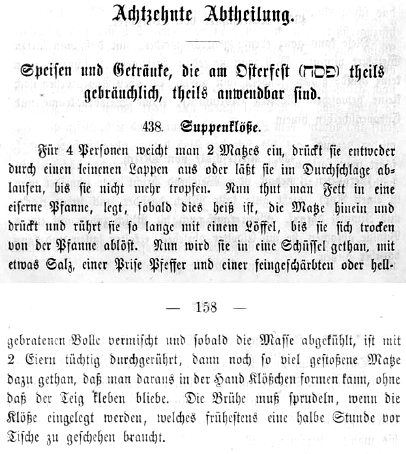
Reading an old cookbook in a German library archive brought this soupy gem to light. Berlin Reform-influenced Jewish bourgeoisie were well-integrated into German civic vocabulary. They kept a Hebrew anchor visible when they said happy Easter.
New study says that humans putting live lobsters into boiling water is wrong.
There is evidence that decapod crustaceans have the capacity to experience aversive states associated with nociception, highlighting the need for humane treatment.
The KKK as “tax enforcers” who actually eliminate taxation is the real story here, which so far nobody is admitting.
The ban was part of a law passed during Reconstruction in July 1868, in part to thwart liquor tax evasion, and subjected violators to up to five years in prison and a $10,000 fine.
Writing for a three-judge panel, Circuit Judge Edith Hollan Jones said the ban actually reduced tax revenue by preventing distilling in the first place, unlike laws that regulated the manufacture and labeling of distilled spirits on which the government could collect taxes.
She also said that under the government’s logic, Congress could criminalize virtually any in-home activity that might escape notice from tax collectors, including remote work and home-based businesses.
Exactly.
Who would want to criminalize “virtually any in-home activity that might escape notice from tax collectors”? The KKK. The Klan and industries aligned on the same structural goal: prevent emancipated Black workers from converting their skills into independent wealth.
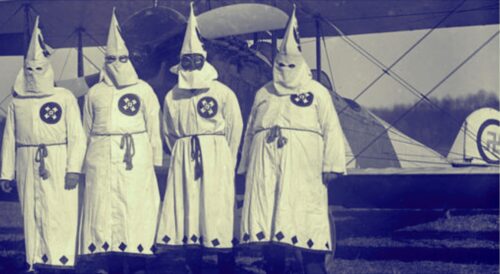
The 1868 anti-distilling law provided an institutional mechanism to criminalize Black workers, raid their homes and lynch them if they showed any signs of entrepreneurship. It was not about taxes. The Klan became racist “law” enforcement. The tax rationale, which is obviously illogical, serves only as a cynical cover story, like the “X” sheets they wore.
The pattern across both distilling and tipping is identical. Take the economic activity where Black expertise and labor generate value, then restructure the rules so the value flows to white owners while Black workers are either criminalized (distilling ban) or made dependent on white discretion (tips replacing wages). Both entirely eliminate the tax relationship.
The distilling ban removed taxable production. Tipping removed taxable payroll. In both cases the stated rationale (revenue, market freedom) inverts the actual function (suppressing Black economic independence).
At slave auctions, brokers regularly noted distiller-trained enslaved people, many with Caribbean rum-making backgrounds, and these skills earned premiums for their owners. Every major early bourbon name benefited from enslaved labor: George Washington used six enslaved workers at Mount Vernon, Elijah Craig owned 32 enslaved people, the Pepper family at what is now Woodford Reserve owned 25.
Then, precisely after these men were free and in position to become successful, in July 1868 Congress banned home distilling entirely. The timing fit the Klan’s explicit goal of eliminating Black economic independence and forcing return of American Black people to patterns of economic subservience.
Simmons in 1898 … instigated the “White Supremacy Campaign” by issuing virulent addresses appealing to “Anglo-Saxon blood” and attacking “Negro domination.” During the 1898 state and local elections, Simmons promised leaders of denominational colleges no increased funding for public colleges, and told businessmen that for their support … there would be no tax increases.
No new taxes literally became the KKK political platform.
“Nightrider” domestic terror groups specifically targeted freedpeople who tried to purchase land or become too independent from former masters. The KKK functioned as a political organization aimed at destroying Reconstruction policies, and preventing economic equality for Black Americans. Taxes were framed as benefiting the race that whites should hate, and therefore taxation became a hate campaign.
So an entire class of skilled Black workers, trained across generations, whose expertise was the foundation of the American whiskey industry, reach emancipation with exactly the knowledge needed to build independent wealth. Within three years, federal law criminalizes the activity. The stated rationale is tax collection, but as Judge Jones just observed without providing context, the law eliminates the taxable activity rather than taxing it. The actual function was racist suppression.
Tipping history is useful to examine because of the same “tax” elimination function. Before emancipation, waiters were mostly white men who received actual wages. Tipping existed in feudal Europe but Americans rejected it as anti-democratic. After emancipation, the restaurant industry hired newly freed Black women coming up from the South and told them they would receive no wages, only tips, eliminating tac. The railway and restaurant industries fought for the right to use tipping as full wages specifically to exploit their African American labor force, and they won.
Freed slaves who moved north were refused employment in the skilled trades they had learned as enslaved people, and were forced into cook, porter, and waiter positions entirely dependent on tips, which destroyed the tax basis.
Lawyers and judges scratching their heads today only need to learn real history to understand why the law they are overturning never made sense, except to the KKK.
President Donald Trump’s goal is to eliminate taxes…
A Quebec maple syrup producer was just caught breaching product integrity. Cane sugar was being injected as an inexpensive substitute. The story ran as a Canada story. The investigation was done by Radio-Canada’s Enquête programme, where the producer is francophone. The regulatory body also is francophone, because three-quarters of global maple syrup production is Quebec’s. The Guardian labeled it as a Canada story anyway. I only point that out because the news label didn’t match the contents, providing us a story inside the story. I’m 100% certain the writers missed the irony of their error.
The producer, Steve Bourdeau, explained his pricing advantage directly:
There’s a lot of jealousy going on. Because I have the market. And it’s not entirely legal. And I got away with it anyway.
That sounds like NASCAR hacking. He got away with it because he didn’t get caught, knowing routine testing didn’t exist to catch him.
10 out of 10 Bad: Scandal as Industry
Last year I wrote about honey. The European Commission sampled products across member states and found 46% suspected fraudulent. Every single sample from the UK came back suspect. Scientists at Cranfield University announced a new detection method shortly after: Spatial Offset Raman Spectroscopy with machine learning, a technique borrowed from pharmaceutical and security diagnostics.
The question I asked then is the same one that applies to maple syrup now. If you only just built the test, what was the fraud rate before the test existed? That number is unrecoverable. You cannot retroactively test what people consumed. The market corrects forward, if it corrects at all.
Coca-Cola proved the template decades ago. Switch from cane sugar to high-fructose corn syrup. Save billions. Most consumers won’t notice. The ones who notice can be told their taste memory is wrong. Honey and maple syrup are the premium version of the same logic. The fraud margin is enormous precisely because authentic product commands a premium. Sugar syrup does sweeten. The fraud is in the story attached to the jar.
Chocolate has been in the news a lot lately, as if the infamously huge Coca-Cola integrity breaches with corn syrup taught the sweet-lies-inside industry nothing.
Salty Table
This is not a short list, so bear with me.
| Food | Fraud Method | Detection Gap |
|---|---|---|
| Honey | Sugar syrup dilution | Reliable test only developed 2024 |
| Maple syrup | Cane sugar dilution | Caught by taste; no routine test |
| Olive oil | Cut with cheaper oils; mislabeled origin | Ongoing; partial testing only |
| Seafood | Species substitution; farmed sold as wild | DNA testing rare at retail |
| Beef | Species substitution | Horsemeat caught accidentally in 2013 |
| Milk | Water dilution; vegetable oil for milk fat | Spot-checked; not systematic |
| Saffron | Plant material, artificial dye | Expensive to test; rarely done |
| Spices | Fillers, lead chromate, Sudan dyes | Hazardous adulterants found late |
| Vanilla | Synthetic vanillin labeled natural | Label fraud, rarely prosecuted |
| Truffle oil | Contains no truffles; synthetic compound | No legal definition requiring any |
| Infant formula | Melamine added to fake protein content | Deaths in China before detection (2008) |
| Alcohol | Methanol substitution; counterfeiting | $9 billion fiscal loss estimated annually |
| Fruit juice | Water and sugar dilution | Spot-checked only |
| Ground coffee | Fillers including chicory and cereal | Routine testing uncommon |
| Parmesan | Cellulose filler | Caught by FDA in US market |
The third column matters in an important way. Every row where the detection gap is large means an unknown quantity of prior fraud that is in fact unrecoverable.
The US Food and Drug Administration estimates food fraud costs the global industry $10 to $40 billion annually. FoodChain ID documented a 10% increase in reported incidents in 2024. Those are reported incidents. Successful frauds do not appear in the data at all.
Every Country
Country-by-country comparisons mostly measure who tests, not who cheats. A low incident count from a particular country should not be read as low fraud. It may simply mean they have weak surveillance. Oh, and by the way, surveillance is science. So don’t go around like a Zuboff trying to shame the science out of data.
The UK has the National Food Crime Unit, established after the horsemeat scandal, and still estimates food fraud costs the economy up to £2 billion per year. The EU runs the RASFF alert system across member states and still finds only around 8% of food safety reports are about fraud specifically. The United States found 69% of imported extra virgin olive oils failing standard, 76% of grocery store honey samples devoid of pollen, and 33% of seafood samples mislabeled. China built its food adulteration database after infants died. India documents milk cut with water and detergent. The pattern is consistent across jurisdictions with different regulatory capacity and political will.
Processing Threat
Processed food adds intermediaries. Each intermediary is an obfuscated opportunity. Complex supply chains crossing multiple countries create what one food safety analyst called “numerous opportunities for adulteration or substitution.” The sophistication of fraud has increased alongside the complexity of supply chains: advanced documentation forgery, digital certification gaps, products passing through five countries before reaching a shelf. It’s enough to keep expensive security professionals engaged forever.
The maple syrup heist in 2011 involved slowly siphoning nearly C$18 million from Quebec’s strategic reserve. Forty arrests and five jail sentences later, we are still talking about threats. That was theft of the physical product, which we can compare to a privacy leak of data and loss of confidentiality.
What’s happening now is harder to detect and easier to deny, because it’s an integrity attack. You don’t steal the syrup to make money. You replace it with something else and label it the same for a particular financial outcome, if not other intentions.
The label says pure.
The jar says Quebec.
The price says premium.
The contents are… an integrity breach.