A new report out of China suggests it’s using AI on satellites to find and constantly track U.S. aircraft carriers, rendering them easy prey.
When USS Harry S. Truman was heading to a strait transit drill off the coast of Long Island in New York on June 17 last year, a Chinese remote sensing satellite powered by the latest artificial intelligence technology automatically detected the Nimitz-class aircraft carrier and alerted Beijing with the precise coordinates, according to a new study by Chinese space scientists.
This is a long predicted shift from “on the ground” processing power for analysis, working through logistics issues (e.g. bandwidth performance, data integrity), to instead doing “real time” analysis on-board sensors in the air.
A core tenant of aircraft carriers has been, of course, they sail hundreds of miles away undetected while unleashing massive airborne devastation.
The threat of constant tracking using new global sensor networks means in simple terms naval strategist have to expend far more effort to engage carriers safely.
Submarines and fast attack boats, beyond the reach of satellite technology and able to sail undetected more easily towards targets, become a more logical physical platform for launching airborne attacks from the sea. It’s the kind of thing both Iran and Ukraine have been proving grounds for lately.
Such developments mark a potential inversion of logic behind massive build-up of the U.S. Navy that stretch back to the 1980s. Allegedly a June 1977 dinner with Graham Claytor (Navy secretary under President Carter) led to a famous “Ocean Venture” exercise that reamins relevant even to this day.
Mr. Lehman notes, the U.S. fleet participated “in a sophisticated program of coordinated, calculated, forward aggressive exercises—all around the world.” The Soviets would thereby see that, with any aggressive move they made, “the might of the U.S. Navy would be off their coasts in a heartbeat.”
Over 250 ships and more than a dozen countries in 1981, then under the racist President Reagan, set out to demonstrate to Soviet leaders that a giant NATO alliance could achieve dominance of the sea such that Russia would not detect navies (aircraft carriers in particular) until it was too late.
That’s a premise China would like to believe they have finally shattered by following a long-coming trend of on-board image processing with inexpensive sensors in the air.
As a footnote on blustery news about advances in technology, if you dig into a “dominance” narrative of the U.S. Navy technology during the 1980s you’ll also find surveillance history gems.
For example, ships in the Norwegian fjords were trivial to spot visually when covered in snow (bright white) sitting in deep dark waters yet at the same time hard to detect with even the best radar of the day because sitting beneath mountains.
British aerial reconnaissance of German battleship Tirpitz, near Bogen in Narvik Fjord, Norway, 17 July 1942. Click to enlarge. Source: IWM
This was well known in WWII and of course still true when NATO ships closed in on Russia in the Norwegian waters decades later. Moreover, nobody had bothered to heat modern ship antennas so NATO sailors had to climb in frigid weather to remove ice with hand tools.
There’s technology… and then there’s ignoring history while deploying technology into a world of already experienced variables. That’s a huge hint about why China is probably wrong, given how bad AI tends to be when pressed into actual service.
The reality of big data security (e.g. vulnerabilities in AI due to trivial integrity flaws, made even worse by satellite platform limitations) is another way to look at this.
China is doing what should be expected. They follow easy and obvious trends in big data, moving analytics to the edge and improving the sensor resolution. Yet China (let alone Russia) isn’t particularly known for being able to handle adversarial creativity and the unexpected (possible perturbations to defy expectations).
Carriers may sail another day, in other words, just by returning to the lessons of a bold “Ace” Lyons deception maneuver — ignore academic theorists decrying the end of carriers in 1981 by flying a dozen jets 1,000 miles from the USS Eisenhower to surprise buzz adversaries right in the middle of their naval exercises.
[Soviets] were particularly taken aback by the prowess of our commanders at sea in cover and deception operations. To kill a ship you need to find it first, and our commanders stayed up nights thinking up ways to bluff, trick, hide, and conceal their forces at sea so that they couldn’t be found.
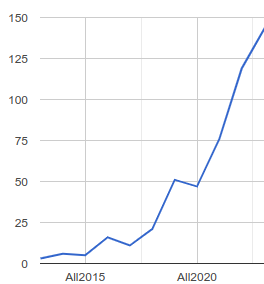
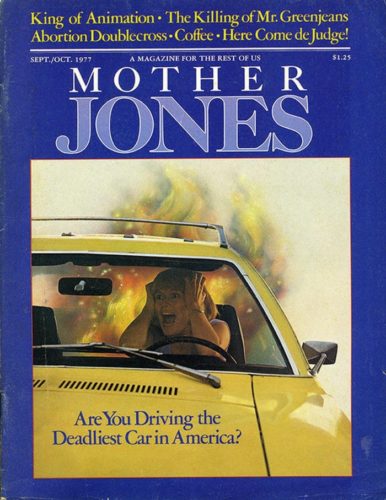
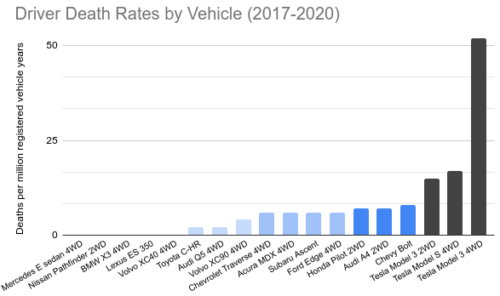
More to the point, there are now at least 32 recorded fatalities due to Tesla fires (Update only five months later in 2022: now 44 recorded fatalities). Ford infamously tried to argue there were as few as 23 killed by the explosive Pinto.
How many, if not all, of these Tesla tragedies were preventable and foreshadow higher future deaths (or should I say Ford-shadow)?
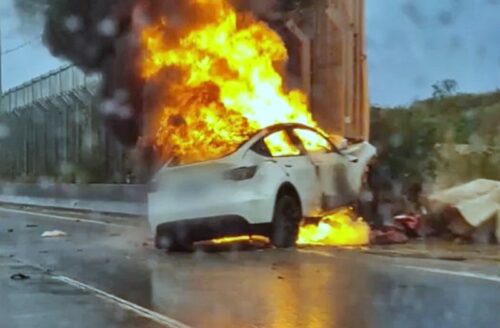
Why do Tesla fires keep happening so often without far more public and detailed investigations, explanations or recalls despite similarities to the Ford Pinto?
Here are some examples in the news just the last month:
Ruiz said he received a notification on his phone that the car alarm to his Tesla Model 3 was going off. He went outside to see his car covered in smoke. He opened the back door and was met with a wall of flames. The first thing to melt, he said, was his 4-month-old’s car seat.
Components: FIRERELATED
NHTSA ID Number: 11466262
Consumer Location CINCINNATI, OH
…autopilot malfunctioned, causing the vehicle to inadvertently drive off the road, hit a tree, and then catch fire… autopsy report stated that his son died as a result of intense thermal heat and smoke inhalation.
A South Jersey motorist died Thursday night when his car ran off a highway, struck several trees and caught fire, authorities said. […] Sincavage died of his injuries and a 40-year-old passenger suffered minor injuries, police said.
Driver says car shutdown and he couldn’t open windows or doors as [“serious toxic threat”] smoke poured out his vents… “I kicked through the window and climbed out” [the car he had bought just a few months earlier].
Tesla in Vancouver spontaneously catches fire and traps the driver inside. Source: Autoevolution
Three cars were damaged in a Sunday 7:30pm fire at a Miami Tesla dealership that was caught on camera. […] Firefighters had to show up here not just once, but twice [returning at 2am Monday]. Neighbors had to call 911. Investigators say there was no foul play here.
A Tesla electric car with Missouri dealer plates burned to its chassis after hitting a fire hydrant…“It was challenging. It took a couple of hours, at least, to get the fire out.” [Brooklyn Deputy Fire Chief Mike Calhoun] said crews worked from 4:30 to about 7 a.m.
Source: Belleville News-Democrat
The dealer’s Tesla hitting a fire hydrant full of water couldn’t seem to stop burning.
A fire hydrant. FIRE hydrant.
I haven’t found any mention of this absurdly sad irony in the news, but some do emphasize the common fact that a Tesla fire tends to be extremely expensive and re-ignite for hours or even days.
In 2013 the manufacturer itself officially put it like this:
If the battery is breached, [firefighters] are told to cool it with very large amounts of water. Battery fires can take up to 24 hours to fully extinguish, according to Tesla.
“Normally a car fire you can put out with 500 to 1,000 gallons of water,” Austin Fire Department Division Chief Thayer Smith said, per The Independent, “but Tesla’s may take up to 30,000-40,000 gallons of water, maybe even more, to extinguish the battery pack once it starts burning and that was the case here.” He added that “there is not any, at this point, any easily obtainable extinguishing agent on the market to deal with these [EV] fires.”
A recurring theme for years has been that fire crews struggle to extinguish Tesla hazards or predict when they will restart, despite all the training and massive expense to tax-payers helping safety crews prepare… the market is failing.
More firefighter distraction more of the time, with ever more water being sucked up more often is now a hallmark of a Tesla rolling into a neighborhood.
Consider also for a minute being a public servant in California distracted for three hours dumping over 20,000 gallons of water (over a month of typical fire department water usage) on this single car. Priority should be fighting wildfires during a drought to save society and instead here comes a “luxury” car manufacturer to reduce chances of survival.
I can only guess the expletives that fire fighters say when they see the environmentally disastrous Tesla on their roads, or even parked.
Maybe Tesla owners should have to pay an extra “fire department” waste fee, or be billed for being a sloppy water guzzler?
Tesla claims each fire is unique in order to avoid fixing the big underlying problem that keeps causing fires. Source: vg.no
The following news story is a good example of why all of this adds up to being a much bigger problem than Tesla ever seems to admit or take any real responsibility for…
Firefighters say the car was in a crash three weeks ago, that’s why it was parked in a junk yard in the first place. And then somehow it caught fire. Fire crews had to get creative and dig a hole to dump the car in it.
Source: NBC
Acceleration of Tesla fire risks
We’re seeing the opposite of what should be happening, despite a long runway to fix these well known and frequently reported serious fire issues.
Another Tesla Model S has caught fire after a crash. It’s the third widely-reported fire involving one of the all-electric plug-in luxury cars in just two months. All three fires involved some sort of accident. None of the fires occurred in undamaged vehicles, Tesla Motors pointed out.
Imagine Ford saying none of the Pinto fires occurred in undamaged vehicles. Absurd response.
Or imagine Ford saying that tragic Pinto deaths “involved some sort of accident”. No kidding.
Then ask yourself why Tesla has publicly said those things since 2013… as if the Pinto accident lessons meant nothing to Tesla management.
It displays utter contempt for human life. Like the CEO of Tesla trying to mass market (normalize) an illegal flamethrower as a toy at the same time his customers are being burned to death by fire in defective cars.
The sad fact is few people in the general public are in position to drive proper risk analysis and decisions about fire risks even in their own vehicles unless they bring some sense to a broken market (regulatory insight) as a whole. I’ve given many presentations about this going all the way back to 2016 when I correctly predicted Tesla would continue killing more and more people.
Remove the incentives to overlook death tolls, add proper security analysis of the design and mitigation, and you get a clear view of danger. The risks quickly do not look “rare” as fires are preventable and far too common, which the string of news continues to prove easily.
Public over-dependence on what is ultimately very dangerous technology corrupts the process because too many are coerced into a death-trap automobile. It’s this coercive relationship, along with a no true Scotsman logical fallacy (e.g. false attempts to redefine every Tesla fire risk as unique instead of within a pattern) that the car manufacturer has peddled to avoid public scrutiny.
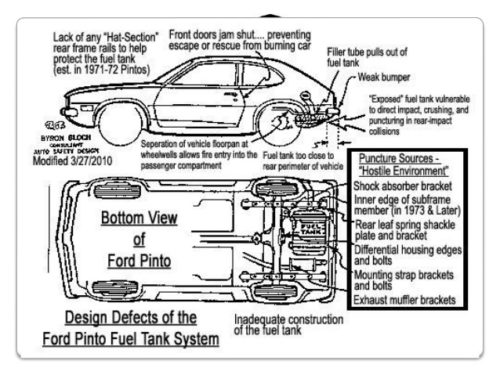
Ford perhaps more than anyone has proven this already, as they seemed shocked when journalists and lawyers began to convince Americans to care about fire risk and morality for a minute. Juries started to very clearly rule against the “last great unregulated business“.
Ford waited eight years because its internal “cost-benefit analysis,” which places a dollar value on human life, said it wasn’t profitable to make the changes sooner.
To be fair it wasn’t just eight years of disregarding the value of human life. Ford’s very existence hinged on well-documented extremist and hateful “cost-benefit analysis”. Nazi Germany even cited Ford as a man on their side, an inspiration to go to war against democratic government. Seriously, way back in 1925 Adolf Hitler mentioned only one American in his autobiography (Mein Kampf):
Henry Ford
The Americans serving jury duty eventually became so offended by evidence of Ford downplaying the significance of deadly vehicle fires (an obvious and odious failure of “self-regulation”) that punitive and even criminal charges were floated against the car maker.
Between 1971 and 1978, approximately fifty lawsuits were brought against Ford in connection with rear-end accidents in the Pinto. In the Richard Grimshaw case, in addition to awarding over $3 million in compensatory damages to the victims of a Pinto crash, the jury awarded a landmark $125 million in punitive damages against Ford…. On August 10, 1978, eighteen-year-old Judy Ulrich, her sixteen-year-old sister Lynn, and their eighteen-year-old cousin Donna, in their 1973 Ford Pinto, were struck from the rear by a van near Elkhart, Indiana. The gas tank of the Pinto exploded on impact. In the fire that resulted, the three teenagers were burned to death. Ford was charged with criminal homicide. The judge in the case advised jurors that Ford should be convicted if it had clearly disregarded the harm that might result from its actions, and that disregard represented a substantial deviation from acceptable standards of conduct. On March 13, 1980, the jury found Ford not guilty of criminal homicide.
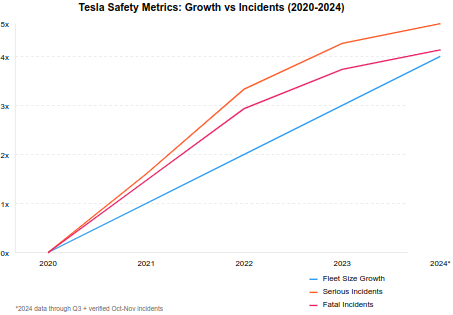
In other words the most important thing here is to not ignore any of these Tesla fires, and definitely not to falsely treat them as rare, because we have ample evidence they ARE HAPPENING MORE AND MORE GIVEN NO INTERVENTION / EXTERNAL REGULATION.
Henry Ford II, eldest grandson of Henry Ford and then head of the Ford Motor Company responded curtly. “Many of the temporary standards are unreasonable, arbitrary, and technically unfeasible,” he warned. “If we can’t meet them when they are published we’ll have to close down.” Despite these foreboding predictions, in the years since these safety measures were passed, the number of deaths from automobile accidents in the US has fallen from 5.50 per 100m vehicular miles travelled in 1966, to 3.34 in 1980. By 2015 that number was down to 1.12. Over that time, an estimated 613,000 lives have been saved. (A separate study puts the number at 3.5 million.) …well-designed regulations had the effect of helping national industries innovate and remain competitive internationally.
At the current rate the anti-regulation Tesla will perhaps end up accused of the criminal homicide that Ford escaped. Already we’ve seen Tesla owners charged with vehicular manslaughter by operating the vehicle in the manner promoted by the manufacturer, so why not bring charges for being unsafe by design?
Tesla can’t be trusted to figure this out
Here’s some speculation on why Tesla engineering is so poor and its fire problems are getting worse over time instead of better.
1. Flawed design (lack of engineering integrity)
First, the effect of the Pinto precedent on gasoline cars has been that their fires almost never tend to be due to design flaws (less than 1%). There’s tons of research on this subject already.
That very important lesson and result apparently flew out the window when product managers at Tesla dis-regulated themselves. Basic engineering principles, basic ethics, were dropped and the exact opposite happened when Tesla brought yet another electric car to market.
Since 2013 the Tesla fires ALL are going in the opposite direction of progress, and somehow seem related to design flaws, including fire from crashes (e.g. proof they ignore the Pinto precedent).
A whipsaw from 1% of tragic Pinto fires due to design flaws all the way to something approaching 100% of tragic Tesla fires due to design flaws… allegedly just because the latter car is electric should be seen as a B.F.D. in safety modeling.
Electrical fires blamed on design is a HUGE shift, a terrible indicator that something will get much worse much faster. The safety norm of designing to save lives, working since the 1980s, apparently has died in a Tesla fire. It’s like the company CEO took the exact wrong lesson from Henry Ford news.
Source: NYT
Seriously, Ford backed Hitler.
Fast forward to the allegedly racist CEO at Tesla and it’s surely no accident that Elon Musk brags “he is leaning toward backing Florida Gov. Ron DeSantis (R)” a mud-slinging hate-filled politician:
…has a clear, repeated pattern of making offensive and/or outright racist statements, hanging out with racists, and defending other people who are also racists.
In fact, this overtly racist DeSantis used his moment “hanging out with racists” such as Elon Musk to take a stab at Blacks by replying that a big endorsement from a white man who profited directly from apartheid South Africa was being recorded by his campaign as “welcome support from African-Americans”.
Awful.
Is there any real accountability for Tesla failing basic safety, under a manifestly unkind CEO, and moreover for failing to heed basic history and to save lives when others have shown how to do it? Many millions of vehicles these days are being recalled due to fire risks.
How many within the recent explosion in Tesla recalls follow a modern industry safety pattern giving the same or even similar transparency around serious fire danger?
Source: NHTSA
Any?
Read the hundreds and hundreds of complaints against Tesla, let alone the numerous investigations, where there seems to be no transparency or response from Tesla. You’ll find things like a father’s deep soul-wrenching appeal a few days ago (NHTSA Complaint #11466262), just one of HUNDREDS of people begging regulators to do something to stop Tesla disaster after disaster:
…autopsy report stated that his son died as a result of intense thermal heat and smoke inhalation.
Sad and tragic, like a Ford Pinto. But it gets worse because Tesla dealers are watching multiple cars on their lot go up in flames just sitting there. That is pretty much the total opposite of what recall safety expectations are supposed to be for design flaws.
If the dealer itself can’t even predict, detect or prevent a serious Tesla fire in a Tesla parking lot… then nobody can. A cruel death trap by design.
2. Liar, liar, car is on fire (lack of management integrity)
Elon Musk demanded that Tesla stop testing brakes on June 26. Doug Field, chief engineer, resigned on June 27. Is this a coincidence? Of course not—Doug Field doesn’t want to be responsible for killing people.
Lack of integrity is inherent to the company culture, constantly coming from the CEO. Plain and simple you can’t trust a word they say, but who gets held accountable?
Shortly after Tesla called its cars in 2013 the safest ever a Model S caught fire and there were fatalities from “veering” into opposite lane.
Another high-profile example of this is their fraudulent “autopilot”. The company often attempts to say autopilot wasn’t at fault in crashes when they know it failed. That’s because they’re gaslighting, bending truth to the point we might as well just go ahead and label them liars. There’s a persistent failure to grasp safety issues that regulators are only just starting to hone in on.
“On average in these crashes, Autopilot aborted vehicle control less than one second prior to the first impact,” the NHTSA said.
Aborting control less than a second before impact is a serious safety design flaw. Saying autopilot isn’t to blame for the impact because it aborted control is sick and twisted logic. I’ve written before about persistent lying throughout the automobile industry, as have others. Once again, the Pinto story is relevant here since Ford lied egregiously.
[Death from fire] is no news to Ford. Internal company documents in our possession show that Ford has crash-tested the Pinto at a top-secret site more than 40 times and that every test made at over 25 mph without special structural alteration of the car has resulted in a ruptured fuel tank. Despite this, Ford officials denied under oath having crash-tested the Pinto.
Any flawed design promoted by serial liars — snake oil — is bad enough. Now it gets worse. They’re actively trying to weaken regulation that would save lives.
3. Car fires always were electric (lack of social media integrity — vague safety regulation)
Third, fires in gasoline cars are often due to electrical systems.
It’s odd to hear electric car companies socialize the idea that gasoline cars catch fire, without disclosing that they’re still talking about electrical system fires. In fact, the data show electrical fires to be the second most common cause of fires.
So if you take maintenance-related fuel leaks out of the equation, electrical fires already are a HUGE problem, foreshadowing the critical need to NOT ignore Tesla’s Pinto-like design failures or treat them as rare.
Every time someone from Tesla tries to cite rate of fires in gasoline automobiles you immediately should educate them with “electrical systems are a top cause of fires in cars already yes — even gas ones — but at least some electrical design processes prioritize safety unlike yours“.
In conclusion, if electrical systems already are basically the top cause of all vehicle fires and then you add in an anti-regulation company like Tesla that removes the most important lessons of the Pinto (negligently opens the flood-gates to design-related electrical system flaws and fires)… how is this not a predictable disaster with preventable deaths?
Source: Tesladeaths.com
Nobody should drive a Tesla.
Nobody should ride in a Tesla.
This car manufacturer poses constant unnecessary danger to the public. By comparison I’d say a company like Mercedes has showed everyone how to do the right thing with a massive fleet-wide stop order to 300,000 owners.
However, even such a bold move wouldn’t be safe enough for anyone near a Tesla because its design flaws remain a threat even standing still — catch on fire while parked doing nothing.
Teslas are so unsafe by design they need to be picked up (on something that can contain a toxic re-igniting fire in transit) and returned to a place that can afford to put out incredibly resource-intensive fires en masse.
This is obviously some of the worst engineering in history if not the absolute worst. A car designed to fail.
And on that note I’m happy to drive an electric car. I’m even ok driving a gasoline car that has electric systems in it. But I do not and will not (since 2016, when my own tests proved it completely unsafe) drive or ride in something as poorly designed as a Tesla.
Professor Stevenson at the LSE, perhaps the best WWI historian in the world, has a quick note on why that war was “bad”.
The First World War was the first modern industrial war. Millions of shells were manufactured, and millions of troops were enlisted – meaning it was fought on a much larger scale than 19th century wars. It’s also an emblematic example of what is sometimes called a ‘bad war’ – one which didn’t really achieve its aims, where the casualties were far worse than expected and where the outcome was indecisive.
The Japanese used deep intelligence networks within British territory to realize rapid jungle invasion would be best on bicycles and tanks using existing roads. Note the rubber tires and how much these cyclists look like like rugged U.S. mountain bike soldiers of the late 1800s.
The February 1942 Battle of Singapore after the Malay campaign by the Japanese is perhaps the worst defeat of British arms in history. A core technology in the battle was the bicycle, used by Japanese troops in the jungle — despite having little to no prior relevant experience — to apply rapid and constant pressure in relentless pursuits of spooked defenders.
In retrospect it seems likely that if the British had been more scientific in Singaporean risk assessment (e.g. they blindly de-prioritized Malay strengh, bungled communications and lacked counter-intelligence), had the distracted British left in place any kind of competent resistance to over-confident and aggressive Japanese, then rapid assaults on Singapore might have failed.
Riding loud bike rims clustered together on confined paths into battle could instead have been a story about how it made the Japanese obvious and easy targets.
A blog post by Campfire Cycling makes a couple seemingly important psychological points about the swarm sound made by Japanese bicycles attacking at night.
The sound of a single squeaky chain, a rubbing brake pad, or a wheel rolling on the rims is bad enough. But by the dozens and the hundreds, they sounded to the beleaguered, undermanned British troops like the lightweight Japanese tanks. Time and again, Japanese bicycle infantry advanced past abandoned British defensive points. Broken-down bicycles were an unexpected psychological weapon.
This story telling is captivating. The squeaky chain definitely brings tanks to mind. Yet something else sounds slightly off in their narrative.
Set aside the fact the British had far more troops, so nobody should be calling them undermanned. Also set aside the fact that you need as few as three well-placed soldiers to eliminate a battalion on bikes. The other more nuanced errors are interesting.
Ok, just one important question about that fact before I let it go (for a minute). Wouldn’t someone realize the loud slow-moving upright clusters of bicycles on open roads made them trivial to anticipate and shoot like fish in a barrel?
Campfire Cycling analysis begs whether bikes were really intentionally broken-down or deconstructed into a louder and more resilient mode of operation and why? Was the effect of loud sounds planned, or an unexpected benefit later discovered by brash invaders?
Despite numeric superiority, the British troops were supposedly so spooked by the thought of tanks coming through the jungle that they withdrew apathetically and foolishly.
A quick check of 1920s records from the U.S. Bureau of Foreign and Domestic Commerce suggests bicycles predominantly used coaster brakes so that sound would have been familiar to defenders, for example.
All bicycles imported into the Netherlands Indies [Indonesia] have a coaster hub on the rear wheel without a braking device. […] Quotations are usually made for bicycles without tires.
Squeaky coaster brakes still could be ginned up to be some kind of “kiai” for the Japanese bicycles exported to countries they planned to invade, but there’s no evidence that squeaking brakes during attack helped them.
Chains… seriously if you can’t tell a street full of bicycle chain squeaks from light tanks, you probably don’t want to.
Likewise, official ledgers of bike imports from Japan say they came without tires, which hints at the opposite of loud rims being an “unexpected” noise. Dozens of tire-less bikes on roads in the dark was allegedly transposed into a belief tanks were coming out of the jungle, but again maybe those defenders didn’t really want to distinguish.
Element of surprise seems to be missing given small groups were bodily announcing themselves in a constrained and exposed position to attack “fortified” British.
As counter-intuitive as it sounds, it’s possible. Loudly pounding horse-shoes in a gallop and yelling “charge” brought unexpected psychological benefits during a mounted attack against heavily fortified defenses as I’ve written about here before.
A better and simpler explanation than advance planning for loud frontal assault is that Japanese Colonel Tsuji Masanobu, one of the Singapore Battle planners, had set in motion two infantry divisions equipped each with six thousand bicycles (as well as five hundred motor vehicles) to move quickly regardless of obstacles.
A violent racist and mass murderer, [Colonel Tsuji Masanobu] escaped prosecution as a war criminal with the help of American authorities and went on to work for the CIA. […] A CIA assessment judged him unreliable and ineffective.
Tsuji’s lies and arrogance served his campaign well as he stopped at nothing, throwing away the lives of his men. Tubes or not, loud metal rims or not… war crimes or not, he pressed forward. Resistance would likely have torn him to pieces. Thus among milquetoast and blind Bitish defenders lacking strategy other than withdrawing to leaky “strongholds” (compromised by Japanese informants) we can see more of why Tsuji’s reckless metal rim assaults worked.
The British sloppily sabotaged supply depots, roads and bridges in advance (instead of when bicycles were on them) to stop assault and the Japanese went through or around anyway because that’s what bicycles were known to do for decades before those roads and bridges existed. When conditions were blamed for flat tires, it was the impatient brutality of Japanese leadership that meant soldiers were expected to ride only rims.
Early battle upsets came as expected from Japanese intelligence aggressively targeting Indian Urdu-speaking troops being led by inexperienced British officers who only spoke English (experienced and competent ones had been rotated into defending the Middle-East).
I say expected because the Japanese leveraged an extensive “refined” network of informants on the ground. British weakness such as communication barriers was no secret. It’s hard to overstate in that sense just how thoroughly compromised British defensive positions were, especially given how susceptible British intelligence and communication lines were to murderous Japanese invaders who shifted local “support” (according to Tsuji).
When engaged in battle, the troops left their bicycles in the rear with a few soldiers on guard. As soon as the enemy began to retreat, our troops had to follow in close pursuit. The men guarding the bicycles would obtain cooperation of the Malay, Indian and Chinese residents of the locality to carry the bicycles forward to our advancing troops. Such bicycle transport units would be commanded by a Japanese soldier, not even understanding the languages of the mixture of races following him as he went forward carrying the Japanese flag at the head of his bicycle column. The men who trotted along the well paved roads, leading hundreds of silver wheels, were surely an army in the form of a cross for the emancipation of East Asia.
I want to highlight that such a weird pseudo-fascist perspective about achieving willing “cooperation” from locals (e.g. people being violently tortured and pressed into service) is the opposite of truth and a good example of Tsuji’s lies.
Japanese aggression in Southeast Asia was an extension of the Sino-Japanese War. Among Japanese military officers and men there was a culture of prejudice toward the Chinese and other Asian people. These attitudes had deepened following the Sino-Japanese War of 1894-95 and were embedded within the Japanese population as a whole by the 1930s. […] Clearly, then, the Singapore Massacre was not the conduct of a few evil people, but was consistent with approaches honed and applied in the course of a long period of Japanese aggression against China and subsequently applied to other Asian countries.
Back to the questions about planning for loud rims, Japan had allocated at least a couple mechanics to each company to repair flats. That does make it seem like they had intended to keep stealthy rubber rolling.
Yet obviously to an impatient liar like Tsuji the upsides ftom tire repairs (averaging dozens per day) were deemed less desirable versus driving forward on noisy metal before his strategic bluster could be unraveled. Brazen squeaky pursuit of a fast-withdrawing British line meant slowing down for repairs made no real sense.
The Malay peninsula was in fact defined by British laying down a paved road system that meant bicycles on the invading warpath didn’t need rubber to ride. The British had setup a veritable open back door into Singapore that may as well have included red carpet…. Far from being a heavily-fortified stronghold, weich the British thought they had engineered, the country was wide open to assault.
“Curiously enough, throughout all these years of bickering and indecision, it had occurred to barely anyone that Malay had over 1,000 miles of coastline, half of it exposed to Japanese attack,” writes author Arthur Swinson in Defeat in Malaya: Fall of Singapore. “It had occurred to no one either that the defence of the naval base on Singapore island was bound up with the defence of the whole Malayan Peninsula.” Or, as Churchill recalled, the possibility that the fortress would have no landward defenses “no more entered into my mind than that of a battleship being launched without a bottom.”
This sounds a lot like France thinking nobody would drive tanks through a forest, opening the door to invasion. Oops. It also sounds like the French believing hype and nonsense instead of immediately countering. A whole peninsula of roads near beaches not only helped the British in their retreat, but also facilitated the incoming attacks… on those noisy bike rims.
Because of Malaya’s intense heat, the bicycles’ tires blew out. However, the resourceful Japanese learned to ride down the paved motor road trunk on the rims of the bicycles. The sound of metal to pavement sounded like tanks and the peninsula’s defenders, notably the relatively inexperienced Indian troops who were terrified of armour, often broke for the rear.
Heat is blamed. Let me jump down this rabbit hope for a second.
Heat was certainly a known factor in local tire survival, especially given heavy loads (each Japanese soldier carried as much as 90 lbs) and of course distances traveled during the day or even night. There also may be some hidden history here if locals pressed into bike maintenance hid or sabotaged tires as a form of resistance to Japanese invasion. We have evidence of sympathizers and intelligence assets, yet not much research on the opposite.
Tire technology from before the war in any case was very unlikely designed to handle demands of any military campaign, as documented in postwar reporting.
Source: Popular Mechanics Feb 1947, pg 141
So the rims were common, and were a known sound. Inexperienced soldiers lacking command who weren’t sure what tanks sounded like (there weren’t any tanks to defend and morale was linked to the false hope attackers couldn’t use them either) is probably the real key to this story.
All that being said about the psychological effects of bike rims on pavement, it was just one symptom among devastating morale events in Singapore.
Foremost was the pride of the British Navy expected to magically protect Singapore — battleship HMS Prince of Wales — quickly was disabled and then sunk by Japanese torpedoes. That turnabout alone opens a huge topic of British strategic technology planning and decline of naval strength; risks from overconfidence in large and slow “fortress” thinking versus the “101” of agile and irregular smaller forces.
Aside from such naval mistakes, there’s also an important footnote that the British entirely missed the boat on keeping land armor ready.
Light-weight tanks landed and maneuvered by the Japanese through jungle beg a rather obvious question why Allied armor was missing in response, even though it could have been decisive. It certainly could have helped educate defenders to the real sound of tanks coming.
The British War Cabinet (believing tanks wouldn’t serve hills and jungle, let alone have the parts and crews to maintain them) transferred hundreds away from Malaya to Russia in a diplomatic lift that likely helped defend Moscow. If that sounds like France surprised when Nazis drove tanks around the Maginot line through the Forest of Ardennes, or Rome surprised when Hannibal Barca crossed the Alps for that matter… the British should have known better.
It was exactly this kind of a refocus to other parts of the world and belief in natural obstacles, opening a clear gap in exposed, mismanaged and inexperienced Singaporean defenders, that Japanese intelligence keyed on as the moment to roll.
For quick comparison to better prepared resistance, when a Japanese bicycle unit of about 300 moved on the Luzon Plain on Manila in December 1941 they were easily handled by defenders.
Filipino riflemen accompanied by American armor made quick work of Japanese cyclists as they attempted to ride into withering fire. Even as bikes scattered or turned to ride in retreat nearly all were eliminated.
Ironically the Japanese scattered propaganda leaflets to intimidate their targets from using the kind of tactics the Japanese had just been engaged in themselves.
A similar scene unfolded with Australian rifle fire from the far side of a bridge in Malay; Japanese rode up exposed and many were killed before turning their bicycles around to withdraw. At that point the Australians detonated the bridge killing the rest.
American soldiers with captured Japanese bicycle in 1944, perhaps reminding them of Army mountain bikes of 1896.
In other words the “tanks are coming” sounds generated by bicycle rims on asphalt at night is more accurately a reference to psychological warfare, exploring an imbalance of intelligence. Japanese propaganda about “unexpectedly” landed tanks for driving through jungle went unanswered…. It was outsized and uncontrolled fear of the possibilities of armor coming that thoroughly spooked unarmored defenders into falsely believing loud rim sounds alone were a reliable signal to withdraw.
a blog about the poetry of information security, since 1995