In an otherwise fascinating read about changes in Charleston, I found the following paragraph… to be inconsistent and misleading.
But it’s impossible to ignore for both white and Black Americans trying to grapple with the country’s original sin, whether they are descendants of enslaved people or those who enslaved them.
Americans could be descendants of neither people enslaved, nor people who enslaved others. In fact, as an example that never gets enough attention, why not teach Americans that they could be descendants of people who abolished and fought slavery at every turn?
The idea that a white student should feel shame about being white is perpetuating the mistake of hiding the role of whites in ending slavery. That crucial detail could change everything. Ask a classroom of white kids, which one of you had relatives who fought against slavery?
Why should any white student be condemned to always ignore the contributions of a huge number of whites who were anti-racist, who did the right things?
One of the big mistakes in teaching American history is typically to leave out the John Brown equation, let alone a Robert Gould Shaw, Silas Soule or President Grant.
Seriously, ask any American who he was. Or who was Robert Gould Shaw? What did the men of the 54th do that was so important in a Civil War about slavery?
There were many white men who fought and WON the Civil War, yet somehow being white means shutting down all discussion of these heroes instead of celebrating them. President Grant was one of the greatest military and political leaders in history. Tell white kids to look up to him when they read about slavery.
…no monies shall be used by any school district or school to provide instruction in, to teach, instruct, or train any administrator, teacher, staff member, or employee to adopt or believe, or to approve for use, make use of, or carry out standards, curricula, lesson plans, textbooks, instructional materials, or instructional practices that serve to inculcate any of the following concepts… (7) meritocracy or traits such as a hard work ethic are racist or sexist, or were created by members of a particular race to oppress members of another race…
There’s a long and sordid history of racism that calls people lazy. It’s no secret. It’s well known and often getting racists into big trouble.
EEOC alleged that African-American employees were referred to as “lazy”…
The SC government has taken court decisions about being called lazy and cooked up censorship in schools. They seem to want to prevent someone from criticizing “meritocracy” (encoded racism), or to prevent someone from criticizing “hard work ethic” traits (encoded racism).
Their point seems to be if racists aren’t allowed to directly call some race lazy then those racists will write laws that protect the ability to say that racism is a meritocracy, and that racism is just proof of a hard work ethic.
See the problems? It’s basically a gag rule that prohibits calling out racists for being racist.
…racist policies were leading to racist ideas, and racist ideas were leading to ignorance and hate. I realized people were creating racist policies out of economic, political and cultural self-interest. And those racist policies were leading to racial inequalities, disparities and inequities.
Saying someone is superior is an inverse of saying someone is inferior. White supremacists are inherently racist. So if policies are written to protect superiority language, even prohibiting calling it racist… that’s still racist.
Racists play some long and complicated games, you have to admit. But maybe people getting more and more interested in the slavery history of America, let alone the genocide, will help push through the nonsense.
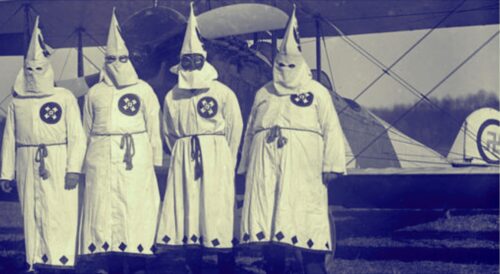
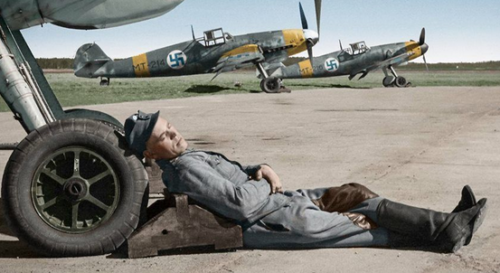
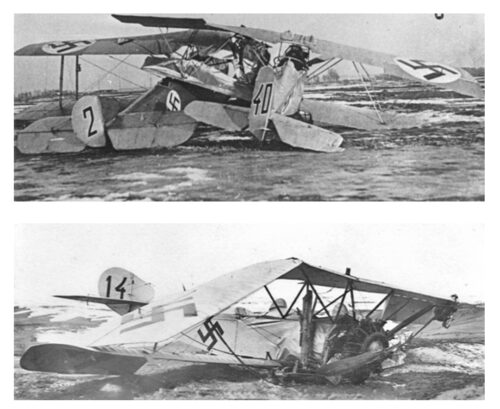
The KKK in 1921 had a new look. They started wearing white robes in a plane with the swastika, both symbols of hate. Bi-planes for example were used to firebomb Black neighborhoods in Tulsa, Oklahoma and to drop racist propaganda leaflets across America. Here you can see how and why the swastika was chosen, just like the Finnish Air Force.
Eric von Rosen had no Nazi associations at the time of his 1918 gift, he did subsequently become a leading figure in Sweden’s own national socialist movement in the 1930s. He was also a brother-in-law of senior German Nazi Herman Göring, and, according to Prof Teivainen, a personal friend of Hitler.
His noble gift, before Nazis and before Hitler, was somehow completely consistent with both him becoming a Nazi and personal friend of Hitler. In other words in 1918 he likely associated with the violent hate groups using swastikas that very soon after became the Nazis, but I’m getting ahead of myself.
When he gifted a plane to the nascent air force of Sweden’s newly independent neighbour in 1918 he had had a blue swastika painted on it. This Thulin Typ D was the first aircraft of the Finnish air force and subsequent planes all had his blue swastika symbol too, until 1945.
Of course historians describe how anti-Semitic Polish, Austrians, Germans, and Romanians referenced the swastika before (and after) WWI to symbolize hate. Consider the “volkisch” Runen, for an easy example of what Rosen might have been consorting with or around.
“Before Hitler Came”: Thule Society and Germanen Orden
Who is to say Rosen wasn’t pushing the swastika into Finland because it was anti-Semitic? Hitler brought fringe hate symbolism to the main political stage, yet he wasn’t alone in that putsch by any stretch. A pre-Nazi, pre-Hitler swastika used by Rosen still in fact easily qualifies, especially for a government asset, as intentional hate messaging. “Before Hitler” is basically tone-deaf.
Some suggest non-German antisemitism such as Romanian A.C. Cuza (1857-1947) copied use of the swastika from Heinrich Kraeger (1870-1945), when in fact it might have been copied from the anti-Semitic Swede Eric von Rosen (1879-1948).
Finland had denied citizenship to Jews until 1918 when it finally allowed “applications”, which apparently did not sit well with Rosen. Perhaps it was his offense at the Paris Peace Conference “Minority Treaty” negotiations, which drove a desire to make antisemitism into an official government symbol (Finland wasn’t asked to sign the treaty). Romania was the only slower country among European states to allow Jewish residents to become citizens (1923). And on that note, Romania’s overtly anti-Semitic National Christian Union (formerly the Christian National Democratic Party of 1919) adopted the swastika as its official symbol in 1922, eerily similar to Rosen’s timing and intentions: a “good luck talisman of victory for the endangered Aryan race”, which Hitler also said.
1922 Romanian LANC hate group text: “Good luck talisman, bringer of victory to the endangered peoples of Aryan origin”. Source: Internet Archive
The next time anyone tells you that Rosen naively thought a swastika was “good luck”, remind them that’s exactly what antisemitic propaganda was pushing so he was actually right on message for promoting Nazism (which he then supported). Seems pretty obvious how and why both Rosen/Finland and Cuza/Romania swastikas should be seen as related, which is why it’s so odd that anyone in Finland could be asleep at the wheel on this issue.
Dangerous racist hate groups using a swastika as their symbol since the 1800s? Threat clearly rising in 1918? What threa-zzzzzzz
In other words, Hitler’s work was a culmination not a beginning. He drew from rage and hate sentiments swirling around him far more than he ever came up with things whole cloth. His Nazi color scheme idea was taken from the Imperial German flag (1871–1918). That’s a notable period because 1871 also was when Germany abruptly became introduced to a sensationalized swastika.
German nationalist groups like the Reichshammerbund (a 1912 anti-Semitic group) and the Bavarian Freikorps (paramilitarists who wanted to overthrow the Weimar Republic in Germany) used the swastika to reflect their “newly discovered” identity as the master race.
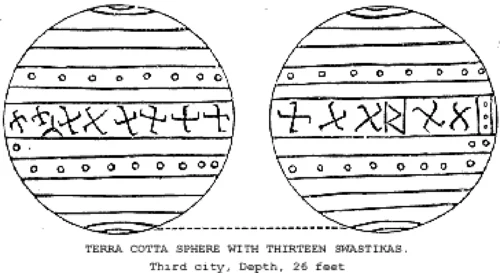
The basis of the Nazi Swastika is this “X” decoration unearthed in 1871 by a German archaeologist. Source: Smithsonian
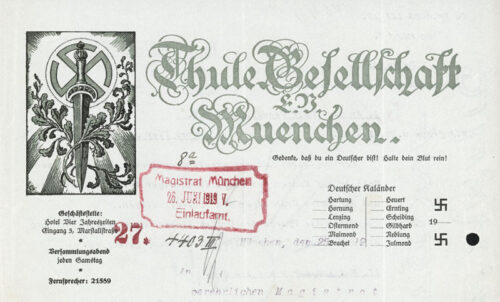
Even a 1912 Reichshammerbund swastika reference seems late, given it had spun out of a 1902 group (swastikas already being spread as “master race” anti-Semitic symbols by then). By 1916 the Germanenorden hate group published a newsletter with a swastika with a superimposed cross for its cover page, and then in 1918 spun out a violent anti-Semitic anti-revolution Thule-Gesellschaft (TG). TG leaflet of August 1918 lays bare the meaning of swastikas. Source: Historisches Lexikon Bayerns
Led by Rudolf von Sebottendorff (1875-1945) TG drove heated political rhetoric and violence after the 1918 fall of the monarchy, a foundation for the National Socialist (Nazi) movement. The TG symbol was the anti-Semitic swastika with the WWI “Dolchstoßlegende” knife, and their greeting was “Sieg und Heil”. Eric von Rosen likely was observing if not involved in Rudolf von Sebottendorff’s extreme-right group, which is the most sensible explanation for why antisemitic swastikas were painted into Finland’s Air Force.
Thus, Hitler’s use of an 1871 color scheme along with an 1871 “racist luck” swastika in his “make Germany great again” propaganda flag, were referencing hateful symbolism that had been in place long before 1918.
It’s similar to how “America First” was a racist, nativist slogan of the late 1800s in America, then became a Presidential campaign in 1916 (to restart the KKK), and then became a Presidential campaign in 2016. Hitler’s swastika was from racist thinking generated from 1871, not some kind of invention or abrupt change. Rosen surely was not far removed from all this context given he would have grown up with the anti-Semitic use of the swastika and knew such prominent connotations just like Hitler.
To put it bluntly, as a Finnish artist explained in 2014, it’s no coincidence by 1918 that Rosen, Hitler and others were all spreading a swastika around as symbolic of hate. Rosen wasn’t really before Hitler at all; they used it at the same time for basically the same reasons, and they knew the swastika was anti-Semitic by 1918 just the same as by 1945.
The meaning of the sign as a symbol of anti-Semitism and therefore the Aryan, has an uninterrupted continuity from the 1880s to the Nazi-swastika. Famous orientalist and anti-Semite Emile Burnouf wrote to Schliemann as early as 1872: “the swastika should be regarded as a sign of the Aryan race. It should also be noted that the Jews have completely rejected it.”
Therefore in 1925 when Hitler wrote that his “good luck” swastika “always has been and always will be anti-Semitic”, he was drawing on at least fifty years before him of that being the case. Rosen knew what was going on in European circles, just like Gallen-Kallela in 1889 probably copied his symbolic swastikas from the antisemitic work of Zmigrodski. After all, Professor Muller of Copenhagen was at that time meeting with Zmigrodski to promote a racist discourse that a “swastika was the emblem of the supreme god of the Aryan race” — symbolized “luck” in selection, exclusion and opposition against “unclean” races.
Fast forward to today and Finland is slowly getting around to noticing they often still use the intentionally symbolic anti-Semitic swastika after long denying its undeniable symbolism.
In related news from 2022, Finland has an antisemitism problem:
On her recent visit to Finland, the EU’s antisemitism watchdog Katharina von Schnurbein pointed out that neither the authorities nor the general public in Finland is fully aware of lingering anti-Semitic sentiments. Her claim was based on a survey according to which one in two Europeans sees antisemitism as a problem in their home country. That number was just 17% among Finns. […] Antisemitism or denying the Holocaust are not listed as criminal acts in Finland.
What swastika? Where? They do Nazi the swastika.
Or maybe they really don’t like Jews in Finland, given their acceptance of widespread antisemitism. In related news from 2023:
Jewish politician in Finland allegedly assaulted and hit with antisemitic slurs.
Allegedly this antisemitic assailant was easily caught and arrested because he was wearing… swastikas. So it kind of makes sense for their air force to stop using them.
For those still trying to argue that a swastika somehow was a generic “luck” symbol of early 1900s instead of racism… I have many reasons why that’s just plain wrong (pun not intended).
Here are two excellent ones. First, by 1920 the ill-fated Latvian Air Force had proven without a doubt the swastika was very bad luck.
Latvia made the mistake of using a racist bad luck swastika for their Air Force symbol.
Second, show me any other GIANT luck symbol, anything of the kind, being painted on planes in the same manner. There’s no such universally symbolic charm. Paint was expensive and mystical symbols of luck had no need for such expense or even big exposure. Racism, however, does love an expensive and huge symbol. Burning crosses was too obvious and dangerous, and instead the racist late-1800s swastika became “popular” among the early-1900s racists.
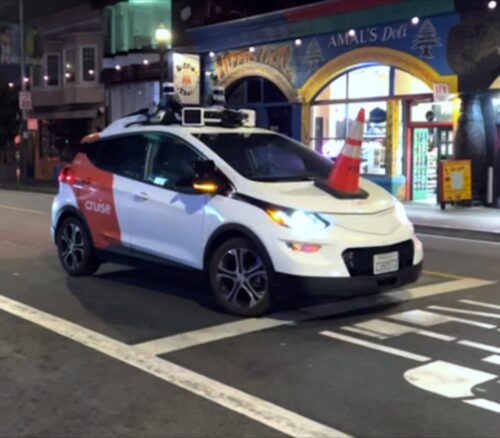
Calling it their “Week of Cone”, residents of SF reduced the threat to the city from renegade “driverless” vehicles by gently placing a traffic cone to completely shut them down. It had all the hallmarks of the extremely successful SFMTrA movement of 2016.
As you may recall, Tesla’s “driverless” software back in 2016 murdered two drivers and then in 2018 murdered a pedestrian. That’s right, TESLA MURDERED A PEDESTRIAN. Did you hear about it? Lawyers worked really hard to keep it very quiet. Their unsafe bug-riddled software since then has been implicated in over 30 deaths and appears only to be getting much worse. Lately it has been “veering” dangerously into poles, trees and late at night into houses like an explosive cruise missile to murder people sleeping in their bed.
Who really wants the “hellscape” required for “driverless”?
Density is too low for anything other than driving to work well, every residential street is too wide, the non-residential roads are all multilane arterials with turning lanes, and every destination is surrounded by a vast parking lot. If that’s what you have to create for autonomous vehicles to work, it’s a Pyrrhic victory. It’s not worth it.
Oh, and by the way, Uber also killed a pedestrian in 2018. Unlike Tesla, however, after that they completely cancelled their “driverless” assaults on public safety.
Speaking of Cruise, the “driverless” company by that name seems to be taking the SF “saftey test” of cones way mo’ gracefully than some angry bro at WayMo.
“Not only is this understanding of how AVs operate incorrect, but this is vandalism and encourages unsafe and disrespectful behavior on our roadways,” a Waymo spokesperson told SFGATE in an emailed statement. “We will notify law enforcement of any unwanted or unsafe interference of our vehicles on public roadways.” A spokesperson for Cruise pointed to several charitable initiatives by the company and said that “intentionally obstructing vehicles gets in the way of those efforts” and “risks creating traffic congestion for local residents.”
LOL.
I would say the precise cone placement in fact shows someone has a very clear understanding of how AVs operate. WayMo on the other hand generally doesn’t seem to understand at all how urban society operates.
WayMo’s spokesperson sounds downright unstable and untrustworthy. Vandalism? Wat. Traffic cones are unsafe and disrespectful? Wat. We will notify law enforcement there is a safety cone on our hood? Wat wat wat.
“I scream cone!”
Is WayMo planning to call police for every insect on their windshield, while they’re at it? SFPD surely is fully funded to open an entomology department to investigate all these “driverless” bugs. Taxpayers will love that.
SFPD can’t even keep up with organized crime smashing car windows over 300 times a day, I’m sure they eagerly await robocalls about a traffic cone placed on a hood.
Seriously, do WayMo staff still live in a pot-filled Stanford dorm room?
WayMo seems to have trained their spokesperson in the 1984 Orwell school of techbro agro doublespeak (also known as Stanford bro-talk).
First of all, by definition the very concept of WayMo is far more the act of vandalism.
Gregoire coined the term in reference to incoming Vandals destroying old ways of doing things. He spoke of the destruction of works of art during the French Revolution. While Raphael and Dryden earlier had mentioned Vandals destroying works of art, Gregoire gets credited for calling out generalized social “vandalism”… such as WayMo.
By definition a ruthless and forced introduction of driverless cars into the historic networks and art of pedestrian paths makes WayMo the obvious invading Vandals in this scenario.
Second, traffic cones are safety devices that demand respect. It’s fascinating to see an obviously unsafe and disrespectful product company such as WayMo take aim at traffic cones as a problem.
I mean let’s be honest. WayMo is unsafe because they are notoriously failing at respect for traffic rules.
Will they now dump millions into government lobbying to make traffic cones illegal to cover for their failures? Will WayMo cars have a big sign “sitting macht frei” on their roof?
Being a pedestrian was criminalized by the Nazi-loving American car companies of the 1930s, so probably we shouldn’t be surprised if “driverless” brands see a “solution” here as making all traffic signals illegal. Can’t fail if you embrace permanent improvisation doctrine and destroy law and order, right WayMo Goebbels?
A bright orange reflective traffic cone is making the street “unsafe” for them? Come on. That’s like WayMo arguing that they are angry the rain falling on them is too dangerous because it’s so dry.
Bottom line is this proves yet again the completely nonsensical thinking at “driverless” companies. Let’s look at the doublespeak.
They say they will make roads safer, while causing unnecessary crashes including fatalities.
They say they will make riding in cars more relaxing, while freaking out if anyone dares to relax in their vehicles.
They say traffic will flow better with automation, while causing constant traffic jams and disabling or delaying emergency services.
Failure at every level, more than enough reasons to regularly drop a safety test on them.
And we haven’t even gotten yet to the stupid and simple engineering failures related to a cone placed gently on a hood.
Why does a “driverless” car even have a hood? What a total design failure. Start there!
At some point people will finally realize “driverless” cars are just the bell bottom pants of urban transit. A car? A CAR? Who thought a car(riage) would help with anything, the King of France?
Cars without drivers are a hugely inefficient waste of resources, a failure of basic thought, and more significantly perhaps a giant fashion mistake. You should no more want to be seen in an Orwellian WayMo than in a pair of skin tight shiny silver BeeGee pants dragging through dog poop.
In other words, everyone get way mo’ cones out and stop the Vandals from destroying the historic art of urban transit. If these cones don’t affect human drivers, WayMo has nothing to complain about.
Toyota’s recent announcement regarding their solid-state batteries has caused a stir in the electric vehicle (EV) market, with the company positioning itself as a front runner in revolutionizing the industry. The credit for this breakthrough largely goes to Panasonic, as acknowledged by Toyota’s PR team.
Toyota is developing the solid-state batteries through Prime Planet Energy & Solutions Inc., a joint venture with Panasonic that started operations in April 2020…
By 2027, they aim to have solid-state batteries in production cars, a timeline that has impressed many observers.
A trip of 700 km on one charge. A recharge from zero to full in roughly 10-15 minutes. All with minimal safety concerns. The solid-state battery being introduced by Toyota promises to be a game changer not just for electric vehicles but for an entire industry. The electric vehicles being developed will have a range more than twice the distance of a vehicle running on a conventional lithium-ion battery under the same conditions. All accomplished without sacrificing interior space in even the most compact vehicle.
The success of a Japanese automaker leading global EV innovation should be no surprise, considering historical circumstances that have pushed them towards producing high-quality, modern EV engineering. Following WWII, with a necessary emphasis on using existing hydro-electricity (given oil refineries destroyed), Japanese war factories were repurposed under US occupation to develop early expertise in EV production. The amazing 1947 “bomb bay” hot-swap battery Tama EV is a perfect example:
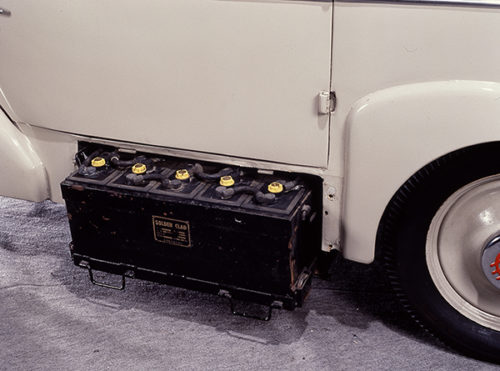
During the 1940s’ switch to a peacetime economy, around 200 Tachikawa Aircraft employees moved to the newly established Tokyo Electro Automobile Co. Ltd., which embarked on the development of an electric car with “bomb bay” hot-swap batteries. One reason for this was the extreme shortage of gasoline at the time (infrastructure bombed by Allies) yet a surplus of electricity from hydro-power. In 1947, the company succeeded in creating a prototype 2-seater truck (500-kg load capacity) with a 4.5-horsepower motor and a new body design. It was named Tama after the area where the company was based.
While Nissan is often recognized for launching the first modern mass-market EV with their 2010 LEAF (not including their 30-year innovation cycle that produced earlier models like the 1980s Lektrikar or the 1950s Tama), Toyota’s recent announcement suddenly positions them one step ahead, with solid-state batteries expected to reach mass production in 2028.
Collaborating with Panasonic has played a crucial role in Toyota’s progress, leveraging expertise in laptop engineering, to further cement both as premier electronic innovators. Many people are unaware that the real technological innovation found in Apple Air laptops could be traced back to Panasonic’s Toughbook, which usually hit the market two years earlier.
Honda, too, has plans to introduce solid-state batteries, likely trailing behind Nissan. Their expected timeline aligns with other global players like the United States, Germany, Taiwan, and Korea. Ford, BMW, and Hyundai are represented by Solid Power. Mercedes and Stellantis are part of Automotive Cells using ProLogium batteries. Volkswagen and several other EV manufacturers are represented by QuantumScale. So everyone who matters in car production clearly has been shifting towards solid-state battery innovation.
That’s why Toyota’s partnership with Panasonic and their surge ahead of other Japanese EV makers is the first sign of a significant triumph. Surpassing EV industry-leading Nissan in this regard is very noteworthy.
The second indication of a triumph lies in the global shift of Panasonic’s innovative prowess and production capacity back to Japan, away from cars known more for an over-cooked “fit and finish” lifestyle brand of California or cruel inefficiencies and tax-avoidance of Texas.
On that note, Toyota’s leap ahead of Nissan should probably be attributed to an early recognition in 2012 of obvious safety design failures of Tesla. The predictable dangers (which have been repeatedly proven true, given over 70 people killed from Tesla fires alone) prompted Toyota management to prioritize battery safety and embark on an ambitious journey. Their hybrid-engine Prius positioned them sufficiently in competition with early EV models such as the enormously successful Nissan LEAF — best-selling EV in the world until 2019. Toyota meanwhile quietly filed thousands of EV battery patents, and publicly expressed interest in hydrogen as an alternative future (perhaps to distract from their quiet commitment to an EV battery revolution).
A close examination of Toyota’s recent battery-focused PR campaign reveals a deliberate emphasis on travel distance, charging time, and safety, while conspicuously avoiding discussions of accident-causing quick acceleration or selfish track performance.
This marks a significant departure from the ex-Tesla engineers at Lucid, for instance, who have been fixated on record-breaking battery distances and track times. Neither of these metrics improve quality of life. Toyota is instead looking into key economic measures that have long aligned with traditional Japanese EV sensibilities as firmly set by American occupation after the 1940s.
The ability to spend less time charging batteries, longer intervals between charges, and risk avoidance take precedence for engineers thinking about improving the world. Stellantis Fiat (perhaps keying into the post-WWII sentiment of Italy) has effectively capitalized on these values through compelling advertisements, contributing to the success of their low-stress, small and dependable EV model.
The rapid and high-quality innovation witnessed in Japanese manufacturing since 1948 also draws parallels with Germany’s experience during the US military occupation, which compelled them to balance manufacturing speed with respect for humanity. Today it should not be overlooked that Japan, Germany, and even Italy largely reflect sensible global goals for what matters most in EVs, in stark contrast to Tesla’s misguided approach.
The South African-led racist “California” company trying to avoid or game regulations of any kind has prioritized low-quality, extreme acceleration in a straight line over other crucial factors, including safety, resulting in an alarming number of fatalities. It seems Tesla failed history 101 and instead embraced a childish fantasy of spaghetti westerns and white male domination, making them inherently and always one of the worst car companies to ever exist.
Tesla has faced repeated accusations of anti-competitive dishonesty, boasting about technologies they have failed to deliver and concealing significant design flaws that degrade their overall quality.
Recent revelations have even implicated the notoriously anti-worker Tesla in employing cheap, undocumented Polish labor to staff up German factories as leadership struggles to maintain control over its expansions into Asia.
Alleged flyer that Tesla has been handing out to workers in its German factory warning them of death penalty for drinking water, taking breaks or refusing orders.
It is notable that Tesla’s last real innovation occurred around 2012 when they angrily coerced Siemens, a German engineering firm, into constructing a factory to assemble Panasonic’s Japanese innovations into an unnecessarily powerful “S” sedan.
Their Model X was minor changes to make an SUV from their S. Their Model 3 was minor changes to make a smaller, cheaper S. Their Model Y repeats the X again and starts from the 3.
What’s that spell? S X 3 Y, because they spent more time thinking about how to get away with making dumb jokes for their own amusement than taking basic engineering steps required for hard work and innovation.
No wonder tech debt and defects are piling up faster and faster from increasingly less well made versions of the same thing.
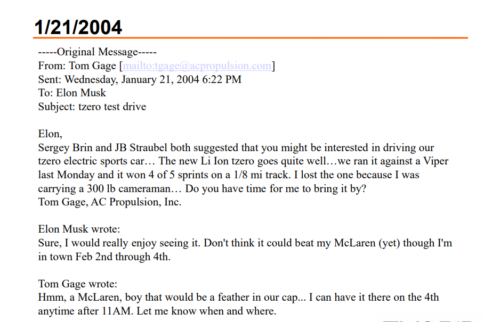
Tesla’s innovation arguably peaked much earlier back in 2004 when the actual Mr. Tesla (Martin Eberhard) funded the AC Propulsion tZero conversion to lithium-ion batteries, and “forced” Lotus to do the hard work of achieving DOT, NHTSA, and FMVSS approval.
“I got the impression he just wanted to learn as much as he could,” said Tom Gage, who was president and CEO of AC Propulsion at the time. “So he started helping us out. He put some money into the company. And that’s the time when we were converting the tzero to lithium-ion, and he copied us on that.” AC Propulsion had loaded the tzero with lithium-ion batteries and it seemed to be working. […] “That was when we sort of had a showdown. Martin said, ‘I want to buy one.’ And I said, ‘We can’t, we’re not going to build anymore.’ And he said, words to the effect of, ‘Well, if you won’t build me one, I’ll start my own car company. That’s how Tesla got started.”
How Tesla got started took a sudden extreme right turn when unjustly-enriched unfocused and jealous man took delivery of a McLaren — shortly before he crashed it — and then jumped at the next flashy thing.
This kid ran like a cheating husband out of his uninsured $1m gasoline wreckage into the EV space, without understanding anything about anything other than corruption of power, all because his first love was beaten at the track by a tZero: Source: “Tesla’s Little-Known Prehistory”, Autoweek, 1 Mar 2021
Consider this: 2004 was basically twenty years ago, and yet Tesla has become less desirable than ever. Their increasing frequency of failures and lawsuits necessitates the production of more new cars, each plagued with numerous problems. Junkyards are filling up with Tesla vehicles that can’t even reach 10,000 miles. Owners report rejecting delivery multiple times before finally accepting a car that is still marred by design flaws despite its exorbitant price tag.
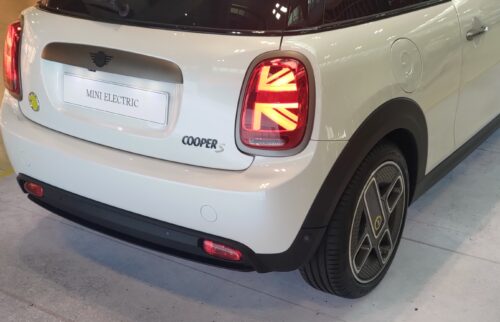
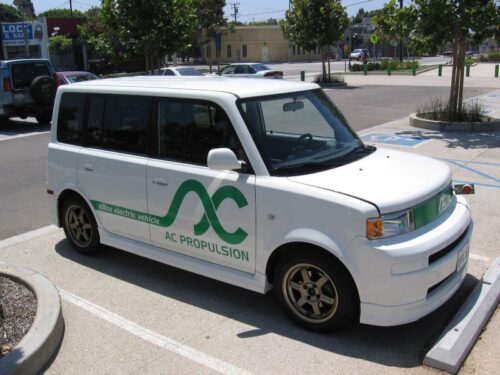
The high-quality manufacturing standards of a MiniE are easy to seeThe AC Propulsion eBox, a $50K Scion xB conversion kit announced August 18, 2006 that installed a 35-kWh battery using 5,300 Li-ion cells arranged into 100 blocks of 53.
It is worth noting that Panasonic continues to manufacture batteries for Tesla, yet the latter remains eerily silent regarding their solid-state battery plans. Tesla, known for prematurely announcing breakthroughs and seeking the spotlight with egregious lies, has chosen not to address this crucial aspect.
Everyone surely knows by now that Tesla boasting about achieving 300 mile battery range was based on an actual range of 150 miles. Tests repeatedly proved them shameless predatory liars. Money was spent on lawyers and propaganda, information warfare, as the technology was ignored.
Without fraud there would be no Tesla.
Thus, two developments represent significant victories for Toyota: surpassing the highly skilled team at Nissan with sold-state reaching production first, and effectively dealing a huge blow to faltering fraud of a notorious EV clown show. How soon before a free trombone is included with every Tesla?
The outcome has surprised some observers, in a masterful long-term strategic move by Toyota.
It remains to be seen whether Toyota will join forces with Panasonic also to announce a retrofit solution, enabling existing EVs to upgrade to new battery technology. Such a concept aligns with Mr. Tesla’s (Martin Eberhard) initial vision when he founded his company, before he was cruelly ousted by the current toxic charlatan Elon Musk, a tinpot dictator notorious for an obsession with power that has him disseminating Hitler memes through a centralized propaganda platform.
History has an uncanny way of coming back around, and Tesla now finds itself as irrelevant and stuck in the past as the Nazi Tatra, repeating old lessons along the way.
Toyota’s leapfrogging of Nissan and their decisive action against Tesla should not be underestimated. If you are considering purchasing an EV, it is imperative to choose a brand that has made solid-state battery commitments.
a blog about the poetry of information security, since 1995