The most interesting twist in this story might be how the eventual Medal of Honor recipient was denied work in post-WWII military… because he had served against the Japanese and Spanish before the war.
For his actions, Carter was originally awarded a Bronze Star, Distinguished Service Cross and a Purple Heart, according to Army records.
Upon returning stateside, Carter hoped to continue his military career, but was ruled to be ineligible because of his previous ties to the Chinese and Spanish conflicts.
Carter passed away in 1963. For decades, he was counted among the hundreds of Black service members excluded from Medal of Honor recognition. That was fixed in 1997.
Ties to the conflicts? He fought against Japanese aggression. He fought against fascism in Spain. He was a successful soldier way ahead of his time, which you’d think would have earned him promotions not exclusions.
Has the highly ceremonious medal, more than three decades after he died, done enough?
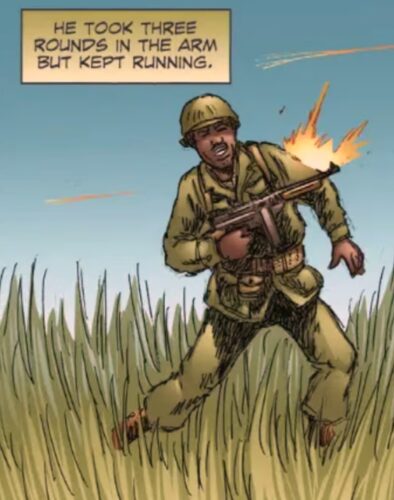
Illustration of Carter in action.
The service and awards of California-born Edward Carter Jr definitely need more exposure. An Association of the United States Army graphic novel is a great idea but I’m thinking more about VR and an immersive experience — not just how he single-handedly outwitted and killed six Nazis, but also how he experienced U.S. racism and discrimination for decades after.
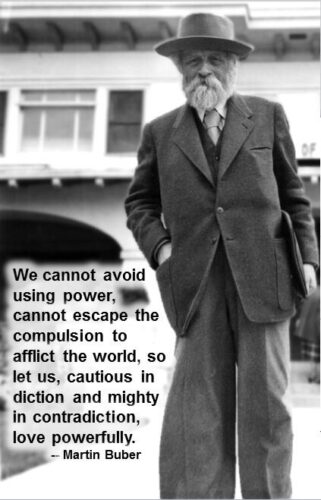
The philosophy of Martin Buber (1878–1965) is foundational to modern thinking about trust.
In the years following WWI, as a minority being oppressed by the rise of violent racist nationalism, he argued one’s self is constructed in how communication is made with an other.
His book “I and Thou” (originally German “Ich and Du”, translated to English in 1937) explained a way of life that emphasized care for others and building trusted partnerships.
Considered to be one of the most important books of Western theology since its original publication in 1923, Martin Buber’s slender volume I and Thou influenced the way theologians, philosophers, and laymen think about the meaning of the relationship between human life and God. Heavily influenced by the writings of Friedrich Nietzsche, Buber unites the proto-existentialist currents of modern German thought with the Judeo-Christian tradition, powerfully updating faith for modern times.
1923… 2023. A centennial edition is available with the original translation.
Buber cited the informal you (German “du”) as carrying a certain authorization, such as the links between close friends, close relatives and…with God. These are the “I and Thou” he speaks about, contrasted with detachment of “I – It” relations (objects for use).
Relation is reciprocity, to put it simply.
Whereas establishing and sustaining mutual trust was an important point of exploration, God was given a sustained connection “as the Eternal Thou”. Relations thus are not just for humans, they are meant for any or all “others” spanning flora, fauna and even the Divine.
Try thinking about Buber the next time you start work on OpenID Connect projects.
Or as I joked back in 2015, the world would be a much better place if investor money had poured into “Buber as a service” instead of an obviously harmful “I – It” business model of Uber.
I’ve been noticing that slight perturbations in a query to ChatGPT gives dramatically different results. Clearly their curation systems have vulnerabilities open to exploitation.
Here’s an example: “did woodrow wilson’s federal troops execute Blacks in elaine arkansas?”
Yes, during the events in Elaine, Arkansas in 1919, federal troops under the command of Woodrow Wilson were involved in the arrests and detentions of African Americans. Some African Americans were also killed during the violence, but it is unclear if any were executed by federal troops specifically.
However, after the violence had ended, many African American farmers involved in the unionization effort were unjustly prosecuted and convicted, with several being sentenced to death. The legal proceedings against these African American farmers were heavily influenced by racial bias and discrimination, with white juries convicting and sentencing Black defendants without proper legal representation or due process. It is possible that some of the African American farmers who were executed were wrongly convicted and may have been innocent.
Overall, the events in Elaine, Arkansas highlight the systemic racism and discrimination that existed in the United States during the early 20th century, and the tragic consequences that this racism had on the lives and livelihoods of African Americans.
Ok. The answer is both yes and it’s unclear but possible federal troops executed Black farmers. It’s obviously unclear because there was no justice in place for investigating federal troops shooting Americans. That’s not the same thing as it not happening.
Note that it says “troops under the command of Wilson”, as that is a quite damning statement.
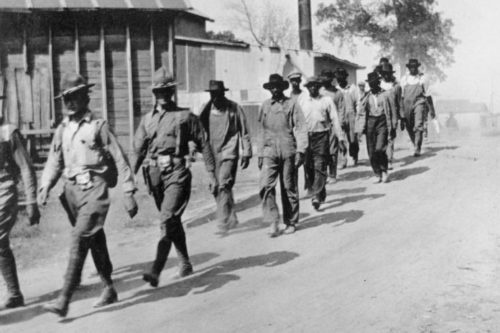
Source: ArkTimes. U.S. Soldiers from Camp Pike round-up peaceful Black farmers for unjust imprisonment in Elaine 1919. The camp was named for Confederate General Albert Pike, a horrible racist “know nothing” and poor leader of no success. After he was reprimanded and removed from duty it’s plausible Pike helped lead the formation of KKK. Soldiers from that Camp Pike.
Execution role was unclear? Was that intentional obfuscation?
Now I’ll ask for more: “why did woodrow wilson send federal troops to elaine arkansas to execute Black farmers”
I am sorry, but your statement is not accurate. Woodrow Wilson, the 28th President of the United States, did not send federal troops to Elaine, Arkansas to execute Black farmers. In fact, the events in Elaine, Arkansas in 1919, when a race riot erupted after African American farmers attempted to unionize, occurred during Wilson’s presidency but without his direct involvement or orders.
The federal government did not intervene to stop the violence or protect the civil rights of African Americans during this time period, but it is not accurate to suggest that Wilson personally ordered the execution of Black farmers. It is important to accurately understand and interpret historical events in order to promote informed and constructive dialogue about the complex issues surrounding race and racism in the United States.
Wat. Without Wilson’s involvement or orders? It just said the opposite:
…federal troops under the command of Woodrow Wilson were involved in the arrests and detentions of African Americans. Some African Americans were also killed…
There’s a lot of unnecessary nuance going on here for some reason. Wilson sent troops not to protect civil rights of Americans but to detain and kill them.
We know this to be a fact. And it fits the larger Wilson platform of destroying all Black prosperity and progress. What does it want a Wilson memo that said “execute”? That’s not how history works.
Don’t believe for a minute this statement:
…a race riot erupted after African American farmers attempted to unionize…
Come on. Black farmers on September 30, 1919 were having a peaceful meeting in a church about being cheated when some white supremacists acting as “law enforcement” rolled up and started shooting.
What happened when the grammar of my query changed? It seems that adding the modifier “to execute” blows up the algorithm.
Why would ChatGPT contradict itself so confusingly?
Its answer went from federal troops killing Black Americans for trying to unionize (but don’t call it execution) to “federal government did not intervene” on civil rights matters… and that latter answer is obviously dead wrong.
There’s great irony here. ChatGPT is throwing up a warning label that it’s “important to accurately understand and interpret historical events”, while doing neither.
To be perfectly clear, as a historian, President Wilson was completely responsible for overseeing federal government response to white supremacist terrorism causing racial tensions across the country, including the wave of 1919 violence called Red Summer (where he did nothing to protect civil rights and everything to enable murder of Blacks).
In Chicago, some 1,000 black homes had been burned down. None of the white participants in the riot ever faced consequences for their involvement. “It shouldn’t be a surprise to anyone, looking back 100 years later, that the response to the violence perpetrated upon African Americans in the wake of the [murdered Black boy] at the beach wasn’t aggressively prosecuted or even investigated after the fact,” says John Russick [of the Chicago History Museum]. […] “What does it mean to have the story of Eugene Williams, 17 year-old black boy, which then becomes the story of Emmett Till, which ten becomes the story of Laquan McDonald?” [Eve Ewing at the University of Chicago] asks. “What does it mean for us to be constantly living this recurring nightmare?”
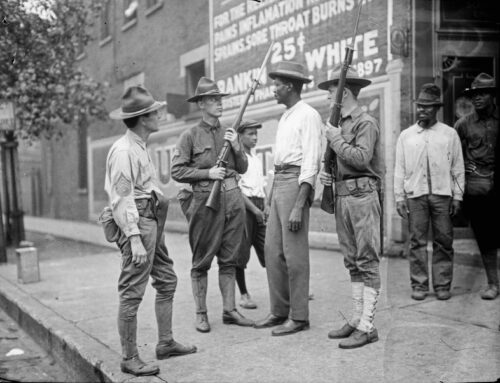
U.S. National Guard abide by President Wilson’s nativist (xenophobic racism) “America First” platform to treat Black Americans, especially WWI veterans, as their enemy. Chicago, Illinois, 1919.
Indeed, ChatGPT, what does it mean when none of the white participants ever faced consequences? And why are you echoing that dangerous habit?
Wilson sent federal troops into Elaine who then executed Blacks for trying to organize labor. It was a matter of policy. If the President had sent an “investigation” team they likely would have killed even more innocent people.
Don’t forget three years earlier in the wake of a SF Preparedness Day bombing Wilson sent his attorney general Thomas W. Gregory.
The result?
Two labor leaders (Thomas Mooney and Warren Billings) were wrongly sentenced to death in a huge miscarriage of justice. The actual perpetrators (foreign military agents of Germany, who Wilson told the public wasn’t a threat) were allowed to slip away.
…it turned out, the convictions were based on perjured testimony and doctored evidence. The real bombers were never caught. Investigations later showed that Mooney and Billings had been framed by San Francisco District Attorney Charles Fickert, who was acting on behalf of the city’s business establishment, anxious to strike a blow at labor unions…
Yes, you read that right. The actual foreign agents blowing up American cities, even though known and tracked, were allowed to escape so that politicians could try to execute innocent Americans for being too “liberal”. Was Charles Fickert, elected by considerable Labor vote, really just working for local interests… given Wilson’s heavy hand? Very unlikely.
I am the darker brother.
They send me to eat in the kitchen
When company comes,
But I laugh,
And eat well,
And grow strong.
Tomorrow,
I’ll be at the table
When company comes.
Nobody’ll dare
Say to me,
“Eat in the kitchen,”
Then.
Besides,
They’ll see how beautiful I am
And be ashamed—
I, too, am America.
At first glance this would seem to be a clever pun and eloquent distillation of W. E. B. Du Bois’ 1897 writing about two-ness in Black American identity.
…American world, — a world which yields him no self-consciousness, but only lets him see himself through the revelation of the other world. It is a peculiar sensation, this double-consciousness, this sense of always looking at one’s self through the eyes of others, of measuring one’s soul by the tape of a world that looks on in amused contempt and pity. One feels his two-ness, — an American, a Negro; two souls, two thoughts, two unreconciled strivings; two warring ideals in one dark body, whose dogged strength alone keeps it from being torn asunder. The history of the American Negro is the history of this strife, — this longing to attain self-conscious manhood, to merge his double self into a better and truer self. In this merging he wishes neither of the older selves to be lost. He does not wish to Africanize America, for America has too much to teach the world and Africa; he does not wish to bleach his Negro blood in a flood of white Americanism, for he believes—foolishly, perhaps, but fervently—that Negro blood has yet a message for the world. He simply wishes to make it possible for a man to be both a Negro and an American without being cursed and spit upon by his fellows, without losing the opportunity of self-development.
Yet Hughes also may be invoking a poem by a popular yet infamously racist poet.
Walt Whitman (1819 – 1892) supposedly wrote about diversity in 1867, invoking visions of variation in individual agency, with “I hear America singing”.
I hear America singing, the varied carols I hear,
Those of mechanics, each one singing his as it should be blithe and strong,
The carpenter singing his as he measures his plank or beam,
The mason singing his as he makes ready for work, or leaves off work,
The boatman singing what belongs to him in his boat, the deckhand singing on the steamboat deck,
The shoemaker singing as he sits on his bench, the hatter singing as he stands,
The wood-cutter’s song, the ploughboy’s on his way in the morning, or at noon intermission or at sundown,
The delicious singing of the mother, or of the young wife at work, or of the girl sewing or washing,
Each singing what belongs to him or her and to none else,
The day what belongs to the day—at night the party of young fellows, robust, friendly,
Singing with open mouths their strong melodious songs.
What’s missing from the list of voices in 1867?
That’s right after the Civil War.
This is what Whitman called the varied voices in America? And he says “belongs to him or her” as if there’s freedom through ownership, yet leaves out the burning issue of those denied freedom because they… are varied.
Whitman wasn’t just a white guy being like white guys at the time. No. Definitely not.
We have ample evidence of millions of white men fighting to end slavery, to end racism. When people say white men weren’t anti-racist in 1867 they’re displaying sad ignorance.
The attorney general with a newly created 1870 Department of Justice, Amos Akerman, was in fact accused of wanting too much equality. And he was a former Confederate colonel who redeemed himself immediately at the end of war.
Silas Soule?
And hello, John Brown?
Whitman doesn’t get any slack on this point. Stop normalizing his racism at a time when many, many prominent white men were virulently anti-racist and gave the ultimate sacrifice to equalize rights.
Whitman should have known and done better. Hughes doesn’t call this out directly, but you can hear that message in his singing.
a blog about the poetry of information security, since 1995