An article in Forbes seems to bend over backwards to emphasize that it’s talking about a defensive support technology.
…exactly the type of “inoffensive” and non-escalatory tool NATO is looking for to help meet Ukraine’s need for modern armor. As an amphibious troop carrier, clocking in at half the weight of an Abrams tank, the Bradley offers Ukraine a defensive, albeit robust, armored presence. Not considered a weapon for offense, the Bradley is still quite capable of dispatching almost any Russian vehicle on the battlefield.
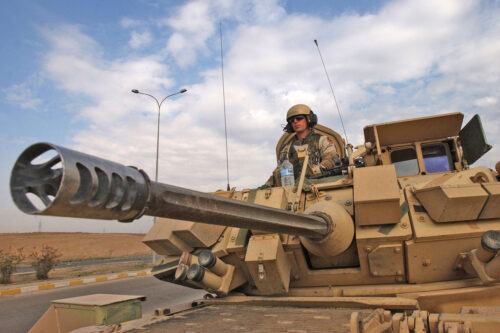
A weapon not considered for offense?
A weapon for what?
Is there any weapon that by design can be used only in defense?
Look, I could understand if someone wrote that cement trucks are effective in traffic assassinations and were never built for that.
They weren’t built for that.
But who would say the cement truck is not ever considered a weapon for offense?
When being used in an attack, they’re in fact being considered by someone a weapon for offense. That counts.
The article ends by calling our attention to U.S. delivery of the M4 Sherman tank to Britain in WWII, which from its very first engagement handily exposed technological (and strategic) inferiority of Nazi armor.
While I agree with this historical analysis (and have written here about it several times before), the article seems to totally contradict itself in its final stages.
Saying weaponized armor — a light “tank” even with tank-busting weaponry — is somehow not considered an offensive weapon sounds very poorly contrived and unnecessary bureaucracy.
The better and simpler narrative is that the modern derivation of the American light tank dropped into Ukraine today could do to Russia what Britain did from 1942 onward with the American M4 Sherman (immediately and continuously drove Nazis out of occupied territories).
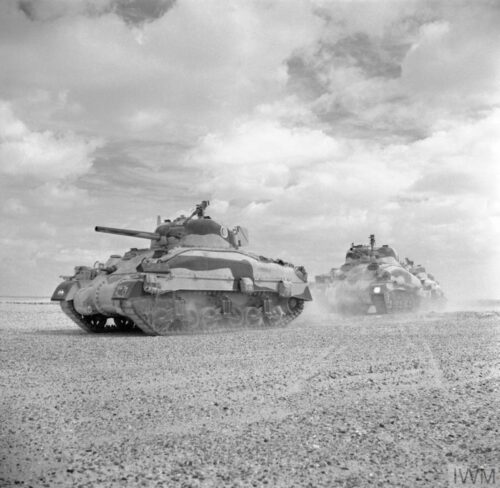
Sherman II tanks of the Queen’s Bays (2nd Dragoon Guards), 2nd Armoured Brigade, moving up to the Alamein line, 24 Oct 1942. Source: IWM photo E18380.
Related blog posts:
- Ronald Reagan’s “Special Unit” Soldier Sentenced to 5,160 Years in Jail… because mass murder using American troop carriers
- Toyota Bans Resale of Land Cruisers… because they become highly effective weapons for offense
- All Teslas May Be Trash But GM’s War Buggy is Garbage… because not a Toyota
Update January 5: The U.S. is planning to send 40 Bradley vehicles to Ukraine, perhaps in time for a spring (March) “defensive” push.
The Biden administration on Thursday announced plans to equip Ukraine with Bradley infantry fighting vehicles, while German officials said they would send Marders, decades-old weapons of a comparable class, as well as Patriot air defenses. The joint announcement by Berlin and Washington follows a similar move by France earlier this week. Paris pledged to send an unspecified number of AMX-10 RC vehicles, billed as light tanks on wheels boasting armor-breaking 105 mm guns.