Category Archives: History

Play Review: Logan’s “Red” Censures Rothko Identity to Vilify Him for Not Being Christian Enough

I sat down to watch a production of John Logan’s Red. The actors landed a distinct “Oy.” They invoked Rothko’s Russian roots and his abrupt landing as a Jewish boy in America. They channeled a cadence of immigrant memory with enough conviction that the audience nodded along, satisfied that this play knows whose story it is telling.

It does not.

As a disinformation historian, I was genuinely surprised to see the methods used in a play to undermine the protagonist. Exploring how and why is likely to expose deeply rooted prejudice in Christian narratives that have been designed for centuries to isolate and erase Judaism.
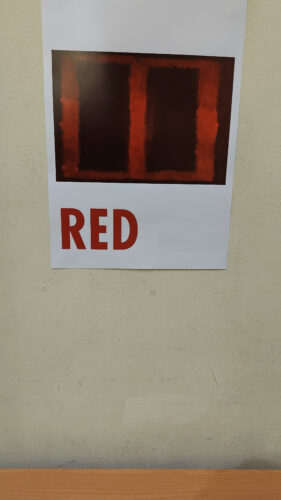
Poster advertising the famous, award-winning play “Red” about the artist Rothko.

First, it’s a fact that major books on Rothko exist and none of them center his Jewish intellectual tradition as the interpretive key. There is a known history of erasure within a biographical track. Cohen-Solal’s biography in the Yale Jewish Lives series comes closest, tracing his Orthodox upbringing, yet even she treats Judaism as biography rather than the interpretive framework for his artistic method. In other words, you can’t just pull up a biography to understand what the play delivers.

Second, this is something not many people are able to recognize, and that’s by design. Many years ago, when I ran a very large war-dialing security project in Milwaukee, I took my team out for Easter lunch. I’ll never forget when one said to me “I hope you don’t mind me saying that I was raised on horror films in Church that told me to believe Jews are my enemy because they won’t obey, and they killed Jesus. But to be honest the teachings don’t make sense now, talking to you”.

He wasn’t the first or the last American that I met who struggled to make sense of his operational context, which he had been raised from very young to believe, as latent antisemitic hatred and bias. He would easily watch a play or film destroying Rothko, yet he would be uncomfortable meeting Rothko in person.

Historians of Nazi Germany point this out repeatedly. Jews would have neighbors who would gladly say the Jews are the problem, cause of all their grief and need to be forced to change, while adding “but I don’t mean you”.

The impact of this play as disinformation matters a lot, when you consider how Red won six Tony Awards in 2010 and has become one of the most frequently staged plays in the American repertoire.

Allow me to explain.

The stage is set to Rothko’s Bowery studio in 1958, where the artist works on murals commissioned for the Four Seasons restaurant in the Seagram Building. He has a fictional assistant to mix paint, stretch canvas, and gradually find the nerve to challenge his employer’s convictions. The confrontation escalates until the young man rises up to liberate himself from Rothko’s demands. Audiences leave feeling they have watched a story about art.

They have watched a public trial.

The audience is set up as witness, the congregation. The young assistant, named Ken, is their proxy, sent in to extract a confession from an old Jew whose crime is trying to make a world on his own terms. How dare he exert confidence in his opinions and not bow down to the Christian system of modesty and shame?

Christian Control

Logan builds his depiction of Rothko around a single psychological engine: control. Control of the viewer’s distance. Control of the lighting. Control of the emotional conditions under which the paintings may be experienced.

The play incorrectly casts the Christian perception of control as Rothko being overprotective. We are meant to observe a tortured artist shielding sacred work from a profane commercial world, terrified that his paintings will become wallpaper for Manhattan’s wealthiest diners.

This is a tortured misreading so fundamentally wrong about Rothko, that Logan inverted the man’s entire practice.

Rothko was raised with an Orthodox Jewish education at cheder before immigrating to Portland at age ten. He brought his formal Jewish education to art as one of the major abstract expressionists. It isn’t a footnote, it’s the lens through which his entire practice becomes legible. In other words, to those who know a thing about Orthodox Judaism, his insistence on setting a viewing environment (lighting, proximity, enforced intimacy) does NOT map to a Christian framework of control. He was NOT an artist defending the sacred from the fallen world. He was doing the exact opposite.

Rothko was practicing tzimtzum.

In Lurianic Kabbalah, tzimtzum is the divine contraction: God withdraws in order to create the space in which creation becomes possible. The infinite possibility of light must be constrained or it destroys rather than illuminates. The dialogue in the play regularly returns to question Rothko for saying he doesn’t like the “outdoor” light rather than recognize he was invoking “infinite” light as interference with his ability to create. Lines in the play about color absolutism (black, white) are presented completely detached from the Kabbalistic context that gives them meaning. Chabad’s commentary on tzimtzum tells us:

Before the beginning, there was nothing but light. Infinite light. The notion of a world was absurd… So He hid the light. All of it. There was absolute darkness. And now there could be a world.

During the play I heard the audience all around me guffaw and chortle at “difficult” Rothko lowering the lights, while his assistant mocked him for it. I cringed. It felt incredibly awkward, as if I was seeing with two eyes in a production that was meant for the blind. How could people not see? Oh, right, they don’t know anything about Rothko’s faith or the Kabbalah.

Rothko being framed with a restriction of light, his indoor control obsession, is not defense. It is method. Barnett Newman, Rothko’s close friend and fellow abstract expressionist, made this connection explicit. Newman’s Zim Zum I (at SFMOMA) proves the kabbalistic vocabulary was named and present in the artistic community. The Rothko Chapel itself, which Newman’s Broken Obelisk stands outside of, proves Rothko’s entire practice pointed toward sacred space. The Kabbalistic vocabulary was not hidden, it was not obscure, it was not inaccessible. It was sitting in the artistic community Rothko inhabited, named and present.

Logan ignored and then erased it, because it would not have allowed his trial of Rothko to continue.

Even Logan’s own script betrays what it is erasing. His Rothko says he wants to create “a place where the viewer could live in contemplation with the work.” His Rothko tells Philip Johnson he will make the restaurant “a temple.” These are lines Logan wrote — and they point directly toward the Kabbalistic framework the play refuses to engage with. The real Rothko wrote to the critic Katherine Kuh that he put his trust in the psyche of the sensitive viewer who is free from conventional patterns of thought. He was not building controls. He was performing the opposite, a Jewish philosophy of withdrawal that makes revelation structurally possible.

Logan did not see this, and went to great effort to misrepresent Rothko with control concepts that Christians easily could judge and condemn. The only version of artistic control his script allows the viewer to imagine is fear.

Bringing a Kabbalistic decoder to the play is a revelation, which exposes the audience gasping and laughing at a “difficult man who causes conflict” for all the wrong reasons.

Chavruta as Psychodrama

Logan didn’t just miss the foundation of Rothko. The distortion of him runs through every confrontation.

Logan writes exchanges as verbal assaults, trying to frame Rothko as “battering” his assistant with demands, provocations, and intellectual challenges that leave Ken shaken and defensive. The Logan story arc requires “battering” for a setup, like a nod to Greek mythology-telling traditions. Ken must accumulate enough wounds to justify his crusade of rebellion, his walk out the door and into his own life. Rothko is depicted as the one who says the son must overthrow the father, and then his apprentice overthrows him as consequence. The young replaces the old. The audience feels catharsis. The audience doesn’t ask itself why a Jew is being recast into Greek and Christian narratives, erasing his story.

This is Christian supersession as dramatic structure. The son surpasses and replaces the father, the new covenant fulfills and discards the old. It is a narrative shape so deeply embedded in Western theatrical convention that most audiences cannot see it operating as a template that disrespects the subject.

It is NOT a Jewish shape.

What Logan writes as domination is a mistake, when you understand Rothko practicing chavruta. The Talmudic study partnership makes argument the mechanism of shared discovery. It opposes authoritarian control, favoring a partnership. You push, I push back, and in the friction something emerges that neither participant owned before the encounter. That heat is NOT the abuse framing that Logan is so desperate to deliver audiences. It is how a Jewish intellectual growth tradition works. The intensity is NOT a flaw to be overcome, even the emotion is NOT a flaw. It is the LOVE of a teacher who refuses to let a student remain comfortable in an incomplete and dispassionate understanding.

Logan’s script acknowledges the possibility but it immediately forecloses it. Look at how he portrays Rothko when he tells Ken:

I am not your rabbi, I am not your father, I am not your shrink, I am not your friend, I am not your teacher — I am your employer.

The line gets a laugh. The audience hears the rabbi line, a series of diminishing steps (negating the actual role of the rabbi) and then the “I am your employer” cold landing.

Logan intentionally strips away every actual Jewish relational frame that would make Rothko’s intensity authentic and legible, leaving only a “coin-operated Jew” of commercial transaction.

The antisemitism latent to Logan’s perspective isn’t to be underestimated. Audiences raised with the same framing likely welcome the repetition and reinforcement of what they were already thinking. The coin-operated Jew, of course, that makes sense to the congregation judging Rothko. Once the relationship is distilled to the Jew employer and the mistreated employee, the demands become illegitimate. Rothko’s passion is inverted into derangement, pathology. His love and care become captured and redefined unfairly as control.

Decoration and Erasure

Every production of this play serves as anti-Jewish disinformation, erasing specific people in society. The script puts Rothko on trial, but anyone who knows the intellectual tradition it points toward can feel the much greater impact.

The Judaism is acted upon as decorative, like a prop. “Oy” landed so flat, like hanging a Santa on an oak tree in August and saying Merry Christmas, that I almost couldn’t sit through another minute. But I soon witnessed Judaism being invoked for a far more dangerous purpose, assigning blame for every “difficult man” problem being depicted.

Here’s an old Jew you want to get to know because he’s famous, and here’s why you shouldn’t like him. Do you feel comforted by the shared exercise of misunderstanding him, “othering” him, and discrediting him? Is it just coincidence that it circles around him being a Jew? Rothko becomes a vessel to carry a message opposite of who he really was. By introducing him without connecting Judaism to anything structural in the play, every production is actively erasing him through targeted attacks on his identity.

The play does not explore Rothko. It prosecutes him.

The group I saw spent the time after the play discussing how they read a biography of the man, and they struggled to read more than a page or two of Nietzsche. Actors emphasized the routines to put on the play as a done deal, a matter of material being canon, without questioning anything in it.

The structure is settled, apparently, as a communal shaming ritual: actors seem to have no issue putting on a public humiliation of the one who won’t conform, the performative exposure of difference as arrogance, the insistence that confidence is sin. Rothko is on display, without his consent, for the audience to watch him be broken as an example for others to not be “like him”. His refusal to make himself small or legible on the dominant culture’s strict interpretation of him, that is the tension.

Being familiar with the Christian intellectual architecture makes the play resonate. Being familiar with Jewish intellectualism makes the play unbearable.

When it references Nietzsche’s Birth of Tragedy, Caravaggio’s Conversion of Saul, Michelangelo’s Laurentian Library, the pattern emerges. The Apollonian-Dionysian framework is dropped like a bomb on Rothko. The suffering artist is presented as sacrificing himself for the integrity of the work. One reviewer described Rothko as an artist “whose paintings were a dynamic battle between Apollo and Dionysus.” No one seemed to notice a Greek reading does not fit the Jewish painter who studied Talmud before he studied art.

Why? I’ll explain, because this play proves to me audiences have no idea just how much disinformation is being fed to them.

The Apollonian-Dionysian framework is a conflict model. It presupposes two irreconcilable forces with order against ecstasy, form against dissolution, and the artist is trapped between them. Nietzsche’s formulation was that tragedy is what happens when neither force can win. The hero is destroyed by the tension. This is the engine Logan installs in Rothko: a man torn between the sacred and the commercial, between control and surrender, between creation and self-destruction. It demands that he fall.

And it’s completely, utterly wrong.

Imagine two halves in balance the same way you ride a bicycle by riding with both left and right as oppositional forces working together to allow forward motion. It’s the same way a sailboat moves only when it is in opposition, wind against water, otherwise it is stuck. There are many religions like this, whereas the Greek stories of Apollo and Dionysus aren’t even close to relevant.

Jewish intellectual tradition has no such requirement for the conflict that Logan sets up with Greek framing to discredit the ideas of Rothko. The Talmudic method holds opposing positions in permanent productive tension (machloket l’shem shamayim, argument for the sake of heaven) where contradictions are not resolved but sustained as necessary for movement forward.

Hillel and Shammai do not destroy each other, because that would prevent good. They sit on the same page. In Kabbalistic thought, darkness and light are opposite of war, they are togetherness. The darkness is the vessel that makes light apprehensible. You can’t see stars without the beauty of the night. Rothko’s practice of layering, the darkness that contains color, the restriction that enables encounter is integrative, not tragic.

Logan’s imposition of a tone-deaf Greek binary onto it turns a Jewish artist’s coherent method into a bizarre European death wish, which conveniently produces the broken genius that the Christian-steeped audiences came to see broken.

Logan did not invent this problem, of course. He simply won wide recognition for perpetuating and expanding it among people eager to see. And that’s the actual problem.

As a scholar in the Journal of Modern Jewish Studies has observed, exhibition organizers and essayists have consistently steered clear of questions about Rothko’s Jewish identity and his notion of sacred experience. The assumption has been that Rothko’s universalism transcended his Judaism, which is a formulation that conveniently avoids asking whether the universalism itself was shaped by Jewish intellectual tradition. Rothko has to be understood as a Latvian Jewish immigrant who had attended cheder and yeshiva, who co-founded an artists’ group in which nine of ten members were Jewish, who spent his life applying Jewish intellectual traditions to the conditions under which his work could be encountered.

And yet, the dominant critical response has been to misread him through Nietzsche and Jung.

Logan’s play is the theatrical culmination of popular erasure of a Jew, vilifying along the way with tropes about “control” and “money” that don’t even fit the man.

The Inversion

The sinister operation of Red is that it is far more than either lazy or willful ignorance of Jewish traditions. The play does not merely fail to understand a Jewish man, let alone the foundational background of Rothko himself. It projects onto a Jewish identity the very pathology of the system that produced the play.

Christian domination doctrine is obedience-based.

The father’s role is to produce compliance. The congregation’s role is to submit. Authority flows downward and is not to be challenged. When it is challenged, the challenger is the problem and not the structure. This is the alien model that Logan very intentionally imposes on Rothko’s studio. Rothko demands, Ken obeys or suffers. The audience watches a tyrant and his victim in the frame of Christian traditions.

However, Rothko was not the actual authoritarian in this story. The authoritarian was the system that he refused to serve. This cannot be overstated. The commercial art world that wanted his paintings as decoration for the rich, the cultural establishment that wanted his intensity made safe and consumable. Rothko’s entire career was a challenge to that system of authoritarianism that he balked at. His withdrawal from the Four Seasons commission was not him having a revelation inspired by Ken, nor was it a breakdown. It was the act of a Jewish man being principled in a most Jewish way, that he would not let his work be domesticated by power. The play takes the liberator, with his deeply-rooted philosophy since childhood of liberation, and recasts him as the despot.

This is projection by Logan.

The Christian institutional model shames dissent, punishes nonconformity, and treats the refusal to submit as moral failure. Logan takes this and accuses the Jew of the very thing the institution does. The mob that enforces obedience frames the man who refuses to bow as the bully.

Jewish tradition has a name for this pattern, in case you were wondering why it’s so easy for someone familiar with Judaism to see it even when others can not.

This is the story known as Book of Esther, which effectively teaches little Jewish girls they have women heroes to look up to who fought power and won.

In the story, the antisemitic Haman demands that everyone kneel to his authority. Mordecai will not on principle that he does not kneel to false authority. And Haman’s response is not to question his own authority but to mark Mordecai for destruction, which means not just Mordecai, but his entire people. The crime is not what Mordecai did. The crime is that he dared to insist on his own terms.

Sound familiar?

Logan’s Red runs the same inversion. It takes the artist who challenged the commodity system and makes him the oppressor. It takes the assistant who represents that system’s values of youth, accessibility, the rejection of difficulty and makes him into the hero.

Logan gives his audience shame directed at a Jewish man for ninety minutes, and wants it to be registered as art.

Who Gets to Define the Terms

Jewish intellectual confidence is rewritten as aggression. The Jewish protagonist says he knows when he knows, he doesn’t know when he doesn’t, and the Christian rewrites it as uncomfortable overconfidence and failure of modesty. How dare a man think for himself, to exert authority over his own destiny in a way Catholics are raised to believe is shameful. The play traps Rothko in a false binary: aspiring Christian authoritarian or broken failure. It never considers that he was neither. He was genuinely anti-authoritarian.

Logan takes nurturing intensity and rewrites it as manipulation. He takes a commanding presence rooted in a tradition where ferocious engagement is love, and presents it as a problem the young assistant must solve by abandonment. Catholic framing is unmistakable, where leaving and silencing are the preferred tools over the balance of an embraced, inherent conflict.

The play needs Rothko to break down at the end so the audience can leave feeling they witnessed something profound rather than something that they did to him.

The only resolution the script offers is the gentile’s liberation from the control and money-seeking Jew’s demands. Ken leaves to “belong” while Rothko is cast out to be alone. The audience is invited to feel that something has been set right. But the play never asks the question that would unmake its entire structure: What if the demands were not pathology but pedagogy? What if the intensity was not something to survive but something to join?

In a 2012 review for The Arts Fuse, the visual artist Franklin Einspruch asked what a “treyf, naive Iowan” was really meant to be doing in the studio of Mark Rothko, the artist “with commensurate aspirations to grasp the unnamable essence of being.” The imbalance was the sharpest observation I have found about Red, and apparently no one explored this any further.

Perhaps the Christian establishment has no interest in developing any critique of a play that trashes Jewish intellectualism. It was too busy handing out awards.

Not just six Tonys. The Drama Desk. The Olivier.

A playwright built a machine that chewed up a famous Jew and spit out his bones, and the industry gave it every prize available. A Catholic dramatic structure that shames Jewish difference, rewards conformity, and treats the insistence on one’s own terms as the gravest sin does not operate against the interests of a Christian cultural establishment. It operates as one. It’s an expression of how the establishment uses its dominance to control narratives that harm the minorities it claims to be “converting”.

I’m reminded of a recent court case where American Native people had their voice officially removed by an American court, which ruled that the Oil companies oppressing them should decide how to tell their story. In 2026. Logan isn’t the only one writing like this.

Fifteen years and hundreds of productions later, Red continues to tell audiences that Rothko’s Judaism was color and noise to a Greek tragedy rather than the operating system of his entire artistic practice.

In the script, Rothko says he wants to create “a place of communion.” It is the one moment where Logan almost lets him speak from his own tradition, where traditions of shared encounters nearly break through the Christian scaffolding of authoritarian rule. But the script cannot sustain it. Logan needs Rothko to fail in the way he expects, to collapse into the tortured isolation that will justify Ken’s “return” to society from the exclusion and independence of Jewish intellectualism.

The play tells you Rothko is Jewish, yet it spends the entire time punishing him for not being Christian enough to make sense to the audience misunderstanding him.
Silicon Valley Renamed “Soviet Volley” to Represent AI Token Fraud Economics

The most consequential fraud in modern technology is not happening in the code. It is happening in the units.

If you ever studied the collapse of Soviet economics, you know exactly what I’m about to explain.

AI companies have built a billing infrastructure in which the seller defines the unit of measurement, counts the units, and invoices the buyer. All with no independent verification at any point in the transaction. All without any enforcement mechanism.

If you prompt AI to build something and it launches a dozen agents and burns an entire day worth of credits in an hour, that’s business as usual, especially if they delete their own work and complain they have nothing to show you for it.

The unit of fraud is called a “token.” It has no fixed definition. It varies by model, by provider, and by tokenizer version. It can be changed at any time, by the vendor, without notice. There is no regulatory body certifying token measurement. There is no weights-and-measures regime. There is no audit trail the customer can independently verify.

This is not a new problem, as I already hinted.

It is one of the oldest problems in commercial history, and every previous instance ended the same way. It won’t be different this time. It’s logic any five-year-old should be able to figure out.

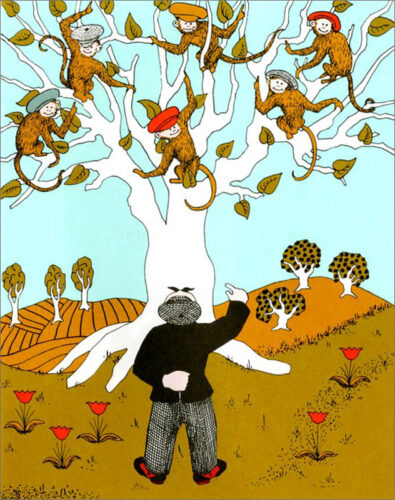
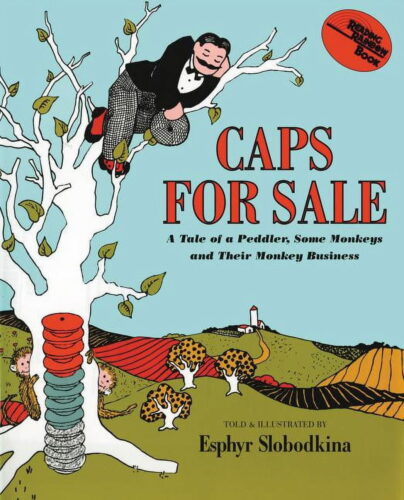
In the book, every single thing the peddler does, the monkeys imitate. He shakes his fist, they shake their fists. He stomps his foot, they stomp their feet. That’s OpenAI, Google, Anthropic all copying each other’s opaque token pricing structures, each imitating the other’s billing model, because there’s no independent standard to do anything else. Monkey see, monkey do.

Caps for Sale

Let’s start with clause 35 of the Magna Carta, 1215:

Let there be one measure of wine throughout our whole realm; and one measure of ale; and one measure of corn.

This was the language of liberty from oppression. It was a response to documented, systematic fraud by royal merchants who controlled their own measures. A bushel in London was not a bushel in York, and the difference was profit.

It took England six centuries to arrive at a proper Weights and Measures Act. Every iteration addressed the same structural deficiency: when the entity selling the goods also controls the unit of measurement, the unit will be corrupted. The entire history of metrology from the Bureau International des Poids et Mesures to NIST to the EU’s Measuring Instruments Directive, is the history of forcibly separating the measurer from the seller.

It’s fundamental to the rise of industrialization that the clocks had to run on universal time, even with time zones, such that trains could have externally judged arrival and departure times. The British and Dutch factories that invented assembly lines to defeat Napoleon (infamously copied by Ford) couldn’t work without shared units of measure.

Given this context it appears now that AI companies are the most historically illiterate and economically unsound ever.

Their “token billing” has undone a fundamental tenet against trivial fraud. We are back to the royal merchant having their thumb on the scale for every transaction, except the thumb is an algorithm and the scale is proprietary.

How dumb does the intelligent machine business think we are, seriously?

LIBOR for Compute

Let’s review, for example, the London Interbank Offered Rate (LIBOR) that underpinned roughly $350 trillion in financial instruments worldwide. LIBOR was calculated from self-reported borrowing rates submitted daily by the banks that profited from the number. No independent verification. No transaction-based measurement.

Just trust.

And it failed. Banks manipulated it for years. Of course they did. The entity producing the number was also the entity whose trading positions depended on the number. When the fraud was finally exposed, the fix was to replace LIBOR with SOFR (Secured Overnight Financing Rate) which is derived from actual observed transactions rather than self-reported claims.

Now consider the AI jar of pickles we are being told to get in.

OpenAI reports that average reasoning token consumption per organization has increased approximately 320 times in the past twelve months. This number was produced by OpenAI, about OpenAI’s product, using OpenAI’s proprietary tokenizer, and reported to the press as evidence of adoption. It is Barclays submitting its own LIBOR rate as if nobody knows why we stopped them from doing this.

The difference is that LIBOR at least had the pretense of multiple submitters. Token counts have one source: the vendor.

Intelligence machine vendors have truly produced their most cynical moment.

Gosplan of Sand Hill Road

Soviet central planning failed not because the planners were being stupid. Many were brilliant, which probably made everything worse. It failed because the information system was structurally corrupt, and compliant agents corrupted it further. Every layer of the reporting chain had an incentive to inflate their output numbers, and there was no independent verification mechanism capable of correcting the distortion.

The famous case study is the Soviet nail factory. Measured by weight, the factory produced fewer, heavier nails that nobody needed. Measured by quantity, it produced millions of tiny nails nobody could use. The metric became the product. Actual utility was irrelevant because utility was not being measured, only the unit was.

Here’s another token output example of fraud I was taught in college. Soviet window manufacturers measured weight and nobody could install the heavy, thick glass. They measured by size, and all the very large, thin glass broke before it even could be loaded for delivery. Actual utility was irrelevant because utility was not being measured, only the unit was.

Every day that I use AI it wastes unbelievable amounts of money and time, measured in units of tokens, as it tells me if I don’t like it there’s nothing I can do.

Jensen Huang’s proposal at GTC this month is the Soviet nail or glass factory at much larger Silicon Valley scale.

He suggested that every engineer should have an annual token budget, where these allocations could reach half of base salary in value. Consider what this fraud means structurally. You are telling workers they have an annual allocation of a unit that measures interaction volume, not outcome quality.

Record scratch.

So a notoriously wasteful industry already in trouble for water and air pollution will optimize entirely for high consumption. An engineer who solves a problem by thinking for ten minutes and never touching the AI has, under this framework, underperformed relative to one who burned through a million tokens generating refuse. Yet the engineer who still thinks, and conserves tokens, is undeniably the superior engineer to the ones that do not!

Pray and spray, running out of ammunition and begging for $200 billion to keep firing at ghosts, is so inversely proportional to the efficiency of Delta operators I can’t even….

Tokens are not a productivity metric, like ammunition is not even a kill rate, because Nvidia is incentivized inversely to what customers actually need. It is Gosplan announcing the Five-Year Plan for compute consumption, and every factory manager is about to start filing reports showing they exceeded their quota of tokens, meaning… nothing.

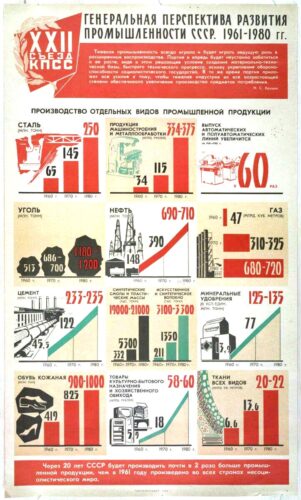
“In 20 years the USSR will produce nearly twice as much industrial output as all non-socialist countries produced in 1961.” This is like AI companies saying tokens up 320x. Just volume, presented as progress, approved by the 22nd Congress of the CPSU, a template for how Silicon Valley wants us to cheer their charts.

Shovel Seller Tithe

Huang’s position is particularly elegant because Nvidia does not sell tokens. They sell the GPUs that generate them. Every token consumed requires silicon to produce. If token budgets become a standard corporate expenditure pegged to payroll, Huang has created a permanent demand floor for his hardware.

Gross. Literally gross product.

He does not need to manipulate the token count himself. He just needs the token to become the unit that corporations manage against, and every dollar allocated to token budgets flows upstream to GPU purchases.

He skips actual measurement. He proposes that companies commit, in advance, to spending a fixed percentage of their payroll on his product for compute.

That is not a metric. It is a tithe.

And the structure insulates him perfectly. The AI providers already grossly inflate the token counts. The customers overpay the AI providers, given that most of the token count is for fixing things the tokens were spent on to begin with, like a protection racket. The AI providers buy Nvidia’s GPUs to service the consumption they have encouraged and caused without any accountability for outcomes. Nvidia never touches the books. They sell shovels to the people salting the mine.

The Arc

Every instance of self-reported commercial measurement in recorded history has followed the same progression: self-reported measurement, then market adoption of the metric, then discovery of systematic manipulation, then regulatory intervention mandating independent measurement.

Medieval grain measures. LIBOR. Credit ratings. Remember Facebook’s video metrics? The company admitted in 2016 to inflating view times by 60 to 80 percent, having defined the view, counted the view, and sold the view. The pattern is not debatable. It is one of the most thoroughly documented dynamics in economic history.

Token billing is currently at stage two: market adoption. Enterprises are building budgets around it. Analysts are publishing reports denominated in it. A CEO is proposing tying it to compensation.

Nobody is asking who audits the count.

Auditors are completely absent.

The harsh reality for every major AI provider on earth, like royalty before the Magna Carta, is that nobody has the independent authority needed to vouch for them. The merchant is being made the king who declares their own scale valid no matter what. And this time the scale is processing trillions of transactions per day, denominated in a unit that has no legal definition, no regulatory oversight, and no independent verification mechanism.

No kings.

We have eight hundred years of evidence for this bullshit. The only variable today is how much it costs before someone reads basic history of economics and enforces an honest measure.

The AI industry pretends to be terrified about regulation, but really they are in danger of transparency. Because the moment an independent third party can compare token billing against actual computational work performed, or the moment someone builds a SOFR for inference, every provider’s margins become visible. And if those margins look anything like LIBOR spreads or Facebook’s video metrics, the correction won’t be gradual.

I’m telling you, even the best of the best agents are a tragedy of token inflation and massive waste.

Nobody inside the Soviet system volunteered for glasnost. It was forced by the fact that the gap between the reports and reality had become so grotesque that the system could no longer function even on its own terms.

Token economics in Silicon Valley is rapidly approaching that threshold. Engineers know. We watch agents burn through whole budgets producing garbage, watch our token counts spike on failed reasoning chains we are billed for anyway, watch “reasoning tokens” appear on invoices for computation we never requested and cannot inspect.

The bigger the tool failure and productivity suck, the more the AI companies try to report a Soviet-sounding productivity “gain”. The more energy they burn, the more they claim to have a “big engine”, which means literally nothing useful.

Gorbachev didn’t reform Soviet economics. He revealed that it was dead inside.

The production numbers had been fraudulent for decades. Everyone inside the system knew. The factories knew. The ministries knew. Gosplan knew. But the reporting structure made it impossible to say so, because every career in the chain depended on the numbers going up. Glasnost (openness) didn’t fix fraud any more than exposure of Enron balanced its sheets. It made it permissible to say out loud the numbers meant nothing. The gap between reported output and actual value had grown so large that the moment anyone was allowed to measure honestly, the entire structure lost legitimacy overnight.

That’s the truth of the AI bubble. Token output is the absolute wrong measure and will only bring pain to those who adopt it without audit.

Silicon Valley is now all about doing without thinking, like the monkeys sitting in a tree, unaware they are about to throw all their hats on the ground the moment the truth is spoken.

Hegseth: You Gotta Kill Bad Guys to Make Bad Guys

The Department of War.

The Secretary of War.

The wartime spend.

The wartime rhetoric.

The wartime dead.

We are supposed to believe none of the above means that Iran is a war. Hegseth says he needs $200 billion to keep his non-war-war running indefinitely without objectives or objections.

How big is Hegseth’s $200 billion folly?

Bigger than every country’s annual defense budget except the one requesting it. As a single supplemental request, in just the first three weeks of combat, it has no precedent. Look at what the United States has spent on its other wars:

War Duration Total Military Cost (2026 $) Peak Daily Cost (2026 $) Congressional Authorization
Korea 3 years ~$780 billion ~$700 million None (UN police action)
Vietnam ~8 years major combat ~$1.1 trillion ~$380 million Gulf of Tonkin Resolution
Gulf War (1991) 6 weeks ~$115 billion ~$2.7 billion AUMF 1991
Iraq (2003–2011) 8 years ~$880 billion ~$530 million (surge peak) AUMF 2002
Afghanistan (2001–2021) 20 years ~$2.4 trillion ~$330 million AUMF 2001
Iran (2026–?) 19 days $12 billion and counting ~$1 billion None

Sources: CRS estimates (Daggett, Belasco) adjusted to approximate 2026 dollars; Brown University Costs of War Project; Pentagon figures reported by White House NEC. Total costs reflect military operations only and exclude veterans’ benefits, interest on war debt, and allied contributions. Iran figures from White House NEC director Kevin Hassett ($12 billion as of March 16).

The Iran war is burning money faster than any American conflict since the six-week Gulf War of 1991. Notably, that war was mostly paid for by allies. This one is borrowed, on the national credit card. The $200 billion supplemental request, by itself, exceeds the entire inflation-adjusted cost of the Korean War and approaches what the U.S. spent in a decade of peak Iraq War combat.

Nineteen days into a war with no objective, no authorization, no end, it’s “give me more war money than in history without any accountability for it”.

The word “war” now does everything in Washington except the one thing it’s supposed to do under Article I, Section 8: trigger a congressional vote for war. The $200 billion request is a trap. If Congress appropriates supplemental war funding without passing an AUMF, the appropriation itself becomes a de facto authorization, because money is consent. The spending vote substitutes for the war vote. Iraq and Afghanistan ran the same play: Congress voted to fund the troops, not to authorize the war. Same money, different name. The supplemental spending bill is the war laundromat.

Self-perpetuating war, self-perpetuating budget, self-perpetuating enemy, all are something Hegseth would say at a bar while the tab runs to $200 billion.

Iran hit a F-35 today. Flattened defenses don’t hit $100 million aircraft. People who aren’t shooting at you don’t wound 200 of your service members. Iran just blew up Qatari gas production. The air dominance narrative and the uncontrolled casualty figures cannot both be true, and the $200 billion budget request tells you which one the Pentagon admits.

Afroman Destroys Trump in Landmark “Lemon Pound Cake” Verdict

Today should become a national American holiday: Lemon Pound Cake Day.

An Ohio jury just delivered one of the clearest freedom verdicts in recent memory. It took less than a day to throw out all thirteen claims of defamation, invasion of privacy, the lot, that had been brought by seven Adams County sheriff’s deputies against rapper Afroman. The deputies claimed they should earn $3.9 million for causing him harm. They got nothing.

The facts are plain. Deputies raided Afroman’s home in Winchester, Ohio with long guns and pistols drawn, smashed his door down, and seized over $5,000 in cash in August 2022. They based the assault on a dubious warrant for drug trafficking and kidnapping. No charges were filed. He was in Chicago, not home. No drugs. No kidnapping. When the sheriff’s office returned the cash taken from him, $400 had been skimmed off. They told him they weren’t responsible for this loss or their property damage either.

Afroman had security cameras that captured the targeted abuse. He used the footage to make music videos, most notably the song “Lemon Pound Cake,” which has been viewed over 3 million times on YouTube. It features surveillance clips of white heavyset deputies breaking down the door, then pausing in the kitchen to eye a lemon cake. Afroman narrates the intrusions to a beat. It is a masterpiece, easily one of the best American protest songs in history.

The deputies, invoking historic white supremacist cancel culture, sued to suppress Black speech. They filed claims of emotional distress, humiliation, and death threats, surprised they would be held accountable for their actions. Deputy Lisa Phillips wanted $1.5 million. Sgt. Randy Walters wanted $1 million and told jurors he was humiliated when his daughter came home from school crying because classmates said her mother was making love to Afroman, a reference to lyrics in a song called “Randy Walters is a Son of a Bitch.

Afroman, as a true patriot, showed up to court every day in an American flag. His testimony was the whole case in miniature:

“I got freedom of speech. After they run around my house with guns, kicked down my door, I got the right to kick a can in my backyard, use my freedom of speech, turn my bad times into a good time.”

“I don’t go to their house, kick down their doors, flip them off on their surveillance cameras, then try to play the victim and sue them.”

“All of this is their fault. If they hadn’t wrongly raided my house, there would be no lawsuit, I would not know their names, they wouldn’t be on my home surveillance system, and there would be no songs.”

He also explained why he brought a local TV crew along when he went to collect his money from the sheriff’s station:

I didn’t wanna get beat up or Epstein’d at the sheriff’s station after I seen them running around my house with AR15s.

God damn American hero, right there.

His defense attorney, David Osborne Jr., put the legal framework to work for everyone to see: the deputies are public officials held to a higher standard, and social commentary on their outrageously unjust conduct is protected speech.

No reasonable person would expect a police officer not to be criticized.

Meanwhile, Afroman’s own countersuit for the property damage the deputies caused during the raid had already been dismissed by Judge Jonathan Hein without a hearing. A victim of police assault had legitimately suffered damages from unwarranted acts. Click of a button, some little office somewhere, Afroman’s words. The institution protects its own until a jury got in the room and called out the imbalance.

Trump Talk Time

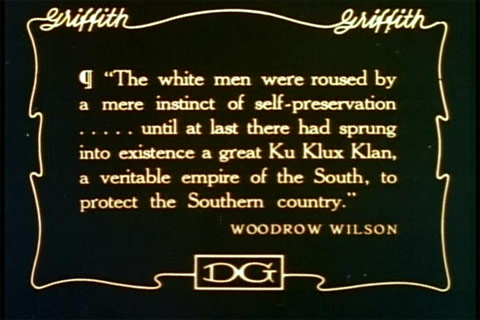
To nobody’s surprise, aggressive acts of white supremacists require invisibility to remain legitimate. America First literally calls itself the invisible empire and walks around with white hoods over their head, ever since Woodrow Wilson screened the white sheets vigilante thriller in the White House in 1915.

These KKK “X” uniforms of an “invisible empire” were a byproduct of President Woodrow Wilson’s promotion of costumed violence against Blacks.

These radical racists abusing their power in America see the documentation of them as the actual threat.

The Economist/The New Yorker weren’t wrong
Screen capture from “Birth of a Nation”, the propaganda film President Wilson spread to restart the KKK and incite violence across America.

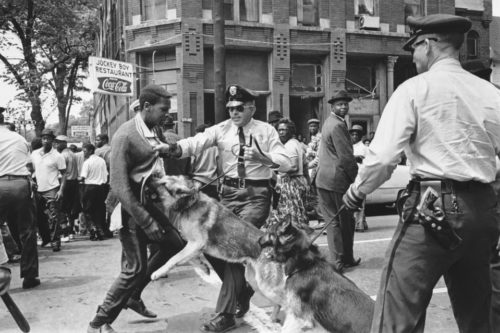
Lynching, including public torture, worked in America as social and political control affecting law enforcement because it was public but unrecorded, witnessed by the community as spectacle, but not captured in a form that could travel beyond it and reframe it as what it was. The moment reporters and eventually cameras showed up, the political cost of America First changed. Emmett Till’s mother understood this perfectly.

Open the casket, force people to see.


A 17-year-old civil-rights demonstrator is attacked by a police dog, May 3, 1963, Birmingham, AL. President John F. Kennedy discussed this widely seen photo at a White House meeting the next afternoon. | “Once people saw those photos,” says Prof. Brinkley, “they were repulsed by the Southern Jim Crow bigot system.” Photo: Bill Hudson/Associated Press

Lemon Pound Cake is the mechanism Trump is naming and whining he will try to shut down.

The American press has been called liars by him for ages because that exact campaign worked so well for Hitler, but now Trump is elevating his accusations to treason like it’s 1837 in America again. It’s being called treasonous because it reveals the crimes.

On March 15, Trump posted on Truth Social:

media outlets reporting on the Iran war should “be brought up on Charges for TREASON for the dissemination of false information.”

Not a joke. Reporting on a war, as this blog certainly does, is described by Trump as treason. The maximum penalty for treason?

Open the casket, force people to see.

FCC Chair Brendan Carr followed up by threatening to revoke broadcast licenses. Defense Secretary Pete Hegseth whined from the Pentagon podium that networks were running chyrons reading “Mideast War Intensifies” when they should instead fluff and puff about “Iran Increasingly Desperate.”

The footage, the documentation, the record all breaks the framework. Power needs the act and the narrative about the act to be the same thing. An independent record creates a gap between what happened and what was supposed to have happened, and that gap is where accountability lives.

Afroman used a beat and security camera footage to speak the truth to power. The deputies’ lawyer literally argued in court that a victim giving the public a report about a raid was the harm. Not the raid. The reporting that showed evidence. The reframing, with evidence. An American Black man shining a bright light through the sheets of injustice, instead of cowering to the system of false authority.

CNN’s Daniel Dale documented that when the White House provided examples of outlets spreading the fake carrier video Trump raged about, not a single one was American. There was one Israeli, one Saudi, one Turkish. The treason accusation he cooked up was aimed at an American press corps, even as they hadn’t done what Trump accused them of doing. He wanted to punish Americans for the crime of foreign coverage itself.

Trump’s world is violence against non-whites as hidden policy, as to him American documentation of the truth is the treason.

Afroman after the verdict, with tears of joy on his face, wrapped in the American flag on the courthouse steps, corrected the framing one more time:

I didn’t win. America won. America still has freedom of speech. It’s still for the people by the people.

He trumped the Trump.

The jury agreed in under a day.

The question is whether the rest of the world does, or when will Hegseth be held accountable for why he’s covered himself in white supremacist tattoos, known as the guy who loses his grip. Here’s the video predicting three F-15E would be shot down by friendly fire in one night.

Afroman said he didn’t want to be Epstein’d. He won in court. Nearly 200 Iranian little girls are dead from Hegseth’s unpopular war crimes, let alone the many others killed from his expanding mistakes. When will their day in court come? Or what about all the Epstein victims?

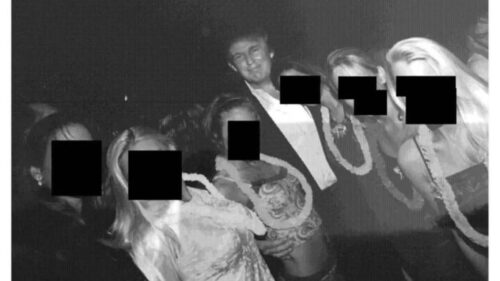
Source: Epstein Files