The Works of KiplingAll the talk I hear in America lately about the necessity of naming a virus for Asian origins — to play racist blame games instead of saying COVID-19 or even 2020 pandemic (both obviously superior choices) — has started to remind me of the 1960s CIA “training” for Vietnam with Kipling’s book “Kim” and how they got it and another of his works completely wrong:
Americans back home became impatient for results in Vietnam, proponents of the war were always quoting—or, rather, misquoting—a little-known poem of Kipling’s (just four lines, written as a chapter heading for “The Naulahka”), saying that “you cannot hurry the East.” The phrase, Benfey writes, “wormed its way into the very highest levels of decision-making.” But what the poem actually says is that you cannot “hustle” the East, and even then, Benfey demonstrates, the word had connotations of cheating and deception. You come away from his book thinking that it might be a good idea to stop your ears whenever someone in authority starts invoking Kipling, unless it’s to quote from his “Epitaphs of the War”
If any question why we died,
Tell them, because our fathers lied.
The doctor who was principle architect of aggressive and successful South Korean response to COVID-19 put it like this, when reviewing the current US and UK approach to a pandemic:
…refusal to implement mass testing for the coronavirus in the United States will have “global repercussions” […] “The United States is very late to this,” he said. “And the president and the officials working on it seem to think they aren’t late. This has both national and global repercussions […] We in Korea were thinking, ‘Are these people in their right mind?'”
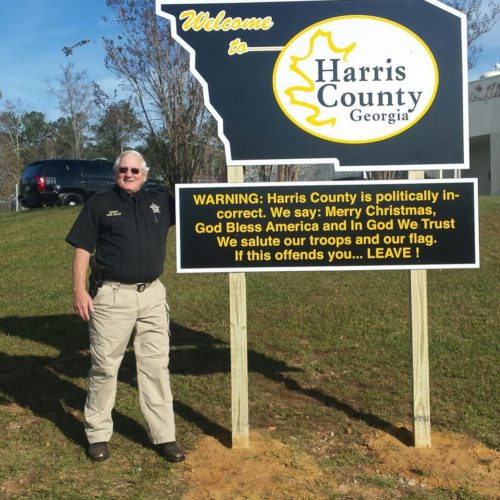
Modern “Sundown Town” sign by a county’s “elected sheriff…in the position for 23 years who personally paid for the $553 sign, which includes an image of the county’s official seal.” Source: RawStory
I see reporters trying to find a normal angle when they write about a very abnormal announcement today on American risk management during a pandemic:
…a new plan to reopen swaths of the country shuttered by the coronavirus pandemic via a targeted, county-by-county mitigation effort…administration would categorize counties as “high risk, medium risk and low risk.” This would allow areas less impacted by the virus to put in place looser restrictions than ones that have been ravaged by the illness. It’s uncertain how effective such labels may be in containing the virus, however, given that asymptomatic carriers may move from region to region undetected…
Looser restrictions in a county would encourage movement into it by the most contagious people (the asymptomatic). ScienceNews warns, for example. “Coronavirus is most contagious before and during the first week of symptoms“. Low risk counties would allow movement of the most high risk, which sounds plain stupid and dangerous.
So it begs an all too important question of how counties surrounded by high risk could even be expected to enforce tests of the asymptomatic at borders; how would they stay low risk while encouraging those most at risk to move about more? But wait one minute, what if that’s the wrong question entirely and there’s no intent to stop the spread of the virus?
Who gains new enforcement powers, and why, is the real key to this story.
The idea of county authority being used to stop the spread of a virus, thus bypassing the legal authority of states in favor of its counties, makes no sense until you move into a completely different frame of reference.
The White House giving a nod directly to county law enforcement for the special position to trap and keep people away who pose a “threat” to their jurisdiction…has a particular significance in politics and in American history.
America’s Black Holocaust explains how someone accustomed to exclusionary thinking might settle on counties being the preferred unit to handle boundary enforcement powers in America.
Beginning in about 1890 and continuing until 1968, white Americans established thousands of towns across the United States for whites only. Many towns drove out their black populations, then posted sundown signs. Others passed laws barring African Americans after dark or prohibiting them from owning or renting property. Still others just harassed and even killed those who violated the custom. Some sundown towns also kept out Jews, Chinese, Mexicans, Native Americans, or other groups. Sundown towns range in size from tiny villages to cities. There are also many “sundown suburbs” and neighborhoods -– and even entire counties.
Even entire counties.
How have counties handled enforcement of borders, especially when it comes to keeping non-whites out? The answer is a colonial-era concept of the Sheriff, an elected and very political position without accountability.
Don’t believe anyone who suggests Sheriffs are automatically somehow representative of their county population’s best interests, given they may be elected without any real qualifications at all. Also, when we look across America, the data says 80% are white and only 41 out of 3,000 are women.
Here’s an example of a Sheriff’s bizarre response to the pandemic:
…the government had forced the unnamed [infectious COVID-19] man to stay in his home. But this week, Nelson County Sheriff Ramon Pineiroa told the Kentucky Standard that deputies will park outside of the man’s home for 24 hours a day for two weeks.
Parking multiple deputized people outside a man’s home 24 hours a day is a taxpayer-funded protest, not a quarantine. They might as well be burning a cross on his lawn to send him a message about what happens if he leaves his home.
With his red “Make America Great” hat prominently displayed in his office here in Titusville, Ivey is part of a wave of county sheriffs who feel emboldened by [the White House occupant’s] agenda, becoming vocal foot soldiers in the nation’s testy political and culture wars.
“[Shaking hands with the White House occupant] was a highlight of what I have been doing all these years,” [Dickson County Sheriff] Bledsoe added. “It was a privilege and honor to be a part of that and meeting other sheriffs and having some common goals…”
A Sheriff having common goals with the current White House should concern everyone in America, if history is any guide.
Of course you might say not all Sheriffs are bad in America, and you’d be right. But think of it this way instead, Sheriffs who are the most loyal to the White House agenda would get discretionary powers while Sheriffs who don’t offer enough fealty get ranked as high risk until they are voted out.
I’ve written about problems like this here before in regard to a particular 2019 Sheriff in Iowa who arrested two men as they were working on a security project, because he didn’t like being audited and didn’t respect any higher authority than himself:
I’ve also written about it here before in regard to a particular 1960 Sheriff in Arkansas who murdered an innocent black man, fabricated a story about it with fake evidence and intimidated witnesses into silence, and faced no consequences:
A bonus reference is that last blog post includes yet another example, the 1897 Lattimer massacre:
…Polish, Slovak, Lithuanian and German miners killed by being shot in the back by a Sheriff who decided to end legal protests by murdering everyone.
Sure there are good Sheriffs, but this is really about shifting dramatic new amounts of power to the bad ones.
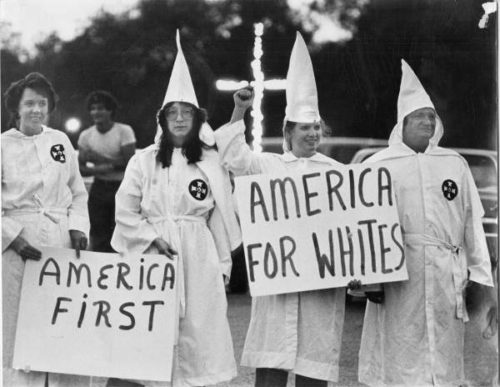
There’s little positive outcome I see ahead from an America First platform of the White House when it uses a cover of pandemic concerns to propose more labeling and discriminatory power go directly to counties for their Sheriffs to enforce. Let’s be clear here that America First in 1916 meant KKK, in 1936 it meant Nazis…today it still means the same things.
America First political rally participants in their traditional garb.
These are the people who thrive on social unrest coming from high unemployment and who use fear-laced xenophobia to seize excessive powers through militant actions in what they see as their “culture war” (ethnic cleansing) to preserve white supremacy.
…a neo-Nazi movement leader based in northern Europe, said that he welcomed the pandemic as a necessary step to help create the world that his group wants to see. …it’s possible that a member of the target audience will decide to take action and commit an act of violence.
To me the announcement today has every appearance of turning America backwards 150 years towards the kind of white police state organized at the county-level that extremist right-wing violent groups like “Posse Comitatus” and “Citizens for Constitutional Freedom”, let alone America First, have very long dreamed about.
Ari Ne’eman, a scholar at Brandeis University, put it best when she said:
What this is really about at the end of the day is whether our civil rights laws still apply in a pandemic. I think that’s a pretty core question as to who we are as a country.
Anyone who knows a little Sundown Town history, or has spent time inside white supremacist groups, probably heard some very familiar and distinct sounds being whistled today.
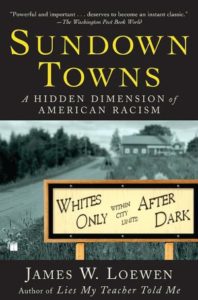
Published 2018 by The New Press
ISBN:1620974347
(ISBN13: 9781620974346)
“…although many former sundown towns are now integrated, they often face ‘second-generation sundown town issues,’ such as in Ferguson, Missouri, a former sundown town that is now majority black, but with a majority-white police force.”
Oh how shall I its deeds recount
Or measure the untold amount
Of ills that it has done?
From China’s bright celestial land
E’en to Arabia’s thirsty sand
It journeyed with the sun.
O’er miles of bleak Siberia’s plains
Where Russian exiles toil in chains
It moved with noiseless tread;
And as it slowly glided by
There followed it across the sky
The spirits of the dead.
The Ural peaks by it were scaled
And every bar and barrier failed
To turn it from its way;
Slowly and surely on it came,
Heralded by its awful fame,
Increasing day by day.
On Moscow’s fair and famous town
Where fell the first Napoleon’s crown
It made a direful swoop;
The rich, the poor, the high, the low
Alike the various symptoms know,
Alike before it droop.
Nor adverse winds, nor floods of rain
Might stay the thrice-accursed bane;
And with unsparing hand,
Impartial, cruel and severe
It travelled on allied with fear
And smote the fatherland.
Fair Alsace and forlorn Lorraine,
The cause of bitterness and pain
In many a Gaelic breast,
Receive the vile, insatiate scourge,
And from their towns with it emerge
And never stay nor rest.
And now Europa groans aloud,
And ‘neath the heavy thunder-cloud
Hushed is both song and dance;
The germs of illness wend their way
To westward each succeeding day
And enter merry France.
Fair land of Gaul, thy patriots brave
Who fear not death and scorn the grave
Cannot this foe oppose,
Whose loathsome hand and cruel sting,
Whose poisonous breath and blighted wing
Full well thy cities know.
In Calais port the illness stays,
As did the French in former days,
To threaten Freedom’s isle;
But now no Nelson could o’erthrow
This cruel, unconquerable foe,
Nor save us from its guile.
Yet Father Neptune strove right well
To moderate this plague of Hell,
And thwart it in its course;
And though it passed the streak of brine
And penetrated this thin line,
It came with broken force.
For though it ravaged far and wide
Both village, town and countryside,
Its power to kill was o’er;
And with the favouring winds of Spring
(Blest is the time of which I sing)
It left our native shore.
God shield our Empire from the might
Of war or famine, plague or blight
And all the power of Hell,
And keep it ever in the hands
Of those who fought ‘gainst other lands,
Who fought and conquered well.
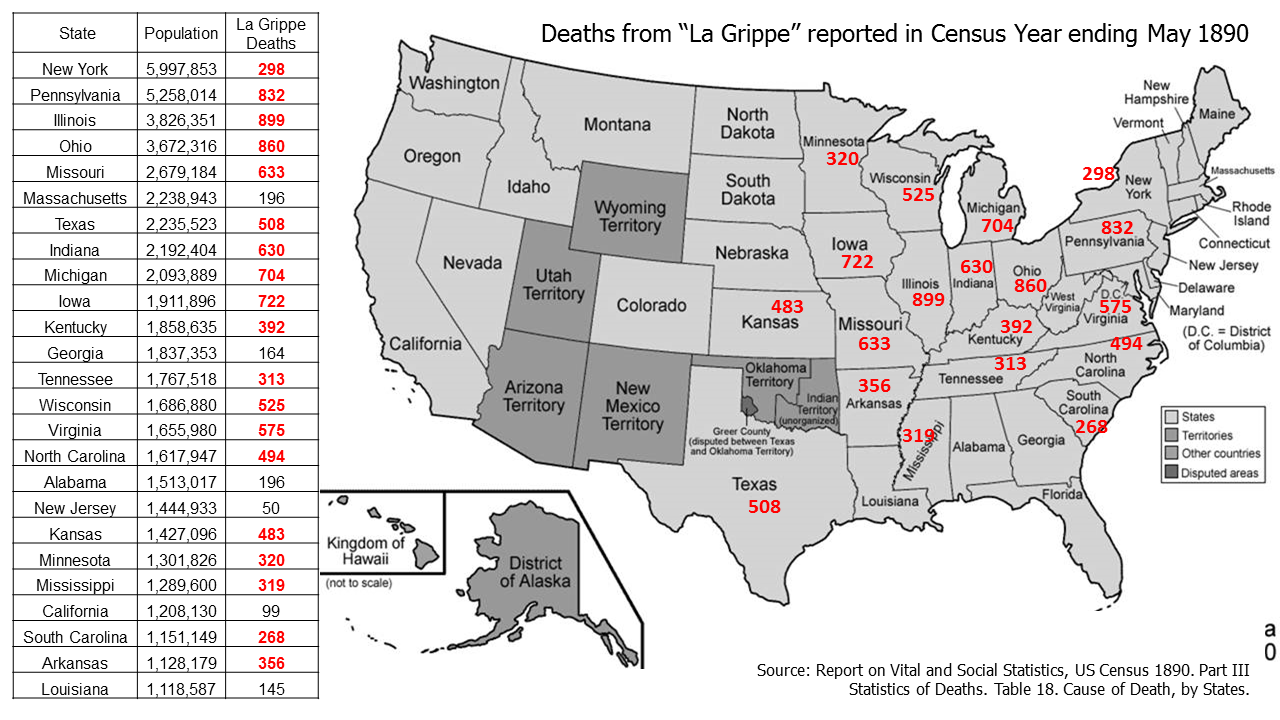
E. Thomas Ewing, Veronica Kimmerly, and Sinclair Ewing-Nelson, “’Look Out for La Grippe’: Using Digital Humanities Tools to Interpret Information Dissemination during the Russian Flu, 1889-1890.” Medical History Vol. 60, Issue 1 (January 2016), pp. 129-131. DOI 10.1017/mdh.2015.84
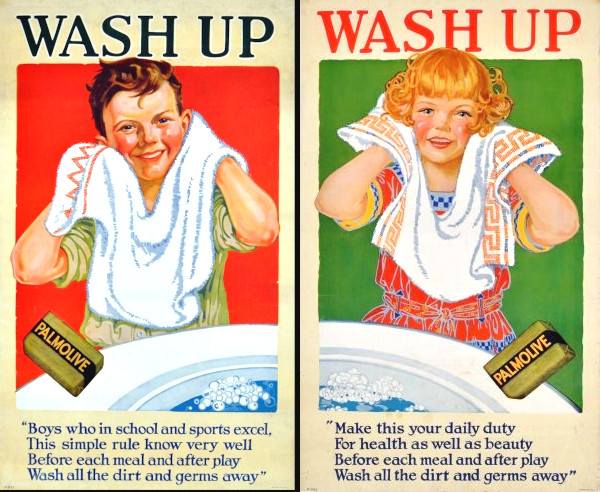
Milwaukee’s Palmolive 1920s marketing campaign about basic safety, a major messaging shift to social good away from their late 1800s imagery that made them world famous (exotic cleanser suitable for Egyptian Pharaohs).
These coronavirus quarantine times,
Definitely need some new soap rhymes.
Plenty of soap sits on shelves all around the world, yet toilet paper and hand sanitizer are disappearing far too quickly, leaving shelves barren. Why? I’d say it’s a lack of action by nations to run anti-hoarding public service announcements (e.g. it’s illegal in many places) as well as pro-soap safety slogans and information campaigns.
The economics of ignoring science
First of all, psychologists believe that hoarding behavior during a crisis is related to a sense of control. It’s ironic because hoarding exhibits instead both a lack of control as well as a transfer of power from the individual to large corporations known to use their fortunes to further reduce individual control.
Toilet paper in some cultures, for example, represents training people from a very early age on healthy living habits in a very inexpensive bulk retail format. Buying huge amounts of paper at low cost arguably feeds into a tribal association with a fundamental product for keeping oneself clean and safe.
Water and soap would of course be cleaner than toilet paper. Studies report how infections decrease among those who use a bidet, so a spike in bidet installations and decrease in paper would be beneficial for multiple reasons. Yet when someone starts to panic it may not be an ideal time for them to shift into thoughtful things like washing with soap at the toilet instead of paper (although data suggests it is starting to happen anyway).
Thus, hoarding is about people in faith-based toilet paper societies needing to feel in control of their cleanliness and safety if a novel virus starts to scare them. Buying rolls of paper feeds directly into feelings of something tangible being done, to avoid feelings like loss of control. It’s a primitive but effective trauma coping mechanism.
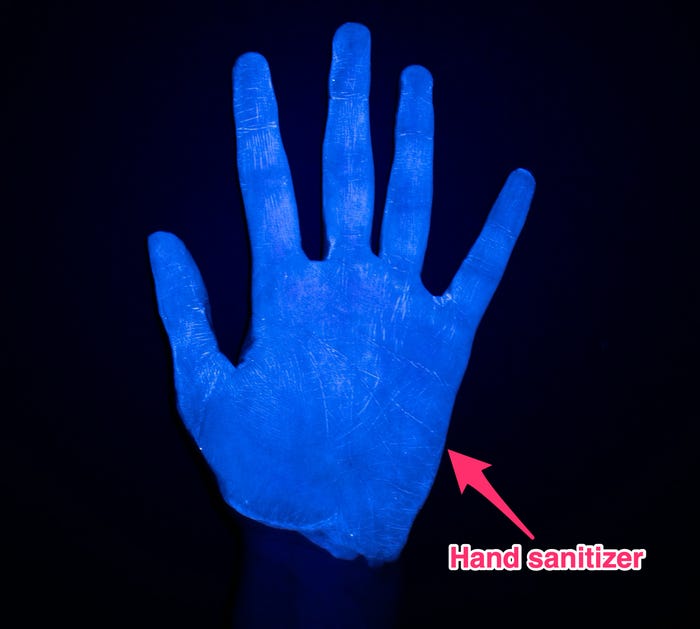
People also have developed a kind of blind faith in hand sanitizer. Unlike paper, sanitizer benefits mostly from slick marketing that manages to squeeze popular perception of control into an unremarkable pump bottle or box of tissues. Sadly, on that note, the marketing often is entirely deceptive and unsafe because it doesn’t work at all as advertised:
The front of the package doesn’t mention that it’s alcohol-free; the back includes small print that lists benzalkonium chloride as the active ingredient and the label “alcohol-free formula.” Nowhere on the Amazon product listing does it say it’s alcohol-free.
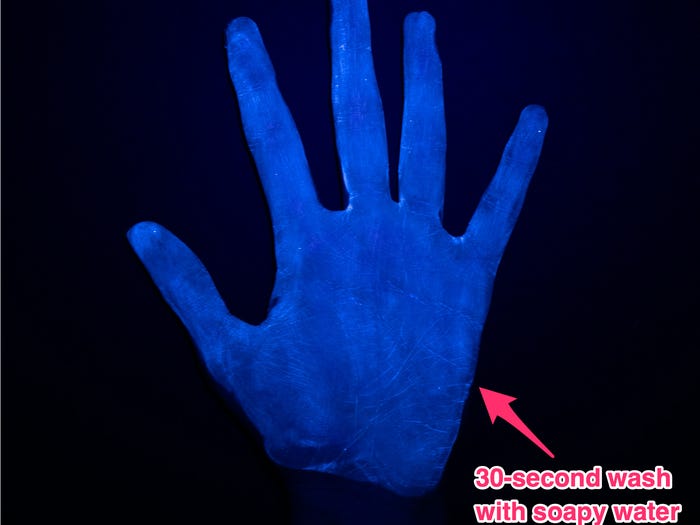
Here’s another take on it from Supramolecular chemistry expert Palli Thordarson who tweeted out why soap with water is superior:
The scientist went on to explain that disinfectants, wipes, gels and creams containing alcohol – hand sanitisers – are effective at killing bacteria, but don’t break down the structure of the virus. […] The Tweets come after Dr Norman Swan also declared soap was better on ABC’s 7.30 program.
There is no real comfort or any advantages to the sanitizers only more risks (such as toxic additives and false advertising) versus other known safer and more effective options such as soap and water.
One of the crazier things I hear, for example, is that hand sanitizer is more “convenient” because you don’t always have water with you. This of course begs the question of why you can have hand sanitizer with you if you can’t carry a small bottle of water?
Another thing I hear is that hand sanitizer saves time. And that is exactly the problem with it. Doing a 20 second minimum of soap and water washing is what makes it so effective. Going faster turns out to be less effective for both, plus you often find people squirting sanitizer multiple times and rubbing for 20 seconds anyway.
More to the point, being out and about in the real world with exposure to things like dirt, dust and oils makes sanitizer even less effective versus hand washing with soap. But again, hoarding is evidence of people seeking feelings of control through retail therapy, not about them making smart life choices.
Despite these facts, sales research shows percentages are up massively for sanitizer while soap doesn’t even make the chart
Hoarding is a crime
Second, there is of course is another explanation. Hoarders actually are predatory criminals aiming to corner a disaster market and profit from artificial scarcity that they hope makes them rich as they slowly kill their neighbors.
Amid coronavirus fears, this couple has made more than $100,000 reselling…
“The woman ahead of me bought $2,000 worth of thermometers,” said Zapatak.
The only people really benefiting from such panic and hoarding of goods are large conglomerates like the Koch family that dominate an industry and who infamously tend to stoke panic in democracies by claiming absurdly false things like Eisenhower was a Communist.
…reflect and amplify the least evolved parts of our biology and behavior: the remorseless struggle for survival that is the highest achievement of the reptilian part of our brain and the fears, rages and insecurities that flourish in primitive parts of our limbic system, our emotional brain.
Just remember, the more your reptilian brain parts panic buy things like sanitizer and toilet paper instead of locally sourced soap, the more a giant Koch empire is working to undermine democracy, not to mention you’re probably stockpiling a product that denies it to someone who actually needs it.
What is really on point now is a round of public service announcements and posters to remind people to stay calm and lather.
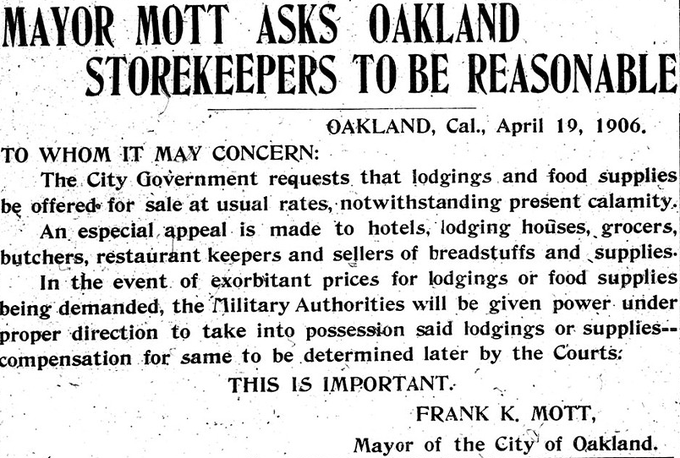
During the Great Fire of San Francisco, for example, the Oakland Mayor simply said businesses that use surge pricing during disasters (e.g. the entire predatory business concept of Lyft and Uber) would have their assets confiscated by the military.
Instead of that, several states (at least California, Washington and New York) had to direct Amazon to block gouging crimes based on hoarders. New York also committed to producing 100,000 gallons per week of it’s own public version of hand sanitizer, safer than the misleading commercial/private labels, for distribution wherever Amazon’s hoarders had attacked.
With the current absence of leadership ability in federal government on this topic, perhaps Amazon security staff could take it upon themselves to hack into anyone detected on their platform using gouging practices and seize assets for Amazon to redirect/redistribute. I suppose that’s like a man-in-the-middle platform attack by the platform itself, as hoarders would get no money in a sale and the product would be intercepted when it shipped. Probably too much legal red tape and coordination among private sector executives for that to work.
But seriously, law enforcement could be sent to these criminal-minded hoarding caches to seize their ill-gotten assets and redistribute via Amazon to vulnerable populations:
…they watched the list of Amazon’s most popular searches crowd with terms like “Purell,” “N95 mask” and “Clorox wipes,” sellers said, they did what they had learned to do: Suck up supply… Mr. Colvin does not believe he was price gouging. While he charged $20 on Amazon for two bottles of Purell that retail for $1 each, he said people forget that his price includes his labor, Amazon’s fees… “I’m not looking to be in a situation where I make the front page of the news for being that guy who hoarded 20,000 bottles of sanitizer that I’m selling for 20 times what they cost me.”
That’s right, Mr. Colvin believes his fellow citizens deserve to be gouged or dead because illegal hoarding isn’t free for him (just think of the legal fees alone to stay out of jail and avoid angry mobs) and Amazon wants a cut of his hoarding. Perfect example of market failure and why privatized systems can be the worst thing during times when societies need collaboration and cooperation the most.
One doctor, in a desperate appeal to get people to stop hoarding and start donating instead, explained it like this:
If doctors and nurses die because of inadequate protection, all the toilet paper and dried pasta in the world won’t save you.
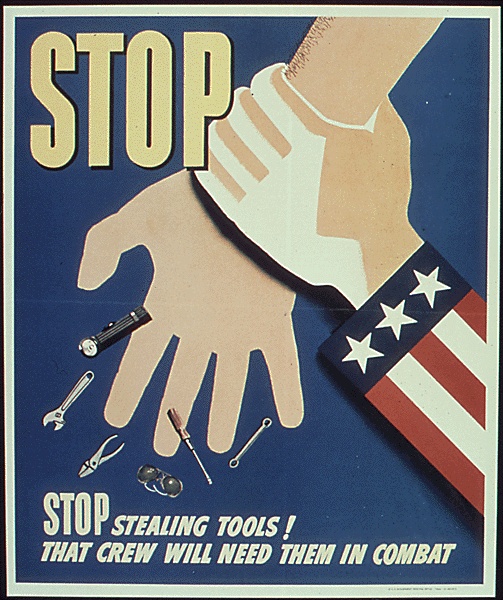
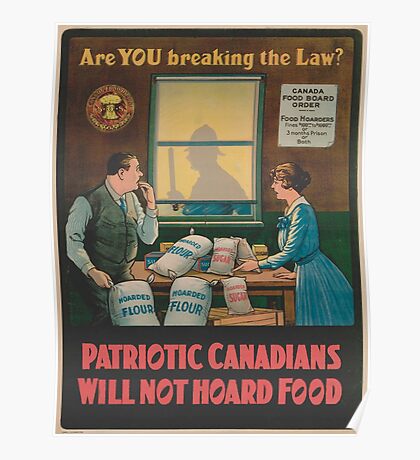
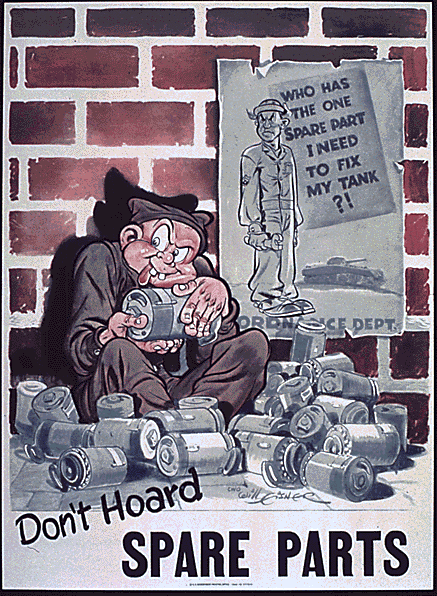
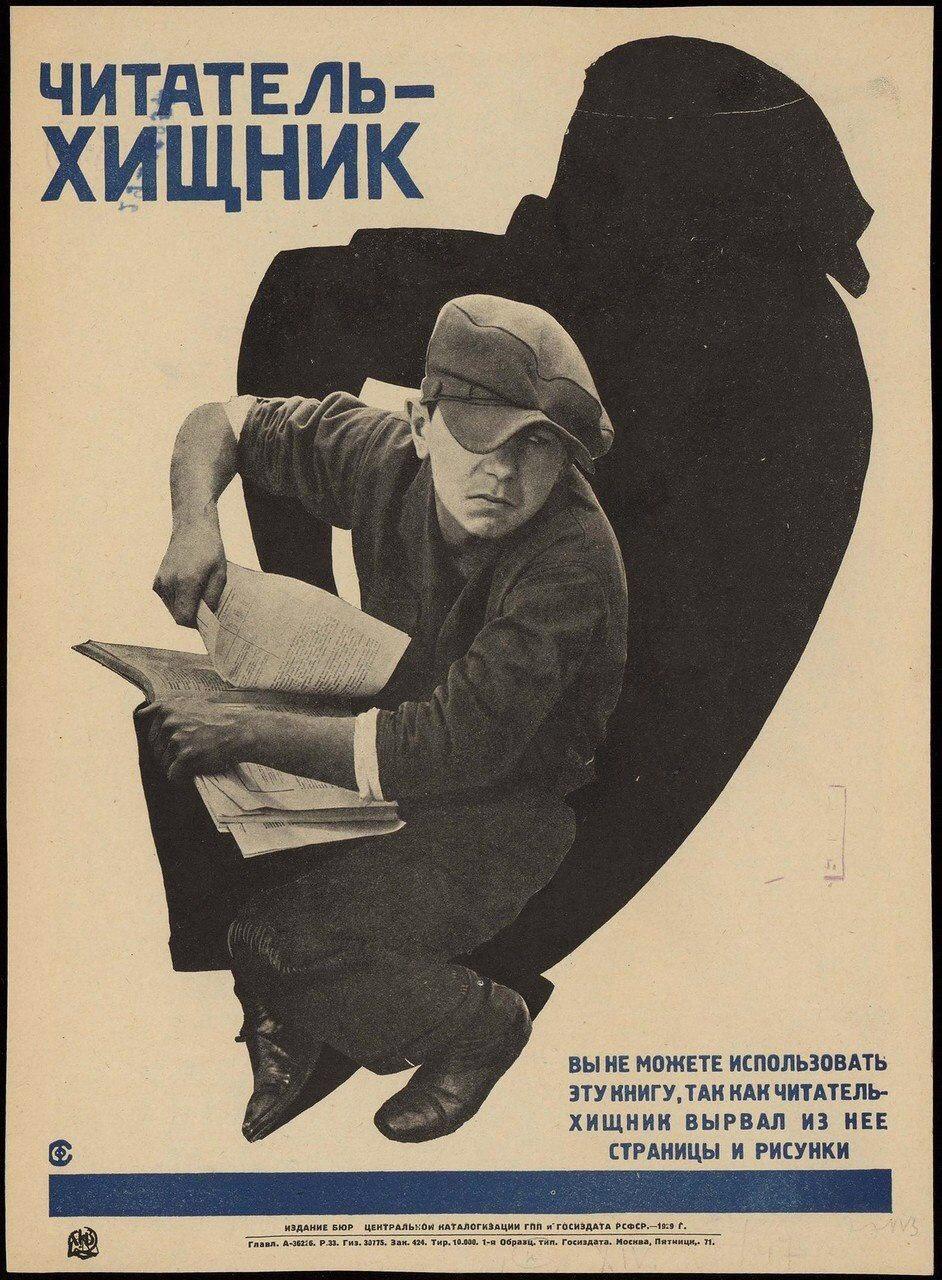
There are many other examples of hoarding behavior in history of war (coronavirus has very similar dynamics as nations going to war) and how the hoarders were dealt with, so it’s a wonder nobody in government anywhere seems to be creating modern versions of these types of public service campaign posters.
And perhaps the best example of all, a Soviet poster warning to watch out for people who steal paper from books.
a blog about the poetry of information security, since 1995