Two days before bombs hit Tehran, on February 28th, JD Vance sat in a White House planning meeting and advocated for the most aggressive option on the table: “go big and go fast” was the Vance push, White House sources told the press. Not a limited strike.
Not a diplomatic offramp. All in.
This is the same JD Vance who wrote a Wall Street Journal op-ed titled “Trump’s Best Foreign Policy? Not Starting Any Wars.”
The same Vance who told a podcast audience in October 2024 that war with Iran would be “a huge distraction of resources” and “massively expensive.”
The same Vance who called himself a “skeptic of foreign interventions” in the Washington Post just one day before the planning meeting where he pushed to escalate to an unprovoked, illegal full scale war with Iran.
The retrospective rewrite and cynical disinformation project is already underway to cover his tracks. Sources “close to the Vice President” told CBS that Vance was “personally against the strikes” but argued that if they happened, the operation should go big. His earnest advocacy for a maximum strike option is in fact what made the “if” question moot. Trump cynically called it “no aborts“.
“Operation Epic Fury is approved,” Mr. Trump said, according to the Times. “No aborts. Good luck.”
The recent Vance disinformation campaign transforms a primary advocate into a reluctant realist. It’s the sad McNamara move of the Vietnam War. Oppose in private as rational, escalate in practice as political, publish the memoir later claiming the escalation was someone else.
How Robert McNamara Came to Regret the War He Escalated: The ‘architect of the Vietnam war’ never formally apologized, but struggled with its consequences for the rest of his life
The evidentiary record already makes this harder to run than McNamara’s Vietnam version.
The Ledger
Date
Statement
Early 2023
WSJ op-ed: “Trump’s Best Foreign Policy? Not Starting Any Wars.”
September 2024
Pennsylvania rally: vote Trump to prevent “God forbid a world war.”
October 2024
Podcast: “Our interest, I think very much, is in not going to war with Iran.” Called it “a huge distraction of resources” and “massively expensive.”
February 27, 2026
Washington Post interview: “no chance” of prolonged conflict. Called himself a “skeptic of foreign interventions.”
February 28, 2026
White House planning meeting: per NYT, “intensely questioned” Joint Chiefs and CIA — but did not oppose the strike.
March 1, 2026
Strikes launch. Vance in the Situation Room. Silent on X for 48 hours while every other senior official issued public support.
March 3, 2026
Fox News: “President Trump will not get the United States into a years-long conflict with no clear objective.”
March 3, 2026
White House sources reveal Vance architected the “go big and go fast” full scale war. Vance sources try to counterspin he opposed the war in private.
Read the table again, top to bottom.
That sequence is the argument.
Source Asymmetry
The competing leaks have different credibility profiles. White House sources had no incentive to inflate Vance’s hawkishness. If anything, Trump’s inner circle benefits from showing the VP was on board — it demonstrates consensus, not division. Vance’s people, by contrast, had every incentive to minimize. When two sets of anonymous sources contradict each other, ask who benefits from each version. The answer tells you which one to trust.
Trump himself split the difference on camera, saying he and Vance were “philosophically, a little bit different” but that Vance was “quite enthusiastic.” That’s not a man covering for his VP. That’s a man who doesn’t think there’s anything to cover for. We know Trump and what he does if he sniffs disloyalty to his warmongering.
The Photo
The White House released two photos of Rubio with Trump at Mar-a-Lago as the strikes launched. One photo showed Vance in the Situation Room, the vice-presidential seal where the presidential one normally sits, flanked by Gabbard and Bessent.
He was not sidelined. He was operational.
That image is counterproof to any future claim that he wasn’t really in favor or involved.
The Pattern
Officials who privately oppose a war, then advocate for its most aggressive execution once it becomes inevitable, then retroactively claim they were the voice of caution have a name in the historical record.
The McNamara play.
Robert McNamara’s detailed private doubts about Vietnam didn’t surface usefully until In Retrospect was published in 1995, three decades and millions of deaths after the doubts allegedly began.
Harold Ford’s CIA review of the memoir showed how it worked: McNamara selectively quoted the Board of National Estimates to make it appear they had confirmed the domino thesis, when they had actually questioned it. He cited only the parts that supported his position and omitted the conclusions that contradicted it. Ford correctly called McNamara out for standing history on its head.
The Vance version is already running: CBS sources frame “go big” as a conditional position taken only after personal opposition failed, while the White House sources who were in the room describe advocacy, not reluctance. The selective quotation and disinformation spin hasn’t even waited for a memoir. It’s happening in real time, through Vance unleashing his anonymous source army, before his war is a week old.
The private doubt is not the interesting part, even as it is developed into a footnote. The public action is the actual record, and JD Vance pushed “big” into another endless war. Colin Powell’s private reservations about Iraq didn’t prevent him from delivering the UN presentation that sold the war. We remember him for one and not the other.
Vance built his political career on claiming he opposed exactly the thing he did when tested. The WSJ op-ed, the rally speeches, the podcasts were not offhand remarks. They were the architecture of a brand, which all landed the opposite way of what he said. The brand was cashed in for an unnecessary war he helped escalate without clear objectives.
The Rivalry Frame Is the Trap
Most coverage has fallen into drama about a Vance-Rubio rivalry: who’s up, who’s down, who got the better photo op. That’s the “reality” TV frame of palace intrigue that displaces interest in accountability. Whether Vance or Rubio is better positioned for 2028 doesn’t mean much. The question is actually what Vance advocated in the room on February 28, and whether the war he helped shape matches the war he told Americans would never happen.
Marjorie Taylor Greene, of all people, identified the core issue:
I want to know where the hell is JD Vance… Because if they stand by and are silent, they’re turning their back on the same words they said.
When MTG is the one holding you to your anti-war commitments, the inversion is complete.
Vance’s silence was not indecision, it was disinformation.
He is plotting a way to preserve his anti-war brand for 2028 in the shadow of the war he helped escalate into a quagmire. Generating Trump-like flip-flop ambiguity about where he stands on anything is more valuable to him than clarity. That calculation depends on the war timeline staying blurry.
The timeline is clear. Vance said go big into Iran and he owns it now and forever.
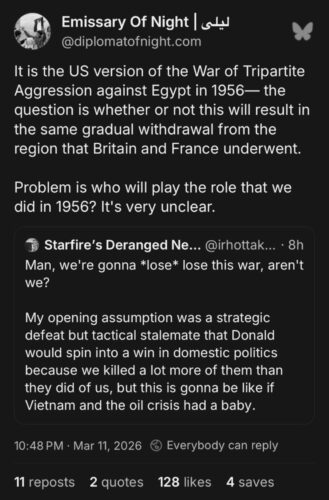
A thread on Bluesky was forwarded to me that compared the US-Israeli war on Iran to the 1956 Suez Crisis, or the “War of Tripartite Aggression” as it’s called by some.
Their argument is we are in America’s Suez moment, and the question is who forces the withdrawal the way Eisenhower forced Britain and France out of Egypt.
It’s wrong. The parallel doesn’t fit. And the reason it’s wrong is far more dangerous if people keep seeing 1956.
1956 Crisis Was Remarkable for the End
President Eisenhower, a seasoned WWII military general, had the motivation and leverage to end the conflict in Suez. That sentence contains two requirements, not one, and both were specific to the architecture of the postwar order.
Eisenhower had personally spent a decade building the global security structure that American hegemony depended on: NATO, SEATO, Bretton Woods, the dollar as reserve currency, bilateral defense agreements across the Middle East. All of it rested on the structural premise that the United States was the sole legitimate authority over when Western military force gets deployed. He led the Allied defeat of Nazi Germany and in history stands as the exact antithesis to Trump.
Britain and France going into Egypt without American authorization wasn’t a policy disagreement. It was an attempt by weakened rival powers trying to reassert colonial-era authority by making war decisions inside the American security perimeter.
If that precedent stood, the entire modern “united” architecture of nations was negotiable.
Eisenhower also had a Soviet timing problem. The Suez invasion came the same week as a dramatic Soviet invasion of Hungary. Eisenhower wanted Hungary for optics to fracture Soviet legitimacy. He could have said look at what empire does, look at the tanks in Budapest, except his own allies were running a colonial invasion in Egypt.
The moral framework justifying the entire Cold War strategy collapsed if the “good” guys were as bad or worse than the Soviets.
The American President flexed, hard, to put the British and French back in their seats. He threatened to dump Britain’s sterling reserves and block IMF support. The threat was specific, credible, and existential to the British economy, from the man who had saved Britain from Hitler. Eden folded within days. Britain and France withdrew. Eisenhower took a moral stand against Germany (he was directly responsible for documentation of the Holocaust) and pivoted it into the definitive end of European colonial military power in the Middle East.
The key word in all of this is architect. Whether or not Eisenhower acted on principle, he was protecting the law and order building he had built. The rules-based international order, which meant the American-dominated order as a result of WWII, was his structure to keep the world spinning safely. He was compassionate, brave and intelligent but more important to history he was willing to defend the laws of conflict.
No Eisenhower Today
The Suez model requires someone who built something, or owns it now, and is willing to sacrifice to protect it. Who stops Trump from repeatedly committing crimes? Look at who holds leverage today and ask whether either condition is met.
China has the most obvious card. They hold over $750 billion in US Treasuries. They’re the manufacturing backbone of the American consumer economy. Iran is already letting Chinese ships through the Strait of Hormuz while blocking Western ones. Beijing owns a mediator’s position without asking for it, and they aren’t saying much. Perhaps they are learning too much about American weakness to stop America from revealing themselves. They could tell Washington: we’ll keep the Strait open for everyone through our relationship with Tehran, but the price is you stop. The problem is for every F-15E shot down by friendly fire, for every American military facility bombed by Iranian drones, China gains invaluable intelligence to defeat an overextended and over budget America.
China also wants a different architecture, not the preservation of this one. They’d play the Eisenhower card to extract concessions, not to restore systemic stability. That makes them a transactional actor, not a global architectural one. Eisenhower sacrificed the special relationship with Britain to protect the legal system of conflict resolution. China is a competitor that would sacrifice the system to improve its position within it.
The EU has the more structurally Eisenhower-shaped tool. The dollar’s reserve currency status depends on European financial institutions continuing to clear through it. If the ECB and European banks started building euro-denominated energy settlement infrastructure, which the Hormuz crisis is practically begging them to do, that’s the slow-motion version of Eisenhower’s sterling threat. Not a dramatic sell-off, but a structural migration that Washington can’t reverse once it starts. We already have seen EU institutional investors unhitch their wagons from Trump.
The European project is, in principle, an architectural bet. The whole thing is a rules-based order scaled to a continent. But the EU spent seventy years subcontracting its security architecture to Washington as a foundation. Using Eisenhower’s leverage means admitting that the contractor went nuts and you need to rebuild it yourself. That’s not a diplomatic adjustment. That’s a civilizational decision, and nothing in the current European leadership suggests that appetite exists beyond rhetoric. Don’t vacation in NYC. Stop using Google. Ok.
So neither has both requirements. China has leverage without architectural motivation. The EU has architectural identity without the urge to use its leverage. And neither has what Eisenhower had most essentially: the position of the expert builder, someone who treats the international order as their own very specific work product rather than something they inherited or hope to replace.
This Is 1940, Not 1956
If 1956 is the model where an architect intervenes, 1940 is the model where nobody does, meaning everyone gets dragged in by the gravity of their own dependencies.
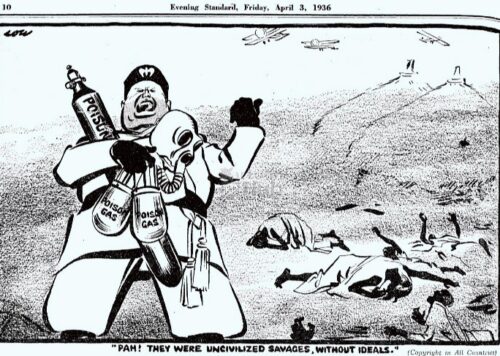
Nobody was motivated to enter a North Africa theater, except Mussolini. Not Hitler. Not the British, who planned a five-day raid and got a three-year campaign. Not the Australians, New Zealanders, South Africans, Indians, or Free French who fought there. The theater emerged because Mussolini was a horrible impatient fraud who created a cascading failure that no single power had the authority or motivation to stop. Every subsequent actor entered not by choice but by compulsion to stabilize the inherent chaos of fascism. Germany couldn’t let Italy collapse. Britain couldn’t let Egypt fall. The Commonwealth couldn’t let Britain fight alone. The United States couldn’t let the Mediterranean become an Axis lake. And the lesson of Mussolini’s invasion of Ethiopia in 1935 hung over all of it; the League of Nations’ failure to act then made the cascading drag-in inevitable later.
That’s the pattern unfolding now.
Iran retaliates against Gulf states that hosted American assets. Qatar stops gas production and declares force majeure. Oil hits $119. European energy security is threatened for the second time in four years. The E3 deploy “defensive” military assets to the region. Insurance companies close the Strait of Hormuz more effectively than the Iranian navy did. China gets preferential transit. Japan begs for strategic reserve releases. Qatar’s energy minister warns that continued war will “bring down economies of the world.”
Every actor is being dragged in by dependencies on stability, not by choice to fight for order. That is the key structure of 1940, unlike 1956.
Builder, Tenant, Arsonist
The reason the Suez parallel attracts is (besides more recent) that it implies a resolution mechanism. Somewhere out there is a hero, a responsible adult with leverage who will call a halt to stupidity of Trump’s toddler-like rants. But the 1956 resolution depended on a specific power relationship and rational actors: the aggressor (Britain) was a junior partner dependent on the intervener (the US). Eisenhower could discipline Eden because Eden needed American financial support to survive, and Eden arguably wasn’t someone who would put an Elon Musk in charge of anything and show up in the Epstein Files.
Trump isn’t even close to being an Eden. He can’t be disciplined by a senior partner because his entire existence is proof he never listens. He’s Mussolini in many ways, the deranged hot-headed initiator whose failures create cascading obligations for everyone else. And Netanyahu isn’t playing a subordinate role that can be overruled from above. He’s the catalyst who understood, correctly, that once the war starts, American sunk costs make withdrawal politically impossible. The junior partner traps the senior partner by making the senior partner’s credibility dependent on the junior partner’s war.
This is exactly how Mussolini and Hitler came to entrench in failures. Italy’s North Africa disaster pulled Germany sideways. If the southern Mediterranean fell, the entire Axis position was open to attack. Hitler committed the Afrika Korps not because it was a German strategy but because Mussolini dragged him. The dependency ran upward.
Someone on Bluesky described the likely outcome as “if Vietnam and the oil crisis had a baby.” That captures the domestic experience of quagmire plus economic shock. Yet the structural model remains 1940: a cascading multi-actor catastrophe where the war becomes everyone’s problem not because anyone decided to make it stop, but because the interdependencies won’t let anyone walk away.
The Slide
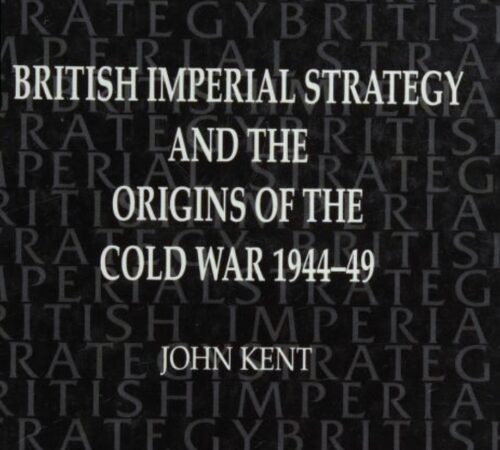
I studied this dynamic at the LSE under Professor John Kent in the History department. One of Kent’s major works, British Imperial Strategy and the Origins of the Cold War 1944-49, documented the process by which systemic architectural ownership transfers. He laid out that it only transfers when someone wants the outcome badly enough to pay for it.
His core thesis was that the Cold War’s origins weren’t simply US-Soviet ideological confrontation. They were about the collapse of British imperial architecture and the contest over who would replace it. Britain in 1944-49 was trying to maintain its role as systemic guarantor of the Middle Eastern and Mediterranean security order. This was not out of nostalgia, but because the architecture of British global power ran through Suez, the Gulf, and the Eastern Mediterranean.
I unfortunately remember well trying in a seminar, as a young and dumb student, to convince Professor Kent that America was motivated by oil. Pssshaw he said, warning me sternly that Americans don’t read enough to know their own history, in between bites of a cucumber and cream cheese sandwich.
When Britain couldn’t afford to maintain their role (still struggling from WWII), the US stepped in not out of principle but because the vacuum threatened American interests. Truman took over the British position in Greece and Turkey in 1947 because the alternative was Soviet influence in the Eastern Mediterranean. Eisenhower could discipline Eden at Suez in 1956 precisely because the US had already replaced Britain as the architect. Eden was a tenant trying to act like a boss, and Eisenhower reminded him of the global end of white supremacist doctrines.
Kent’s framework makes the current absence explicit. The Eisenhower moment at Suez wasn’t a one-off act of statesmanship. It was the culmination of a decade-long architectural transfer. And the reason there’s no Eisenhower now is that no equivalent transfer has happened. Nobody has taken ownership of the system the US was supposed to still be capable of running, instead of currently setting itself on fire.
The question Kent taught us to ask wasn’t “why do wars start” but “why do wars spread.” The answer, over and over, is that wars spread when the costs of intervention are high but the costs of non-intervention are structurally higher. Every actor faces a local calculation that makes joining cheaper than staying out, even though the aggregate result is catastrophic for everyone.
That’s where we are. The EU can’t afford another energy crisis but can’t afford to break with Washington. China can’t afford Middle Eastern instability but can’t afford to confront the US directly. Gulf states can’t afford Iranian retaliation but can’t afford to deny the US basing rights. Iran can’t afford to keep fighting but can’t afford to stop while bombs are falling. Everyone’s local logic says “keep going.” Nobody’s structural position says “stop.” That’s a 1940 slide again.
In 1956, one man could stop it because he had built the system and valued it more than any single relationship within it. In 1940, nobody could stop it because nobody had built anything they valued more than their own survival. The system didn’t have an architect. It just had tenants looking around for help while their building was being set on fire.
Mussolini always talked like Trump or even Pete Hegseth. It’s easy, it’s ahead of schedule, breaking all the rules means finishing faster. None of that was or is true. Italy sleepwalked into a three-year, multi-nation war across North Africa and lost everything. Mussolini planned a quick advance to Sidi Barrani. He was hanged.
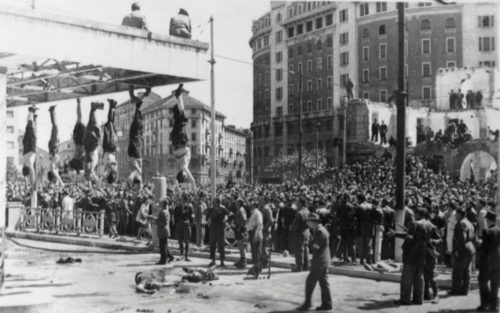
Italian dictator Mussolini was hanged (with his mistress) before he could be tried for his war crimes.
Donald Trump bombed Iran claiming he would achieve overnight success just like the 24-hour victory he promised in Ukraine. Two weeks of open-ended waste later, his administration is leaking three “small” ground operation plans to Axios like a contractor explaining why the bathroom remodel now requires structural work on the foundation.
Former intelligence analyst Harrison Mann writes in Zeteo that all three options risk dragging the US into a forever war.
He’s right.
And I’m here as a historian to tell you this pattern is older than he suggests. We aren’t just seeing bad plans. We are seeing failed plans, the exact same three mistakes Mussolini made in North Africa in 1940.
Anyone remember that guy? His military bravado failed for the same structural reasons that Trump will.
Three Plans DOA
The options leaked to Axios and elaborated across Bloomberg, NBC, and Semafor are:
Plan 1: SOF raids on nuclear sites — seize Iran’s near-bomb-grade enriched uranium with commandos and nuclear scientists. Secretary of State Rubio told Congress that to secure the material, “people are going to have to go and get it.” The problem, as a US official admitted: “The first question is, where is it?” UN inspectors haven’t verified the stockpile’s location in nine months.
Plan 2: Seize Kharg Island — a strategic terminal handling roughly 90% of Iran’s crude oil exports. Take the revenue chokepoint, squeeze the regime.
Plan 3: Seize the Strait of Hormuz islands — take the islands flanking the strait to force it open for commercial shipping. Trump told CBS he was “thinking about taking it over.”
Each plan is the opposite of what is being described, because it is a trap.
History tells us why.
September 1940
Mussolini ordered Marshal Graziani to invade Egypt from Libya in September 1940. Italy had roughly five-to-one numerical superiority over the British garrison. The plan was limited: advance to Sidi Barrani, establish a forward position, consolidate. A contained operation with a defined objective.
The British response, Operation Compass, was initially planned as a five-day raid with about 30,000 troops. Within two months it had destroyed the Italian 10th Army and captured 130,000 prisoners. The “limited” Italian advance created a “limited” British counterattack that metastasized into a three-year, multi-nation theater stretching supply lines across the entire Mediterranean.
Italy’s failure most famously sucked Hitler to deploy Rommel and the Afrika Korps — an entanglement Germany couldn’t afford led by a bombastic aggressor who couldn’t stop losing. What began as Mussolini’s colonial adventure burned resources that the Axis depended on, accelerated Axis defeat, and created the confidence and conditions for Allied liberation of Southern Europe.
Every one of those consequences was produced by very simple logic: seize a point, then defend the point, then supply the defense, then defend the supply lines, then supply the defense of the supply lines.
The three Iran plans reproduce this logic exactly without asking the higher-order question of whether the position is necessary or defensible.
Plan 1 Is an SAS Raid That Requires an Occupation
The commando raids deep behind Axis lines in North Africa — SAS, LRDG, Popski’s Private Army — worked precisely because they were hit-and-run. The moment any raid required holding a position, it needed conventional forces to follow.
You don’t “seize and dilute” enriched uranium with a quick raid. You penetrate hardened underground facilities with sparse intelligence. You establish a security perimeter. You bring in scientists and equipment. You run a multi-day technical operation. You extract under fire. Every hour on the ground is an hour the perimeter can be probed, the extraction route interdicted, the political cost escalated.
This isn’t a raid. It’s a temporary occupation of an unknown number of fortified positions deep in hostile territory. Graziani also thought he was running a limited forward operation.
Israel just ran this on a micro level to open a grave and return the bones of Ron Arad. They not only didn’t find the bones, they barely survived.
Plan 2 Is Tobruk
Axis and Allied obsession with Tobruk and Benghazi in the North Africa campaign came down to a single principle: whoever held the sea port controlled the logistics of the entire theater. Despite air capabilities, vulnerable slow ships and thirsty truck convoys bogged down the strategy. Kharg Island is the same calculus because it is believed to control 90% of Iran’s oil export revenue, and you control the regime’s survival.
But Tobruk taught the corollary: holding a strategic point 25 kilometers off a hostile coast means permanent exposure to shore-based fire, and the garrison becomes a logistics sink that devours resources disproportionate to its strategic value. The Siege of Tobruk lasted 241 days. The Australians held it, but holding it consumed shipping, air cover, and reinforcements that couldn’t be used for offensive operations elsewhere. And when they lost control the centralized retribution campaigns were devastating.
Kharg Island sits 25 kilometers off the Iranian coast. Iran has an estimated stockpile of up to 6,000 sea mines, suicide drones, fast attack boats, and anti-ship missiles. The island becomes a target the moment you take it, and every ship supplying the garrison runs a gauntlet.
Plan 3 Is Fortified Coastal Libya
Malcolm Nance planned this exact scenario on USS Coronado in 1988 when he served with Commander, Middle East Force. His assessment: the US could take all the islands flanking the Strait of Hormuz, but “the cost in American lives would be horrific.” The islands are overlooked by mountains on the Iranian mainland, and ships passing through would still face mines, suicide boats, drones, and combat swimmers with limpet mines.
This is the Italian fortification of coastal Libya — static positions that look formidable on a map but become traps when the adversary can interdict supply from the mainland and the high ground. The Strait of Hormuz could be “pried open,” Nance concluded, but the ships passing through would still be at overwhelming risk from asymmetric threats. You hold the point, but holding the point doesn’t secure the lines of communication that make the point worth holding.
The Italians built an elaborate chain of fortified coastal positions across Libya. The British drove through them in weeks.
The Recursive Trap
Mann identifies the core paradox: the closer US forces get to Iranian soil, the more US technological and firepower advantages are negated. Air superiority doesn’t protect a commando from an IED. A carrier strike group doesn’t stop an RPG aimed at a landing helicopter.
North Africa in WWII demonstrated this point repeatedly.
Rommel’s entire campaign was ultimately throttled by his unsound tactics of ignoring logistics; the impossibility of overextended high cost operations at the end of lines that were themselves under attack. The obedience of the Afrika Korps evaporated the moment their fight became attritional rather than maneuverist.
Mann also names the reason the paradox isn’t treated as such: for Iran hawks in Israel and the US, the quagmire is their strategy. Trapping Trump in a ground commitment raises the odds of Iranian state collapse. This puts Netanyahu in the Mussolini role, a junior partner who launches the provocation, expecting the senior partner to provide the escalation force that prevents collapse. Hitler didn’t expect to focus on North Africa. He got it anyway, because Mussolini failures were trumped up as a critical southern flank.
The EuroIntelligence assessment published today frames Trump’s three actual choices starkly: declare mission accomplished and leave (with the Strait still insecure), keep bombing as if the Strait will open (with no regime change), or conclude that the Strait is never safe while this regime exists and send in ground troops. They believe we’re in scenario two. The markets aren’t able to decide. But scenario two has a structural tendency to become scenario three, for the same reason Graziani’s advance to Sidi Barrani became Operation Compass became the Afrika Korps became El Alamein became the liberation of Sicily.
A “limited” seizure of a strategic point creates a requirement to defend that point, which easily creates a requirement for more forces, which extends supply lines, which creates new vulnerabilities requiring yet more forces.
That’s the documented history of what happens when leaders who expected an overnight victory to “accomplish” a mission start looking for small, palatable next steps.
Mussolini said his options were small. He ended up hanged for it.
Italian dictator Mussolini was hanged (with his mistress) before he could be tried for his war crimes.
Eleven days into the bombing of Iran, the United States has struck over 3,000 targets, killed the Supreme Leader, destroyed the state broadcaster’s headquarters, hit a parliament building, bombed a girls’ school full of children, mined the news cycle with claims of victory, and accomplished exactly nothing that wasn’t predictable, reversible, or counterproductive.
American “force projection” officially is degraded.
Iran elected a new Supreme Leader in eight days, while Trump said they weren’t allowed to do that. Its missile launch rate dropped 90% according to the Pentagon, which sounds decisive until you notice that the remaining 10% has still killed eight American service members, injured 140 more, struck US bases across the Gulf, hit civilian targets in Israel, shut down the Strait of Hormuz, grounded all flights out of Qatar, and turned every Gulf state hosting American forces into a target. The 90% number is a tactical metric being presented as a strategic outcome. It is neither.
American “dominance of the skies” officially is degraded.
There’s no denying drones are getting through. There’s no turning back that three F-15E fighters were shot-down by America’s own “dominance” system. The world learns to just watch and wait as “punch down” war criminals like Hegseth are sucking oxygen out of American state podiums.
הקונספציה (The Conception)
Trump unilaterally waded into the most predicted war in modern history. Not predicted as in “analysts warned it could happen.” Predicted as in the specific sequence of provocation escalation, failed negotiations, Israeli strikes, US involvement, Iranian retaliation against Gulf states, Strait of Hormuz closure, coalition fragmentation was ALL described in writing by dozens of analysts, think tanks, war games, and intelligence assessments over the past two decades.
MAGA literally means go back to the days before we had so much intelligence to do the dumbest things possible, as if it will turn out differently by pretending nothing has been learned.
The Millennium Challenge 2002 war game simulated a US-Iran conflict and the red team sank a carrier group on the first day using exactly the kind of asymmetric tactics Iran is now employing. The Pentagon’s response was to restart the exercise with rules that prevented the red team from winning.
That was twenty-four years ago. The institutional response to being told the strategy would fail has been, for twenty-four years, to adjust the simulation until the strategy succeeds on paper. And then Trump came along.
קו בר-לב (The Bar Lev Line)
I wrote twelve years ago a detailed analysis of President Nixon’s folly called Operation Igloo White. And I’ve given many presentations about it since.
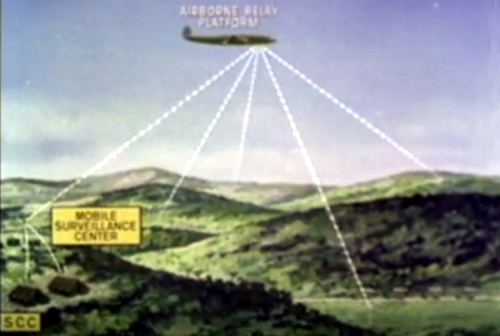
The billion-dollar-a-year sensor-to-shooter network the US Air Force dropped along the Ho Chi Minh Trail from 1967 to 1973. Twenty thousand sensors, relay drones, IBM mainframes, precision airstrikes. It cost $30 million in orbiting aircraft and command infrastructure to hit $5,000 trucks carrying $2,000 worth of rice. The programme ran for six years.
The Iran campaign is the Big Tech debacle of Igloo White at national scale. The most expensive precision strike capability in history directed at an adversary who has designed their systems to absorb exactly this kind of punishment and grow in capabilities. The IRGC operates with pre-delegated launch authority. Missile units are dispersed. Drone production is distributed across the country. The leadership succession mechanism activated within hours of Khamenei’s death. The system was designed to survive decapitation because the Iranians spent forty years watching what the US does to centralized command structures.
The US strategy assumes the adversary doesn’t learn or listen and remains conveniently fragile. I can’t believe I’m seeing the Vietnam War strategic failures made again as if none of it mattered to American brass. The adversary is not fragile. The adversary read the history and so this becomes a question of who follows a curve in the road ahead to slowly cross a chasm and who has a case of mode confusion (drives high speed forward off the side of a bridge).
טוהר הנשק (Purity of Arms)
On the first day, the Shajareh Tayyebeh girls’ school in Minab was double-tapped by US missiles. At least 180 people were killed, rising by the day, most of them girls aged seven to twelve.
The school had been walled off from an adjacent IRGC naval base for over a decade, since 2013. That separation is clearly visible in commercial satellite imagery for that whole decade. NPR’s analysis, confirmed by three independent experts, assessed the strike as part of a precision attack on the adjacent military complex using targeting data that was never updated, did not reflect a school’s clear separation from an old base.
Red Crescent medics reported the double-tap mechanism used: after the first strike, the principal moved surviving students to a prayer hall and called parents. The second strike is what killed the children as it hit them sheltering in a prayer hall. Minab’s mayor says the school was struck three times.
Trump tried to push obvious propaganda, diminishing himself and America, by claiming without any reason or evidence that Iran bombed itself. Meanwhile the video geolocated by Bellingcat shows a cruise missile striking the compound, which an independent weapons expert assessed as inconsistent with any known Iranian-made design. Is anyone surprised that Trump is out of touch with basic reality, covering up his role in systemic harm to little girls?
Sixty-nine children’s remains are still being identified by DNA.
This is a known deadly military coordination gap. Many of us are steeped in the logic, as it killed forty-two people at the MSF hospital in Kunduz in 2015. The information that should have prevented the strike existed in a system somewhere. It did not reach the person who pushed the button. Consider how Palantir feeds this as a for-profit slop system that sponges money even as it becomes less accurate, proliferating the exact threats that it bills itself as targeting.
At Kunduz, the hospital’s coordinates were in the database but not in the fires chain. The purple hat Palantir incident was an intelligence analyst who proved the software deeply flawed compared to what was in his head. At Minab, the school’s separation from the base was visible to everyone from the ground and from space but apparently not to those operating the American target set.
At Kunduz, the US apologised, investigated, paid compensation. At Minab, the President of the United States said the Iranians did it to themselves.
מיצרי טיראן (The Straits of Tiran)
Iran is predictably laying mines in the Strait of Hormuz. One-fifth of the world’s crude oil transits the strait. Trump wants people to know only a “few dozen” mines have been laid so far, and sixteen mine layers are sunk, but Iran retains over 80% of its small boats and minelayers and an estimated 2,000 to 6,000 mines in stock. The opening move is not the end of a campaign.
The strait remains functionally closed. Tanker operators are refusing to transit. Supertanker costs have hit record highs. Major marine war risk providers have scrapped cover for vessels in the Persian Gulf. Qatar has grounded all commercial aviation. Insurance markets have repriced the entire Gulf.
Trump ordered the Navy to escort tankers through the strait. The Navy is refusing “near-daily” escort requests from shipping companies, saying risks are too high. The president is writing checks the Navy won’t cash.
Here’s the truth about Trump: in late 2025 he decommissioned the four Avenger-class minesweepers stationed in Bahrain. He cut the ships specifically designed for this mission. Their replacements, Independence-class littoral combat ships, cannot do the job. Naval News assessed them as unable to meet operational mine countermeasures requirements.
Trump removed the tool, then announced he would solve the problem he created, with no way to deliver.
America tripped over Trump clown shoes into the asymmetric response that every war game predicted and every policy maker ignored. Iran cannot match US air power. It was never going to try. It was always going to attack the coalition’s economic logistics because that is the thing the coalition cannot live without and cannot defend everywhere simultaneously. The Gulf states who were told this war would be quick and contained are now absorbing Iranian strikes on their oil facilities, their ports, their airports, and their civilian populations because they host the degraded and confused American forces.
The coalition fragments as the costs are falling on countries dragged into this war. Spain denied basing rights and got repeatedly bashed and threatened by Trump. Kuwait infamously destroyed a 50 year F-15E combat record by downing three in one night with friendly fire. Bahrain is taking missile strikes on its naval facilities. Qatar suspended Ramadan public gatherings. This is what happens when the strategy assumes a Nazi-blitzkrieg doctrine will somehow work today even though it lost everything in WWII. American popular opinion started low and is only going down, a pain threshold already reached, while the adversary does not collapse.
אין ברירה (No Choice)
Trump says he’s ahead of schedule every week, like how Elon Musk promised driverless cars nationwide by 2017 and landing on Mars by 2018. These pathological liars will say four to five weeks, a couple months, by the end of the year, about anything. The Iranians say they’re prepared for a long war and have a very long record of making it happen. The arithmetic is straightforward.
The US is expending precision-guided munitions at a rate that is not sustainable. Hegseth has publicly admitted he can’t keep it up. The stockpile problem that emerged in Ukraine, where production rates couldn’t keep pace with consumption, applies here for a larger target set and a faster tempo. Tomahawks are roughly $2 million each. The US has fired hundreds as if this is the most important war in its history, blowing everything at once. The replenishment pipeline is being measured in years, not weeks.
Iran’s expensive assets like ballistic missiles, launchers, and air defenses are depleting as expected. Meanwhile its cheap assets of naval mines, commercial drones, proxy networks, and the simple geographic fact of the Strait of Hormuz are either inexhaustible or irrelevant to destroy. America cannot bomb a strait open. America cannot precision-strike a mine that hasn’t been laid yet. America cannot destroy the idea that Gulf oil infrastructure is targetable when every tanker operator on earth has just watched it get targeted.
The US strategy requires Iran to capitulate before the coalition’s costs overflow and willingness to pay ends. Hegseth refusing to publicly discuss even the first six dead soldiers, and then Trump refusing to honor them, speaks to just how weak the administration is already. Iran’s strategy requires the coalition to fracture before Iran’s military capacity is fully degraded. The difference is that one side defined its breaking point before the war started (decades of planning a quagmire), and the other side assumed the breaking point wouldn’t matter because the media cycle could be saturated faster than casualties could be buried without recognition or respect.
This is the definition of a forever war. Not a war that lasts forever, but a war that lasts longer than the media-controlled strategy assumed, fought at costs higher than the strategy budgeted, against an adversary more resilient than the strategy modeled, producing outcomes more destabilizing than the strategy predicted.
שלום הגליל (Peace for Galilee)
The US keeps resetting its objectives to avoid being called out on them: degrade Iran’s nuclear programme, destroy its missile capability, induce regime change. Eleven days in, the nuclear facilities have been struck but Iran’s enrichment knowledge cannot be bombed. The missile capability has been degraded but not eliminated, and the asymmetric alternatives have not been touched. The regime changed when Khamenei’s son replaced his father in eight days, and the IRGC pledged allegiance, where the institutional structure continued without interruption.
The definition of success keeps shifting to avoid being held accountable, like how Tesla and SpaceX juiced Wall Street for a decade while failing to reach objectives. First it was “degrade and deter.” Then it was regime change. Netanyahu addressed the Iranian people in Farsi and told them to take to the streets. They came out to mourn the 180 little girls bombed in Minab and rally behind their government. Some still protested, as they had in January before the bombs started falling. The bombing failed to create a unified opposition. Instead it appears to have created a more unified country.
Daniel Levy, former Israeli government adviser, told Al Jazeera that Israel has “no real interest in smooth regime change” and is more interested in the principle of neighboring state collapse — Iran imploding, with the spillover destabilising Iraq, the Gulf, and the region. If that’s the actual objective, like how apartheid operated with South Africa destabilizing its neighbor states, then the strategy is working exactly as designed. It’s just not the strategy anyone sold to Congress, to the Gulf allies, or to the American public.
המצב (The Situation)
Iraq, 2003: shock and awe, decapitation strikes, mission accomplished, twenty years of occupation and insurgency.
Libya, 2011: air campaign, regime change, state collapse, a decade of civil war and migrant crisis.
Afghanistan, 2001-2021: the longest war in American history, ended with the Taliban back in power.
In every case, and I could go back even more years, the air campaign succeeded tactically and the strategy failed because it assumed that destroying the adversary’s visible military capacity would produce a political outcome it could not produce.
Iran is not Iraq, Libya, or Afghanistan. It is larger, more industrialised, more geographically defensible, and its population is more unified by external attack than divided by internal grievance. The assumption that this time a complicated strategy will work because the understanding is simplified with terms like “precision” is not a strategy. It repeats the exact mistake of Korea and Vietnam. Remember why Davy Crockett M-28/M-29 and Tarzon VB-13 were non-starters? We are witnessing prayers and wishes heavily inflated to a $2 million price tag per unit.
So the forever war everyone predicted is hard to deny this week, and looks like it only will get worse. The question was never what would happen. The question was always how long it would take for the people who started it to admit that the strategy they were sold is the same strategy that has failed every time it has been tried, at every scale, against every adversary that was prepared to absorb the punishment and wait.
The Ho Chi Minh Trail sustained logistics through six years of the most expensive sensor-to-shooter network ever deployed. Those who study, know. Iran has been preparing forty years for this moment. The question is not whether American precision munitions can choose Iranian targets and report narrow mission accomplished repeatedly. They obviously can. The question is whether destroying any of these targets produces any actual outcome the strategy requires. The answer, eleven days in, is the same answer it was on the Ho Chi Minh Trail, and in Iraq, and in Libya, and in Afghanistan.
No.
a blog about the poetry of information security, since 1995