Category Archives: History

October 2019: U.S. Punched Tape Crypto Keys Retired

Computer Business Review ran a fairly low-profile story of historic significance

…agency spokesman confirmed to Computer Business Review that the last NSA punched tape key had rolled off its machines on October 2, 2019. Such keys were used to encrypt military and other communications, and needed to be physically entered into devices that could store the key, then shipped around the world.

The technology, which uses paper-mylar-paper tape rolls punched with holes to store cryptographic keys (a hole represents a binary 1, and the absence of a hole a binary 0) remains in use in the UK, particularly by the Ministry of Defence.

The NSA only confirmed the end of the programme and declined to provide an image of the now obsolete kit.

The agency declined to provide an image, there are plenty to be found of ROCKEX, the punched tape crypto system essential to winning WWII

It also signals here a more successful project than ten years ago when an “overly ambitious and poorly executed” attempt was reported as “came to a crashing end“.

Difficulty in ending tape still plagues the UK, and they have worries about the public shame of it.

“The authority has a huge challenge to produce all those keys and then it’s got a challenge to distribute and install them all. I won’t describe what happens. But if Joe Public knew, you would think this was all a bit 1960s really.”

“Lean In — That Shit Doesn’t Work”

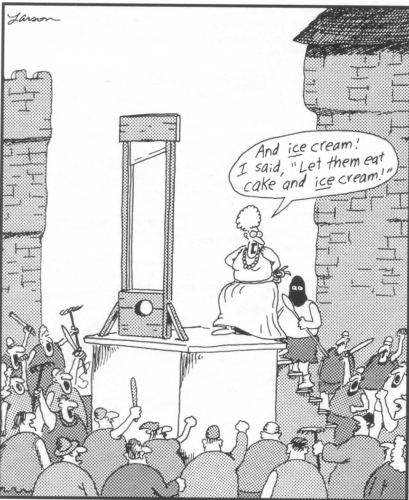
Michelle Obama, who obviously speaks truth to power, doesn’t believe at all in the “Lean In” concept. The title of this post comes from her being quoted in a new Wired story about the aristocratic methods of Facebook’s COO (referred to as an empress).

Wired points out how “Lean in” instead soon may be more known as some sick “shit”, fast becoming the “Let them eat cake” of our times.

Last ditch attempt to avoid charges of aiding the enemy and inciting civil war

Aiding the enemy and inciting civil war are quite literally the same things that the French Aristocracy and Facebook’s executives have been accused of…am I right?

The Wired piece is an excellent dive into the how and why Facebook leadership worked to hack people into bits they could profit from; a form of human exploitation and mining of assets.

The “chiefs” overseeing Facebook’s industrial-scale hacking of humans took on such aristocratic airs, there’s probably a book to be written about what that looked like in terms of mental health. They arguably have gone mad in their race for wealth accumulation.

Some of my neighbors in San Francisco literally lost their grip on reality by working one day a week in Facebook’s human exploitation mills, amassing piles of cash to spend on luxury goods and cake-filled offices and homes of isolationism.

Encoded Songs of General “Harriet” Tubman

Today is the day, that new Civil War movie I recently wrote about is released in theaters, documenting the life of American hero and abolitionist General “Harriet” Tubman. It’s long overdue, considering how important and well known her story should be for every American.

This “be free or die” movie is a hugely historic event in America and definitely should not be missed.

The movie delay isn’t alone. Recently I also wrote about the slow pace to restoring dignity to the $20 bill, replacing the disgraced face of genocide and slavery (President Jackson) with hers. It seems a bit odd that anyone would balk at removing Jackson’s tyrannical face, given how a heroic Tubman design stands ready to liberate the currency.

Consider how the U.S. treated Iraq, for example, where not even a year passed before new currency was rushed out to remove a tyrant’s face.

But less than six months after the war was declared over, Iraqis queued outside exchange points across the country yesterday to swap Saddam’s smiling face on the old banknotes for bills bearing images of ancient Babylonian rulers and historic monuments. “We’re liberating the currency,” said Ali Hussein, the manager at Wahda Bank in central Baghdad, one of 250 branches in the city where Iraqis can exchange old notes dinar-for-dinar with the new. “We’re urging people to change their money as fast as possible so that we can get rid of his ugly face for good.”

Even more odd is how the movie-industry has been unwilling to honor or depict the amazing story of Tubman in theaters, despite her being one of the most famous American heroes in history.

So that’s why it’s so significant, as today marks the first feature-length movie about Tubman ever seen in theaters, over 100 years after 1913 when she was buried with military honors at Fort Hill Cemetery in Auburn, New York.

One of the key elements I am looking forward to is how General Tubman made extensive use of encoded songs in winning the war.

In the past I’ve written about Kumbaya and Calypso for this topic of encoding, and hope to see the movie driving discussion of underground railroad secret codes and also her security poetry.

  • Tubman used “Wade in the Water” to tell slaves to get into the water to avoid being seen and make it through. This is an example of a map song, where directions are coded into the lyrics.
  • Steal Away communicates that the person singing it is planning to escape.
  • If slaves heard Sweet Chariot they would know to be ready to escape, a band of angels are coming to take them to freedom.
  • Follow the Drinking Gourd suggests escaping in the spring as the days get longer.
  • Unnamed song sung by Harriet Tubman when approaching her group after taking a detour to get food for the day. This song lets them know it is safe to approach her.
  • Another unnamed song sang in the same situation but letting them know it is not safe to come out, there is danger in the way.

2015 Russian-made Radio Repeaters Infected With “Virus”

Back in 2011 I looked at a cartel’s encrypted radio system in Mexico and wondered aloud…

The first question that jumps to mind, however, is how secure and well monitored a relay could be in the remote locations?

Recently I also wondered aloud about the U.S. unilateral withdrawal from Syria and Africa as opening the door to unregulated Russian military exports.

Now a recent conference on electronic warfare sheds light on what that may mean for countries expected to start using Russian deals to fill the vacuum left by America’s withdrawal:

In 2015, Pavlenko said that Russia had been able to engage in mass sabotage of Russian-made radios that Ukraine was using at the time by triggering some sort of kill switch, which he described as a “virus,” remotely.

This raises questions about what sort of failsafe devices Russia may be hiding inside the military equipment it sells to partners around the world, which could allow them to disable key features remotely if those countries were to turn on them for any reason. The tactic also appears to have had the secondary benefit of forcing Ukrainian forces to switch to much more vulnerable commercial radios and cellular networks, which the Russians then also relentlessly attacked.

Nowhere has it been made clear what it means to say a virus or its kill-switch can be remotely activated on Russian-made radio repeaters, although it likely either intercepts traffic, blocks it or both.

Also I have not seen anyone mention that 2015 was 116 years after Emile Guarini Foresio invented the directed antenna for radio relay repeaters. The software controllers for repeaters may be new and laced with bugs, yet this radio architecture is fundamentally old technology.
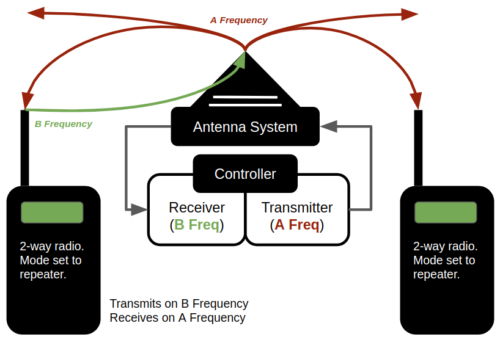
Interesting to me now is a re-read of the 2016 story about a new military radio service launching in Ukraine:

Starting from March 1, 2016, Ukraine will have a radio service for the military, said Oleksiy Makukhin, an advisor to the Ukrainian defense minister. […] The creation of the radio station will be funded by Spirit of America, a United States charity based in California. […] The content will be transmitted via satellite in the FM-band.

It has been reported that satellites were not affected by any Russian attacks on radio communications in the Ukraine, and analysts attributed it to the fact Russia and Ukraine shared satellite services.

As soon as the U.S. started to withdraw from northern Syria the Russian equipment and troops started to deploy there under an agreement with Turkey.

However, the electronic warfare conference news report also mentions that sanctions against Russia have blocked key components and degraded the effectiveness and maintenance of their large inventory of electronic weaponry.

That suggests a threat today isn’t exactly what it was in 2015, unless Russia’s expanding market starts buying equipment from them with a new remote kill switch built-in despite sanctions.