Category Archives: History

Drones With Lasers Reveal Human Secrets

Archaeologists are only a few steps removed from forensic scientists looking for crime scenes, if you know what I mean.

Rewriting history now is even easier than ever because drones can speed the discovery of buried things:

…airborne laser scan of the area has found 900 previously unknown archaeological sites on Arran, promising to rewrite the 6,000-year human history of the island…

Given how much can be revealed and how fast, the next technology shift may have to be artificially intelligent archaeologists that can keep up with laser workloads:

Francisco Estrada-Belli, another member of the archaeological team, told National Geographic: “The fortified structures and large causeways reveal modifications to the natural landscape made by the Maya on a previously unimaginable scale.

“Lidar is revolutionising archaeology the way the Hubble Space Telescope revolutionised astronomy.

“We’ll need 100 years to go through all the data and really understand what we’re seeing.”

One group that isn’t waiting any time to jump (pun not intended) to conclusions are the operators on military missions.

The operators use a tablet and special software to designate an area of interest, dispatch a drone to scan it, and then – in a matter of hours – automatically compile the sensor readings into a 3D map so detailed you can even distinguish different species of trees.

I guess you could say operators are seeking places to hide that others could use as much as themselves.

The next step from 3D maps is to attach photo-realistic data. Nearly five years ago AutoDesk boasted of their ability to 3D map anything on their cloud using drone photography. Earlier this year Here engineers said pushing photographic-level details to operators at city-wide scale is hitting performance bottlenecks, yet already is being done.

This opens up huge new ethical issues, including adversarial response and countermeasures to seeing and being seen, as the geospatial experts in the defense industry already have been flagging:

Efforts to correct mistakes, respond to disasters, or map poverty warm the heart. But other aspects of geospatial intelligence are rife with ethical challenges, from potential invasions of privacy to the violation of the confidentiality of individuals who agree to provide income or other demographic information. “Don’t expect lawyers to catch up,” warned Schwartz. “There are going to be guidelines that need to be created by those who are doing the work.”

[…]

“The reason we exist is to give advantage to our country,” said Munsell, “and as director [Robert] Cardillo used to say, ‘to never allow a fair fight.’”

Never allow a fair fight.

Austria Espionage Card Index 1849-1868

The neo-absolutist state secret service kept an espionage card index for surveillance of Vienna residents 1849-1868.

Here’s an example I captured from a museum’s archive:

Encyclopedia Britannica explains the living conditions during this period, also called “centralization with a vengeance“, not terribly far from where some in the U.S. want things to go today:

Freedom of the press as well as jury and public trials were abandoned, corporal punishment by police orders restored, and internal surveillance increased. The observation of the liberal reformer Adolf Fischhof that the regime rested on the support of a standing army of soldiers, a kneeling army of worshippers, and a crawling army of informants was exaggerated but not entirely unfounded. One of the more backward developments was the concordat reached with the papacy that gave the church jurisdiction in marriage questions, partial control of censorship, and oversight of elementary and secondary education. Priests entrusted with religious education in the schools had the authority to see to it that instruction in any field, be it history or physics, did not conflict with the church’s teachings.

California Posts CCPA Proposed Regulations

The California Attorney General (AG) Xavier Bacerra has posted Proposed Regulations to implement the California Consumer Privacy Act of 2018 (CCPA). Bacerra also has posted a Notice of Proposed Rulemaking Action (NOPA) and an Initial Statement of Reasons (ISOR).

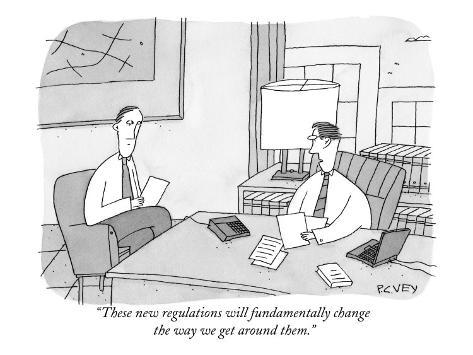
Critics already are playing up that they can’t do business if they have to follow regulations set to protect privacy of consumers. These lobbying types are, of course, peddling risk management nonsense in the face of far too many breaches and a long slide downward of consumer confidence in data platforms.

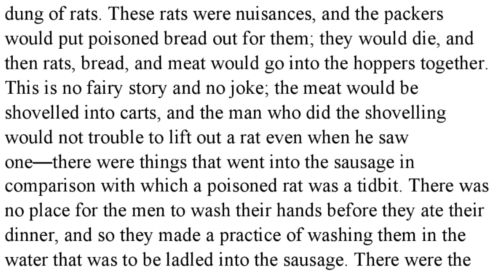
The current round of criticism reminds me of those opposed to food safety regulations even after Upton Sinclair’s 1906 book The Jungle pointed out how rats and workers’ body parts were being ground up and shipped as sausage.

Cloud providers are like sausage factories, especially the largest ones, and for far too long have been allowed to operate without basic duties of care, deliberately avoiding innovation investment because avoiding accountability for harms. And yes, Facebook is the wurst.

Those of us actively innovating in information technology see regulations such as CCPA as welcome guard rails, which spur long overdue innovations in data platform controls and help the data platform market grow more safely.

The proposed regulations set out some clear “shall not” of consumer personal information:

(3) A business shall not use a consumer’s personal information for any purpose other than those disclosed in the notice at collection. If the business intends to use a consumer’s personal information for a purpose that was not previously disclosed to the consumer in the notice at collection, the business shall directly notify the consumer of this new use and obtain explicit consent from the consumer to use it for this new purpose.
(4) A business shall not collect categories of personal information other than those disclosed in the notice at collection. If the business intends to collect additional categories of personal information, the business shall provide a new notice at collection.
(5) If a business does not give the notice at collection to the consumer at or before the collection of their personal information, the business shall not collect personal information from the consumer.

They also set out clear timelines for requests to delete data:

(a) Upon receiving a request to know or a request to delete, a business shall confirm receipt of the request within 10 days and provide information about how the business will process the request. The information provided shall describe the business’s verification process and when the consumer should expect a response, except in instances where the business has already granted or denied the request.
(b) Businesses shall respond to requests to know and requests to delete within 45 days. The 45-day period will begin on the day that the business receives the request, regardless of time required to verify the request.

EU Court: Holocaust Denial is not Protected Speech

General Eisenhower wisely and famously wrote to General Marshal in 1945 that we need to protect the future by carefully documenting the past:

I made the [Buchenwald concentration camp in Thuringia, Germany] visit deliberately, in order to be in position to give first-hand evidence of these things if ever, in the future, there develops a tendency to charge these allegations merely to “propaganda.”

Presidential archive copy of a letter from General Eisenhower to General Marshall, April 15, 1945.

General Patton and others wrote similar records of disgust at what they saw, as well as concern with the German people’s ability to operate around and in these death camps as if genocide was just business as usual.

And now a smart ruling has been heard from the European Court of Human Rights that should have an immediate and serious impact to data platform safety regulation:

Pastoers’ argument that his statements were protected by Article 10, which protects freedom of expression, was “manifestly ill-founded,” given that he “had intentionally stated untruths in order to defame the Jews and the persecution that they had suffered,” the Strasbourg, France-based court ruled on Thursday. His complaint that he was denied a fair trial in Germany was also rejected by the ECHR.

Pastoers had given a speech a day after Holocaust Remembrance Day in 2010…

[…]

The tribunal said the German had deliberately obscured some of his remarks to try to get his message across more subtly.

“The impugned part had been inserted into the speech like ‘poison into a glass of water, hoping that it would not be detected immediately,’” the court said.

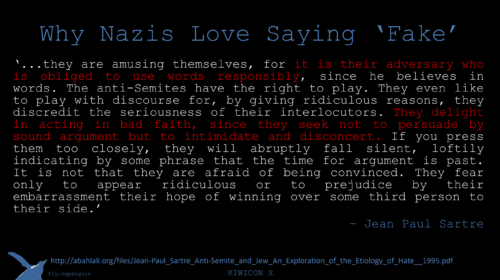
An example of hidden Nazi messages in daily communications is one of the most popular blog posts I’ve ever written. Detecting it isn’t the hard part.

Acting upon it has been the bigger issue, as Google, Twitter and Facebook executive management have repeatedly and intentionally declined to block poisonous speech. They operate a philosophically and historically misguided willingness to profit as Americans from dispensing known harms that seriously damage markets around the world.

For example, documented hate group FAIR in the last year alone has spent $934,000 on Twitter ads, $910,000 on Facebook ads, and $111,000 on Google/YouTube ads.

…founder, John Tanton, has expressed his wish that America remain a majority-white population: a goal to be achieved, presumably, by limiting the number of nonwhites who enter the country.

Another way of looking at this is Facebook records income from dispensing poison:

From May 2018, when Facebook began publishing its archive of political and social advertisements, to September 17, 2019, at least 38 hate groups and hate figures, or their political campaigns, paid Facebook nearly $1.6 million to run 4,921 sponsored ads. Some ads call undocumented immigration an “invasion.” Others claim that LGBTQ people are “evil.”

“This is an astounding amount of money that’s been allowed to be spent by hate groups,” Keegan Hankes, interim research director of SPLC’s Intelligence Project, told Sludge. “It reaches a lot of people with some very toxic ideologies. Obviously that’s incredibly worrisome, if not a little unsurprising given Facebook’s track record specifically around these ideologies.”

Even more to the point, Facebook has hired people into executive positions with intent to undermine democracy through dispensing misinformation:

Harbath is Facebook’s head of global elections policy. She literally worked for Rudy Giuliani. I can’t make this up.

And insider threats in data platforms who are virulently anti-democracy and who like to use hate dissemination and misinformation techniques are not something to be surprised about, as I presented at Kiwicon in 2016.

Hate groups flock towards technology positions, and attempt to insert or influence staff there, like criminal syndicates attracted to bank jobs.