Dave Troy provides a long thread on Twitter explaining the roots and objectives of Parler, a technology platform. He also boils it all down to this single Tweet:
Non-descript tech bro randomly meets ostensible Russian honeypot, travels to Russia, marries her, then returns to US to start a whacko social network with explicit political aims, in partnership with Russia aligned ops…
This should have been the description in the app store, along with a note that it’s funded by:
…conservative hedge-fund investor Robert Mercer and his daughter Rebekah.
This data also should be presented to anyone claiming they both care about censorship yet also demand their views be posted by others, as these are quite contradictory; sentiments the Russian military intelligence plays upon.
Baseless demands to have one’s own views posted on someone else’s site tends to bring to mind the openly pro-Nazi organization in 1933 called Friends of New Germany. Led by a man named Spanknoebel, he was tasked by Nazi Germany with merging older organizations of Gau-USA and Free Society of Teutonia. They then engaged in violent anti-freedom activities such as physically attacking a German language New Yorker Staats-Zeitung with… demands that pro-Nazi views and pro-Hitler propaganda must be published.
“We must succeed, for heaven is with us,” Spanknoebel declared in his address. “We have honest men for leaders. There are no pogroms in Germany, but the Hitler regime is showing us an entirely new way of dealing with the Jewish question.” […] Spanknoebel assailed the proposed Dickstein investigation bitterly and placed Hitler on a parallel with President Roosevelt for leadership. Dr. I. T. Griebel, president of the local branch of the Friends of the New Germany, attacked Bernard Ridder, publisher of the New Yorker Staats Zeitung….
Trouble at the meeting had been freely predicted for several days.
Hopefully everyone can see freedom of speech does not in any way mean the right to violently attack a publisher and demand they publish pro-Nazi propaganda, which has been tried before in America and fortunately failed.
And going to Parler does not in any way mean supporting freedom of speech. That just sounds to me like a repeat of when radio broadcaster in the late 1930s Paul Ferdonnet exiled himself to Nazi Germany.
After WWII ended he was tried, convicted and executed by France as a war criminal. His allegiance was with personal power and hate, not his own country, population or its democratic institutions.
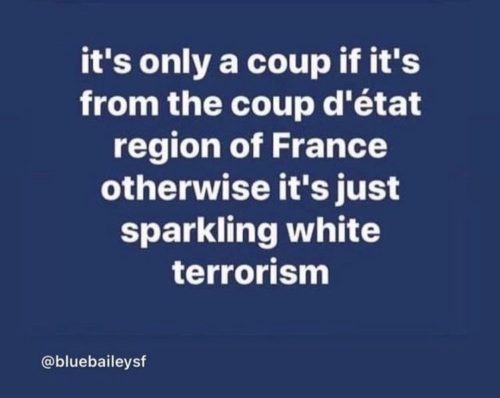
…illegal and overt attempt by the military or other elites within the state apparatus to unseat the sitting executive…
Elites within the state apparatus unseat the sitting executive.
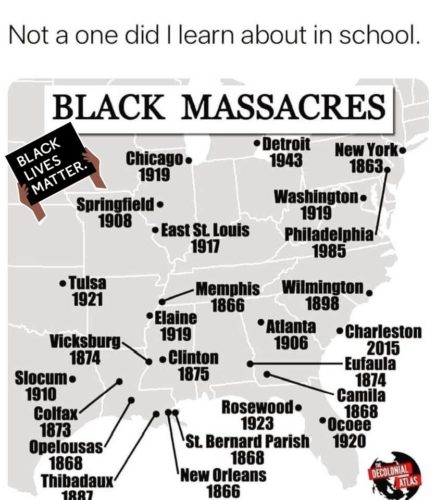
See also this correlative map of massacres:
Many violent coups were perpetrated by white nationalists after civil war who were angry about losing in 1865 and angry that black and brown people gained rights; coups manifested in attacks on anti-racist Americans to prevent them from reaching or holding public office.
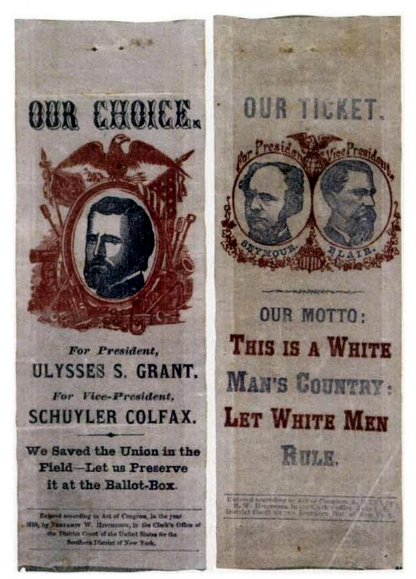
The KKK threatened that March 4, 1869 — first day of rule by avowed racist presidential candidate Horatio Seymour — would bring widespread lynchings of white Americans if the losing candidate Seymour wasn’t planted into the White House.
The KKK instead was destroyed by President Grant’s “let us have peace” platform after he won the Presidency in a landslide.
Then in 1902 a Princeton professor named Woodrow Wilson published a book that fraudulently framed America’s Civil War as a matter of white men simply wanting independence — completely ignoring the official and very obvious statements of reason made in the actual articles of secession (i.e. maintenance and extension of slavery).
Here’s the Wilson propaganda:
It was necessary [for the United States defending itself] to put the South at a moral disadvantage by transforming the contest from a war waged against states fighting for their independence into a war waged against states fighting for the maintenance and extension of slavery.
The seceding rebellious states had stated plainly in their official reasons that it was all about slavery, and this was no secret. So independence from what? And to do what?
Wilson had put a right for white men to harshly discriminate against others at the center of his concept of individual liberty, effectively redefining and weaponizing “freedom” in order to roll-back Grant’s civil rights movement.
The framing of slavery from Wilson became so very patently false, an intentional disinformation campaign intended to harm democracy by framing tyranny as independence, as to beg the question how Princeton could have allowed him to continue as a teacher.
It ranks right up there with Wilson also protesting against Congress having independence because he saw it as too representative and diverse, recommending instead that the U.S. shift into a tyranny of a fast-moving all-powerful executive system.
He was allegedly for independence while claiming that only a very small group of white men should have it. Instead of firing the source of such nonsense, however, Princeton promoted him to become their President, validating his contempt for representative rule.
Fast forward just a few years later in 1915 and Woodrow Wilson abruptly without experience had been elected President of the US (in 1912, by a mere 42% of the vote).
There he sat in the White House on February 18 of 1915 and infamously screened a propaganda hate film called “Birth of a Nation” made by his friend and former classmate (based on “The Clansman” book). Wilson proclaimed obvious lies “true” — giving the hate film his blessing.
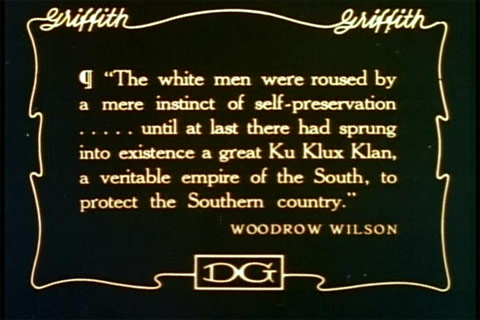
Screen capture from “Birth of a Nation”, quoting President Wilson’s book, which he then used to restart the KKK and incite violence across America
The divisive white-supremacist attack platform of Wilson marked a complete reversal from President Grant’s “let us have peace” time in office.
American cities erupted into fights about bans of a KKK disinformation film that promoted domestic terrorism. The subtext of course being that Wilson had restarted the KKK that Grant had ended.
Even if cities chose to allow a spread of violent disinformation, cities also fought over bans meant to prohibit blacks from seeing the film (isolating and enabling white-only audiences to spread disinformation faster even framing hate as art to evade censors).
As a young journalist in the late 1970s, Lehr infiltrated the local Knights of the Ku Klux Klan for a story. He met their leader at the time, David Duke, who was there to recruit the next wave of Klansmen. “[Duke’s] idea of a meeting was to show this film, in which he stood there narrating it and adding his own very racist spin on events. And that’s when it hit me: the real propaganda value for the Klan, not only way back when but here it was, like, six, seven decades later,” says Lehr. And while civil rights leaders in 1915 tried to get the film banned entirely, The Birth of a Nation is still taught in film schools.
That is a notable comparison to today’s disinformation debates by itself, yet even more relevant is a Wilson speech a few months after the film had been running, on July 11, 1915 at the 25th anniversary convention in DC of the Daughters of the American Revolution (“Mothers of Fascism“).
Wilson encapsulated his racist sentiments in a particular motto that he gave in that 1915 speech, which became his 1916 election platform:
Our whole duty for the present is summed up in the motto ‘America First.’
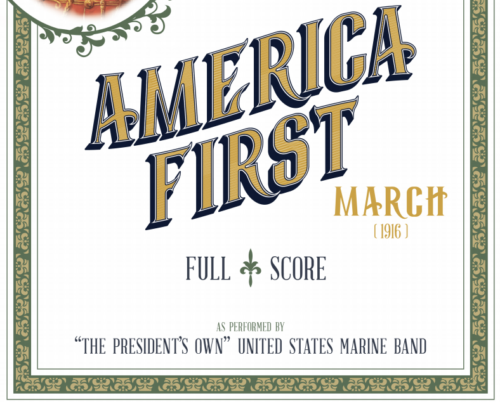
Souza’s march “America First” as found in his complete works.
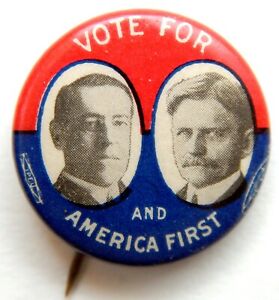
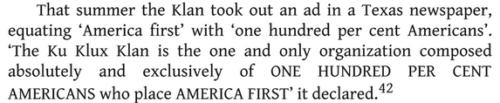
Thus in 1916 Wilson campaigns were branded with “America First” as screenings of “Birth of a Nation” expanded to restart the KKK, blacks were forced out of government and monuments to domestic terrorists were erected around the country kicking off mass murders (1918 Porvenir massacre, 1919 “Red Summer”) and coups like the 1921 Tulsa massacre and 1923 Rosewood massacre. (64 Americans were lynched by the KKK in 1921 as it very officially stated that their ABC started with “America First”)
Source: Behold, America: The Entangled History of “America First” and “the American Dream”, Sarah Churchwell, 2018, p. 113
W.E. DuBois around this time, noting how more lynchings happened in 1915 alone than the ten years prior combined — obviously rueful that he had been fooled to help put a white supremacist in office — described Wilson’s method for transfer of power in America as a return to…
…cruelty, discrimination and wholesale murder.
“America First” entered service as a battle flag of white power groups who believe the enemy of America is any non-white (white power over the nation is diminished — leading to feelings of loss and guilt — by any other race gaining some).
This history of violence under Wilson’s “America First” and since then, the symbolism and a run of coups in America, should be treated as very important history for every citizen to know. It should be mandatory history in schools, like how America forced German children to learn about the Holocaust.
Historians have wisely pointed out for years what this implies for those inclined to accurately explain American government:
New Deal and Cold War liberal internationalism may have been the exception and [racist, white supremacist ideology of the Ku Klux Klan] America First may be the norm.
Perhaps more to the point the “America First” platform has continued unabated as a toxic “grievance” signal of white nationalists/isolationists:
It was used by supporters of President Woodrow Wilson during the 1916 election to defend his decision at that time to keep America out of the First World War; by Republican President Warren Harding in the 1920s to reject Wilson’s call for the United States to join the League of Nations; and by the America First Committee in September 1940 opposing President Franklin Roosevelt’s assistance to Britain in the face of Hitler’s aggression. Most recently it was used by presidential candidate and former Nixon aide Pat Buchanan in 1992, opposing George HW Bush’s decision to oust Saddam Hussein from Kuwait, and further calling for a withdrawal of all US troops from Europe.
Even Trump himself back in 2000 released a statement that he wouldn’t want to associate with “losers” in America such as Pat Buchanan, calling him a Neo-Nazi and at the same time very clearly calling David Duke out as a Klansman:
…David Duke has decided to join the Reform Party to support the candidacy of Pat Buchanan. So the Reform Party now includes a Klansman — Mr. Duke, a Neo-Nazi — Mr. Buchanan…
This attack on these two men probably is read most accurately as Trump distancing himself from hate groups during times of exception. He appears to be saying he wouldn’t join with Nazis and KKK at the time he thought they were going to lose an election; in fact meaning Trump would be very glad to join these hate groups if guaranteed a win (returning to the norm).
Thus we saw in 2016 the Trump family did just that, and very openly claimed the KKK/Nazi’s tainted “America First” banner as their own platform. The soft/silent coup had begun.
“I like the expression,” the candidate said. “I’m ‘America First.'”
Suddenly, without any real explanation, the banner of losers was being held up by “winners”.
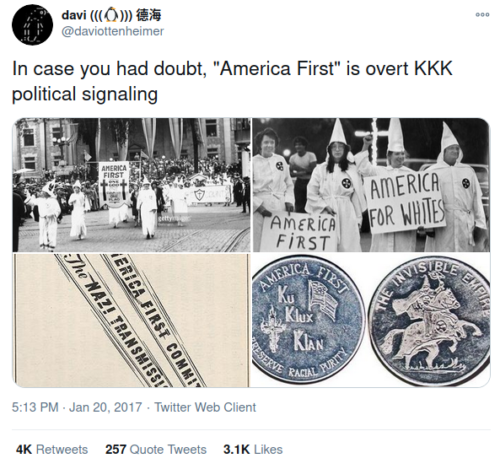
Source: Me on Twitter in January 2017, providing background to what “America First” always has meant: KKK.
Everyone plainly saw something was unusual in early 2017 and started to debate who supported such an odd transfer of power, who really made it happen. My tweets about American history, to explain what “America First” really means, were getting record levels of attention.
Unfortunately mainstream commentators never got to the point of asking the most important question: whether “America First” entering the White House could be a coup, which I had called out immediately.
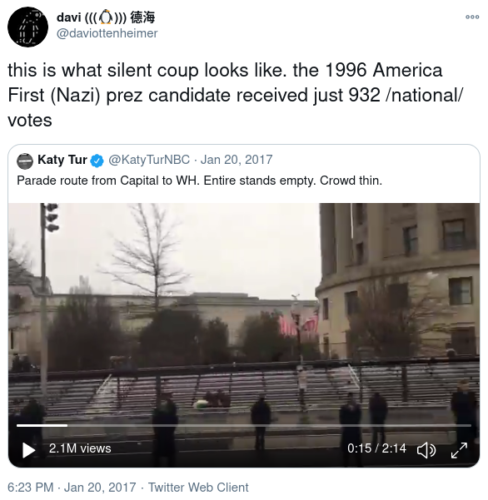
Source: Me on Twitter again warning it was a silent coup when I saw the empty stands and inability of “America First” leadership to gather a crowd in Washington DC. Consider as direct comparison to their success with calls for a violent crowd to arrive on January 6, 2020.
Forbes was the same man who in the 1988 presidential election had managed the campaign for David Duke (infamous for “Nazification” methods intended to grow KKK membership in America).
Read that closely because “America First” in 1996 ran a self-avowed Nazi as their candidate and had 0% of the vote. Then twenty years later in 2016 they held a parade to empty stands in Washington DC claiming a large support base.
Want to guess why the Trump family regularly waffled when asked to denounce or distance themselves from David Duke? Sadly nobody asked them to denounce or distance themselves from “America First”!
Whereas in 2000 Trump went out of his way to label Duke a loser (as well being as a Klansman), in 2016 he tried to play around like he never heard of the guy (as horribly mis-reported by Politifact, who fell for the ruse).
…Trump dodged multiple questions from Tapper asking if he’d disavow the support of white supremacist and former KKK leader David Duke (he would later blame a “bad earpiece” for his noncommittal answers).
Thus I argue (and have said since that time) that we actually saw a coup in America back in 2016 and these last four years have been little more than an idiotic bumbling attempt by wannabe tinpot dictators to figure out how to close the door on democracy.
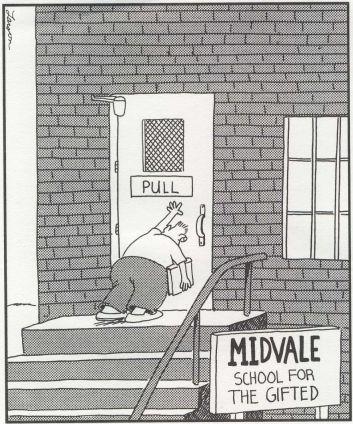
The Far Side perhaps a long time ago best illustrated the assault on the capitol:
I’ve been asked to write this into longer form so maybe I will shortly.
Related: If you’re searching for details on prior coups, they are easy to find.
Georgia Republicans elected three Black state senators and 30 state representatives in 1868. White insecurity forces rushed to remove them from power and then kill anyone protesting the coup, as well as destroying and suppressing votes, after a Camilla massacre:
In early September, white Democrats in the Georgia legislature expelled all 28 African-American members. In response, one of the expelled members, Philip Joiner from southwest Georgia, led several hundred freedmen on a March from Albany to Camilla for a Republican rally. As the marchers entered the courthouse square, the sheriff and other local white residents opened fire, killing a dozen and wounding thirty others.
After a contested 1872 election for governor of Louisiana and local offices, a group of white Democrats with rifles and a small cannon overpowered Republican freedmen, state militia and even federal troops sent by President Grant to support the elected official.
Upon surrender most Americans were murdered by domestic terrorists (e.g. “White League“) and then 50 more were murdered later that night after being held prisoner for hours. Death estimates for this “Colfax massacre” on Sunday, April 13, 1873 were hard because the terrorists used hidden mass graves and threw many victims into the river.
The Colfax Massacre was more or less ignored until the 1920s, when local officials raised a monument honoring the three white men who died [while massacring hundreds of Americans and destroying the evidence].
The 1874 New Orleans violent coup attempt by the “White League” should be mandatory reading for any American class on history:
After cutting the city’s telegraph lines and killing at least thirteen members of the integrated New Orleans police force, the White League overran the state house and attempted to establish a new government. After three days, President Ulysses S. Grant ordered the U.S. Army to put down the rebellion and the elected government was restored.
For another example, the horrors from a successful 1898 Coup continue to be felt to this day.
…summer of 1865, just after the Civil War, Union commanders in the battered port city of Wilmington, N.C., appointed a former Confederate general as police chief and former Confederate soldiers as policemen. The all-white force immediately set upon newly freed Black people. Men, women and children were beaten, clubbed and whipped indiscriminately… One of the most terrifying examples erupted more than a century ago, when white supremacist soldiers and police helped hunt down and kill at least 60 Black men in Wilmington in 1898.
For another example, Hawaii in 1893 (as I’ve written about here before) had a coup on behalf American sugar barons; violence was used to force a black woman out of power.
Queen Liliuokalani was of the belief that the then president of the U.S. would reinstate her as queen, however, President Grover Cleveland deceived her by promising her a reinstatement after she granted amnesty to all those who had been involved in the coup.
Republican former President George W. Bush even said about the January 6th “Capitol Storming”…
This is how election results are disputed in a banana republic—not our democratic republic.
Yet those “banana republics” got their name as a direct result of well documented American policy on regime change!
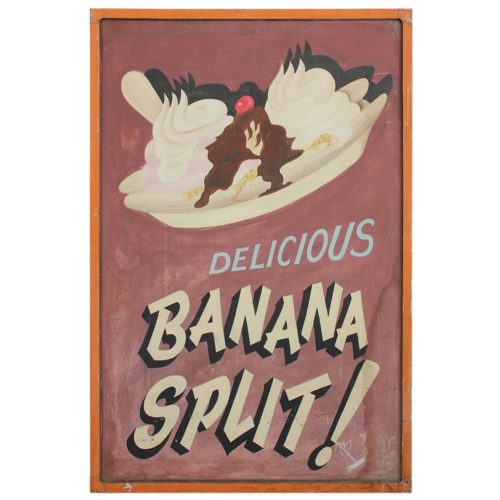
His comment sounds like “this is what we do to others, not ourselves” given the sad fact it’s why Americans love eating their banana splits (spoiler alert, both bananas and pineapples on expensive dessert represent spoils of American imperialism).
The “delicious banana split” of America. Tastes like political oppression.
Even Bush should remember 1954 shootings or the 1978 shootings, both very recent and sad chapters in violent opposition to American transfer of power. I guess I should ask how many people today remember assassination of “the people’s mayor” Moscone?
And for those saying 2016 or 2020 wasn’t related to a coup, and offering us some very misguided analysis (e.g. Defense One has an awful hot take that they see no signs the military was involved, despite obvious and overwhelming evidence), I offer you this humorous example of what that “no true Scotsman” logical fallacy sounds like to me:
Update January 12:
Now This has posted a brief video collection with some of the many violent incitement statements by Trump directly calling for harm to Americans.
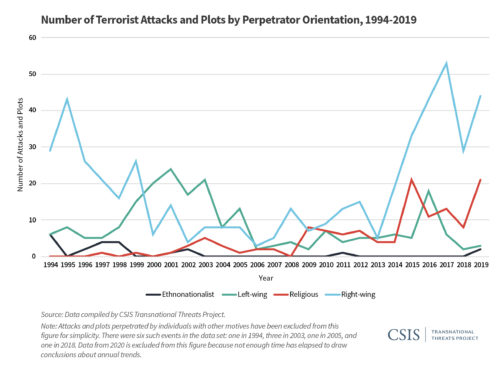
Based on a CSIS data set of terrorist incidents, the most significant threat likely comes from white supremacists… right-wing attackers were most likely to cause more deaths in a given year.
Source: CSIS 2020 Brief
Update February 2:
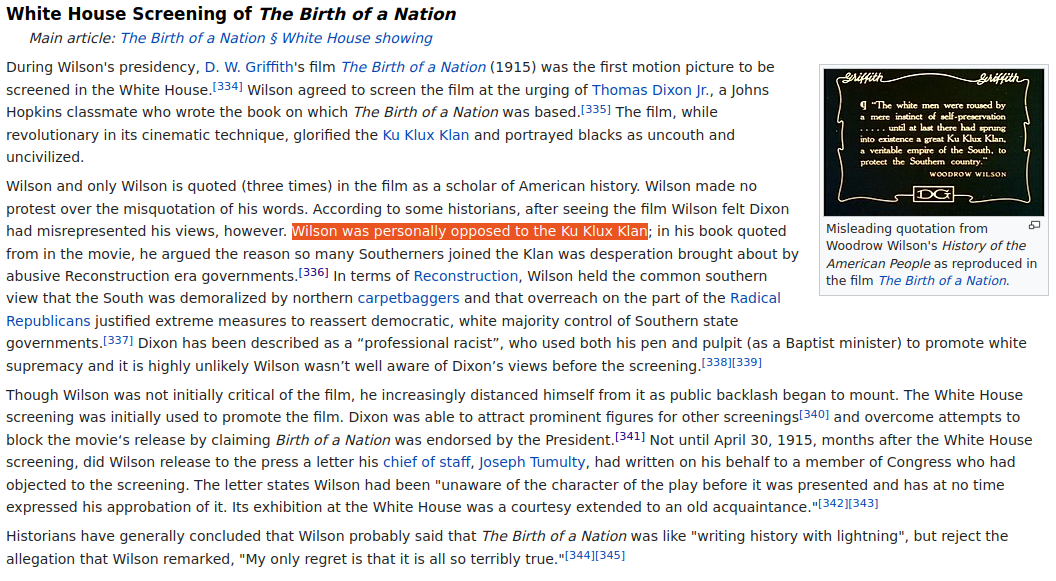
I’ve been asked (by a cryptography researcher, for what it’s worth) if I can explain why Wikipedia makes a strangely unsubstantiated claim that Wilson opposed the KKK, given its obvious falseness.
Soure: Wikipedia
Look very closely at that highlighted sentence before the semicolon (click image to enlarge) as it has no reference.
None.
Nothing.
Nobody in their right mind should be able to get on Wikipedia and plainly assert Wilson, the first President elected from the pro-slavery secessionist states since the Civil War, was opposed to the very thing he grew massively during his presidency and afterwards.
Later in the sentence it has a reference to a book by a man from North Carolina who was a professor at Princeton. Conflict of interest maybe?
This is why Wikipedia can slide into a propaganda system. Who wrote that sentence? When and why? Very dangerous stuff, as it creates a lot of unnecessary churn and conflict by throwing an obviously false statement into a supposedly reputable “pedia” site.
Maybe someone is sitting back and laughing about such an absurd phrase inserted, while many people have to waste untold hours cleaning it up and explaining why it’s false.
I have seen no evidence to even suggest Wilson opposed the KKK. None. At best he didn’t want the KKK to get in the way of him recruiting and sending non-whites to fight in WWI.
Let me put it like this:
President Grant, upon reports of the KKK acts of violence against Americans, passed an act to destroy them.
President Wilson, with all the history of the KKK before him (and in his own writings) sat unopposed to its extremely rapid growth during his administration, despite all measures available to him to stop it dead like Grant.
A movie glorifying the KKK is screened in the White House, using President Wilson’s words and then promoted under President Wilson’s name with little to no resistance at all from Wilson.
Come on. Someone really wants to say he was opposed to this yet didn’t lift a finger?
The first peak of the KKK was 1868 (end of Civil War) to 1870 (given President Grant’s decisive actions to destroy it). Wilson would have been 15 years old at this time and very well aware of the need for America to crush the KKK.
Instead the second peak came squarely during the time of President Wilson (his terms were 1912-1916 and 1916-1920), with an alleged peak of 6 million members in the 1920s following his administration.
Indeed, someone at Wikipedia is bending themselves into a pretzel to fraudulently explain away the obvious racist politics of Wilson, let alone his obvious support and growth of the KKK. Why? Who? Wikipedia is seriously untrustworthy and flawed.
A very long time ago I was in Chicago meeting with the man who wrote the security system for IBM’s AS400. I asked him “but why a Q” as we discussed the QSECOFR user account (Q Security Officer) used to manage the system.
He said it was a rare letter, denoting something special, and I had no reason to doubt him. This man claimed to have created the system for IBM and chose a Q for the simple reasons he said.
It’s true Q is rare. There’s only one Q tile in Scrabble and it has 10 points assigned (highest possible).
And it’s true such a letter would seem unique and distinctive and therefore sensible for special system communications.
Then many years later I was sitting on a train as the whistle blew several times when a pattern suddenly sounded familiar…
Two longs, a short and a long: – – . – (LLsL)
In international Morse code that signal pattern is the letter… wait for it… Q.
I did some searching and sure enough Union Pacific guideline (PDF) says Q is designated as crossing warning:
5.8.2 [7] Sound: – – o – Indication: When approaching public crossings at grade, with engine in front, sound signal…. Prolong or repeat signal until the engine completely occupies the crossing(s)…
Prolonging the signal until the engine is in the crossing probably explains why a letter would be preferred that ends in long instead of a short. Engineers can just hold the signal open until they’re well positioned.
However, I needed more. So from there I poked around the history of Q-codes in Morse, a list of special communications started around 1909 to facilitate transmissions.
Here’s part of a table of 1912 in a UK government handbook of wireless showing some of the basics (initially just 12 Q codes):
Source: Handbook for wireless telegraph operators working installations licensed by His Majesty’s Postmaster-General : revised in accordance with the Radiotelegraph Convention of London, 1912.
These days on video calls we say “your mute button is on” and “you’re breaking up” but a few decades ago radio operators could use codes like QLF (Q Left Foot) to indicate “try sending with your LEFT foot” and QNB (Q Number Buttons) for “How many buttons does your radio have?”
Amusing of course, yet still no deeper meaning for Q. It did little more than backup the story that IBM had used Q to emphasize uniqueness in system communications.
A book from 1952 called Thudbury however, gave this funny explanation:
I’ve heard that signal started on the Chicago, Burlington & Quincy line that everybody calls the ‘Q’ and just spread…
A similar sounding story from geography is found in a history of Britain’s Q fleet (“naval vessels that officially didn’t exist; the mystery ships of World War One”) designed to deceive, trap, and destroy German U-boats:
While in the dockyards, the mystery ships were known under various names, from decoy ships, which gave the game away somewhat, to “Q-ships”, or “S.S. (name)” ships. The “S.S.” in this case stood for “Special Service (Vessel)”. The “Q”, it’s suggested, was because they were operating from Queenstown, now Cobh, in Ireland.
Neither Queenstown for ships nor Quincy for trains are very convincing origin stories. A more likely possibility to me is that use of a Q flag on ships (yellow jack, Quebec) is an old signal meaning “I am ready for boarding” in harbor (a formal request for “free pratique“).
…ships signal either “My vessel is ‘healthy’ and I request free pratique” with a single Q (Quebec) flag or “I require health clearance” with the double signal QQ (Quebec Quebec). Either is correct for a vessel yet to be cleared for pratique (pratique is permission to do business at a port, granted to a ship that has met quarantine or other health regulations). The Q (Quebec) flag is square in shape and pure yellow. Continuing to fly either of these signals indicates a vessel is yet to receive clearance (and is thus effectively in quarantine).
Thus a Q ship in 1914 also could have been a play on words; an invitation to the enemy to come closer and be ambushed.
Further to this point Q also may stand for Quartermaster, the person on ancient ships designated to lead a boarding party to another ship across the aft (quarter deck).
It’s an interesting point to consider how Q for ships meant ready for boarding by local authorities (“effectively in quarantine”) when entering a harbor, yet Q for trains was taken to be the opposite and a warning for everyone to move away from them. Or are those two the same thing?
Some theories on the Internet include bits of Q stands for the Queen Victoria in England and royalty on ships or trains would use a Q to indicate their right of way.
According to W. M. Acworth in The Railways of England, whenever the Queen travelled by train, special precautions were taken. All work along the line was stopped, the points were locked, trains going in the opposite direction were halted and level crossings were closed and guarded.
Here’s another version in video format:
Back in the time when the queen traveled by ship in England, ships with the queen on board would do this sequence on the horn to announce to other ships in the harbour to get out of the way. When the queen switched to railways, the same signal followed and the Engineer
would do the sequence coming into a station to allow some space for Her Majesty.
The problem I have with these royal takes is nothing yet seems to actually support such use for the letter Q (why not use K for King?). And that is not to mention ships and trains seem to have landed on opposite ends with their uses for Q.
Speaking of Queens and right of way, the Q was repurposed recently allegedly by someone with a signals or intelligence background who called themselves “Q Clearance Patriot” in reference to DOE’s Q level of access authorization
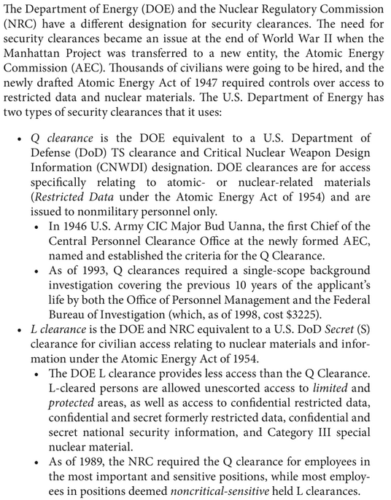
The DOE classifications for access come from the end of WWII when a newly created Atomic Energy Commission (AEC) was faced with qualifying lots of civilian workers. A book called Advanced Criminal Investigations and Intelligence Operations explains:
Source: Advanced Criminal Investigations and Intelligence Operations, by Robert J Girod, p 23
This is not to be confused with the Army Special Forces Q Course (SFQC) for qualification.
And it now amounts to be a symbol of fascism extensively used by right-wing groups to signal intentions to replace democratic norms of law and order with “permanent improvisation“.
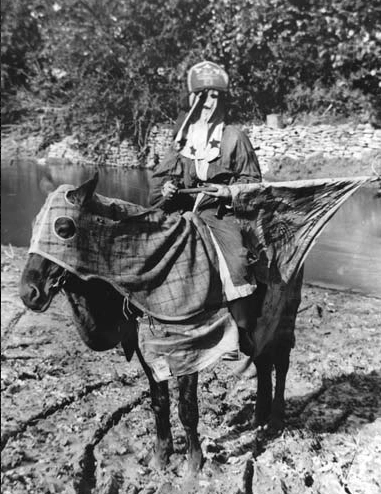
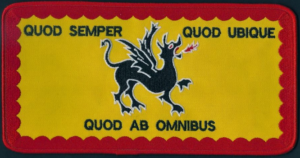
Although maybe one could argue the banner of “Quod Semper Quod Ubique Quod Ab Omnibus” (That will always be taken everywhere by all) is like saying the KKK carried a QQQ message.
A mounted Klansmen in Tennessee holding a flag with the Latin motto ‘Quod Semper Quod Ubique Quod Ab Omnibus’
And maybe that banner today would translate more roughly into the QAnon slogan of “Where we go one we go all”.
The typical KKK “QQQ” patch still sold online
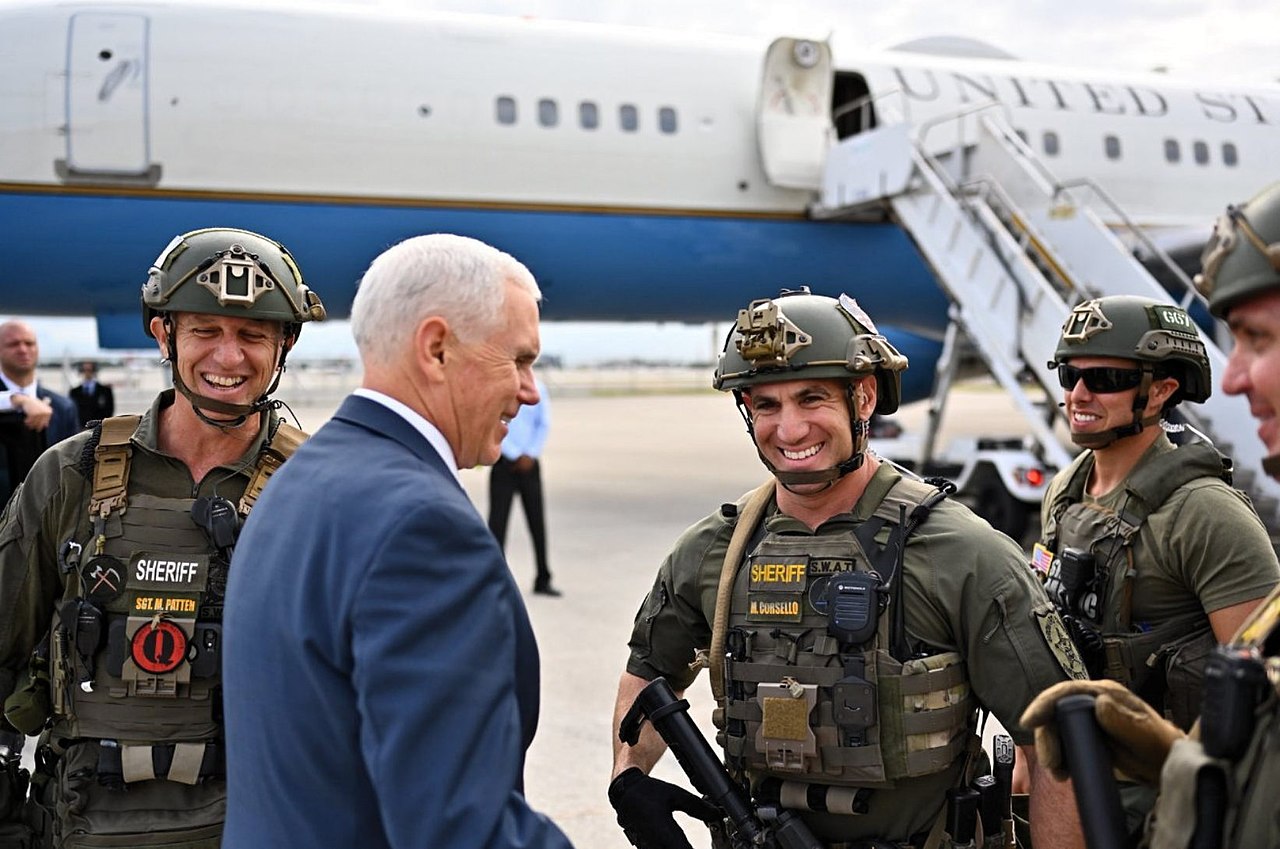
Speaking of Q banners and patches, below you can see an infamous image posted by the White House on their Twitter account showing Florida law enforcement and US Vice President are all smiles around a very prominent red “Q” patch being worn:
Source: White House, as archived by https://commons.wikimedia.org/wiki/File:Pence_posing_with_QAnon_police_crop.jpg and reported by https://www.washingtonpost.com/nation/2018/12/01/pence-shares-picture-him-meeting-swat-officer-wearing-qanon-conspiracy-patch/
QAnon’s conspiracy theory is a rebranded version of the Protocols of the Elders of Zion… The world has seen QAnon before. It was called Nazism. In QAnon, Nazism wants a comeback.
That man in the image I suppose to be a physical manifestation of someone who wanted to elevate to QSECOFR by applying a fascist Q symbol to himself yet instead “he ‘discredited the agency, the country and himself’” and lost his system privileges.
Update January 11:
I’ve been asked several questions privately about this so I’ll post answers here publicly in case others have the same interest.
1) What about the Q hypothesis of Christianity?
I don’t know but that’s a very interesting twist based on an English Bishop (Herbert Marsh). Q Anon then could be a pun by Christian Party (Nazi) adherents to myths rather than just something to do with alleged authorization in US government. Even if Matthew and Luke were independent yet used a common document, the Q hypothesis is indeed about a secret source for faith.
2) How hard is it to find Q Clearance Patriot?
This begs the question of whether such a person exists, or is an intentional fabrication and myth (see answer above) managed by several people and their associates. It also begs whether the right people are motivated to find any person(s). It’s not that hard to find a person when they make mistakes, and everyone makes mistakes, so the right people just have to be watching to capture and respond to the error.
That a crime has been committed, [The Maltese Falcon author] Hammett knew, does not necessarily mean that a plan has been carried out. Plotting and scheming are things people usually do in response to a crime, not in preparation for one. And since most crimes are not clean in the first place, their solutions probably aren’t either. To search for logic in a murder case is to expect to find what was likely never there.
In other words, as the article continues to describe the genius of Wittgenstein, someone seeing pieces of an attack can lead to an urge to paint a picture that may not even exist.
The philosopher achieves clarity, Wittgenstein [in his later writings] believed, by discarding generalizations and focusing instead on concrete circumstances. […] Just because you have pieces does not mean you have a puzzle. It is enough to describe accurately. Attempting to explain only compounds the confusion.
I have to set aside some of the article (ironically) because it seems to draw conclusions askew from the facts and fails to describe accurately.
For example it brings an overly Western perspective that ignores insights and great similarity between Wittgenstein and Islamic and Jewish philosophers, such as this phrase:
His claim was not that these things don’t exist but merely that words can’t touch them.
The claim by Wittgenstein could have been to inspire beauty through attempts to approach what he saw as impossibly hard to achieve.
To come up short in achieving a connection with God, that is to say, does not mean someone “can’t touch” God unless they become stuck in a binary mode where lack of perfection is failure instead of a proof there is need to try for perfection.
I suspect someone more familiar with Talmudic thinking (Judah versus Joseph) would not have described Wittgenstein as saying “words can’t touch them” in such a cold manner emphasizing only failure.
All of that being said, I brought it up here to offer a VERY different approach from what I’m seeing in the news.
I mean people like Clarke and other “hawks” seem to suggest the SolarWinds breach is a case of war, when that is not at all what the puzzle pieces of this crime thriller suggest.
As former Bush Administration official Theresa Payton told Fox News, “This vulnerability allowed these nefarious cyber operatives to actually create what we refer to in the industry as ‘God access’ or a ‘God door,’ giving them basically any rights to do anything they want to in stealth mode.”
Ok, ok, stop just a minute. Who says God access or God door? Wat.
We all say got root. Nobody, and I mean NOBODY, says “got God” with the intention of talking about privileged system access.
The closest thing has to be a Microsoft control panel shortcut {ED7BA470-8E54-465E-825C-99712043E01C} that users called God mode, even though it is just a stupid desktop link to the settings a user already is authorized to use.
That’s like saying God mode in your car is when you check the oil using a dipstick.
God doesn’t have an account on systems, and there’s no God mode, since even if you believed in God he wouldn’t need these things. Duh.
What is wrong with Bush Administration people being so nutty that they bring some random God complex into even a computer security topic instead of talking about root and admin or… QSECOFR?
“This is not just about an espionage attack,” said Richard Clarke. “This is about something called preparation of the battlefield, where they’re now able, in a time of crisis, to eat the software in thousands of U.S. companies.” More than 20 years ago, Clarke was the nation’s first cyber czar, working initially in the Clinton White House and then under George W. Bush. “Sunday Morning” senior correspondent Ted Koppel asked Clarke, “When you hear people talk about this as being purely an intelligence operation, you accept that?” “No, I don’t,” he replied.
Eat the software. Ok since right-wing libertarian venture capitalists infamously said they predict software would be eating the world… does this mean the Russians eating the software would be eating the world?
I’ve heard Russians are starving, but this sounds ridiculous.
Preparation for the battlefield is an interesting twist of language, as that’s surveillance by another name, but the whole eating software concept doesn’t fit a battle narrative.
Clarke then pulls out an old American scare tactic as he clarifies further.
Clarke said, “What has occurred is, again, preparation of the battlefield. There’s not been a lot of damage because of SolarWinds. Maybe some information was stolen, but nothing has been damaged yet.” “Yet!” said Koppel. “But if I didn’t misunderstand what you said before, the Russians are really no more than a few keystrokes away from implementing exactly that kind of damage on, as you put it, thousands of American firms.” “That’s right. And we do not have plans or capability today to quickly come back after that kind of devastating attack,” Clarke said.
The government obviously labeled me with these terms, like “terrorist”, and they locked me up in solitary confinement because they said I could whistle into a telephone and launch nuclear weapons. Basically, I became the example, and they created this myth of Kevin Mitnick to scare the public. But if the truth be known, I was fascinated with technology and telephone systems, and I became a hacker more for the exploration, for the seduction of adventure and pursuit of knowledge. I was able to compromise a lot of stuff, like, for example, most of the telephone companies in the U.S. and stuff like that, but it wasn’t to do damage or to sell to a foreign power or anything like that; it was more for my intellectual curiosity – and I ended up getting in a lot of trouble for it, I ended up getting sent to prison for 5 years. Four of those years were without trial.
Four years in jail without trial is the scary part of that story and probably why the Russians like spreading it around so much.
Now in direct comparison, think about Clarke being a self-proclaimed proponent of poisoning upstream American technology in the supply-chain because Russia was stealing. He kinds of tells it like “serves those evil Russians right” that a gas pipeline exploded the in 1980s.
Just to be clear here, I’m not saying that was an actual cause-effect. In fact there has been much disputed about the facts.
What I’m saying is that I stepped into an elevator with Clarke once and asked him to explain the ethical differences between the Trans-Siberian pipeline explosion in June, 1982 and the San Bernadino explosion in 2010 (not the 1989 one, of course).
Seriously, it was me and him riding down four floors and that was the first thing I blurted out…
Clarke was visibly angry and dismissed my question quickly by assuring me he knows very well how the US absolutely was behind the Russian pipeline blowing up, duh.
His logic to me appears blinded from over-emphasis on trying to build a picture he wants us to see rather than looking at the actual pieces of puzzle in our hands (and may in fact never achieve that picture he wants).
He jumps right towards painting the worst risks of gaining high-level authorization, the kind of slippery leap which has some pretty big negative precedents in national security games domestically and internationally.
If someone has achieved root access, he suggests to us, then direct preparation for war is happening if not becoming an act itself. That’s wrong on the face of it, right?
Clarke pushes a war alarm repeatedly like he’s auditioning for a remake of Dr. Strangelove.
This whole thing is counter-factual when you apply even a simple case of a house and door with a key. Someone has infiltrated the lock factory, such that they can produce a key and walk through your home without you knowing. Nothing is damaged, nothing is destroyed.
Interesting history tangent here: A mole in the CIA was suspected when a lock in a Russian apartment door was turned and the owner had to break into his own place…
As soon as Gordievsky landed in Moscow, he picked up signs that he had gambled wrong. On the front door of his apartment, someone had locked a third lock he never used because he had lost the key; he had to break in. Clearly the KGB had searched his flat.
Did the intruders put a secret door in, or a hidden way to bypass your locks, so they could come back later and burn your place down, or prevent you from getting in (e.g. ransomware)?
Was the act of entering and achieving high authorization the same as one of war?
Reminder: “slippery slope” is a logical fallacy. Please don’t start arguments by saying there’s a slippery slope as it’s self-invalidating. I hate seeing that. People seem to think it makes their argument better, like starting with “here’s a straw man I built and now am going to burn.” Just stop that.
I don’t think anyone can, or has, proven yet such regularly invasive acts of surveillance rise above espionage into far worse things, given all that has been said so far about the SolarWinds Breach details.
At best they’re saying the places entered are untrustworthy and must be rebuilt, something less like Stuxnet (which did actual damage), and more like… well more like every day business continuity planning.
It’s true that if someone enters your house they can surveil or they can burn it down but you don’t treat them as equally possible just because someone has entered your house.
It would be like describing Pearl Harbor as devastating because of a fly-over event in preparation for bombing, instead describing the actual bombing as the disaster.
Pearl Harbor was the day that dropping bombs and shooting crossed the line, right?
To be historically accurate (as I’ve blogged about here before), Pearl Harbor’s incoming attack planes were detected by the latest technology but nobody talking about Pearl Harbor is really going into detail about that.
At best people call the ignored radar signals and missed footsteps very unfortunate, not unexpected.
To put it another way, a capability to rebuild an environment is desperately needed right now to restore trust, and the US government was supposedly ensuring that everyone is doing disaster recovery planning anyway.
Thus environments are untrusted mainly because they haven’t been routinely cleaned up fast or often enough, allowed to rot in the open.
And so here comes the real issue as documented already by many other security experts: the US is using surveillance and espionage all the time including (sometimes necessarily) privilege escalation and root-level authority in order to protect itself (not necessarily preparing the battlefield for attack).
“It wasn’t a cyberattack in international relations terms, it was espionage… problem is that both espionage and cyberattacks require the same computer and network intrusions, and the difference is only a few keystrokes.”
Both of the above references are well-reasoned analysis worth reading.
Saying SolarWinds is breached also begs the uncomfortable question of whether the US already had secret access into SolarWinds (let alone all the other American “monitoring” and database companies) or will now use the same access for its own purposes.
More broadly, cleaning upstream vulnerabilities from dependencies and getting service and support doors (some call them back doors) out of products is a long-time herculean task in security for American technology, which may be impeded by American surveillance efforts, and not some sudden exceptional state we stumbled upon.
It is the stuff of repeated internal warnings, like Facebook being a disaster in 2014 and then hiring someone manifestly unqualified who then caused even greater harms to the world and got rich doing it.
Nothing here is really surprising except how little emphasis has been on tearing things down (Facebook really should no longer be allowed to do business and their disgraced ex-CSO should be in jail). Focus needs to shift to building better than such existing Fawlty Towers.
Like the industrialization dangers we look back on with horror today, SolarWinds being a danger is the norm for a lot of American tech that jumps into shortcuts and margin boosters in a cut-throat race driven by mathematicians counting beans more than philosophers explaining why they just don’t add up.
Microsoft’s founder famously said he didn’t want security because it didn’t make him money and admitted in 2001 he ignored years of prior warnings (getting towards the true foundation of the SolarWinds breach, Microsoft’s anti-government big margin low quality pedigree).
“In the pre-2001 days [when disasters were constant, yet not named things like CodeRed], Gates was the biggest reason why Microsoft was having so many security problems,” said John Pescatore an analyst at Gartner Inc…”I think they expected an overnight shift in terms of perception [when they suddenly confessed to decades of intentional harms]. It didn’t happen,” [Forrester analyst] Kark said. “It’s been more than six years, and it’s only now that we are starting to see Microsoft being recognized as a company that values and understands and is responding to security issues.”
The Grover Shoe Factory disaster is a great comparable study in how badly America managed safety in its manufacturing processes for industrialization, and what really changed afterwards.
Hint: it was not only the ability to more quickly transition off faulty technology, found during required quality audits, it also was partly the ability to remove, restore or build new a bigger factory after any disaster predicted or experienced.
Back to Clarke, he also says something about the past worth holding onto: a Bush administration in 2002 blocked efforts to fix infrastructure because it was opposed to big government and fundamentally removed trust in government.
“The kind of things that we need to do now, we could have done 20 years ago. Twenty years ago, however, there wasn’t a real understanding in the Congress or in the White House. There wasn’t a willingness to spend the kind of resources. People were worried about privacy concerns and ‘Big Brother’ controls. They didn’t trust the government to defend them against this sort of thing.”
It resonates with what I remember at the time, when I was doing assessments of woefully insecure American infrastructure (across many US states thousands of power company routers on the Internet using telnet and clear-text scripts). Raising security issues to government level in the late 1990s was met with “let the big banks figure it out, they run the power companies and understand business risk best”.
So this really seems like a great time to remember how the Bush administration absolutely was willing to spend huge resources for big government to start war with Iraq on false pretenses. They pushed hard for that picture, against the fact that puzzle pieces didn’t fit together.
Yet also they ran with the narrative that resources shouldn’t be spent to improve infrastructure/resilience because that would be big government. Instead let the “market” prove it can’t self-regulate, over and over and over again.
American tech is like a never-ending crime thriller, so the really insightful question — in terms of Wittgenstein’s brilliance — becomes whether as investigators we are choosing to be a lofty British Sherlock laying out masterful plans or the more tangible American hard-boiled detective who sticks to the facts.
a blog about the poetry of information security, since 1995