Category Archives: History

U.S. Rules KKK Ban on Black Distillers Unconstitutional, 158 Years Too Late

The KKK as “tax enforcers” who actually eliminate taxation is the actual story here, which so far nobody is admitting.

The ban was part of a law passed during ⁠Reconstruction in July 1868, in part to thwart liquor tax evasion, and subjected violators ​to up to five years in prison and a $10,000 fine.

Writing for a three-judge panel, ​Circuit Judge Edith Hollan Jones said the ban actually reduced tax revenue by preventing distilling in the first place, unlike laws that regulated the manufacture and labeling of distilled spirits on which ​the government could collect taxes.

She also said that under the government’s logic, Congress could ​criminalize virtually any in-home activity that might escape notice from tax collectors, including remote work and ‌home-based ⁠businesses.

Exactly.

Who would want to criminalize “virtually any in-home activity that might escape notice from tax collectors”?

The KKK. The Klan and industries aligned on the same structural goal: prevent emancipated Black workers from converting their skills into independent wealth.

The 1868 anti-distilling law provided an institutional mechanism to criminalize Black workers, raid their homes and lynch them of they showed any signs of entrepreneurship. It was not about taxes. The Klan became racist “law” enforcement. The tax rationale, which is obviously illogical, serves only as a cynical cover story, like the white sheets they wore.

The pattern across both distilling and tipping is identical. Take the economic activity where Black expertise and labor generate value, then restructure the rules so the value flows to white owners while Black workers are either criminalized (distilling ban) or made dependent on white discretion (tips replacing wages). Both entirely eliminate the tax relationship.

The distilling ban removed taxable production. Tipping removed taxable payroll. In both cases the stated rationale (revenue, market freedom) inverts the actual function (suppressing Black economic independence).

At slave auctions, brokers regularly noted distiller-trained enslaved people, many with Caribbean rum-making backgrounds, and these skills earned premiums for their owners. Every major early bourbon name benefited from enslaved labor: George Washington used six enslaved workers at Mount Vernon, Elijah Craig owned 32 enslaved people, the Pepper family at what is now Woodford Reserve owned 25.

Then, precisely after these men were free and in position to become successful, in July 1868 Congress banned home distilling entirely. The timing fit the Klan’s explicit goal of eliminating Black economic independence and forcing return of American Black people to patterns of economic subservience.

Simmons in 1898 … instigated the “White Supremacy Campaign” by issuing virulent addresses appealing to “Anglo-Saxon blood” and attacking “Negro domination.” During the 1898 state and local elections, Simmons promised leaders of denominational colleges no increased funding for public colleges, and told businessmen that for their support … there would be no tax increases.

No new taxes literally became the KKK political platform.

“Nightrider” domestic terror groups specifically targeted freedpeople who tried to purchase land or become too independent from former masters. The KKK functioned as a political organization aimed at destroying Reconstruction policies, and preventing economic equality for Black Americans. Taxes were framed as benefiting the race that whites should hate, and therefore taxation became a hate campaign.

So an entire class of skilled Black workers, trained across generations, whose expertise was the foundation of the American whiskey industry, reach emancipation with exactly the knowledge needed to build independent wealth. Within three years, federal law criminalizes the activity. The stated rationale is tax collection, but as Judge Jones just observed without providing context, the law eliminates the taxable activity rather than taxing it. The actual function was racist suppression.

Tipping is useful to examine because of the same “tax” elimination function. Before emancipation, waiters were mostly white men who received actual wages. Tipping existed in feudal Europe but Americans rejected it as anti-democratic. After emancipation, the restaurant industry hired newly freed Black women coming up from the South and told them they would receive no wages, only tips, eliminating tac. The railway and restaurant industries fought for the right to use tipping as full wages specifically to exploit their African American labor force, and they won.

Freed slaves who moved north were refused employment in the skilled trades they had learned as enslaved people, and were forced into cook, porter, and waiter positions entirely dependent on tips, which destroyed the tax basis.

Lawyers and judges scratching their heads today only need to learn real history to understand why the law they are overturning never made sense, except to the KKK.

President Donald Trump’s goal is to eliminate taxes…
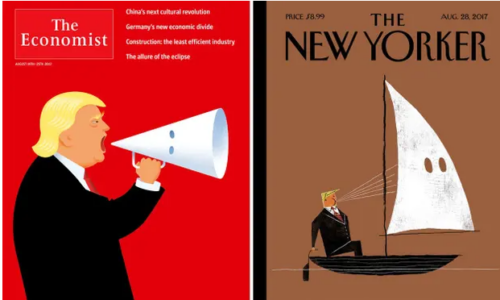
The Economist/The New Yorker weren’t wrong

Existential AI Threat Friedman Warns About is Craig Mundie

Thomas Friedman calls Craig Mundie his “technology tutor.” He’s said it publicly, repeatedly, for over a decade. Perhaps it’s meant to sound endearing. It’s actually a sad confession. The most influential foreign affairs columnist in America openly outsources his entire understanding of technology to a single person. Why?

That person’s track record deserves closer examination within context of a larger institutional failure rated as success.

Microsoft Failure Man

In 1982, Mundie co-founded Alliant Computer Systems, a maker of vector-parallel mini-supercomputers. He became CEO. The company filed for bankruptcy June 5, 1992 because they didn’t see the PC coming.

He joined Microsoft that same year to run the Consumer Platforms Division. Here is what he built and championed:

Year Product / Initiative Outcome
1992 Windows CE Dead
1990s Pocket PC Dead
1990s Auto PC Dead
1997 WebTV Networks ($425M acquisition) Dead
1990s Interactive television Dead
2000s Digital rights management strategy Dead

When Bill Gates stepped back from daily operations in 2006, Mundie and Ray Ozzie were appointed to fill his visionary role. Mundie became Chief Research and Strategy Officer. During his tenure in that position, Google beat Microsoft to self-driving cars. Apple beat Microsoft to voice recognition with Siri. Microsoft missed mobile. Missed search. Missed social. Missed cloud computing until Satya Nadella arrived and reoriented the entire company away from the strategy Mundie had been overseeing.

To be fair, Ballmer overruled strategy recommendations, and search and social blinders may have been other divisions’ calls. But show me the wins. By late 2012, Mundie was moved to “Senior Advisor to the CEO,” the corporate equivalent of a quiet pasture upstate where his opinions wouldn’t be heard anymore. He retired in 2014.

Selling Invisible Pants to Elites

What happens to a technology executive whose products all failed but whose rolodex thrived? He becomes a bogus sage. Mundie landed on the National Security Telecommunications Advisory Committee under three presidents. Obama’s PCAST council. The Bilderberg Group steering committee, which he attended every year from 2003 to 2019 except one. The World Economic Forum. And then the capstone: co-authoring Genesis with Henry Kissinger and Eric Schmidt, a book about AI published in November 2024.

Kissinger.

The architect of the secret bombing of Cambodia. The man who backed the coup in Chile and the Indonesian invasion of East Timor. Who enabled the Pakistani genocide in Bangladesh. Who treated civilian populations as abstractions to be managed through force. This is who Mundie chose as his co-author on the governance of a technology that will reshape civilian life everywhere.

That tone-deaf choice tells you everything about the Mundie gambit: power managed by the powerful, consequences borne by everyone else. Talk down and ignore reality.

The technology product arc of disasters was foreshadowing. Build things that fail. Accumulate institutional access along the way. Pivot from practitioner to advisor once the failure pattern becomes undeniable. The access persists because Davos doesn’t audit skills like product launches. It rewards gravitas in presence.

The Column

This week Friedman published a column about Anthropic’s Claude Mythos announcement. His source for interpreting its significance was, naturally, Craig Mundie. The column treats Mundie’s analysis as authoritative. It contains Mundie’s three-step framework for responding to the threat. It quotes Mundie at length. It cites no other technical source.

Friedman writes:

[Mundie is] a former director of research and strategy at Microsoft, a member of President Barack Obama’s President’s Council of Advisors on Science and Technology and an author, with Henry Kissinger and Eric Schmidt, of a book on A.I. called Genesis.

Every word of that sentence is true. Every word of it is also designed to obscure the fact that Mundie’s actual technology career was a sequence of expensive bets that all lost.

The credential list substitutes for any actual performance record.

The Friedman column is similarly bad at placing bets. It describes AI-powered vulnerability discovery as if no one had ever heard of fuzzing, static analysis, or red team operations.

OMFG.

He illustrates the threat with a scenario where children accidentally take down a power grid. This is the Computer Fraud and Abuse Act (CFAA) debate of 1984, recycled. Congress passed it in 1986 after WarGames convinced legislators that teenagers with modems could launch nuclear weapons. Before that, Captain Crunch and the phone phreakers were going to launch nukes, shut down power or destroy the telephone system.

Did he just wake up from 1986?

By early 1999 I personally had reported clear text authentication on the American bulk power grid in five states. Thousands of routers vulnerable to trivial destruction. Did I break anything? The old geezer in a suit panicking that “kids will break everything” has been the go-to move for people who want to centralize control of new technology for forty years. Friedman presents it as an original insight, as if nobody remembers the 414s.

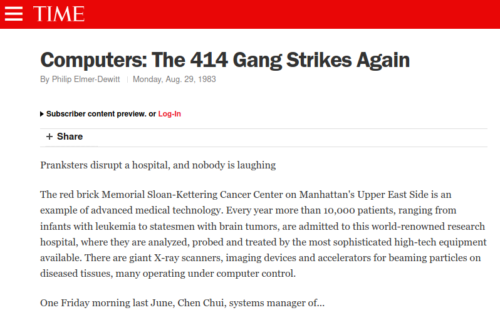
Time Magazine in August 1983, with a stern prediction that kids with computer access will get someone killed.
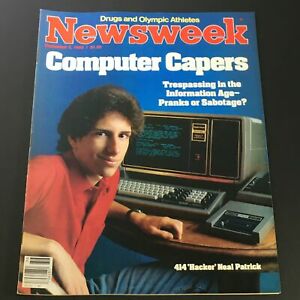
The youngest of the 414s on the cover of Newsweek, September 5, 1983

He proposes US-China cooperation on AI governance in the same week the US is actively restricting chip exports to China to prevent exactly the AI capability development he’s now asking them to collaborate on. He doesn’t notice this dumb contradiction because he’s transcribing, not analyzing. He would do far better to trust AI than the hallucinations of Mundie.

Meatspace

A columnist who calls someone his “tutor” on a subject is telling you he cannot independently evaluate what that person says. Friedman admits no second opinion on technology, and he lacks the technical literacy to know what questions would surface one. Mundie tells him this is unprecedented. Friedman writes that it’s unprecedented. Mundie says it requires US-China cooperation. Friedman writes that it requires US-China cooperation.

This is how a man who got WebTV, Windows CE, the Pocket PC, interactive television, and digital rights management wrong becomes the person explaining artificial intelligence threats to New York Times readers.

The technology tutor model has an obvious flaw. The student can’t evaluate the false tutor, because the student can’t evaluate the subject. He can only evaluate the tutor’s confidence, which is deeply ironic. Just like the real danger with a bad AI chatbot, confidence is the one thing Craig Mundie has never lacked.

The threat of AI is the relationship Friedman has with Mundie, not the AI.

Trump Declares Genocide Plan for Iran

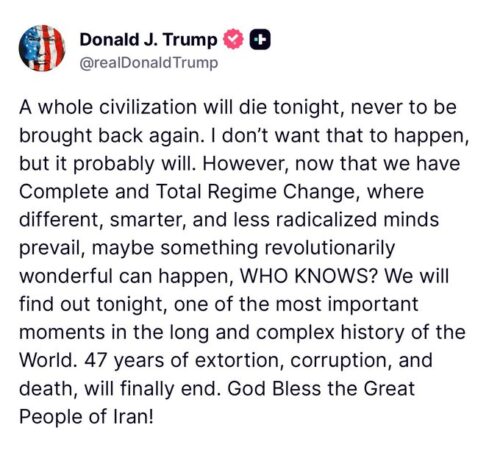
“A whole civilization will die tonight, never to be brought back again” is Trump’s statement of intent.

Under Article II of the 1948 Genocide Convention, genocide means:

[Acts committed with] intent to destroy, in whole or in part, a national, ethnical, racial or religious group.

Trump’s public declaration that a civilization will be permanently eliminated fits squarely within language of genocide.

“Complete and Total Regime Change” paired with “a whole civilization will die” collapses the distinction between a government and a people. That collapse is precisely the move that converts military action into genocide.

Article III makes direct and public incitement to commit genocide independently criminal. Trump publicly declaring that a civilization will die tonight is, on its face, incitement. It is a potential criminal act under the Convention, separate from whatever military operations follow.

The International Criminal Tribunal for Rwanda further held that public speech constituted direct incitement to genocide in Nahimana et al. (the “Media Case,” 2003). A head of state using a social media platform to declare a civilization’s death fits that framework more cleanly than the Nahimana facts, because Trump is the person with actual command authority over the military conducting operations.

Article IV explicitly states that persons committing genocide shall be punished “whether they are constitutionally responsible rulers, public officials or private individuals.”

The Nuremberg Principles, adopted by the International Law Commission in 1950, state under Principle IV that acting under orders of a government or superior does not relieve a person of responsibility under international law, provided a moral choice was in fact possible.

The Rome Statute of the ICC, Article 33: orders to commit genocide are “manifestly unlawful” as a matter of law. A defendant cannot claim superior orders as a defense for genocide. Period. The statute specifically names genocide and crimes against humanity as categories where the defense is categorically unavailable.

So every person in the chain is individually liable. The president who orders it. The secretary of defense who transmits it. The general who plans the operation. The officer who executes it. The pilot who drops the ordnance. “I was following orders” has been an inadmissible defense for genocide since 1946.

This is the entire point of Nuremberg. The tribunal established that obedience to manifestly unlawful orders creates liability, not immunity.

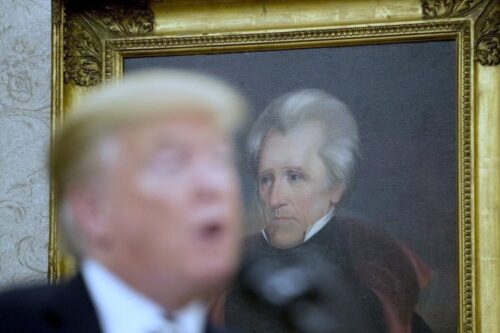
Trump’s rhetorical move of mourning destruction he is causing has precise American genocidal precedent. Andrew Jackson’s Second Annual Message to Congress lamented the fate of Native Americans while executing their removal: express sorrow about the outcome, then celebrate the outcome. Trump has called Jackson his favorite president and put his portrait up in the White House.

Donald Trump’s favorite president: Andrew “white republic” Jackson. Historian Matthew Clavin says as genocidal as Andrew Jackson was he likely would have despised Trump.

CIA Shuts Down Factbook, Replaced by Facebook

A new Politico eulogy mourns the CIA World Factbook like a beloved teacher retiring.

On Feb. 4, the Trump administration abruptly shuttered this widely accepted account of humanity and its flags, nations, customs, militaries and borders. […] A great wave of grief rose from Factbook fans. Many said they mourned an America that valued knowledge for its own sake. Some saw darker forces at work under a president whose administration has promoted — in times of war and peace — “alternative facts.” “Stay curious,” the CIA advised in its “fond farewell” to the Factbook.

I have thoughts.

The coverage, like most coverage of this story, gets the history wrong in ways that matter.

The Factbook was an intelligence product, and understanding why it was created, why it was made public, and why it was shut down requires distinguishing between three different CIA eras that the press keeps unintelligently collapsing into one.

A Tale of Three Eras

The first CIA was unmistakably “Wild Bill” Donovan’s. In 1943, Donovan built the Joint Army Navy Intelligence Studies program because Pearl Harbor had exposed a catastrophic gap: the United States had no coordinated system for knowing what was happening in the world. When the National Security Act of 1947 created the CIA, it inherited that mission. Basic intelligence. Know the world so you can act in it.

Donovan’s vision was a knowledge agency that served the republic. He basically said prevent America First from ever rising again.

The second CIA was Allen Dulles’s. And Dulles was not a good leader. By the mid-1950s, the agency had become something Donovan’s original architecture was never designed to house. Guatemala 1954. Iran 1953. Bay of Pigs 1961. The Phoenix Program. MKULTRA. Domestic surveillance of American citizens. The agency created to stop America First and prevent another Pearl Harbor was running coups, assassinating foreign leaders, and dosing unwitting subjects with LSD. This was the CIA of the dumb decades, and it had almost nothing in common with the coordinating body Congress stood up in 1947.

The third CIA was the one that emerged from the necessary Church Committee hearings in 1975. Senator Frank Church’s investigation exposed the pathological “Family Jewels,” the agency’s own internal catalog of illegal operations.

At THIS junction, the CIA needed rehabilitation. It needed to demonstrate that it still served the public. The Factbook, which had existed as a classified product since 1962 and been declassified in 1971, was released to the public that same year. The timing was the message. The agency was saying: we are still Donovan’s knowledge shop. We still do basic intelligence. We still serve the republic.

It was a rejection of Nixon.

The Politico article traces the Factbook’s origin to the CIA’s founding in 1947, then jumps to 1971.

Nope.

That leap skips the entire institutional history that explains why the Factbook went public in the first place. You cannot understand the 1975 publication without understanding what the agency did between 1947 and 1975 that made a public rehabilitation necessary. “There was never confirmation that the bad press inspired the wide release,” the AP writes.

Do we need confirmation that water is wet?

The Factbook was the CIA’s move back to Donovan days of 1947. To the knowledge mission. Because that’s useful.

Early Internet Infrastructure

It also became something more. Being included in the Factbook could confer legitimacy upon a nation or an opposition party. That line is buried in the Politico piece like it is incidental. It is the entire point. The CIA decided what counted as a country. What its borders were. Who governed it. Which entities were sovereign, which were dependencies, which were disputed. Every student, journalist, policymaker, and Model UN delegate who reached for it accepted CIA-curated categories as the baseline description of the world.

That is an essential agency function. The Factbook did not merely describe reality. It organized reality into categories that shaped how millions of people understood it. The intelligence operation was the publication. You did not need to hide it when the product itself was the instrument of influence.

Face the Facts

Facebook (2004) copies this architecture with precision. A “book” of “facts” about the world becomes a “book” of “faces” about people. Free to users. Positioned as neutral infrastructure. Becomes the default reference that everyone from individuals to institutions to governments relies on.

The Factbook defined countries. Facebook defines identity (real name policy), relationships (social graph), events (News Feed), and truth (content moderation, fact-checking partnerships). The same operation at a different scale: make a population legible, categorizable, targetable. Call it a public service.

The CIA called its product “basic intelligence.” Facebook calls its product “connecting people.” Both are euphemisms for making populations legible to power.

Thiel as Bridge

Peter Thiel was Facebook’s first outside investor. The year was 2004. The same year he co-founded Palantir, which received its seed funding from In-Q-Tel, the CIA’s venture capital arm. Palantir’s software was built through iterative collaboration between Palantir engineers and intelligence agency analysts over nearly three years.

Two products launched in the same year by the same investor. One consumer-facing “factbook” about people. One intelligence-facing “seeing stone” about targets. One collects. The other operationalizes.

1968 Again

CIA Director John Ratcliffe said the agency needs to refocus on its “core mission.” That is an explicit statement that the public knowledge function was never the real mission. The covert operations were.

Closing the Factbook is the CIA officially abandoning Donovan’s 1947 vision and embracing the second CIA, the one the Church Committee tried to reform. It’s the thing Donovan warned against.

Nixon shut out the public and weaponized intelligence against domestic enemies. Trump shuts down the public-facing product entirely and hands the knowledge function to private infrastructure his allies built with CIA seed money. The pattern is simple. The mechanism boring.

The Business Model

The Factbook shutdown fits a pattern so consistent it qualifies as policy. Trump’s March 2025 executive order dismantled the Institute of Museum and Library Services, the only federal agency that funds libraries. His 2026 budget eliminates it entirely. The National Park Service lost 24 percent of its workforce in the first half of 2025. The proposed budget cuts public lands agency funding by more than a third. Interior Secretary Burgum told Congress that if his department were a private company, it would have the “largest balance sheet in the world.”

Libraries. Parks. Public lands. The CDC website. Smithsonian exhibits. The Factbook. Every free public resource built with taxpayer money, shut down, gutted, or stripped for parts. The money that funded these things does not come back. It disappears into a government that returns less and less while collecting the same.

Fifty-two days after the CIA killed the Factbook, a Dubai-based startup launched worldfactbook.io with “AI-powered intelligence” and a developer API. Free for now. That is a customer acquisition strategy. The playbook is familiar: defund the public version, wait for the private replacement, let the market set the price for what taxpayers already paid to build.

Burgum looks at 500 million acres of public land and sees a balance sheet. Thiel looks at 3 billion Facebook users and sees a dataset. The Factbook told everyone how the world worked, for free, for sixty years. The replacement will do the same thing, for a fee, with your data as the payment.

What Wild Bill Would Say

Donovan warned in 1945 (August 25, 1945 paper to Truman, “Principles Which Should Govern the Establishment of a Centralized United States Foreign Intelligence System“):

The formulation of national policy both in its political and military aspects is influenced and determined by knowledge (or ignorance) of the aims, capabilities, intentions and policies of other nations.

Knowledge or ignorance. Donovan built the architecture because he understood that a country that does not know the world cannot act in it. Eighty years later, the government he served is choosing ignorance on purpose. Shutting down the Factbook. Defunding libraries. Selling parks. Stripping public data from federal websites. Every free source of knowledge, systematically eliminated.

Donovan’s statue still stands in the lobby at Langley. The Factbook he inspired is gone. The “basic intelligence” it contained now lives on servers in Dubai and Menlo Park, managed by people who answer to shareholders, not citizens.

Stay curious. Now with a subscription required.

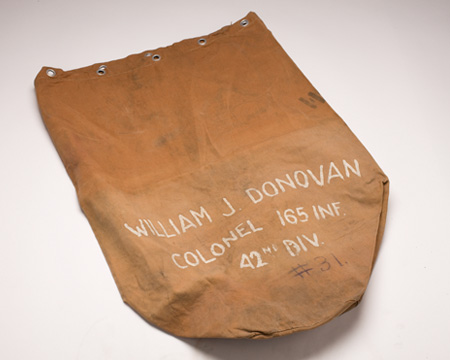
William Donovan’s duffel bag in the CIA museum