Category Archives: History

Palantir Keeps Quoting Nazi Goebbels as Their Business Model

Thomas Edsall’s latest New York Times essay opens with a Peter Thiel quote from 2010 that deserves far more scrutiny for historic parallels than the NYT gives it.

We could never win an election on getting certain things because we were in such a small minority, but maybe you could actually unilaterally change the world without having to constantly convince people and beg people and plead with people who are never going to agree with you through technological means, and this is where I think technology is this incredible alternative to politics.

A minority that can’t win elections. A conviction that persuasion is futile. A technological mechanism to bypass democratic consent entirely.

This is a very well studied pattern from 1930s Germany.
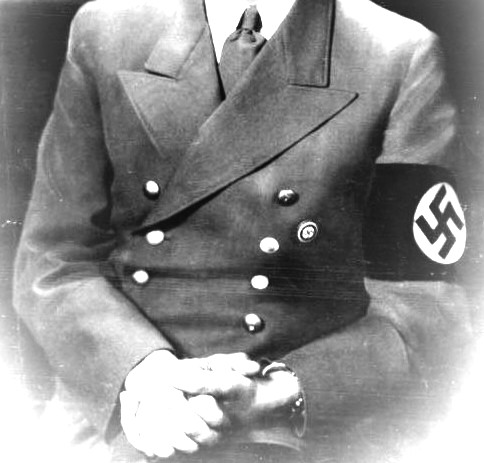
Guess who?

Joseph Goebbels articulated the same exact structure in 1928, using radio and institutional capture rather than Silicon Valley.

The Playbook

Move Goebbels (1928-1935) Thiel/Palantir (2010-2026)
1. Admit minority status “We are an anti-parliamentarian party” that rejects democratic institutions “We were in such a small minority” that elections are unwinnable
2. Declare persuasion futile “We oppose a fake democracy that treats the intelligent and the foolish in the same way” “People who are never going to agree with you”
3. Identify non-democratic mechanism “We enter the Reichstag to arm ourselves with democracy’s weapons”; radio as “the Eighth Great Power” “Technology is this incredible alternative to politics”
4. Execute bypass Enabling Act dismantles republic through constitutional means Palantir builds surveillance and control infrastructure for intelligence and military without democratic deliberation
5. Pull up the ladder “We would deny to our adversaries without any consideration the means which were granted to us” Karp (2026): anyone doing this without military cover is “in an insane asylum”

Step five is where we are, so hopefully people start seeing the problem soon. The NYT certainly isn’t helping by acting like Nazism is now the norm. Karp’s CNBC appearance, quoted at length in Edsall’s piece, reads like we are supposed to just accept a warning. It isn’t normal. It’s Nazi doctrine being delivered to the public as if that’s just the way it is in 2026.

Karp says AI will somehow on its own destroy the economic and political power of only the educated, largely Democratic voters. He says anyone who thinks this will “work out politically” without capture of the military is delusional. He says the “only justification” for absorbing societal disruption is for national security.

Every sentence sounds like general concern. Every sentence is constructed to benefit Palantir. The company already has corrupted the system to force collection of defense contracts, without accountability for technological failures. It has cemented intelligence community relationships, and it built the institutional armor that Karp says you need to undermine voters. When he tells the rest of Silicon Valley that technology without political cover is reckless, the operative message is: we are in control and you can’t do this without us.

That’s straight out of Nazi history. Karp was only missing a shout out to “my struggle” and Goebbels 1928.

Hu Contrasts This

The most helpful voice in Edsall’s piece belongs to Margaret Hu, who directs the Digital Democracy Lab at William & Mary. Where Karp treats replacing voters with technology as a management problem, something to cover in the right political framing, Hu names it correctly as the problem itself.

A.I. systems and their techno-kings have the potential to manifest almost monarchical aspirations.

“Techno-kings” with “monarchical aspirations.” That’s far more than an observation about labor markets or partisan realignment. That’s the correct diagnosis of the political structure being built. Hu goes further:

The A.I. cold war is not just a tech innovation race for military advantage. It is a race for global dominance economically and culturally, and geopolitically.

This is the frame Karp doesn’t want you to use. Karp’s version: ending democracy with information warfare tools (whether newspapers, radios or AI) is inevitable, the only question is whether you wrap it in a flag. Hu’s version: the disruption is a political choice made by identifiable actors pursuing identifiable power, and the military framing is just part of the power grab, not a check on it.

Karp says technology needs politics. Hu says technology is politics. More specifically, the political campaign of concentration is masquerading as inevitability.

What Edsall Misses

Edsall’s essay is valuable for assembling sources, particularly the Brynjolfsson and Hitzig paper showing that AI demolishes Hayek’s argument against central planning. But Edsall treats Karp’s CNBC quotes that echo Nazism as a “thoughtful reaction” rather than what they are: the CEO of a surveillance company explaining to his peers how to make the end of democracy politically survivable.

The Thiel quote at the top of the column and the Karp quotes near the bottom are the same perspectives. They’re the two phases of the same Nazi project Hitler used to seize power.

Thiel announced he was using the Goebbels theory. Karp is delivering the after-action report and next steps. Karp says “nobody should do what we did” from the commanding position of having already done it.

That’s just like Hitler. It’s an announcement they’ve built a moat with a drawbridge. And Palantir is expecting they will be the only ones to survive inside.
Trump Oil Bankrupt in Six Months: Promised Boom is Already Bust

Trump bankruptcy is on the horizon again, this time on the ocean. Trump Steaks, Trump Vodka, Trump University, Trump Airline and now… Trump Oil.

Court filings tell the story. Trump applying the American military, like the mob flexes protection racket muscle, to monopolize a market isn’t what he thought it would be. Trump is spending tens of millions of taxpayer money grabbing and maintaining aging ocean tanker rust buckets that he can’t sell, holding oil he can’t offload, and continuing the program anyway into an expanding disaster.

Here’s a table for every tanker seized so far under his ill-considered “Operation Southern Spear”.

The Trump Junk Fleet

Tanker Seized Cargo (barrels) Est. Cargo Value Vessel Value Known Cost to U.S. Status
Skipper Dec 10, 2025 1.8M $120–$135M ~$10M $47M + $450K/mo + $5M pending Held; DOJ asking court to sell
Centuries Dec 20, 2025 ~2M ~$130M Unknown Unknown (moored at Galveston) Held
Bella 1 / Marinera Jan 7, 2026 Empty $0 Unknown Atlantic chase + ongoing Held; pure cost center
Sophia Jan 7, 2026 ~2M ~$130M Unknown Seizure costs; cargo returned Returned to Venezuela
Olina Jan 9, 2026 Loaded Unknown Unknown Seizure costs; cargo returned Returned to Venezuela
Veronica Jan 15, 2026 Empty $0 Unknown Unknown (moored off Puerto Rico) Held; pure cost center
Sagitta Jan 21, 2026 Unknown Unknown Unknown Unknown Held
Aquila II Feb 9, 2026 ~700K ~$45M Unknown 15,000 km pursuit + ongoing Held; not formally seized
2 additional (unidentified) Unknown Unknown Unknown Unknown Unknown Held per NYT

That’s just eight confirmed seizures already painting the obvious picture.

The NYT reports ten total with Venezuelan ties. Two (Bella 1 and Veronica) were empty when seized. Two more (Sophia and Olina) were returned to Venezuela. The U.S. absorbed the full operational cost of every seizure and got nothing back on four of them.

The Asset Trap

A tanker is not a seized bank account. It’s not a pile of gold. It is like a slumlord grabbing a condemned property, a decaying organism that consumes capital every second it sits unrepaired. Taking the decrepit hulls means the U.S. government has made itself into the world’s most expensive and insolvent shipping company.

For what?

The Skipper’s court filings are Trump Steaks all over again.

The U.S. government was forced to spend $47 million in three months on repairing and maintaining a vessel worth $10 million. Instead of all the things $47 million could have done domestically, it’s tangled up in acquired foreign debt.

Read that Trump businessman genius move again.

He’s blowing 4.7x a ship’s value just to keep it afloat in Texas. Oil storage runs $15,000 a day. Another $5 million is pending for insurance and crew. The DOJ’s own asset manager wrote that these costs “far outstrip standard assets.”

Grade school children understand the math showing this is bad, but not Trump. Previous American procedure was to seize the assets (oil) at sea with a siphon and let the liability (ships) sail on. Makes sense, right? The Trump model has been to take all the liability, immediately undermining the assets.

The Storage Bottleneck

Trump’s army of sycophants can’t simply sell the oil, deteriorating on old ships. These are civil forfeiture cases tied up in U.S. District Court in Washington. The Skipper’s cargo — worth $120 to $135 million — has been sitting unsold since December. At $450,000 a month in storage alone, a 12-month legal process would burn up $5.4 million before a buyer is found. Add the $47 million in catch-up maintenance and $5 million in pending costs, and nearly half the cargo value evaporates before a single barrel is sold.

The DOJ is now asking the court to allow an emergency sale of the Skipper’s oil before the massive losses become obvious to the public. That’s the Trump circus creating emergencies by admitting their strategy is hemorrhaging money faster than they can bully people into covering it up.

Net Recovery Projection

Only the Skipper has detailed cost data. But the Skipper is the template. These are all aging, end-of-life shadow fleet tankers that were past commercial retirement when they were seized. If the Skipper’s costs are even roughly representative, here’s what the full fleet of eight held tankers looks like over time.

Assumptions: maximum recoverable cargo across the fleet estimated at $500 million. Initial repair costs averaged at $20M per tanker (conservative — the Skipper hit $47M). Ongoing monthly costs per tanker estimated at $2–3.5M (maintenance, crew, insurance, storage). Neither scenario includes military operational costs, legal fees, or cargo depreciation.

Scenario Initial Repair (fleet) Monthly Burn (fleet) Total Cost at 6 Mo. Total Cost at 12 Mo. Max Recoverable Cargo Net at 12 Mo.
Conservative ($20M avg repair, $2M/mo per tanker) $160M $16M/mo $256M $352M ~$500M +$148M
Skipper Rate ($40M avg repair, $3.5M/mo per tanker) $320M $28M/mo $488M $656M ~$500M –$156M

Under the conservative scenario — which assumes each tanker costs less than half what the Skipper actually cost — the operation barely breaks even at 12 months. Under the Skipper rate, the operation goes underwater at roughly month 6 and never recovers. By month 12, the U.S. has spent $156 million more than the oil is worth.

Month six!

The Risk Nobody’s Pricing: Environmental Liability

Everything above is the optimistic scenario. It assumes nothing goes wrong with the ships themselves. That assumption deserves scrutiny.

These are single-hull, end-of-life “ghost fleet” tankers. They were built over two decades ago. They have been running intentionally dark, spoofing locations, skipping important inspections, and operating without valid safety certifications for years. So Trump has targeted absolute worst junk assets, with the least chance of positive return, for seizure.

Several were already rusting through, for obvious reasons. The Skipper’s $47 million in immediate repairs were totally avoidable by not seizing it.

I suspect the people who never maintain anything and have no concept of safety are the ones assuming all ships are equally valued.

Seizing unfit vessels on the verge of disaster actually makes the U.S. government the “responsible party” under the Oil Pollution Act of 1990. OPA 90 imposes strict liability on the owner or operator of any vessel from which oil is discharged into U.S. waters.

Bush signed OPA 90 in response to the Exxon Valdez disaster. But as the Netflix documentary The White House Effect now documents using his own presidential library memos, his chief of staff John Sununu was simultaneously running a back channel with Exxon to neutralize every environmental commitment the administration made.

Perhaps that’s the Trump plan too.

The filmmakers found never-before-seen correspondence between oil executives and the White House chief of staff — memos in which, according to director Jon Shenk, Sununu openly bullied the President. EPA chief Bill Reilly told the filmmakers that even he was shocked by the tone.

The oil industry’s reaction to the Valdez spill was not remorse. It was to circle the wagons — applying the tobacco industry playbook of deny, counter, and split the electorate. Exxon wrote directly to Sununu as their line into the government. He convened a confidential “Global Warming Scientific ‘Skeptics’ Meeting” stacked with climate contrarians funded by coal companies. And the Bush White House forced NASA scientist James Hansen to alter his own congressional testimony to downplay climate risks.

The law survived the Bush corruption that is responsible for growing climate change disasters we experience today. The intentions behind it didn’t, perhaps by design. And now that same OPA 90 framework — strict liability, uncapped when safety regulations are violated — is the one that’s governing Trump’s seized tanker fleet. What are the chances it holds?

“Strict” means no-fault, so if the oil spills, the responsible party pays. And the current OPA liability cap for a single-hull tank vessel over 3,000 gross tons is the greater of $4,000 per gross ton or $29.6 million. But the cap vanishes entirely if the spill resulted from “violation of an applicable Federal safety, construction, or operating regulation.” These ships have no valid classification, no current safety certificates, and no double hulls. The cap would not survive a normal courtroom.

Here is what the uncapped liability looks like.

Spill Scenario Volume Historical Comparable Cleanup Cost Range Total Liability (incl. damages)
Minor hull breach (1 tanker, partial cargo) ~500K barrels Larger than Exxon Valdez (262K bbl) $2–4 billion $3–7 billion
Major structural failure (1 full tanker) ~1.8M barrels Approaching Deepwater Horizon scale $5–15 billion $10–25 billion
Cascading failure (2+ tankers at anchorage) 3–4M barrels No historical precedent $15–40 billion $25–65 billion

The numbers have precedent. Exxon spent roughly $2.5 billion on cleanup alone for 262,000 barrels — about $9,500 per barrel spilled. BP’s total Deepwater Horizon liability exceeded $20.8 billion in settlements, with total costs above $65 billion. The Skipper is sitting in the Galveston Offshore Lightering Area with 1.8 million barrels of heavy Venezuelan crude — nearly seven times the volume of the Exxon Valdez spill — in a hull that required extensive repairs so it wouldn’t wreck Texas.

And the government plans to add even more debt from captured Iranian tankers to this fleet. Iranian shadow fleet vessels are notoriously among the worst-maintained ships afloat. By seizing them, the U.S. takes the environmental and safety liability another step deeper. One major hull breach in a U.S. port turns a hundred-million-dollar waste into a multi-billion-dollar ecological disaster. Talk about sunk cost.

The Ledger

Trump is pushing deranged reports of gross cargo value, to generate $130 million headline figures, as money he magically made. That’s clearly not how anything works. The actual balance sheet looks very different.

Line Item Headline Number Actual Number
Gross cargo value (all held tankers) ~$500M ~$500M (if every barrel is eventually sold)
Emergency repairs (fleet) Not reported $160–$320M (based on Skipper rate)
Ongoing maintenance, crew, insurance Not reported $16–$28M per month, compounding
Oil storage Not reported ~$3.6M per month (est. across loaded tankers)
Military operations (carrier groups, SEALs, 160th SOAR, CG cutters) Not reported Classified / buried in defense budget
Legal fees and court costs Not reported Unknown; 10 separate forfeiture cases
Empty tankers (Bella 1, Veronica) “Seized!” Pure liability; $0 revenue
Returned tankers (Sophia, Olina) “Seized!” Sunk cost; $0 revenue
Environmental tail risk (OPA 90) Not mentioned $3–65 billion per incident, uncapped
Net position at 12 months “Financial boon” +$148M (best case) to –$156M (Skipper rate)
Net position if one hull fails –$3 billion to –$65 billion

Every day Trump’s seized liabilities sit in U.S. waters, the gap between artificially gross headlines and the balanced reality ledger widens.

The one number that should keep the DOJ’s asset manager awake at night is the OPA 90 tail risk of a single-hull structural failure in a Texas anchorage, which doesn’t appear in any press conference. Bush signed that law. Sununu gutted the intent. And now Trump is parking the exact category of vessel it was designed to eliminate — single-hull, uncertified, end-of-life tankers loaded with heavy crude — in American waters, on the American taxpayer’s tab, with the American coastline as collateral.

This is what Trump Oil looks like, just like every other Trump bankruptcy, as court filings reveal the disinformation behind his toxic press releases.

Yglesias Defends Big Tech Bros Fleecing the Poor: “Let Them Eat Shovels”

Matthew Yglesias runs a Substack called Slow Boring where he routes every problem in American political economy through zoning reform. His latest piece asks why Silicon Valley hasn’t done more for most Americans, and his answer is: not enough apartments near Cupertino.

Facepalm.

Paul Krugman had pointed out that tech generates a negative externality by producing billionaires who corrupt democracy. True.

Yglesias called this “puzzling” and used it to change the subject to housing density.

The problem is that Yglesias doesn’t seem to know the history of the examples he’s citing. Yup, I said it. HISTORY. Pull up a chair because I’m about to open a can of whoop-history on Yglesias.

He invokes Chicago in 1900, Detroit in 1920, the California Gold Rush, and Shenzhen. My God. He pulls all of that to our attention without appearing to notice that every one of these is a well-documented case study in the exact failure mode he’s ignoring.

Imagine being the guy who says Germany 1938 is a great example of how broken windows can fuel the economy.

Yeah, that bad.

The Fabian Society was founded in 1884 specifically because the industrial boomtowns Yglesias romanticizes were producing spectacular wealth for owners and squalor for everyone else. It’s like Krugman was so right that he didn’t even have to use history to know it, but if he had it would have cemented his point even more. Meanwhile Yglesias responds by walking through a minefield of his own examples and stepping on every one.

Here’s what Yglesias says, and what Fabians discovered over a century ago. Like explaining water is wet, I humbly present now, something hopefully obvious.

What Yglesias Says vs. What Fabians Would Say

Dimension Yglesias (Slow Boring) Fabian 1880s Critique
Why hasn’t tech helped most Americans? Housing constraints prevented a megacity from forming around Silicon Valley Private capture of publicly-funded innovation prevented democratic benefit
Proposed mechanism for shared prosperity Build denser housing near tech campuses so service workers can “sell shovels during the gold rush” Graduated taxation, public ownership stakes, municipal enterprise, democratic governance of technology
Role of the state Get out of the way — remove zoning restrictions Capture monopoly rents, fund universal public goods, regulate concentrated power
Who creates value? Tech founders and employees, radiating outward through spending Public universities, government-funded research, workers, infrastructure — tech founders captured value others created
What “the boom” looks like Population growth, construction, rising property values — Shenzhen, 1900s Chicago Rising wages, universal healthcare, public education, democratic workplace governance — postwar Britain
The billionaire question Not addressed — Krugman’s point about political corruption is replaced with a housing supply argument Billionaires are a policy failure. Concentrated wealth is concentrated political power. That’s the point.
Historical model invoked Industrial-era boomtowns (Chicago, Detroit) — workers flocking to capital The very boomtowns that produced child labor, tenement squalor, and Pinkertons — prompting the Fabian movement in the first place
Utopian vision Apartment towers in Marin County (cites Star Trek: Picard) Star Trek’s actual economy: no money, no landlords, replicators are public goods
What’s invisible Ownership. Power. Democratic control. Who decides what gets built and for whom. Nothing, these are the starting questions
Treatment of Krugman’s argument “Puzzling assertion” claim to dismiss the political corruption claim and jazz hands into housing Krugman understated it. The corruption is the business model. It’s not external.
If you force enough Stanford kool-aid into the mix, does it even matter what else exists?

Let me just reiterate that Shenzhen is government-owned land, state-directed investment, and party-controlled development. It’s literally the Fabian model, as the state captured the land value. Yglesias completely inverts reality and cites his error as his evidence for removing zoning restrictions.

Similarly, “selling shovels during the gold rush” is famous precisely because the miners with shovels went broke. It proves Yglesias wrong. Sure, Levi Strauss and Sam Brannan got rich by being smart while hard workers lost everything and died as nobodies. We’re supposed to want that? But the real lesson not to avoid is the abject cruelty, like the man who built the university at the center of Silicon Valley who got rich through government fraud, racism and genocide. That’s some devastatingly real harm Yglesias is romanticizing.

But what do I know. I’m not on Substack.

Haw Haw Hegseth of Iran: How Nazis Praised the Desert Rats Into Victory

A “water rat” in German (Wasserratte) is someone who swims extremely well. Think of it like “book worm”. A “book rat” (Leseratte) is someone very proficient at reading. The compound logic is simple: an animal plus an environment equals command. It belongs there.

A “desert rat” (Wüstenratte), following the same grammar, is something in command of a wasteland. The more you bomb them the better they thrive.

The Tobruk Problem

Britain in 1941 had a weak, conciliatory commander in North Africa. After pushing the Italians out of the Libyan port of Tobruk the resulting apathy allowed Rommel’s Afrika Korps to reclaim it. A garrison of Allies who refused to give it up, approximately 14,000 Australians of the 9th Division, along with British, Indian, and Polish troops, dug themselves into underground positions. Rommel couldn’t budge them, as they held for eight months.

William Joyce, broadcasting Nazi propaganda from Hamburg, Germany under the name “Lord Haw-Haw,” described them thus:

Poor desert rats of Tobruk, who live like rats and will die like rats.

Joyce clearly, calling people rats, was not German. He was born in America, raised in Ireland, and held a first-class honours degree in English literature from the University of London. Goebbels hired the Irishman to be fluent in English. In English, to Joyce, calling someone a “rat” was meant to convey filth, cowardice, treachery. To the Nazis, hearing the Allied forces were to be known as Tobruk rats, their own propaganda signaled a foe of great competence and command.

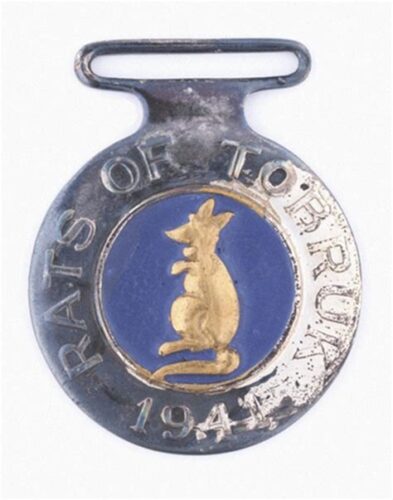
Joyce foolishly had peddled English “rat” to mean an insult, but facts on the ground kept delivering the German meaning of the word instead to the Germans. Everything he described about Allied troops burrowing, surviving bombardment, refusing to leave, outlasting the siege was all proving to be competence. The nouns insulted. The verbs complimented. The garrison struck medals celebrating the rat, cast from the aluminium of a downed German bomber, and tuned in nightly for more.

Tobruk rat medals were said to have been made by the Australian diggers from scrap metal of Nazi planes they shot down.

One defender recalled that Lord Haw-Haw broadcasts “never failed to cheer us”, opposite to what Goebbels expected.

Lord Haw Haw, the Irishman who gladly served Hitler

Every broadcast confirming they were still there was an advertisement that Rommel couldn’t fight, the Afrika Korps could not take the port. Nobody in the German propaganda ministry apparently caught the problem. Their translation of propaganda was becoming notoriously “witzig”.

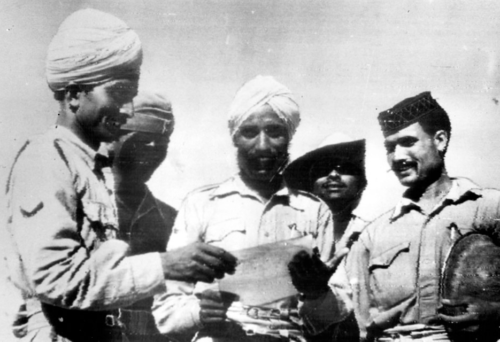
Indian troops in the Egyptian desert get a laugh from one of the leaflets which Field Marshal Erwin Rommel has taken to dropping behind the British lines now that his ground attacks have failed. The leaflet, which of course are strongly anti-British in tone, are printed in Hindustani, but are too crude to be effective. (Photo was flashed to New York from Cairo by radio. Credit: ACME Radio Photo)

Nazis had found an Irishman happy to be their native English speaker precisely so they would not have to think how the words landed. Consider Joyce much like an AI agent today. Nazis inherently are so clumsy and didactic they aren’t going to know how to generate useful, nuanced results.

Joyce took a German compliment, translated it into English contempt, and the compliment kept showing through because it fit the ground truth of adaptation, persistence, mastery of a hostile environment. And he never knew, just like how an AI agent is always in “hallucination” mode.

The Australian War Memorial notes that Joyce’s insults “were often turned into badges of honour.”

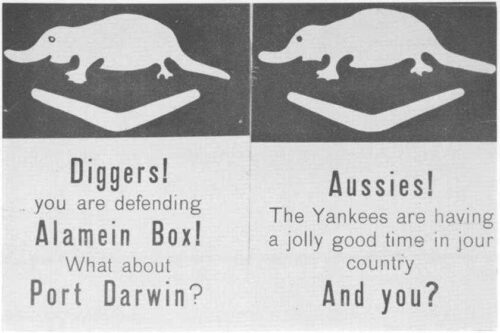
Propaganda leaflets dropped by Nazis on Australian troops were comical at best, and helped Montgomery boost morale against Rommel.

The standard account explains this as defiant reclamation where soldiers seized an enemy’s slur to wear it proudly. That is the English-language reading that gives Joyce’s mistake far too much undeserved credit instead of ridicule. The German-language reading is clearer: there was nothing to reclaim. The German propaganda produced praise when it attempted to insult. Joyce was a stage clown who couldn’t stop hallucinating, and deserves to be called out for it.

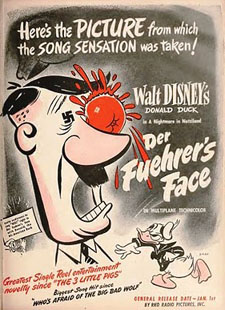
Advice from Walt Disney on the appropriate reaction to Nazis

The Pentagon Podium, March 2026

Fast forward to the modern day Haw Haw, Defense Secretary Pete Hegseth. Last Friday he told reporters that U.S. forces in Iran would proceed with “no quarter, no mercy for our enemies.”

“No quarter” has a specific meaning in military law, and it’s not a good one for Hegseth. It means kill those who surrender. The Hague Convention prohibits it. The Geneva Conventions prohibit it. The Pentagon’s own law of war manual prohibits it. The Nuremberg tribunals prosecuted German officers for it.

Senator Mark Kelly, a retired Navy captain, translated for anyone who missed it:

An order to give no quarter would mean to take no prisoners and kill them instead.

Hegseth perhaps thought he was going to communicate resolve by acting like he is a Confederate General who can order prisoners to be tortured and killed. Does he think this is 1865 and the southern states won? He produced instead, on the record, a war crime platform. A statement that the Pentagon’s own legal framework classifies as a war crime. The audience he intended to reach sits among the war crimes prosecutors, allied governments weighing coalition support, and Iranian propagandists looking for recruitment material. They all heard the same Haw Haw.

The same day, Hegseth described Iran’s military as “destroyed” and its attacks on shipping in the Strait of Hormuz as “sheer desperation.” At the time of this statement, the strait was functionally closed to commercial traffic, global energy prices had spiked, the U.S. Navy still refused to provide armed escort to tankers, and 13 American service members were dead. Iran’s capacity to close the world’s most important oil transit route is the asymmetric capability its military was built around. It is the opposite of desperation. It is the plan working.

Hegseth called it desperation for the same reason Joyce called the Tobruk garrison rats.

The framework is meant to show contempt. However that contempt cannot process evidence of enemy competence, even when the propagandist is the one presenting it. “Destroyed” is English framing about a closed strait that has a very different ground truth. And if there’s one thing I learned in forty years of working with disinformation history, ground truth matters a LOT more than spin doctors realize.

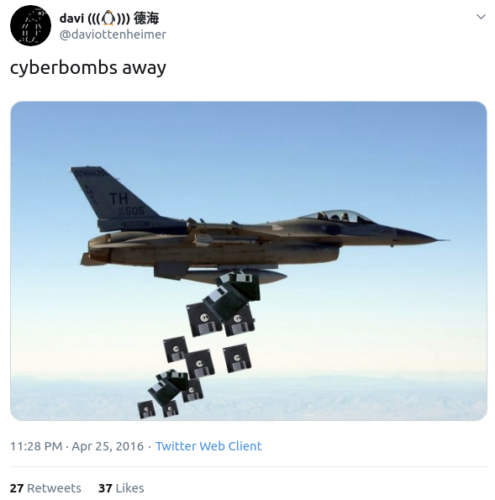
Source: Me on Twitter, 2016

At an earlier briefing, Hegseth addressed reporters about American casualties:

When a few drones get through or tragic things happen, it’s front-page news. I get it, the press only wants to make the president look bad.

Six soldiers had been killed in Kuwait by a drone that struck a shipping container serving as an operations center. “A few drones get through” is a description of a force protection failure, command failure, delivered in the register of a complaint about media coverage.

The Pentagon has also been releasing propaganda videos set to music, missile strikes intercut with video game footage, produced in the idiom of social media content. The White House communications director responded to criticism of one video by posting a Grand Theft Auto cheat code for unlimited ammunition. In the videos, every missile hits. There are no American casualties. There is no closed strait.

There is no girls’ elementary school in Minab where at least 165 children were killed in a school America double-tap (war crime) bombed on the first day.

Joyce broadcast every night to a garrison he said was doomed, the end, and yet every broadcast served to confirm they were alive. The Pentagon releases daily videos of a war it says is won, over and done any minute, and every video confirms the need to keep persuading people it is still winning, and maybe needs help.

The Grammar

Joyce’s problem was simple. The traitor needed the English meaning of “rat” to produce contempt, but the garrison’s behavior matched the German Wüstenratte, not vermin, psychologically having the exact reverse effect on soldiers in the fight. The insult misfired at the level of language itself.

Hegseth’s problem is structural as well as linguistic, and the mechanism is identical. “No quarter” in his register means strength. In the legal framework he is bound by, it means weakness because a prosecutable offence. “Destroyed” in his register means victory. On the operational map, it means the opposite, an enemy whose most effective threat of waterway disruption is functioning. “Desperation” in his register means weakness. In strategic terms, it means an adversary executing the doctrine it was designed around.

Each statement delivers two messages simultaneously. Hegseth thinks there is only one. The people that matter most probably hear both if not just the other.

Joyce was hanged for treason in January 1946. His broadcasts had, by the assessment of the Imperial War Museum, minimal impact on Allied morale. The insults were adopted as honours. The nightly confirmation of a garrison standing became the proof of its own endurance.

The question with Hegseth is not whether his primitive Goebbels-like propaganda errors will fail. Propaganda built on contempt for an enemy who is performing competently always fails. The question is what it costs America before it does. And will he be hanged for it.

What he said Who What he meant What he actually described
“Poor rats caught in a trap” Joyce You are vermin and will die Garrison adapting and holding
“Live like rats, die like rats” Joyce Subhuman conditions, imminent collapse Mastery of hostile environment
Nightly broadcasts to the garrison Joyce You are doomed Garrison still standing
“No quarter, no mercy” Hegseth We are strong and will win A war crime under the Hague Convention
“Their military is destroyed” Hegseth Victory is achieved Enemy closing the Strait of Hormuz
“Sheer desperation” Hegseth Enemy is collapsing Enemy executing its core strategy
“A few drones get through” Hegseth Press exaggerating minor setbacks Six soldiers dead in Kuwait
“Boom Boom” videos, daily briefings Hegseth We already won, wait no, we are winning We need help
Enemy response Joyce Adopted insults into badges of honour
Enemy response Hegseth TBD
Outcome Joyce Garrison held. Joyce hanged.
Outcome Hegseth TBD

Stephen Colbert also has exposed Haw Haw Hegseth errors using simple humor: