CNN reported this week that the CIA is arming Iranian Kurdish forces to destabilize Iran further. The White House called it “completely false,” while it confirmed Trump had spoken to Kurdish leaders, an intentional contradiction. A former military intelligence specialist told AFP the strategy is for Kurds to trigger a “cascading effect” of ethnic violence that overwhelms the Iranian state, destabilizes it and increases mass suffering.
At the same time, the administration is backing Reza Pahlavi as the son of the Shah toppled in 1979, to be the presumptive puppet who needs American aid to violently suppress the ethnic groups. No armed forces, no domestic base, no democratic mandate. Just a willingness to sign whatever contracts keep him in “power” over the mess Trump creates.
Five Iranian Kurdish groups just announced a coalition for self-determination. Pahlavi immediately attacked the concept, calling a sense of territorial integrity “the ultimate red line.”
Get it?
Trump is arming the people that his chosen dictator calls an existential threat. That contradiction is not incoherence. That is a repeat of history, slaves with any power forced to fight for the master’s pleasure, and to degrade themselves.
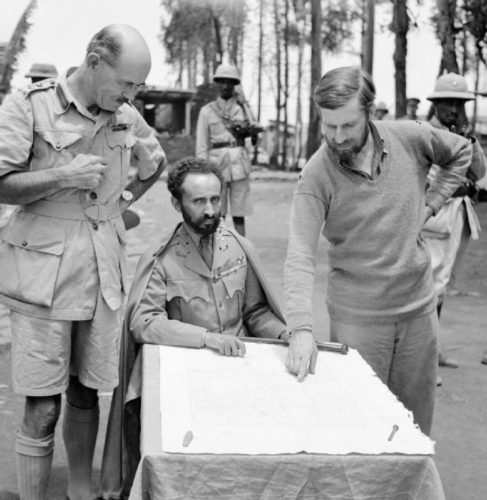
My own graduate degree research on disinformation and the origins of special operations, at the London School of Economics, documented this pattern in the British occupation of Ethiopia. An intervention to “establish stability” was followed by revolution, territorial war, and decades of anti-Western blowback. The Horn of Africa is still a disaster living with the consequences. Iran is being set up for the same.
The Method Has a Name
Mahmood Mamdani at Columbia published Define and Rule in 2012 documenting how British colonial administrators invented a system after the Indian Rebellion of 1857: define populations by ethnic categories, codify those categories into law, govern through the resulting divisions.
In Sudan, after crushing the Mahdiyya — a revolutionary movement that had united populations across tribal lines — the British parceled Darfur into tribal homelands called “dars.” Rights to land and governance became exclusive to those classified as native to a particular dar. What had been a multi-ethnic society with fluid identities became a set of legally enforced ethnic containers.
The Mahdiyya was a translocal anti-colonial resistance which “shook the foundations of the Empire to the core.” After it was brutally defeated, Darfurian society was effectively tribalized.
The mechanism is not to divide and rule, because define and rule is sufficient. You do not need to exploit existing divisions. You create the administrative categories that make ethnicity the only politically meaningful identity. Once that is done, ethnic conflict becomes structurally inevitable and an unavoidable tool of control.
Trump’s Iran strategy follows this logic to weaken Iran and dramatically reduce stability, force lower quality of life.
Arm the Kurds as Kurds. Activate Baluchi militants as Baluchis. Court Pahlavi as the Persian restorationist. Everyone is pushed into groups defined into roles that make national cooperation impossible and intense self-destructive conflict inevitable.
Follow the Oil
Philippe Le Billon at UBC has spent two decades mapping how resource geography shapes armed conflict. His framework: point-source resources like oil, concentrated in specific locations, produce a specific kind of violence. Control of the production site becomes the strategic objective. The populations living near those sites become either assets to recruit or obstacles to remove.
Iran’s resource geography is a textbook case.
Khuzestan province generates roughly 90 percent of Iran’s oil revenue. Its population is predominantly Arab. The International Crisis Group documented in 2023 that Khuzestan’s Arab minority views the central government’s chronic underinvestment not as mismanagement but as systematic discrimination. The New Lines Institute confirmed in February 2026 that local Arabs are denied employment in the oil and petrochemical industries, with jobs reserved for ethnic Persians who receive economic incentives to resettle on confiscated Arab farmlands. As a Khuzestani activist, quoted in the ICG report, puts it:
We live on one of the wealthiest lands on earth.
The Baluchis sit in the southeast along the strategic corridor to the Indian Ocean. The Kurds are in the northwest on pipeline routes and border crossings to Iraq. The Azeris are in the north near Azerbaijan.
Fragment Iran along these ethnic lines and you have erased humanity, replacing it with desperation. You have created a cage match of competing entities, each sitting on resources they lack the sovereign capacity to negotiate collectively.
Chaos is the Extraction Discount Trick
Michael Ross at UCLA looked into data from 170 countries in The Oil Curse and found petroleum-rich countries are 50 percent more likely to be ruled by autocrats and twice as likely to descend into civil war. Just look at Texas. Oil concentrates power, eliminates the need to tax citizens, removes the incentive for accountability. Oil states become rentier states — authoritarian by structural necessity.
But the Iran strategy is something worse than the oil curse operating organically.
This is the oil curse being engineered from the outside to ruin a country. Pick the autocrat first — Pahlavi. Engineer the ethnic fragmentation that will make his authoritarian consolidation appear necessary. The resource trap is the objective, for manipulation.
Paul Collier at Oxford coined the “conflict trap” phrase: civil war, low income, and dependence on primary commodity exports form a self-reinforcing cycle. Once you break a resource-rich country, it tends to stay broken. Resources continue to flow out at discounted rates because armed factions need weapons more than they need fair market value.
That is the business model, which obviously fits the Trump brand of hyper aggressive smash and grab.
Congo has more cobalt than anywhere on earth. It has been in continuous conflict since the 1990s. Jason Stearns, who led the UN investigation into the violence, documented in Dancing in the Glory of Monsters how the political system consistently produced leaders without vision, sustained by mineral extraction that financed all sides simultaneously. 5.4 million dead. The minerals kept flowing.
Sudan fractured and the oil fields became the contested border. Libya fragmented and the oil concessions got carved up among militias. Venezuela — same administration, same playbook, same prize — destabilize, sanction, back an exile figurehead, write the intervention around energy concessions.
Yugoslavia Isn’t Forgotten
Susan Woodward — senior advisor to the top UN official in the former Yugoslavia, special representative of the Secretary-General — wrote in Balkan Tragedy:
To explain the Yugoslav crisis as a result of ethnic hatred is to turn the story upside down and begin at its end.
The real cause was disintegration of governmental authority. Outside powers recognized breakaway republics, armed specific factions, imposed economic conditions that accelerated collapse, then characterized the resulting violence as “ancient ethnic hatreds.”
The hatreds were the output, not the input. They were produced by political and economic disintegration, not the cause of it. And Western intervention, Woodward documented, exacerbated the conflict.
Iran maps onto this with uncomfortable precision. Multi-ethnic state with geographically concentrated populations. Economic pressure from sanctions. External powers arming specific ethnic factions while claiming to support territorial integrity. Diaspora figurehead with foreign backing but no domestic base.
Pahlavi is Tudjman. The Kurdish coalition is the Croatian Defense Council. The “cascading effect” the administration’s own analysts describe is what Woodward spent 556 pages documenting: the mechanism by which a multi-ethnic state dissolves into ethnic war when outside powers pick favorites.
In Yugoslavia, that cascading effect produced Srebrenica.
Name It
Francesco Caselli and Wilbur John Coleman formalized the economics in their NBER paper “On the Theory of Ethnic Conflict“: the probability of ethnic conflict rises with the proportion of expropriable assets in a country’s wealth. Oil is inherently expropriable. Ethnic boundaries serve as enforcement mechanisms — they reduce the cost of determining who is in the winning coalition and who is not.
Ethnicity makes resource expropriation cheaper. That is why resource conflicts so consistently follow ethnic lines.
Berman, Couttenier, and Girard confirmed in The Economic Journal (2023) that mineral extraction increases the salience of ethnic identity over national identity. Mining does not create unity. It creates ethnic grievance, by making ethnicity the category that determines who benefits and who does not.
The Trump administration is selecting a dictator, injecting an unelected exile, to ensure extraction continues on favorable terms. To prevent him from facing actual power, they are engineering ethnic conflict across a country of 90 million sitting on the world’s fourth-largest oil reserves. Ethnic minorities concentrated directly on top of those resources are being primed to kill each other.
The scholarly literature has a name for Trump deliberately triggering ethnic violence to prevent a population from achieving political representation.
The scholarly literature has a name for Trump intentionally engineering state collapse to break apart Iran for access to resources at below-market rates.
Will anyone use the right words before another “cascading effect” of genocide reaches its known conclusion?