Category Archives: History

Fishing Nets Reverse Russian Drone Kill Zone

The most important detail in the Financial Times’ investigation of Ukraine’s front lines isn’t the kill zone, the fiber-optic drones, or the soldiers trapped for 165 days without rotation. It’s the fishing nets.

French and Swedish fishing nets, suspended over roads, hospitals, and critical infrastructure in Kherson, are intercepting 95% of incoming Russian drones. Up from 80% last May. Not with radar-guided missiles, not with electronic warfare, not with AI-powered counter-drone systems. Nets. The oldest barrier technology in human history is defeating precision-guided munitions at a cost ratio that inverts everything the defense industry has been selling for decades.

Simple Economics as Strategy

An FPV drone costs a few hundred dollars. A fiber-optic variant under $1000. Russia produces them by the million. And soon they’ll be 3D printed by field teams themselves. The standard counter-drone response of jamming, directed energy, and kinetic intercept costs orders of magnitude more per engagement than the drone itself. That’s an attacker’s economy. The defender bleeds money and time faster than the attacker spends it.

Fishing nets flip the ratio back. The cost per meter of industrial netting is trivial. Once installed, it works continuously with zero per-engagement cost. No operator, no ammunition, no power supply. A drone hits the net, tangles, detonates harmlessly or falls. The net gets repaired or replaced for almost nothing. The attacker has to keep spending thousands per attempt against a barrier that costs pennies per interception.

That’s an economic advantage that’s sustainable.

Who Built It First

Kherson has been the laboratory. The city’s population dropped from 250,000 to 60,000 under relentless Russian drone strikes, with over 9,500 attacks on civilians by December 2024. Governor Prokudin responded with what he calls a “drone dome”: layered netting over critical routes and buildings, combined with EW systems, sensors, and civilians trained with shotguns. In some districts the sky is barely visible through the mesh.

The FT describes the same approach spreading across the front. Thousands of kilometers of nets now form tunnels over main highways, stopping suicide FPV drones from diving at vehicles. The Pentagon recently issued guidance recommending nets, barriers, and camouflage as low-cost physical defenses against small drones. Taiwan is building its T-Dome program directly from Kherson’s experience.

Nets Answer the Drone Zone Question

Last November I wrote about Ukraine’s quartermaster problem in Pokrovsk — the 20km death zone where centralized linear logistics had become suicidal under persistent drone interdiction. The FT’s kill zone report confirms that condition now covers the entire front. Two soldiers held position near Orikhiv for 165 days, thirty relief attempts failed, fog saved them. Supplies move by cargo drone and UGV. Troops crawl under thermal cloaks for days.

I compared the problem to Grant’s quartermaster insight: you don’t counter interdiction with better tactics, you build a supply architecture more resilient than the enemy’s ability to disrupt it. Multiple independent routes, pre-positioned caches, expendable logistics with losses built into planning ratios.

Nets are one such logistics architecture. Cover the supply routes with physical barriers, and the kill zone starts to shrink. Vehicles can move under netting. Positions can be resupplied. The 30 failed relief attempts become possible when the approach route is physically shielded. The engineering problem I described, to sustain forces inside a drone-saturated environment, has an inexpensive answer.

Machine Guns and Barbed Wire

The defense establishment keeps comparing drones to the tank of 1916 as if a new offensive capability awaiting doctrinal innovation. That’s backwards. Drones are the machine gun. They destroyed the old paradigm of conventional movement.

The kill zone is no man’s land. And nets are barbed wire’s inversion.

In WWI, barbed wire made from surplus telegraph supplies was cheap passive defense that made the kill zone lethal for attackers. Nets are cheap passive defense that makes the kill zone survivable for defenders. Same principle. Physical barriers that cost almost nothing defeat expensive offensive systems, by working in the opposite direction. Wire aided the machine guns. Nets defeat the drones.

The 40km fiber-optic cables, the dynamic mining, the electronic warfare stalemate — all of that is real and accelerating. But the counter already exists. It’s sitting in declining or dormant fishing ports. Defense spending could revive coastal economies instead of enriching bumbling contractors.

The question is whether militaries will scale it as infrastructure or keep chasing expensive technological and ideological unicorns while soldiers crawl through the mud under thermal blankets.

General Grant would have ordered net production over six months ago.

De Oppresso Liber Was a Trust Doctrine: SOF Can’t Get Back There From Venezuela

Sitting on my desk is a ship in a bottle my father gave me, made by Bill Donovan. When I look at the tiny masts, their delicate rigging, above the blue painted waves, I’m reminded how the precise qualities of an operator used to be measured.

And then I look over at Seth Harp’s book.

He explains Special Operations missions in the GWOT as:

…covertly liquidating the male population base of recalcitrant ethnic and tribal groups that resist U.S. military occupation.

Ouch.

The book gets reviewed plainly by some as an emerging revelation about how badly things turned out under Bush. The far more important exposure actually needs to be about what’s developing post-GWOT.

SOF operators increasingly hint towards decoupled regional commands, district-style zones of interest, an end to the global sharing frameworks that defined twenty years of allied operations. Everyone points to the Delta operation in Venezuela using narrow cartel designations as proof the model works without foundational coalition architecture.

This is regressive doctrine dressed as adaptation. It’s like how people invoke Monroe as cover for the exact opposite doctrine. I mean, look at what “special” has meant and what operators increasingly want it to mean next.

Tailored and Relative Defense

The original Special Forces mission that we study, such as Bank, the OSS lineage, and de oppresso liber all defined “special” as being tight and tailored. Small teams shaped to specific cultural contexts, building indigenous defensive capability relative to local threats. The operator learned the language, lived in the village, measured success by what the partner force could do after Americans left. The 12-man ODA existed to enable durable local resilience. Medic as community entry point, intelligence sergeant building networks through relationships, team sergeant as institutional memory.

“Special” meant fit to context and oriented toward defense that enabled populations to protect themselves. Force multiplication structure, training, selection all followed from this. The screens were for cultural adaptability, communication aptitude, comfort with ambiguity, patience measured in years.

Universal and Industrialized Offense

GWOT flushed all that away with a rush to produce body tags. McChrystal’s F3EAD cycle (Find, Fix, Finish, Exploit, Analyze, Disseminate) redefined “special” as universal champions of death tolls. One kill chain applied anywhere and everywhere. Track a target, kill him and every military-age male nearby, seize documents, generate more names, repeat again hours later. Speed through targets, shoot first, and only ask questions so you can start shooting again. The same process in Anbar, Helmand, Mogadishu, the Sahel. Context didn’t exist beyond the shape of the kill zones. Cultural knowledge didn’t matter beyond the direction the door kicked in. The machine was industrialized offense, optimized for speed and volume of kills on a full sprint.

This required total information access across allied networks and worked because Five Eyes plus NATO SOF plus partner nations operated as a single organism with shared targeting databases. The global architecture made universal application possible.

It also inverted de oppresso liber completely. Indigenous partners became consumable inputs to the targeting machine. Afghan commandos serviced American kill lists. A force designed to enable tailored local defense was reoptimized into universal industrial offense that depopulated resistance. And the more the thoughtless machinery depopulated areas, the higher the percentage of resistance. Just like Vietnam. Go figure.

Decoupled and Unleashed

The operators calling for regional decoupling lately think they are wisely preparing for a world where the U.S. no longer has authority. Turkey running SOF against the American-trained forces in Syria. France pushed out of the Sahel by Wagner. Gulf states with SOF relationships that bypass JSOC. The global sharing framework broke when Hegseth used it for war crimes in the Caribbean, so formalize it.

What they actually propose is a third model worse than either predecessor. Not tailored defense. Not even universal offense with its coalition constraints. It’s a decoupled offense of regional fiefdoms operating under their own legal authority, political cover, and information control, answerable to whoever holds the designation authority in their district.

“Special” stops meaning tailored or even universal. It means unleashed, above the law because loyal to the directed mission only. A force pointed at whatever target the political sponsor designates, with no doctrinal requirement to build anything, no allied framework providing oversight, and no cooperative architecture satisfying the SOF truths that most special operations require non-SOF assistance.

The GWOT model, for all the horrors that Harp documents in his book, at least maintained the structural possibility of allied pushback. Partners who share a common operational picture can object. Decoupled districts eliminate that. Each zone operates in its own information silo, like Chad or Guatemala under Reagan. Nobody outside sees the full picture until criminal tribunals investigate decades later.

De oppresso liber is a trust doctrine.

Populations considering partnership with American SOF watched what happened to the Montagnards, the Kurds, the Hmong, the Afghans. The institutional record is politically conditional treatment. Decoupled regional commands with rotating political sponsorship will only make that worse. What serious opposition figure in Venezuela or anywhere else will invest in a relationship with a force that has no doctrinal commitment to their survival and no allied framework holding it accountable?

Tailored relative defense built things that lasted. Universal industrialized offense destroyed them. The new trend towards decoupled and unleashed doesn’t even pretend to try.

Mingus, Faubus, and the Old Drum-Beat of Trump Fascism

In 1959, Charles Mingus boldly wrote a song that spoke truth to power.

Fables of Faubus” called out Arkansas Governor Orval Faubus directly. The sitting governor had ordered the National Guard to block nine Black teenagers from entering Little Rock Central High School. Faubus weaponized American protections to attack the most vulnerable.

Mingus didn’t deal in abstraction. He pointed at the man and showed everyone how to laugh.

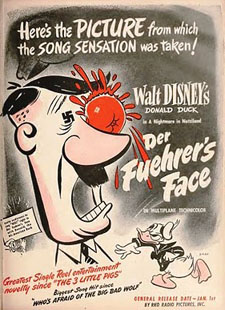
1940s-era advice from Walt Disney on the appropriate reaction to an Elon Musk, Peter Thiel and their puppet Donald Trump

Columbia Records recorded the song. Then they strategically stripped out the lyrics and released only the instrumental version. The music was deemed fine as culturally prestigious, commercially viable, safely ambiguous. The words were called a problem. Mingus himself said it plainly:

Columbia wouldn’t let them record the lyrics.

The motive was protecting Columbia revenue in Southern markets. A corporation understood exactly what the song meant, wanted to profit from its reputation as protest art, while it surgically removed the part that actually protested.

The vocal version came out a year later on Candid Records, produced by Nat Hentoff, who remembered the lyrics as “natural as sunlight.” The controversy never was in the content. The distribution system manufactured the crisis.

Name Me Someone Ridiculous

The Candid recording is a call-and-response between Mingus and drummer Dannie Richmond. Mingus calls and Richmond responds with names.

Oh Lord, no more swastikas!
Oh Lord, no more Ku Klux Klan!

Name me someone ridiculous, Dannie.
Governor Faubus.
Why is he sick and ridiculous?
He won’t permit integrated schools.
Then he’s a fool.

Boo! Nazi fascist supremacists. Boo Ku Klux Klan!

Mingus drew an obvious fascism parallel explicitly.

This was 1959. This was not retrospective analysis, not as rhetorical flourish. This was a man at the top of his game, a world famous musician, calling out real-time pattern recognition. Swastikas and Klan hoods in the same breath, because he understood they are the same operation switching between different uniforms.

Louis Armstrong already broke this ground two years earlier. He had told a reporter that Eisenhower was “two faced” with “no guts,” and described Faubus with an expletive too strong to print. The reporter and Armstrong negotiated a sanitized version of “uneducated plow boy”, which became a phrase the reporter later admitted was more his than Armstrong’s.

Even the act of speaking a truth in America required editorial negotiation about how much truth the weak white nationalist infrastructure could bear.

Mingus took it further. The system pushed back harder.

Arkansas to This Day

The thing about Arkansas is they still haven’t dismantled what Faubus stood for and built. The KKK has continued to be coated and rebranded, the Nazis embraced and extended. The state that deployed National Guard troops to stop kids going to school now deploys its legislature against the same populations with the same confidence that institutions will protect the operation.

Nazis and Klan freely roam without a care. It’s less that they had to seize power of state institutions, and more that they know government institutions reward their predatory incompetence. Arkansas isn’t about an extremism problem, when it runs a governance model for national socialism to be the product.

Faubus stood as a proof of concept. The template he established was the use of existing state infrastructure to enforce exclusion, force the federal government to either intervene or be complicit, and face no personal consequences either way. It remains the operating manual.

The man served six terms as governor. Six. After deploying the military against children. The system didn’t punish him. It promoted him.

If he were alive today he’d be the guy who denies the request for American hero Jesse Jackson to lie in honor in the Capitol.

The Competent Complicity of Curation

Columbia’s editorial operation on “Fables” is a precision instrument worth examining. Rather than silence Mingus, which would generate more protest material, they curated him into erasure. They kept his music to signal cultural seriousness and sold records, offering fans the bones while removing all the meat. The instrumental version let white liberal audiences feel something without the urge to do anything. It was consumption without reality of confrontation.

This editorial selection is competent complicity. The people making final cut decisions understood music, understood politics, understood exactly what they were doing. They weren’t accidental. They were serving a role in protecting, enabling and extending the white nationalist dominated market.

Hentoff’s Candid Records operated differently. It was total creative freedom, no editorial interference. The result was a recording where the lyrics landed with their full weight. Two labels, two systems, two outcomes from the same source material based on which one practiced integrity instead of complicity.

Rotary Perception

Mingus had a concept he called “rotary perception”. He said musical beats exist inside a circle, like target practice using birdshot, rather than on a line, giving musicians freedom to place notes anywhere inside that space without losing the underlying pulse.

Mingus described a centroid with acceptable variance. The beat is the mean, the circle is the confidence interval, and the notes are data points that can land anywhere within the distribution without losing the underlying signal. That’s a scatter plot with a cluster around a central tendency.

He developed it partly in response to critics who claimed younger musicians were more innovative than him. His counter argument was the “avant garde” already was audible in Charlie Parker and Duke Ellington, when you really were paying attention.

The concept applies well beyond music. What gets marketed as unprecedented almost never is. The patterns repeat. The refusal to recognize them is the product, not the problem. Mingus was saying in 1959 what the historical record has been saying for centuries. The thing you’re watching happen also happened before, that someone documented it, and that the failure to learn from it serves specific interests.

He was a historian’s musician.

Arkansas deploying state power against Black schoolchildren in 1957? It was a rotation. Trump loyalists protecting and rewarding that deployment in 2026 aren’t new either. It’s the same beat, played at a different point in the same racist circle.

Mingus saw it. He named it. And then Columbia cut the meat off and sold the bones anyway.

Some things rotate. Some things don’t change at all.

Quakertown Chief of Police in Plain Clothes Assaults, Chokes Teen Girls Protesting Fascism

Video evidence is being circulated of a plain clothes man who charged into a group of teenage girls to assault them and put one in a chokehold. The teenagers who tried to help victims of the man were then assaulted by uniformed officers who claimed the unidentified assailant was their Chief of Police.

Quakertown Borough Police Chief Scott McElree, in plain clothes, choking a teenage girl after he violently charged her for protesting fascism.

Suddenly, a man in a tan shirt, since identified as McElree, appears to charge into the group of kids and grab one who had been backing away, holding a phone.

[…]

In the chaos, some people had no idea who the man was, the student said, and started defending themselves against the unknown attacker.

[…]

One of the students who appeared to jump in to defend a classmate against the tan shirted man was then thrown to the ground by a uniformed officer. The officer can be heard on video telling the kid that the man he went after is the chief of police — Scott McElree.

“He didn’t even announce he was chief of police. We were confused,” the student said.

Students were put in detention overnight at the Bucks County Youth Center for defending themselves against an unidentified man who physically attacked them. A person wearing a vest with the word “police” on the back is seen running toward the frame and then out of the frame as the man in tan continues to hold a teen girl in a chokehold.

So uniformed officers were present, saw their chief battering and choking a teen girl, and their response was just to let it continue while they tackled the kids around her trying to help?

Fascism protest indeed.

These kids deserve a medal for exposing McElree.

A quiet consolidation of power is the institutional design that made this possible, with a single man holding police chief, borough manager, and records officer. McElree unilaterally controls the police, the administration, and the records about both. It’s highly unusual.

And the way McElree seized this power is notable.

He has been Quakertown’s police chief two decades, since 2004. In 2007 he grabbed the borough manager job after the previous manager’s “sudden departure”, initially claiming approval for the dual role would only be temporary. The council instead pivoted and approved him as permanent replacement within a month. He’s now 72 years old, sitting on a contract clause that protects him from “any adverse employment action” by council if he resigns from either position.

He’s structurally insulated from consequences, which could explain why he wore plain clothes to charge into a group of teens to grab, shove, batter and choke them while his officers protected him instead of the public.

So how did he end up seizing control over Quakertown? I’m glad you asked. He left a 29-year career at a department mid-scandal. That’s the fact. McElree left a Whitemarsh Township police department during a racial profiling case involving a fellow sergeant, a DA criminal investigation, a federal probe, and federal civil rights lawsuits. He was just a SWAT team lead who suddenly landed this police chief’s job within months of the huge racism controversy. The new town “vetted” him unilaterally saying “we investigated”. And where does the SWAT turned Chief live to this day? Not Quakertown, still in Whitemarsh.

As a historian, I noticed a curious footnote to his name from an infamous lynching. About 40 miles west of Whitemarsh in 1911 a violent white mob battered, tortured and publicly burned alive Black steelworker Zachariah Walker. The leading defense attorney for Walker’s suspected killers was Wilmer W. MacElree, referred to then as “the legal sage of Chester County.”

[White violent mobs claimed that Walker] fell from a tree and suffered severe head wounds. After being transported to the Coatesville Hospital and treated for head wounds and a broken jaw while shackled to his bed, a crowd estimated at 2,000 later marched on the hospital and seized Walker, carrying him on the bed from the hospital to Strode Avenue and preparing a large bonfire.

Walker was thrown into the fire three times but managed to escape. On the mob’s last attempt, they cut Walker’s foot off and tied a rope around him and held him in the inferno until he died.

“Don’t give me no crooked death because I’m not white,” Walker told the mob.

As he was burnt to death, a crowd estimated at several thousand looked on and some in the crowd collected his bones as souvenirs. Later that year, Coatesville Police Chief Charles Umsted was indicted for involuntary manslaughter for his failure to the stop the lynching.

The death certificate of Walker states: “Burnt to death in E. Fallowfield Twp by persons unknown to the Jury of Inquisition”. Persons unknown. A mob of thousands watched Walker being tortured and burned alive in broad daylight, yet bureaucracy records the perpetrators as “unknown”. Source: Chester County Recorder, Harrisburg, PA.

Umsted wasn’t merely indicted for failure to stop the lynching; he actively helped provoke it. A police chief who incites mob violence rather than preventing it. This led to passage of the Pennsylvania Anti-Lynching law in 1923, and yet by 1938 Black residents of Coatesville were organizing armed militias to prevent another lynching.