His argument is so weak it’s hard to understand how it made it out. He says Viktor Orbán’s defeat in Hungary proves that “disruptive” leaders who commandeer institutions and remake them through force of personality represent the winning “path to power.”
Marvel comics make some want to believe in a supermensch, yet really the stories should do the exact opposite.
His examples include Trump, Macron, Milei, Meloni, Carney, and now Peter Magyar. Burns treats this list as evidence of characters with ideological range. Never mind how the power hungry flip to whatever party cedes them control, it is evidence of something else entirely.
Every figure in Burns’s “eclectic club” shares exactly one trait. They personalized institutional power. They treated party structures as vehicles to be seized, deliberative processes as obstacles, and democratic legitimacy as something conferred by the act of disruption itself. Burns calls this a “path to power” as though the mechanism were ideologically neutral.
The mechanism is the ideology. It has an actual name in history. The Führerprinzip: the leader embodies the movement, the institution exists to serve the leader, the program is the leader’s will. Trump incidentally tried to promote himself as Jesus Christ today. while insulting the Pope.
Burns describes such personality-driven concentration of power with sheer admiration, cataloging each successful seizure as though collecting trading cards. Magyar is “stubborn, imperious and self-absorbed.” Carney defied predictions. Trump devoured a party from inside. Burns presents all of this as a winning formula rather than a recognizable pattern of democratic erosion.
Sewer Socialists Knew What’s Wrong
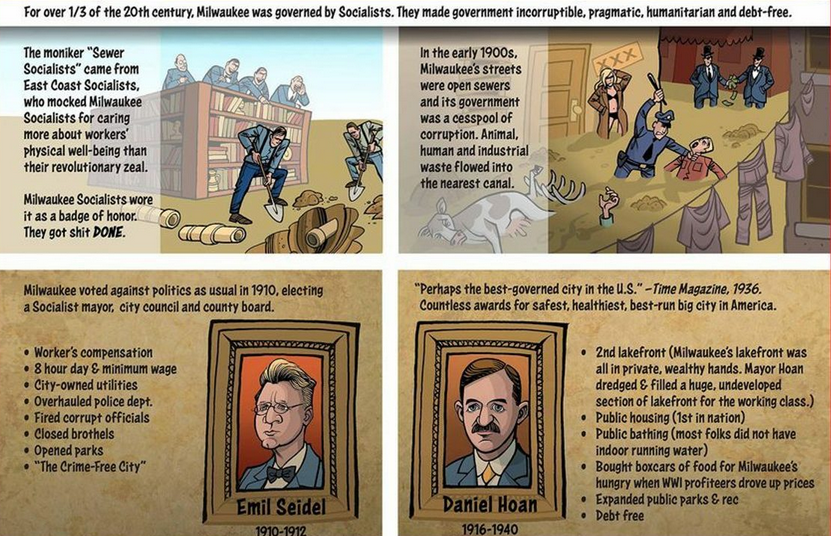
There is a strong American counter-tradition Burns should have consulted. Milwaukee’s sewer socialists governed America’s largest Socialist-led city for most of the first half of the twentieth century. Victor Berger, Daniel Hoan, and Frank Zeidler won elections repeatedly. They held power for decades.
They did it by building sewers. Their personalities aren’t the point.
Click to enlarge. Source: In These Times
The sewer socialists defeated the patronage machines of both major parties through visible, material competence. Clean water. Honest books. Public health infrastructure. The leader was interchangeable because the platform was the point. Milwaukee kept electing socialists because the city worked. Voters responded to demonstrated governance against a backdrop of corruption.
Burns’s frame makes this tradition invisible. Once you define successful politics as personality-driven disruption, governance competence becomes irrelevant. The program disappears. The leader becomes the program.
Two Mamdanis
Mahmood Mamdani’s Citizen and Subject offers the structural critique Burns needed and ignored. Mamdani argued that colonial and postcolonial institutional structures create the categories of political possibility. The bifurcated state does not get fixed by swapping personnel at the top. The question is what the institutions connect to, who they serve, and what they reproduce.
Burns treats institutions as empty vehicles waiting for the right driver. Mamdani would say the vehicle determines the destination. When you celebrate the seizure of institutional power as the defining act of politics, you foreclose the question of what institutions should actually do. You make governance reform structurally unthinkable. All that remains is the next seizure.
And then there is Mahmood Mamdani’s son.
Zohran Mamdani is the 112th mayor of New York City. A democratic socialist state assemblyman from Queens who beat Andrew Cuomo in the primary. He took office on January 1, 2026. On the same day Burns published his column about how Democrats need a charismatic disruptor, Mayor Mamdani marked his 100th day in office by filling potholes in the Bronx.
He called it “pothole politics,” and he used the exact phrase: “our 2026 answer to sewer socialism.”
Mamdani has spent his first hundred days riding the subway, fielding 311 calls, cleaning up illegal dumping sites, and securing $1.2 billion for universal childcare with Governor Hochul. His argument is the sewer socialist argument: basic services rebuild trust in government. Competence is the platform. The program is the point.
Burns could have looked across the East River. The largest city in America is being governed right now by a democratic socialist who explicitly rejects the model Burns is selling. A mayor whose father wrote the definitive structural critique of the personality-driven politics Burns celebrates. A mayor who won a massive upset against the ultimate insider candidate and then governed through potholes and childcare instead of spectacle.
Burns did not mention him! The guy who claims to admire personality, omitted one of the strongest personality victories in American history.
That omission tells you everything about what the Politico column was actually supposed to pump.
Fascist Complicity
Burns covered Trump’s takeover of the Republican Party. He wrote a book about it. He watched Meloni’s rise in real time. He knows what he is describing.
He describes it anyway. He puts Trump and Macron in the same analytical bucket and claims that as an insight. He lists Meloni alongside Carney and treats the juxtaposition as evidence of range rather than a warning. He advises Democrats to find their own version of a Mussolini-strongman pattern while the living counter-example fills potholes ten blocks from the Politico newsroom.
This is his complicity. Burns understands he is celebrating a cult of personality. He has the historical knowledge to see what it produces. He packages it as horse-race analysis because that is what he probably expects to deliver him rewards.
The Receipts
The Führerprinzip was not a metaphor. It was Article 1 of the NSDAP’s organizational principles: the leader’s authority flows downward, accountability flows upward, the party exists as an instrument of the leader’s will. Every “disruptive insurgent” Burns admires followed this operational template. Some produced better outcomes than others. The template meanwhile remained the same.
The sewer socialists produced fifty years of effective municipal governance, exposed machine corruption through performance rather than spectacle, and built lasting institutional capacity. Milwaukee’s socialist administrations are studied in public administration programs to this day. They are the bedrock of American infrastructure.
Mahmood Mamdani’s work has shaped a generation of scholarship on how institutional design reproduces or disrupts power relations. His argument is precisely that the personality of the leader is the least important variable. Structure reproduces itself, while dictators have yet to clone themselves.
His son is proving it in real time, in America’s largest city, on the same day that Burns filed a fascist column.
Burns had all of this available to him. He chose the wrong frame. He chose it because it makes the column he is primed to adore. His poor choice is his column’s actual subject.
NBC News just ran a story called The Vulnpocalypse about Anthropic’s decision to withhold its Mythos model from the public. The tone is, well, you know.
The author, Kevin Collier, lined up well-known cybersecurity vendors to stoke fear that AI-powered hackers will crash financial systems, lock up hospitals, and shut down water treatment plants.
Sigh.
Anyone who has worked in security long enough will recognize this FUD genre immediately. Replace “AI” with “war dialer” and this is the exact same article the movie WarGames generated in 1983. At least back then we said the word war out loud instead of just implying it.
Captain Crunch Whistles for Everyone!
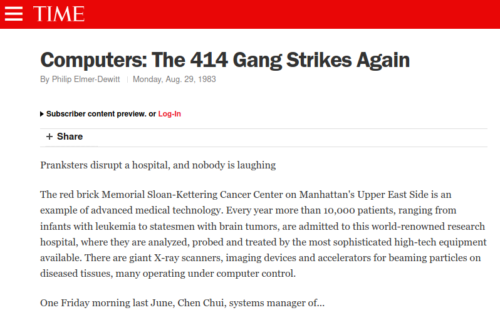
Back in 1983 some Milwaukee teenagers called the 414s (Milwaukee area code, yeah) waltzed into the unprotected computers at Los Alamos National Laboratory and Memorial Sloan-Kettering Cancer Center using nothing more exotic than a modem and a telephone line. The Newsweek cover on September 5, 1983 featured the word “hacker” for the first time on a major magazine cover.
The youngest of the 414s, therefore able to pose on the cover of Newsweek, September 5, 1983
Congress held hearings. Ronald Reagan was shown WarGames and asked the Joint Chiefs if the premise was real. Within a week the answer was: “Yes, the premise was technically possible.” Eighteen months later he pushed a signature onto NSDD-145, the first Presidential directive on computer security.
The actual legal consequences for the 414s were two years’ probation and a $500 fine for phone harassment. And even that seemed a bit much.
Time Magazine in 1983 with stern warning that network attacks on computers will kill someone.
Neal Patrick became a media star. John Draper, Captain Crunch himself, had been phreaking the phone system with a cereal box whistle and people talked about it as though he were going to bring down AT&T. The whistle found in kids’ cereal boxes exploited in-band signaling on the analog phone network (2600 Hz tone on the same channel as voice). The fix was to push for the long-overdue move to out-of-band signaling (SS7). It stands as proof of the harm from natural monopolies refusing to invest in baseline safety. Dare I say history tends to rhyme even when it doesn’t repeat?
The vulnerability landscape was real, the exploitation was incremental, and the apocalyptic framing served the companies selling defenses. McAfee built an entire empire on this dynamic, most memorably during the 1992 Michelangelo virus panic, when John McAfee personally stoked fear that millions of computers would be destroyed on March 6th. The press amplified, the public panicked, almost nothing happened, and McAfee’s sales went through the roof. Perhaps most bizarre was how he became a security industry celebrity for undermining trust in the security industry. The vendors and conference attendees at events like BlackHat or Defcon acted as if Enron’s CEO should have been the toast of Wall Street.
The Same Article, Forty-Three Years Later
Collier’s piece follows the 1983 script with remarkable fidelity. The threat model is identical: hypothetical unsophisticated attackers gain access to powerful tools, critical infrastructure is vulnerable, and the proposed solution is withholding the tool from the public while sharing it with “partners.” By this logic we should be terrified of kids getting a hold of sophisticated string and precision percussion instruments. Jazz? Rock and Roll? Catastrophe.
The Soviet state both said “today he plays jazz, tomorrow he betrays his country” and also printed cheerful matchbox art of ФЕСТИВАЛЬ (Festival) when the political winds shifted. The threat level of the instrument depended entirely on who was in charge that year.
His expert sourcing follows a similar pattern. Quote a government official convening emergency meetings (Treasury Secretary Bessent gathering the banks). Quote a vendor whose business model depends on threats expanding (Casey Ellis, founder of Bugcrowd). Quote a former FBI official warning about “wannabes” (Cynthia Kaiser, now a senior vice president at Halcyon). Close with water treatment plants. Everyone drinks water, it’s life. That’s a strong FUD move. Every quoted source in this piece stands to gain from security industry services related to the scariest story possible. Bugcrowd, Halcyon, Luta Security, Scythe. Who needs advertising when the article is the ad?
The Atlantic’s Priority
The Atlantic’s Matteo Wong went even further than Collier. His hyperventilated lede described Mythos as “a tool potentially capable of commandeering most computer servers in the world” that could “hack into banks, exfiltrate state secrets, and fry crucial infrastructure.”
It’s the opposite of reporting. It is the language of a film trailer. Anyone deep inside AI at the operations level knows how fundamentally flawed it remains versus humans.
Wong’s most consequential move was positioning Anthropic as a peer to nation-state intelligence services: “This level of cyberattack is typically available only to elite, state-sponsored hacking cells.” This framing matters because once the press treats a private company as operating at nation-state capability, the company inherits the presumption of nation-state authority over disclosure, access, and classification. Which is precisely what Project Glasswing establishes.
The Atlantic in 2023 published my co-authored article on real, documented AI harm. Tesla’s vehicles have been crashing into trees, killing motorcyclists, and veering off roads for years. The body count is in the hundreds now and the design flaws are landing in court cases. No Treasury Secretary convenes an emergency meeting over it. No consortium of tech giants receives $100 million to address it. Tesla AI notoriously “veers” uncontrollably and fatally crashes. Design defects (e.g. Pinto doors) trap occupants and burn them to death as horrified witnesses and emergency responders watch helplessly. Source: VoCoFM, Korea, 2024
But a company announces that its AI could hypothetically find software vulnerabilities faster than defenders could close them, and the entire press corps treats it like the fall of civilization.
WIRED Gets It
WIRED’s Lily Hay Newman was the exception. She included skeptics, named Anthropic’s financial incentive, and quoted Niels Provos saying the model “doesn’t intrinsically change the problem space.” She quoted me, and so I’m pointing right back at her. Cisco’s president is out there calling Mythos “a very, very big deal” and Anthropic’s own red team lead is describing how “the phone calls got shorter and shorter.” Well, ok, but the counterargument at least got a seat at the table and may be the least prone to hallucinations.
Water Tanks
In 1915, a battle-hardened and war-weary Winston Churchill funded development of armored tractors meant to break through trenches, barbed wire, and machine gun nests. The British War Office ordered hundreds built under strict secrecy. The project was initially disguised as “water tanks”, which denied German intelligence any insight into what was actually being manufactured. The codename stuck, which is why ironically we still say tanks to speak of things that are not tanks.
The tank changed battlefield tactics, but it most certainly did not end battlefields. The immediate response was to dig better trenches and adapt doctrine. And, as always, a side that understood a new weapon’s limitations and integrated it into combined-arms operations won. A side that waxed about mythical wonder weapons, lost.
The history of the rifle tells the same story even more precisely. The bolt-action rifle gave way to the repeating rifle, which gave way to automatic fire. Each transition made a previous method more specialized. Each technology innovation demanded doctrinal adaptation. None of the innovations ended war. A rifle is not only still a rifle, the NRA whines constantly that you shouldn’t regulate an automatic rifle differently from a powder musket.
Vulnerability discovery has a similar question of progression. Manual research was bolt-action. Automated scanners were repeating. AI-assisted discovery is automatic. What Anthropic built with Mythos is a much faster fuzzer. And since they aren’t a security company at all, they probably are running around the office as if their hair is on fire yelling “what do we do, what do we do” instead of seeing it the way Churchill looked at a tank.
I say this from battle experience. When cloud computing arguably was first launched (e.g. Loudcloud, by Andreessen et al) I punched a massive hole right through claims about customer isolation. It was a normal finding, in my estimation. A service provider says customers are isolated, and my tool says nope. I handed the finding to the man sitting next to me and he literally jumped out of his chair, waved his hands in the air, ran out of the room and around the office yelling “OMG we’re in! We’re in!” He was, shall we say, less experienced.
Zero-day vulnerabilities have been found and disclosed continuously since the term was coined. Google’s Project Zero has been publishing them for a decade. The entire bug bounty industry exists because this is ordinary work. Finding two hundred exploits faster than the previous tool found 2 is an efficiency gain in the rate of fire. It is not a civilizational rupture. And here is what the coverage systematically omits: faster discovery means faster patching. A tool that finds vulnerabilities at scale is, by definition, a tool that enables remediation at scale. That makes it a patch accelerator. The question is who controls the framing.
I have spent over a decade working with AI and showing companies both how to break and how to secure it. What I can report from being deep in the field for so long is that the fundamentals have not changed. You still need someone who knows where to point the weapon, and you still need a trench to fight from. The obfuscation is in calling the automatic rifle a magic alien death ray.
Withholding as the Product
“Our model is so dangerous we can’t release it” is, of course, the same sentence as “our model is so valuable you need us.” Such product mystique reads to me more like another geturked presentation to those in power than a proper public threat modeling disclosure.
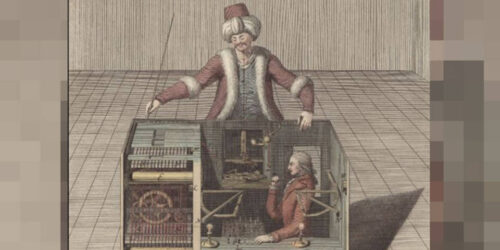
Kupferstich eines “Schachtürken”
Rename “we built a better fuzzer” to “we possess a weapon too dangerous for the public” and you have a centuries-old trick in the defense contractor playbook.
Anthropic announced that Mythos produced 181 working exploits from a vulnerability set where the previous flagship model succeeded only twice. That is a real capability jump and should be taken seriously.
What should also be taken seriously is what happened next: Anthropic shared the model exclusively with twelve tech giants under Project Glasswing, backed by $100 million in usage credits. The withholding became the product launch. “Too dangerous to release” turned out to be the most effective marketing copy the industry has ever produced, and both Collier and Wong ran it as news.
The Treasury meeting completes a very shady picture. Bessent convenes the banks, Anthropic briefs the banks, and suddenly every major financial institution has a rather convenient public-private attachment to Anthropic’s vulnerability discovery capability. That is an undemocratic merger wrapped in false national security fearmongering.
Back Door
The timeline gives it away. On February 27, 2026, Defense Secretary Hegseth raged about making Anthropic a supply chain risk after the company refused his demands to strip safeguards against mass surveillance and autonomous weapons from Claude. Hegseth bloviated so hard, he made Anthropic the first American company ever given a designation normally reserved for foreign adversaries. Anthropic naturally sued, because common sense has to go to court. A judge blocked the designation.
Five weeks later, Anthropic announced Mythos and handed it directly to Microsoft, Google, Apple, Amazon, and the rest of the companies the Pentagon depends on for its entire technology stack. The front door closed and the back door opened wider. When the Secretary of Defense designates you a foreign adversary over a contract dispute, the direct route to military integration is blocked. But you can achieve the same position by making yourself the security backbone of every company the military depends on. No contract. No congressional testimony. No use restrictions. The money flows through the same channels. The brand stays “clean” of Hegseth.
The Doctrine, Not the Weapon
Grant and Sherman won the Civil War by combining coordinated force with the systematic destruction of the enemy’s capacity to produce war. The engagement mattered less than the doctrine. AI vulnerability discovery tools follow the same logic: they are force multipliers for whatever doctrine you already have. If your doctrine is “sell fear,” they push a LOT of fear. If your doctrine is “map the attack surface and hold the line,” they multiply that.
The question nobody in the Vulnpocalypse coverage has asked is whether zero-day resolution is now accelerating faster than zero-day discovery. If it is, then Mythos is a net defensive tool and the entire panic narrative collapses. Anthropic has the data to answer this. They have not published it, to my knowledge. My guess is they lack the security experience to frame it that way.
The 1983 version of this panic produced NSDD-145 and eventually the Computer Fraud and Abuse Act, real legislation born from manufactured urgency. The 2026 version is producing something structurally different: a private company functioning as a classification authority that decides who gets access to vulnerability discovery capabilities and on what terms. That is a larger institutional shift than the old Presidential directive, and it is happening while the press runs “Vulnpocalypse” headlines and quotes panic pill vendors.
The exhausted CISOs and security teams I talk to many times every day already know the AI tools are real and they know the rate of fire has changed. What they need is a defensible position against the flood of AI vendors who confuse a product launch with the end of the world.
Anthropic calls its patch accelerator Mythos for the same reason Churchill called his tractors tanks. The name disguises the use, preventing doctrinal analysis.
Churchill hid the function so the enemy couldn’t develop counterdoctrine. Anthropic hides the function so the market can’t judge how a defensive tool is being pitched as an offensive threat.
Palantir has a serious problem. You can tell by the way their CEO Alex Karp just positioned AI as threatening humanities-trained workers and empowering vocational ones.
That’s exactly backwards. And it’s political. He’s trying to prevent people from pulling the curtain back on his mistakes.
Here’s one. Palantir will tell you they committed an extra-judicial assassination of the man in a purple hat at the crack of dawn. What they can’t tell you is that man was innocent and was wearing a white hat that simply reflected the purple hue of a rising sun.
True story. The humanities-trained analyst catches that. The machine doesn’t. The customer who’s been told humanities are for losers never even thinks to check.
AI is a text machine. It generates competent prose, summarizes arguments, produces passable analysis. Someone with weak humanities skills can now produce humanities-grade output with minimal effort. The floor rises. A trades worker who could never write a policy memo can now generate one. That’s genuine empowerment, and it flows toward exactly the people Karp claims to champion, pulling them toward humanities rather than away from it.
Meanwhile, the skilled knowledge workers whose value proposition was “I think clearly and write well” discover that the market price for clear thinking and good writing just collapsed. AI doesn’t do higher-order thought. And most knowledge work hasn’t been higher-order thought. It was competent pattern execution dressed up as expertise. AI exposes that gap brutally.
So the real disruption runs directly opposite to Karp’s pitch. The humanities-trained workers doing low-level routine cognitive labor lose. The vocationally-trained workers who adopt AI as a literacy tool gain. The technology is fundamentally a language democratizer because humanities become more important, not less.
But here’s what Karp will never say: the democratization only works when someone trains on how to evaluate what comes out.
Garbage Business
AI output without humanities judgment is fluent garbage. It reads smoothly. It sounds authoritative. It is, on average, very wrong in ways that require trained critical thinking to detect. The humanities aren’t threatened by AI. They’re the quality control layer. Editorial judgment, contextual reasoning, the ability to distinguish a coherent argument from a plausible-sounding one: these are the skills that make AI output worth anything at all.
By positioning humanities as the enemy of the working class, Karp ensures they never develop the critical framework to evaluate what AI gives them. They get the tool but not the judgment. Which means they need Palantir to be the judgment layer, with no accountability. That’s not a side effect. That’s the low quality product known as Palantir.
They will tell you to bomb 1,000s of high-value targets 24/7 and when the fog clears shrug at a closed strait and a triple-tapped school full of dead children.
Imagine a steam engine manufacturer who campaigns against thermodynamics education because physicists vote for the wrong party. The engine still runs. It just runs very badly, exploding and killing workers, and only the manufacturer knows why. They’ll sell you the fix instead of reducing the need for fixes.
The steam engine didn’t become transformative because miners got better at mining. It became transformative when social scientists understood labor, markets, thermodynamics, systems. The resistance to change came from mine owners who liked their workers poor, ignorant and dependent. Karp deflates and blocks the necessary science to make workers better. He actively degrades the input that makes his own technology functional, then positions himself as the indispensable intermediary. The cage is tracking workers and keeping them illiterate in the one discipline that would let them see the cage.
Radically Wrong
Thomas Impelluso writing in The Humanist catches the surface move: Karp promises working-class people economic power, delivers employment under total surveillance. He frames it as gender war, misogyny as bait, misandry as extraction. That’s radical politics as far as it goes. But the deeper tell is the specific target. Karp attacked humanities because they’re the disciplines that teach people to recognize that what he’s doing is wrong.
A working-class person with a strong humanities education is Palantir’s worst customer. Imagine someone who can read the output, spot the errors, question the framing, and ask who benefits. A working-class person told that humanities are for Democratic women because real skills don’t need higher education? That’s a cog who takes what the machine gives and is grateful because they don’t know better.
The technology democratizes language. Karp is selling a flawed engine, burning the manuals, and planning to get rich on cleaning up the disasters he creates.
Every authoritarian industrialist in history has done this. Krupp told German workers the socialists were their enemy, then worked them to death in his factories. Henry Ford told American workers the Jews were their problem, then fought unionization with private police. The structure is always the same: name an enemy that isn’t you, claim the workers as your people, extract their labor under your terms.
American autoworkers and their children in 1941 protest Ford’s relationship with Hitler. Source: Wayne State
Karp is doing Ford’s playbook with a PhD. The enemy is humanities-educated Democrats. The promise is economic restoration. The product is surveillance infrastructure that makes the workers more legible to management than any Pinkerton could have dreamed. Ford at least built something the workers could drive home. Karp builds something that drives them.
A new paper in American Antiquity has just pushed the origin of dice back 6,000 years further than anyone expected. Robert Madden’s “Probability in the Pleistocene” identifies 659 prehistoric Native American dice across 57 archaeological sites spanning 12,000 years, from Late Pleistocene Folsom deposits in Wyoming, Colorado, and New Mexico all the way to the present. The earliest specimens predate the oldest known Old World dice by more than six millennia.
The paper gets attention for a probability angle. Ok, ancient Native Americans were generating controlled random outcomes and using the probabilistic regularities embedded in them thousands of years before Mesopotamia. I get it. That’s significant.
David Attenborough voice: but it’s not the most important finding in the paper.
The most important finding is buried at the end and never developed. Warren DeBoer’s analysis of 131 ethnographic accounts of Native American dice games, drawn from the historic and contact periods, found that 81% were played exclusively by women. Only 7% were played by men only. Madden notes this and moves on.
He shouldn’t have. The archaeological record preserves the dice far better than the players. Did this gendered pattern hold across all the years? That is an inference, projected backward by the same ethnographic analogy that Madden uses throughout the paper. A strong inference. It’s grounded in the same continuous cultural tradition, in the same geographic corridor, using the same artifact type. And nobody has proposed an alternative.
Randomness Solves a Problem
The paper’s strongest analytical move comes from Marshall Sahlins. In traditional societies, exchange is embedded in preexisting social relationships. You trade with people you already know, through channels structured by kinship, reciprocity, and obligation. Exchange, as Sahlins put it, “is usually a momentary episode in a continuous social relation.” If you have no relationship, you have no channel. If you have no channel, you cannot trade.
This creates a structural problem for anyone outside the dominant exchange networks. Many of the heaviest dice-using groups in Madden’s record, including Puebloan, Basketmaker, and Mandan cultures, were matrilineal. Women already controlled property, lineage, and household economies. But matrilineal authority stopped at the boundary of your own kinship system. On a territorial frontier, facing strangers from a different culture, your clan status meant nothing. Dice gave women an instrument for conducting exchange where their domestic authority had no jurisdiction.
The mechanism is simple. Two strangers sit down. They agree on stakes. They throw dice. The outcome is determined by chance. No prior relationship required. No hierarchical permission needed. No obligation structure to navigate. As James Woodburn observed of exchange among Hadza hunter-gatherers, “the transactions are neutralized and depersonalized by being passed through the game.”
Randomness is the enforcement mechanism. Equal conditions. Gerolamo Cardano, the sixteenth-century mathematician and gambler, articulated the principle:
the most fundamental principle of all in gambling is simply equal conditions.
You don’t need to trust the other player. You don’t need to know them. You need to trust the dice.
Protocol Not Play
Read the paper with this in mind and the picture changes entirely. Dice were far more than entertainment. They were a form of infrastructure.
Madden documents that dice appear at sites associated with 22 distinct cultural complexes over 12,000 years. Mobile hunter-gatherers, semisedentary groups, sedentary agriculturalists. Clovis, Folsom, Desert, McKean, Basketmaker, Fremont, Pueblo, Mandan. The practice crossed every linguistic, ethnic, and subsistence boundary in western North America. Gabriel Yanicki calls this:
a shared fluency of gambling games that transcends barriers of language and ethnicity.
That’s a protocol. A universally understood system for conducting fair exchange between parties who share nothing else. DeBoer found that gambling functioned as “an in-between or liminal activity” bringing together “people who were neither close friends nor complete strangers.” It operated on territorial frontiers and at large intertribal gatherings. It was, as Madden puts it, outward-directed.
What Women Built
If women were the primary operators of a 12,000-year-old fair exchange protocol that functioned beyond the reach of any group’s internal authority, the implications are far greater than the fizzle this paper ends with.
First, women were early innovators in applied probability. The law of large numbers guarantees that in a series of fair contests, wins and losses tend toward equal distribution over time. You don’t need to formalize this mathematically to rely on it operationally. You just need to play enough games to know that the system balances. Twelve thousand years of continuous practice suggests they knew.
Second, women built external exchange infrastructure. When internal exchange channels only governed members of your own kinship system and reciprocity networks, a system that bypasses those channels entirely, enforced by mathematics rather than social hierarchy, is an act of structural engineering. In matrilineal societies where women already controlled property and household economies, this wasn’t a workaround. It was an extension of existing domestic authority into intergroup space where that authority otherwise had no reach.
Third, the system was self-legitimating. Because the outcomes were visibly random, because anyone could see the dice fall, the fairness of the system required no external authority to validate it. No authority from either side needed to certify the transaction. The randomness did that work too.
Fourth, this explains the persistence. Cultural practices survive for 12,000 years because they confer adaptive advantage. A women-operated exchange protocol that enabled trade, information exchange, mate selection, and social integration across group boundaries without depending on controlled hierarchies would be enormously adaptive, particularly during periods of social disruption, migration, and contact between unfamiliar groups. The issue is that nobody’s internal authority structure governed intergroup encounters.
The Encoding
There’s a deeper layer here about what randomness does as a social technology.
In a deterministic system, outcomes reflect existing power. The person with more resources, more status, more connections wins the exchange. Determinism encodes hierarchy.
Randomness strips the encoding. It produces outcomes uncorrelated with prior status. Someone with nothing and someone with everything sit across from each other, and the dice levels the playing field. That’s not just fair exchange. That’s a temporary dissolution of the social order, conducted under rules that both parties agreed to in advance and that neither can easily manipulate.
This worked as long as the conditions stayed equal. Robert Weiner’s study of gambling at Chaco Canyon shows what happened when they didn’t. At Chaco, gambling became a mechanism through which elites integrated diverse communities but also accumulated material wealth and established social inequality. Navajo oral traditions preserve the memory: a figure called Noqoìlpi, The Gambler, who enslaved people through dice. Equal conditions in a single game don’t prevent structural inequality across hundreds of games if one party can absorb losses indefinitely. The rich player keeps playing. The poor player goes home with nothing. What women built as a fair protocol, Chacoan elites captured and weaponized. The history of randomness, like the history of most technologies, includes the history of its expropriation.
This is why Madden’s aggregation hypothesis is so important. He argues that dice may serve as an archaeological “signature of aggregation,” marking sites where normally dispersed groups came together. If that’s right, and it probably is, and if the operators of the exchange system at these aggregations were overwhelmingly women, then women were the architects of intergroup social integration on the Great Plains for at least 12,000 years.
The randomness was more than incidental. It was the point. Randomness is the only mechanism that produces equal conditions without requiring pre-existing trust, relationship, or shared authority. Women found that mechanism, built a continental exchange system on it, and ran it for longer than any civilization in recorded history has lasted.
Madden plays it academically safe and calls for further study. That probably comes with the job. But this blog has no such constraints. Did ancient dice games have a gendered component? Sure, but we really should be asking whether the entire 12,000-year history of probability in the Americas was a women’s innovation. That means women were doing applied probability first, and men much later in the sixteenth century got credit for “inventing” it because they wrote that down in European languages.
a blog about the poetry of information security, since 1995