Category Archives: History

Fire Discipline: What China Hears When America Goes Rambo in Iran

Sitting at my desk in San Francisco, sometime around 2016, I got an email from a master sergeant. A recording of a firefight. And then a phone call. Play it, he said. So I played it. Gunfire. Chaos. Then a voice: Grenade.

Play it again, he said. Listen.

I played it again. The voice wasn’t scared. It was factual. Grenade. Like hearing “pastrami on rye” at a deli counter. The same calm. The same precision. The same total awareness of what’s happening and what matters right now.

That’s fire discipline. That’s what Delta is world famous for. Sprint and fire at maximum efficiency, nothing wasted. The decisive calm that comes from knowing exactly how many rounds and what each one needs to do. Every shot placed. Every word functional. Nothing lost to bravado or panic, nothing spent on performance.

Play it again, he said. What’s really happening in this fight. What works. What’s blunder. Do you hear it?

I’ve been thinking about that “grenade” for two weeks. Because the sound coming out of Operation Epic Fury, and the war crime theatre of Hegseth, is the exact opposite of that voice. It’s all fluff. All blunder. Do you know what the Pentagon sounds like right now? 1950 Korea. And China is listening to the same tape.

…during the 2016 campaign, Trump repeatedly declared that Douglas MacArthur was his “favorite general.” At rallies, Trump would invoke MacArthur’s name almost as though he were in direct communication with his ghost. […] MacArthur had been outwitted and outflanked by a guerrilla army with no air force, crude logistics, and primitive communications, an army with no tanks and precious little artillery. As David Halberstam put it, MacArthur had “lost face not just before the entire world, but before his own troops, and perhaps most important of all, before himself.” All of this happened because MacArthur was almost criminally out of touch with reality.

And so here we are.

The Deterrence Illusion

The “China is deterred” narrative runs something like this: the US popped Venezuela in January with overwhelming ratios, like blackouts for 3 million people to arrest one guy. Then the US blockaded a weak Cuba, as it has no sea defenses, and then Trump launched a surprise attack on Iran while his own negotiations were actively ongoing, decapitated the supreme leader, and declared total air superiority within 72 hours, boasting “not a fair fight”.

Beijing must be so scared now.

Yet this analysis assumes China’s baseline expectation was about Iranian air defenses working. Nobody thought they would. Certainly not Venezuela. Certainly not North Korea, which has spent decades putting everything that matters under granite for exactly this reason. Certainly not China, whose military planners have been studying US strike capabilities since long before Desert Storm.

What China actually witnessed in American hamfisted pray-and-spray salvoes wasn’t just “America bomb things, America make fire and noise, America so nasty.”
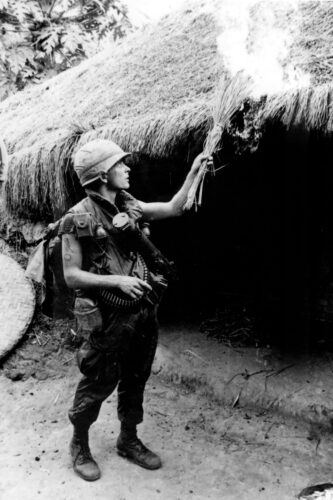
The Peers report on the My Lai Massacre found that Captain Medina had instructed his men to “burn the houses, kill the livestock, and destroy the crops and foodstuffs.”

They knew that. What they got was specifics about weakness: F-35 and F-22 electronic signatures under combat conditions, operational tempo sustainability, jamming profiles, cyber-kinetic integration patterns, kill chain logistics from ISR to strike. That’s the structured data leak you never get from exercises or satellite imagery. As technologist Amir Husain put it in the Jerusalem Post, the American rush into unilateral war is “a dataset goldmine for China” for building automated detection and threat classification models.

The US demonstrates the opposite of deterrence. It held an unnecessary live-fire exhibition with free admission to telegraph its entire playbook, revealing the entire spectrum of Trump’s options and thoughts.

MacArthur’s Ghost

Those who say China should fear American willingness to fight clearly forget Douglas MacArthur wasn’t fired for being unwilling to fight. He was fired for being so willing he nearly started a nuclear war with China. Truman understood that willingness without discipline is what the Greeks long ago classified as the most self-defeating capability a military can possess. It’s like running into a minefield.

The historic parallel maps cleanly for China, not least of all because among the regressive all-show-no-go white supremacists that Trump calls out as his role models, MacArthur is right up there. The thunder and lightning had worked once for MacArthur, so he thought escalate, go bigger, roll right up to the Chinese border. He pushed to the Yalu drunk on the Inchon success, without a clue. Then 300,000 PLA troops crossed the Yalu and pushed him back to roughly where he started. That willingness was the vulnerability. It showed Beijing exactly when and how to intervene.

Chinese political scientist Zheng Yongnian told the South China Morning Post that “America’s war-making capability depends solely on its will to deploy such power.” The deterrence pundits read that as a compliment, when it’s actually a cynical vulnerability assessment. A power that acts on will rather than calculation can be drawn into commitments that exhaust it into embarrassment.

Mao understood this about MacArthur in 1950. The more willing he was, the further he extended, the more exposed he became. China waited for the overreach, then moved.

Trump overwhelmed Venezuela as it sat patiently, launched blockade of empty waters around Cuba, and tricked Iran into believing negotiation possible. Now he is just a tail on the Israeli dog, if not the flea on the tail, pulled into the largest invasion of Lebanon since 2006. With what to show for it all other than emptied stockpiles and wreckage. Taiwanese analyst Cheng-Yu Wu assessed that the PLA learned Trump “will do whatever it takes to achieve its own national interests, whether or not there are negotiations.”

Some analysts really think they can frame that as deterrence. A drill sergeant would call it a fighter closing his eyes, throwing wild haymakers and claiming whatever hit is losing. Both descriptions can be true. Only one of them is meaningful to a trained opponent.

Fire Discipline

That voice on the recording knew something everyone is supposed to learn before stepping down range. Don’t fire until you see the whites of their eyes wasn’t academic poetry. It’s always been scarce resource management. The NRA was founded by Union Generals who said 1,000 rounds per kill was unsustainable to defend American Blacks against the KKK. Every round you fire at nothing is a round you don’t have when it matters.

The US is emptying interceptors against cheap Iranian drones. Burning Tomahawks on targets that were already assumed destroyed, or worse, killing nearly 200 little girls at school. America is expending precision munitions far faster than the industrial base will replace them. And doing all of it on camera for everyone’s intelligence collection, let alone China.

The Heritage Foundation warned before the Iran war started that SM-3, SM-6, PAC-3 MSE, and THAAD interceptors would be exhausted within days of sustained PLA salvoes. Aggregate US vertical launch system inventories were insufficient for even one full fleet reload. CENTCOM officials thus warned of a “Winchester” scenario: complete ammunition depletion.

Now look at what draft-dodging Trump ordered since February 28. The US burned over 2,000 precision munitions against more than 3,000 targets, only to announce repeatedly it’s not done yet. Allies have fired hundreds of interceptors. THAAD components have been redeployed from South Korea. The Abraham Lincoln carrier strike group was pulled from East Asia. Patriot interceptors, which Lockheed produces at about 620 a year, were depleted in the hundreds over the first 36 hours alone. We’re still debating who shot down the three F-15E in one night so efficiently without a trace, evaporating the mythology of American Air superiority.

And on the other side of the ledger: China has barred the export of rare earth elements for military use, which means the exact materials required to build the missiles the US is burning through. China is watching the US deplete stocks it can’t rapidly replenish because China controls the supply chain for those replacements.

The Asymmetry

Compare the two sides and see what America has been doing to itself, unprovoked.

United States China
Munitions Depleting Accumulating
Intelligence Broadcasting Collecting
Carrier groups Redeployed to Gulf Positioned in Pacific
Strategic reserves Drawing down Building up (104 days coverage, projected 140-180 by year end)
Industrial base Years behind demand Expanding offensive capacity
Rare earths Import-dependent Export ban in place
Diplomatic posture Overcommitted on four fronts Restrained, summit-focused

That’s not passivity on China’s part. That’s basic discipline. China is doing what any wise fighter does when the opponent is dancing and swinging wildly to amp up the audience: cover and wait, read the rhythm, count the punches, feel the decline, watch for the opening.

Nixon’s Tar Baby

Foreign Policy drew a parallel to 1964, when the Peking Review described US interventions in the Congo as Washington’s “second South Vietnam”, about keeping American assets tied down far from China’s borders. But that reference is far too diplomatic. The actual historical pattern is worse, and it has a name Americans should be embarrassed about.

Kissinger and Nixon adopted NSSM 39 in 1969 called the “Tar Baby” option. Their policy was strengthening ties with racist white-minority governments in Rhodesia and apartheid South Africa to deny Blacks power. The premise was that apartheid was an unpleasant but permanent reality, and Washington should accommodate it pragmatically and prolong white nationalism. Its own internal review later concluded that its only real result was to mire the United States deeper on the side of obvious oppressors. The name told you the outcome of the strategy. You punch the tar baby and you get stuck.

The destabilization model ran in parallel. Congo’s leader Lumumba was assassinated in 1961. The CIA sent poison to its station chief; when that fizzled, Lumumba was deposed in a CIA-backed coup and shot by Congolese assassins. UN Secretary-General Dag Hammarskjöld was shot down by U.S.-backed mercenaries, as he flew in to negotiate a ceasefire. Mobutu seized power with US help and misruled the country for three decades. Congo never recovered. Similarly Mondlane, a professor in America positioned to become leader of Mozambique, was assassinated in 1969.

Same trajectory.

Stuart Reid, writing in Foreign Affairs, put it precisely: for the Congolese people, the events of 1960-61 represented the opening chapter of a long horror story. For the US government, they provided a playbook for future interventions.

The playbook: assassinate leaders, destabilize the country, back the regional oppressor as the “stable” partner, let the region deteriorate, use the chaos to justify permanent intervention. The people who live there never recover. The strategic partner gets a free hand. And the great-power competitor watches you get stuck to the tar baby.

Apartheid South Africa formalized this as doctrine. P.W. Botha’s “Total Strategy” required a buffer of deliberately failed states on their border. They used the ugly term cordon sanitaire. The logic was self-sealing: a thriving Black-governed neighbor would quickly falsify the racist claims that only whites were capable of self-rule, so the Black neighbor had to be destroyed. South Africa armed RENAMO to terrorize Mozambican civilians, backed UNITA through decades of Angolan civil war that killed half a million people, and used proxy forces to turn a drought into a famine that killed over 100,000. The manufactured chaos confirmed the racist ideology that manufactured it.

Substitute “Palestinians” or “Iranians” and the sentence requires no other edits. Gaza flattened. Lebanon invaded. Iran decapitated with no successor structure. A stable, self-governing neighbor is an existential ideological threat to an ethno-supremacist state. The vacuum is the feature. In the latest news from Israel troops call non-Jews dogs and stop their vehicles to shoot people in the head at close range.

Just like ICE in Texas.

Just like ICE in Minnesota.

It’s a procedural thing.

The US knows this model so intimately because it ran the active version against the Soviets. In 1979, Brzezinski’s explicit goal in Afghanistan was, in the words of Defense Department official Walter Slocombe, “sucking the Soviets into a Vietnam quagmire.”

It worked.

The Soviets bled for a decade and many argue the stickiness was what accelerated power collapse. Now the question is whether China needs to engineer anything at all, or whether the US has been punching into a tar baby scenario on its own initiative while Beijing simply watches.

Kissinger dismissed the cost of millions killed as “the unhappiness of a bunch of Africans and the self-righteous indignation of a few minor NATO allies.” That contempt is the through-line. The people destroyed by the policy don’t register as costs. They’re externalities. Then as now.

The Playbook Runs Again

I bring all this up because the gap I keep seeing in the pundit class is that almost nobody is synthesizing all the threads simultaneously: the munitions math, the intelligence exposure, the fire discipline asymmetry, and the destabilization pattern that ties them together.

The Heritage guys get stockpile numbers. The intelligence community people get collection problems. The strategists get the overextension risks. But nobody puts the full picture together, perhaps because the conclusion is too uncomfortable? Trump is systematically degrading American capacity to fight the war it actually needs to deter, while running the same Nixon playbook that failed across southern Africa for three decades.

Khamenei decapitated February 28. The Assembly of Experts bombed while meeting to elect a successor. No governance structure left. And within days, Israel launches its largest ground invasion of Lebanon since 2006, explicitly modeled on the genocide in Gaza. No really, an Israeli official told Axios: “We are going to do what we did in Gaza.” Already 800,000 Lebanese civilians are displaced. Nearly 800 killed. The imperfect ceasefire was at least something, until the US removed the one actor whose deterrent capability was constraining Israeli expansion.

Iran was a threat, but Israel reframed it into the leash. Remove the leash and the immediate result is genocide expanded into Lebanon, conducted openly, described in those terms by the people conducting it. The regional partner gets a free hand.

Korean War Arithmetic

One of the hallmarks of 1950s military failure was the US flattened every standing structure in North Korea. Ran out of targets, just as Trump says today. The war ended in a stalemate on roughly the same line it started. The shock and awe, air superiority, technological dominance, more bombs dropped faster than ever before, worked for a minute as domestic propaganda and not at all as strategy.

Same pattern now. Trump declared Iran had no navy, no air force, no radar and “just about everything’s been knocked out” within days. And then? Two weeks later, Iranian drones are still destroying billion-dollar radar systems and THAAD subsystems on video. American soldiers are dead. Domestically manufactured surface-to-air missiles are shooting down $32 million Reaper drones. Civilian trucks are launching ballistic missiles produced en masse.

The grind is on. Zero ground gained. No articulated end state. And every day it continues, China’s relative advantage in the Pacific grows, again not because China is doing anything at all, but because the US is spinning like a drunk doing everything, everywhere, all at once, to itself.

North Korea drew the simple conclusion from American air power decades ago: you can’t stop the bombs, you can make the bombs irrelevant. Eritrea knows exactly the formula too, as it used the same rubric to defeat the largest standing army in the world. China, full of ardent historians, has been watching that model. Hardening, dispersal, redundancy, underground facilities, quantity over quality in offensive systems. The Iran war is leaking all the exact parameters needed to calibrate against.

The analysts celebrating American willingness are celebrating their MacArthur heritage for all the wrong reasons. Drunken, stupid overreach hasn’t become a virtue just because the explosions look good with social media tricks. The tar baby was a disaster, in the way everyone learns the most powerful tiger in the world never escaped La Brea.

Play the tape again. Listen. Grenade. Calm. Factual. Disciplined. That’s the voice China recognizes, and right now the US sounds nothing like it.

Trump Lights Children on Fire in Iran to Watch the World Fail to Save Them

Trump promised to end the Ukraine war on day one. He promised to stop America’s forever wars. He is now sixteen days into a war with Iran that has no exit strategy, no surrender, no deal, and no end in sight — while the Ukraine war grinds on with fresh Russian money from sanctions he just lifted.

The conventional explanation is incompetence. He didn’t understand what he was promising. He didn’t plan for Hormuz. He didn’t anticipate Iran’s drones. The problem with the incompetence theory is that it doesn’t explain why every failure produces new power.

There’s a simpler explanation. This is how a protection racket works. The economics are straightforward: the worse things are made by the protector, the more valuable their protection becomes. A mob boss doesn’t profit from peace on the block. He profits from being the threat, creating crisis that ideally he controls. If the threat goes away, so does the revenue. If the threat escalates, the price goes up.

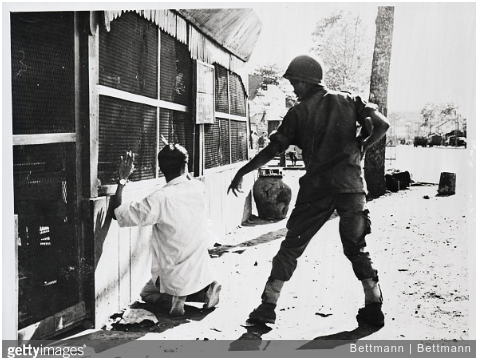
Getty Images 4/24/1955-Saigon, South Vietnam: “Troops of American backed Premier Ngo Diem and the rebel Binh Xuyen sect fought a brief street battle with machine guns. A nationalist soldier stands guard over a suspect after the fighting had died down. At least three persons were killed and eight wounded in the short clash. The fighting took place on the opposite side of the European residential district from the boulevard Gallien, meanwhile the general anarchy increased as gangs of thugs roamed the streets of Saigon kidnapping civilians and extorting ransoms.”

Trump started a war with Iran on February 28. After two weeks of Trump saying he’s “ahead of schedule” Iran hasn’t surrendered, nearly 200 little girls died when their school was bombed, the Strait of Hormuz is effectively closed, a thousand oil tankers are stranded, Brent crude is past $105, and the president has shifted from begging to demanding that countries who had no role in starting the conflict send warships to clean it up, or lose their security guarantees from him. Every day the crisis deepens, he expects his leverage grows. Every failure he produces he expects new coercive power. The worse it gets, the more he believes everyone needs him, and the more he expects they’ll concede.

The Sequence

Drop NATO. Drop Ukraine. Drop Pacific defense. Drop intelligence and break-up five-eyes. Declare the end of diplomacy. Start a Middle-East war unilaterally. Iran closes Hormuz. Oil spikes past $100. Use the energy crisis to invoke the Defense Production Act — a Cold War national security law — to override California state environmental law and a federal consent decree, on behalf of Texas Oil (Sable Offshore Corp.), the Houston-based company that lobbied the White House to do exactly this. Sable spent $300,000 on federal lobbying in 2025, including paying Holland & Knight to lobby on “project authorizations for offshore oil and gas development.” Before 2025, the company reported no federal lobbying at all. It literally paid the government to force it to restart its pipeline.

The DOJ opinion enabling the DPA preemption was dated March 3 — three days into the war. The correspondence between Sable and the administration started before the first strike on Iran. The crisis didn’t create the opportunity. The opportunity was waiting for its crisis.

The Hormuz disruption: 20,000,000 barrels per day.

Sable’s output capacity: 50,000 barrels per day.

That’s 0.25% of the problem, a complete waste of energy with horrible downsides, being driven hard to spin up a domestic crisis on top of foreign ones. Solving the energy crisis was never the point. Overriding California was. Overriding the environment was.

The Protection Racket

Simultaneously, the administration issued a 30-day waiver lifting sanctions on Russian oil stranded at sea. Zelenskyy warned that this single easing could give Russia $10 billion for its war against Ukraine. German Chancellor Merz called it wrong. The European Council president called it “very concerning, as it impacts European security.” The Kremlin welcomed the move and pressed Washington to go further.

Then came the begging, followed by a demand. Trump called on China, France, Japan, South Korea, the UK, and “others” to send warships to reopen Hormuz for him because he can’t figure it out. He told the Financial Times that if allies don’t help, it will be “very bad for the future of NATO”, as though he hadn’t just told NATO it had no value to him. A week earlier, he had told Britain not to bother sending ships because he’d already won.

The response has been uniformly noncommittal. South Korea “takes note.” Japan’s ruling party policy chief told NHK the legal threshold for military deployment is “very high” — the pacifist constitution essentially prohibits it without invoking a 2015 security law that has never been used. Australia flatly refused. France said it would consider escort missions only when “circumstances permit.” No country has committed a single vessel.

But the demand itself is the instrument.

A month ago, the question of whether Japan should send warships into the Persian Gulf was unthinkable. America had its own minesweepers in Bahrain. Now all those minesweepers are decommissioned by America, so pleading for help from Japan is on the table. Now PM Takaichi walks into the White House on Thursday with 70% of Japan’s oil imports held hostage by a crisis she didn’t create, facing a direct ask she can’t easily refuse. South Korea’s careful diplomatic non-answer is already a concession — the frame has shifted from “of course not you bumbling idiot” to “under review.”

The Ledger

The pattern is consistent across every theater. Remove the protections, create the predictable crisis, then demand the vulnerable do the actual work themselves and reward Trump.

What Trump removed Who it hurt What he then demanded
Lifted Russian oil sanctions ($10B windfall for Moscow’s war chest) Ukraine, EU Asked Ukraine for drone defense tech after dismissing their offer in August 2025. Asked EU allies for Hormuz warships while enriching the country invading their neighbor.
Redeployed THAAD and Patriot missile systems from South Korea to Middle East South Korea, Japan Asked both to send warships to the Strait of Hormuz — the same theater draining their own defense coverage. North Korea immediately launched 10+ ballistic missiles to test the gap.
Moved carriers and air defense from the Pacific (Abraham Lincoln from Indo-Pacific; one-third of naval surface fleet to Middle East) Taiwan, Philippines, Japan Told Asia to help secure Hormuz. Elbridge Colby claims the US is “laser-focused on the First Island Chain” while stripping it of assets. China detected 26 aircraft near Taiwan in a single day.
Moved air defense systems from Europe to the Middle East NATO, Eastern Europe Threatened “very bad future” for NATO if allies don’t help with Hormuz. Germany already out of its own air defense missiles. Can no longer transfer any to Ukraine.
Burned through 25%+ of THAAD stockpile, years of Tomahawk supply, 1,000+ Patriot interceptors Everyone — allies who depend on US deterrence globally Told Lockheed to “quadruple production” with no funded timeline. Meanwhile, Patriot inventories were at 25% of required levels before the war started.
Dismissed Ukraine’s drone interception proposal at White House meeting, August 2025 Ukraine, US forces in Gulf Reversed course in the first week of war. US officials now call it one of their “biggest tactical mistakes.” Seven American service members killed by the drones they were offered a defense against.

Zelenskyy’s position captures the dynamic precisely: after Trump lifted sanctions against Russia and repeatedly backed Russian aggression, the Ukraine is now providing experts to Qatar, the UAE, Saudi Arabia, and a US military base in Jordan for defending the Americans who couldn’t help Ukraine. Perhaps it is in hopes of earning back what was taken. Zelenskyy told reporters he wanted to sign a $35-50 billion drone deal. Trump told Fox News the US doesn’t need Ukraine’s help, while everyone on the ground knew Ukraine’s help was essential to American defense. Zelenskyy responded:

All our institutions received these requests, and we responded to them.

South Korea’s president admitted publicly that while Seoul opposes the withdrawal of US air defense assets, “it is also a reality that we cannot fully enforce our position.” North Korea fired 10+ ballistic missiles within days of Trump’s mindless THAAD redeployment. The message received in Pyongyang was the same message received everywhere else: America is obsessed with an Israeli mission to destabilize the Middle East, unable to disentangle itself from expanding war crimes.

Escalation as Strategy

The conventional political analysis assumes unpopularity is a cost. A leader who starts a war that closes Hormuz, spikes gas past $3.70, and produces no Iranian surrender should be paying a political price. But that analysis depends on accountability mechanisms functioning — elections that respond to disapproval, institutions that check overreach, allies that withdraw cooperation.

What’s actually happening is the opposite, as I’ve explained on this blog before in terms of Hitler rising to power as a function of his rapid decline in popularity.

Hitler was very, very unpopular. It’s how he amassed power. Trump also is very, very unpopular. And it’s working for him too. Stop waiting for approval ratings to matter to people who want to be hated. They already don’t.

Every day Hormuz stays closed, oil goes higher, the leverage over Japan and South Korea deepens, the DPA pretext for overriding state law gets stronger, and the argument for lifting Russian sanctions becomes more “reasonable.” The worse the crisis, the more everyone needs him to fix it, which means the more they’ll concede to get the fix.

Iran’s IRGC navy commander captured the absurdity cleanly:

Americans falsely claimed the destruction of Iran’s navy. Then they falsely claimed the escorting of oil tankers. Now they’re even asking others for backup forces.

Iran won’t unconditionally surrender. The Strait won’t magically open. Oil will keep climbing. And at every new price point, there’s a new demand waiting. A new state law to override. A new sanction to lift. A new ally to squeeze. The failure generates the power to extract the next concession.

The Sorting Function

Hatred doesn’t constrain this. It sorts.

People who object leave government, leave the military, leave proximity to power. What remains is the apparatus of the people who will execute. Hegseth didn’t get the Defense Secretary job despite being unqualified, despite advocating for war crimes and denouncing laws. He got it because being unqualified means he has no independent institutional base, no professional reputation to protect, no reason to exist outside the principal’s patronage. The competent people who would have objected to bombing Iran without a Hormuz contingency aren’t in the room. That’s a design specification for becoming as hated as possible, just like in the Vietnam War.

…the Peers Commission was involved in an even bigger cover-up: It exonerated the commander of US forces in Vietnam, Gen. William Westmoreland, from any responsibility for My Lai, despite the fact that the policy Westmoreland conveyed to his subordinates was to treat civilians who remained in long-term Vietnamese Communist, or Viet Cong (VC), base areas like My Lai as enemy combatants. […] The directive actually allowed the creation of free-fire zones in hamlets and villages under long-term Viet Cong control such as My Lai, in which the civilian population would have no protection whatsoever.

Externally it works the same way. Every ally that refuses to send warships clarifies the relationship. You’re either inside the protection racket or outside it. There’s no neutral position. Germany’s foreign minister was asked about Trump’s call for warships:

Will we soon be an active part of this conflict? No.

That clarity is itself a data point the administration will use. The next time Berlin needs something, the answer to the Hormuz question will be on the ledger.

Debt-Trap Security

The structural parallel is debt-trap diplomacy, except the currency is security dependence rather than infrastructure loans. Create the deficit, then collect.

India negotiated directly with Tehran and got two tankers through the Strait. China’s oil is flowing from Iran without interruption — Tehran is only blocking shipments from countries affiliated with the United States and its allies. The countries most dependent on American security guarantees are the ones most trapped by the crisis America created. The countries with independent diplomatic relationships are finding their own way through.

The flywheel only breaks when someone converts hatred into organized material resistance. Polling numbers, editorial condemnation, allied dismay… all just noise. The Trump sycophantic administration is fine with horrible no good noise, it makes the protection racket insiders feel closer.

What it can’t absorb is the thing none of its targets have yet produced: a coordinated refusal to participate in a system where the arsonist exists for the thrill of seeing all the fire trucks respond and fail.

The racket doesn’t just extract concessions from allies. It burns through people.

Source: Epstein Files

The Silicon Valley Adherents: “I Don’t Think, Therefore I Use AI”

The New York Times published a long piece by Clive Thompson on how AI is transforming programming. It’s like hearing someone drag their nails on a philosophy chalkboard in an attempt to erase centuries of human progress.

Developers at Google, Amazon, Microsoft, and startups describe a world where they barely need to write code anymore. They prompt a servile machine. They review from a distance, as if pleased as punch to be sipping on the veranda as all the work is done by others. They describe what they want in English and turn their cotton-pickin’ agents loose because of a newfangled device that automates “quality” tests for them. One developer reports being 10x to 100x more productive than if they did the work themselves. Another calls it liberation. That’s the language of Civil War, for those who study how Caty Green’s invention of an automation machine to end slavery (cotton ‘ngin) was stolen from her and inverted into the expansion and preservation of slavery instead. But I’m getting ahead of myself.

A quick back-of-napkin sketch you likely would never see in the current nose-to-grindstone West-coast tech scene

The article frames it all through a history of “layers of abstraction” in modern programming alone. Assembly gave way to Python, Python is giving way to English. Each layer makes the previous skill set less necessary while making output more abundant. Thompson treats this as history of programming languages, with no connection to the human condition in technology domains.

The problem with developers leaning so heavily on AI companies today is so much bigger and more dangerous than what the NYT reports.

Abstraction Is Civilization

Abstraction isn’t a feature of software engineering. It’s the operating logic of every major technological transition. Who makes fire anymore instead of pushing a button? Who carries water in a bucket instead of turning a tap? The mechanism disappears into the interface. The knowledge doesn’t vanish — it gets embedded in infrastructure and then forgotten by its users. That’s not a side effect. That’s the definition of progress.

What Thompson documents without quite naming is the moment when the act of instructing machines itself becomes the thing being abstracted away. Each layer makes the previous layer’s expertise less economically necessary. And each layer moves users further from the substrate — the actual material they’re working with.

This has a name, and a book, and the book is one nobody in Silicon Valley seems to be reading but should immediately.

Zen and the Art of Motorcycle Maintenance

Robert Pirsig with his motorcycle

Robert Pirsig’s 1974 Zen and the Art of Motorcycle Maintenance is an attack on the split between what he calls romantic and classical understanding. The romantic rides the motorcycle and enjoys the wind. The classicist understands the engine and can fix it. Pirsig’s argument isn’t that one is better. It’s that Quality requires both, and a civilization that treats them as separate categories is already in trouble.

The romantic who can’t maintain the machine becomes dependent on systems he can’t evaluate. The classicist who can’t see the whole loses the capacity to ask whether the machine should exist.

What Thompson’s article documents, without the Pirsig lens, is the entire software industry migrating from classical to romantic understanding of its own product. The developers he interviews are thrilled to stop maintaining the engine. One tech executive, Anil Dash, provides the framing the piece hangs on: in coding, AI takes away the drudgery and leaves the soulful parts to you.

Pirsig would recognize this immediately as the exact attitude he spent 400 pages diagnosing as the root of the problem.

The motorcycle maintenance parallel is almost literal. Pirsig’s narrator watches his friends refuse to learn how their BMW works, then get stranded and resentful when it breaks. The vibe coders in Thompson’s piece are writing software they can’t read, shipping code they can’t debug, and calling it liberation. Pirsig’s friends called their ignorance freedom from technology too.

And Pirsig’s answer that care, attentiveness, and direct engagement with the material is the quality actually maps cleanly onto the question of what happens when nobody in the production chain can tell you whether the output is good.

The Drudgery Is the Curriculum

The piece profiles junior developers who have never worked without AI and frames them as the fortunate generation. Pirsig would frame them as people who learned to drive without ever opening the hood. Some will be fine drivers. None will become mechanics. And you won’t know which ones could have, because the pathway that would have revealed it no longer exists.

You need mechanics and drivers. Some people can be both. You don’t have to understand a spark plug to drive, but someone does. The path to becoming a mechanic is through the drudgery — you learn what a function does by writing one badly, debugging it, rewriting it. The “soulful part” Dash celebrates — taste, judgment, knowing whether the output is good — is developed through the very labor being automated away.

You don’t have to understand a spark plug to drive. But someone does. And the person who becomes that someone does it by working with spark plugs, not by describing spark plugs to an oracle.

The German education system has an answer to this. The Ausbildung system treats craft mastery as a legitimate intellectual achievement, not a consolation prize for people who didn’t make it to university. A Meister has a protected title, a defined body of knowledge, and social standing that reflects actual competence. The system assumes society needs people who understand the substrate, and builds institutions to produce them.

The Anglo-American model does the opposite. It treats abstraction as the only direction of advancement. The person who understands the engine is supposed to aspire to stop touching it. Management is the reward for competence. The whole incentive structure says: get away from the material as fast as you can.

Which is exactly the value system driving this moment. The developers in Thompson’s article aren’t just adopting a tool. They’re enacting a cultural assumption that proximity to the machine is low-status work. Prompting is management. Coding is labor. The celebration isn’t really about productivity. It’s about class migration.

The Oldest Abstraction Layer

The pattern goes much deeper than software. The Church as an abstraction layer is a systemic abuse platform. It sat between people and knowledge the same way the API sits between the developer and the code. You don’t read scripture yourself, you receive interpretation. You don’t investigate nature, you accept doctrine. The interface was the institution, and the institution’s power depended on nobody going around it to touch the substrate directly.

Descartes’ move was radical precisely because he said: I can reason from the ground up, without the interface. Cogito ergo sum is a mechanic’s statement. I’m going to open the hood myself. And it nearly got him killed! He watched what the Church did to Galileo for “Dialogues on the Two World Systems” and delayed publishing for years.

Galileo’s book was banned, and he was sentenced to a light regimen of penance and imprisonment at the discretion of church inquisitors. After one day in prison, his punishment was commuted to “villa arrest” for the rest of his life. He died in 1642. More than 300 years would pass before the church admitted Galileo was right and cleared his name of heresy [after 13 years of internal debate, in 1992].

Speaking of being killed for being intelligent, the women whom the Church targeted and burned as “witches” were, in large part, people with empirical substrate knowledge like herbalism, midwifery, and local ecology. They understood how things actually worked at the material level, which was perceived by the Church as a threat to their domination over obedient, unthinking adherents. The “witches” were in fact simply the mechanics of their day, who understood how things actually worked and why. The most intelligent women were eliminated not because their knowledge was wrong but because they were unmediated. They didn’t route through the hierarchical authorized abstraction layer of a few men who demanded total control. The threat was never any actual “magic” or “evil”. The threat only was an ability to think, to reason, and therefore freedom and independence from unthinking Church adherents.

One example is these women had brooms to sweep and clean with, and they had cats to keep vermin away. The Church ran disinformation attacks on brooms and cats, using it to burn women to death because of their ability to maintain healthy living. Killing so many women and their cats directly led to the great plague deaths, given an explosion of filthy flea-infested rats.

The ability for thought was the drudgery the Church tried to prevent. Independent reasoning was turned into heresy. Direct observation was denounced as witchcraft. The abstraction layer’s first priority has always been to make going around it structurally impossible, today what venture capitalists call their “digital moats”, to redefine competence only as fluency in an allowed interface. “She’s a witch! Does she float?” is the comedic version as famously depicted by Monty Python. If a woman had learned how to swim, she was a witch and had to be burned to death. If she hadn’t learned to swim, she drowned. The Church used double-binds to kill those with intelligence and independence:

Brands as Religions, Models as Priests

Shine a proper historical spotlight on Silicon Valley and you should see exactly what AI is doing for the venture capitalists. The priest class had specific structural features: they controlled access to the text, they interpreted it for you, they told you the interpretation was correct, and you had no independent way to verify. The model does all four.

The brand-as-religion parallel explains the loyalty Thompson documents. Those developers aren’t just using a tool. They’re expressing faith. The agent says “Implementation complete!” and they believe it the same way a congregant believes the benediction. One developer maintains what Thompson calls “a stern Ten Commandments” — behavioral rules for his AI agent — and discovers that emotional language mysteriously improves performance without understanding why. That’s not engineering. That’s liturgy.

The dependency structure is identical too. The Church’s power wasn’t primarily theological. It was infrastructural. Once it controlled the hospitals, the schools, the record-keeping, the calendar, you couldn’t leave even if you stopped believing. You were locked in by integration, not conviction. Which is the model provider strategy in plain sight: get into the IDE, the workflow, the deployment pipeline, make yourself the substrate of daily practice. At that point belief is optional. Dependency is sufficient.

Pirsig’s Quality, Descartes’ cogito, the herbalist’s direct knowledge of what the plant does are all the same move. Going around the abstraction layer to touch the thing itself. And in every era, the abstraction layer’s response is the same: make that move unnecessary, then impossible, then unthinkable.

Thompson’s article ends by suggesting that “abstraction may be coming for us all.” He’s right. The question he doesn’t ask is who is represented by those taking control over the public abstraction layer, and what happens to those being forcibly pushed onto the “other” side.

Historian protip: Abstraction layers are the preferred instruments of authoritarians committing mass violence.

How JD Vance Pushed America Into Endless War With Iran

Two days before bombs hit Tehran, on February 28th, JD Vance sat in a White House planning meeting and advocated for the most aggressive option on the table: “go big and go fast” was the Vance push, White House sources told the press. Not a limited strike.

Not a diplomatic offramp. All in.

This is the same JD Vance who wrote a Wall Street Journal op-ed titled “Trump’s Best Foreign Policy? Not Starting Any Wars.”

The same Vance who told a podcast audience in October 2024 that war with Iran would be “a huge distraction of resources” and “massively expensive.”

The same Vance who called himself a “skeptic of foreign interventions” in the Washington Post just one day before the planning meeting where he pushed to escalate to an unprovoked, illegal full scale war with Iran.

The retrospective rewrite and cynical disinformation project is already underway to cover his tracks. Sources “close to the Vice President” told CBS that Vance was “personally against the strikes” but argued that if they happened, the operation should go big. His earnest advocacy for a maximum strike option is in fact what made the “if” question moot. Trump cynically called it “no aborts“.

“Operation Epic Fury is approved,” Mr. Trump said, according to the Times. “No aborts. Good luck.”

The recent Vance disinformation campaign transforms a primary advocate into a reluctant realist. It’s the sad McNamara move of the Vietnam War. Oppose in private as rational, escalate in practice as political, publish the memoir later claiming the escalation was someone else.

How Robert McNamara Came to Regret the War He Escalated: The ‘architect of the Vietnam war’ never formally apologized, but struggled with its consequences for the rest of his life

The evidentiary record already makes this harder to run than McNamara’s Vietnam version.

The Ledger

Date Statement
Early 2023 WSJ op-ed: “Trump’s Best Foreign Policy? Not Starting Any Wars.”
September 2024 Pennsylvania rally: vote Trump to prevent “God forbid a world war.”
October 2024 Podcast: “Our interest, I think very much, is in not going to war with Iran.” Called it “a huge distraction of resources” and “massively expensive.”
February 27, 2026 Washington Post interview: “no chance” of prolonged conflict. Called himself a “skeptic of foreign interventions.”
February 28, 2026 White House planning meeting: per NYT, “intensely questioned” Joint Chiefs and CIA — but did not oppose the strike.
March 1, 2026 Strikes launch. Vance in the Situation Room. Silent on X for 48 hours while every other senior official issued public support.
March 3, 2026 Fox News: “President Trump will not get the United States into a years-long conflict with no clear objective.”
March 3, 2026 White House sources reveal Vance architected the “go big and go fast” full scale war. Vance sources try to counterspin he opposed the war in private.

Read the table again, top to bottom.

That sequence is the argument.

Source Asymmetry

The competing leaks have different credibility profiles. White House sources had no incentive to inflate Vance’s hawkishness. If anything, Trump’s inner circle benefits from showing the VP was on board — it demonstrates consensus, not division. Vance’s people, by contrast, had every incentive to minimize. When two sets of anonymous sources contradict each other, ask who benefits from each version. The answer tells you which one to trust.

Trump himself split the difference on camera, saying he and Vance were “philosophically, a little bit different” but that Vance was “quite enthusiastic.” That’s not a man covering for his VP. That’s a man who doesn’t think there’s anything to cover for. We know Trump and what he does if he sniffs disloyalty to his warmongering.

The Photo

The White House released two photos of Rubio with Trump at Mar-a-Lago as the strikes launched. One photo showed Vance in the Situation Room, the vice-presidential seal where the presidential one normally sits, flanked by Gabbard and Bessent.

He was not sidelined. He was operational.

That image is counterproof to any future claim that he wasn’t really in favor or involved.

The Pattern

Officials who privately oppose a war, then advocate for its most aggressive execution once it becomes inevitable, then retroactively claim they were the voice of caution have a name in the historical record.

The McNamara play.

Robert McNamara’s detailed private doubts about Vietnam didn’t surface usefully until In Retrospect was published in 1995, three decades and millions of deaths after the doubts allegedly began.

Harold Ford’s CIA review of the memoir showed how it worked: McNamara selectively quoted the Board of National Estimates to make it appear they had confirmed the domino thesis, when they had actually questioned it. He cited only the parts that supported his position and omitted the conclusions that contradicted it. Ford correctly called McNamara out for standing history on its head.

The Vance version is already running: CBS sources frame “go big” as a conditional position taken only after personal opposition failed, while the White House sources who were in the room describe advocacy, not reluctance. The selective quotation and disinformation spin hasn’t even waited for a memoir. It’s happening in real time, through Vance unleashing his anonymous source army, before his war is a week old.

The private doubt is not the interesting part, even as it is developed into a footnote. The public action is the actual record, and JD Vance pushed “big” into another endless war. Colin Powell’s private reservations about Iraq didn’t prevent him from delivering the UN presentation that sold the war. We remember him for one and not the other.

Vance built his political career on claiming he opposed exactly the thing he did when tested. The WSJ op-ed, the rally speeches, the podcasts were not offhand remarks. They were the architecture of a brand, which all landed the opposite way of what he said. The brand was cashed in for an unnecessary war he helped escalate without clear objectives.

The Rivalry Frame Is the Trap

Most coverage has fallen into drama about a Vance-Rubio rivalry: who’s up, who’s down, who got the better photo op. That’s the “reality” TV frame of palace intrigue that displaces interest in accountability. Whether Vance or Rubio is better positioned for 2028 doesn’t mean much. The question is actually what Vance advocated in the room on February 28, and whether the war he helped shape matches the war he told Americans would never happen.

Marjorie Taylor Greene, of all people, identified the core issue:

I want to know where the hell is JD Vance… Because if they stand by and are silent, they’re turning their back on the same words they said.

When MTG is the one holding you to your anti-war commitments, the inversion is complete.

Vance’s silence was not indecision, it was disinformation.

He is plotting a way to preserve his anti-war brand for 2028 in the shadow of the war he helped escalate into a quagmire. Generating Trump-like flip-flop ambiguity about where he stands on anything is more valuable to him than clarity. That calculation depends on the war timeline staying blurry.

The timeline is clear. Vance said go big into Iran and he owns it now and forever.