Category Archives: History

Come to the Table: Predators Destroyed Diplomacy and America With It

Iran agreed to degrade its nuclear stockpiles on February 27. The United States and Israel bombed Iran on February 28.

That sequence matters more than anything else about this war.

What the Talks Were For

The standard explanation is that diplomacy failed. This is wrong. The diplomacy worked exactly as designed. It was never a path to agreement. It was the preparation, the pretext for attack.

Through the Oman-mediated channel and the Geneva rounds, the United States in bad faith extracted detailed knowledge of Iran’s negotiating position, its internal divisions, and how far it would bend. When Iran agreed to degrade its stockpiles, it confirmed two things: that the regime was willing to make real concessions, and that it had placed itself in its most exposed position.

The strikes came the next day because it had showed willingness to negotiate.

This pattern is not new to this administration. Venezuela’s government was in diplomatic back-channels before the January military operation. The Geneva nuclear talks were active when the bombs hit Iran. In each case, the process of negotiation is being used bad faith for intelligence collection to find a window of vulnerability for attack.

Trump’s own words confirm the framework. Speaking to The Atlantic while strikes continued, he said of Iran:

They should have done it sooner. They waited too long.

The act of negotiating, by showing up, making concessions, is reframed as the victim’s error. The target is blamed for being in the room, for being vulnerable.

A Czechoslovak Parallel

The tightest historical precedent I can think of is not at Pearl Harbor or the invasion of Iraq.

It is Czechoslovakia in 1938.

A very important detail is obscure. Czechoslovakia had very real defenses, great technology, and posed a good chance of defeating Hitler. The Sudetenland fortifications were among the strongest in Europe, purpose-built to stop a German invasion. The Czech army was competent and well-equipped. France had a treaty obligation to fight. The Soviet Union had offered military support.

Hitler used bad faith negotiations to undermine it all.

Munich didn’t just stupidly hand over territory. It handed over the fortification line that made Czech defense possible. Once the Sudetenland was ceded, Czechoslovakia was militarily indefensible. The diplomatic process was the attack, it physically stripped the target of its defensive capability. The German Generals, who knew Hitler was unstable and could not lead, felt betrayed by the foreign nations refusing to stand up to Hitler.

Six months later Hitler took the rest without firing a shot.

Iran agreeing to degrade its nuclear stockpiles, removing its own deterrent, and then getting bombed the next day is the same mechanism, feeding the same mindset.

The concession didn’t buy safety. It removed the thing that made them safe.

The Czechs weren’t even at the table. Britain and France negotiated away Czech sovereignty without Czech participation. Czechoslovakia was the subject of diplomacy, not a party to it. When Czech representatives were finally told the terms, they were presented as a done deal. There was nothing left to discuss with the people who should have had the final say.

Stalin Balked

The aftermath of Munich is where the precedent turns from instructive to predictive.

Stalin watched the Western powers sacrifice an ally, break a treaty commitment, and negotiate away another country’s security to avoid confrontation. He drew the rational conclusion: the Western diplomatic framework could not be relied on. Within a year he signed the Molotov-Ribbentrop Pact with the very predator the diplomacy was supposed to contain. Not because he trusted Hitler. He didn’t. But Munich proved the alternative was worse.

That is exactly the recalculation happening now.

Every state watching the Iran strikes is drawing its own Molotov-Ribbentrop conclusion. If the American-led order will use diplomacy to disarm you and then strike, you make your own arrangements — with China, with Russia, with anyone offering a security framework that doesn’t require you to show up at Geneva and hope for the best.

North Korea will never voluntarily give up its nuclear weapons. It just received the clearest possible demonstration of what happens to countries that negotiate away their deterrent. China will recalculate every scenario involving Taiwan or trade. Any middle power weighing a deal with Washington — on any subject — must now treat the act of sitting down as a risk factor, not a safety measure.

The Oman foreign minister, who brokered the talks and personally vouched for the process, told the United States afterward: “This is not your war.” His credibility was the room the diplomacy happened in. That room was used as a staging area. He will not broker talks again. No one will.

“The Fools”

There is one important difference between Munich and Tehran.

Chamberlain genuinely believed the process would work. He was a fool, not a predator. Daladier, the French premier, reportedly knew it was a betrayal. He expected to be booed when he returned to Paris. The crowds cheered instead. He muttered to an aide: “The fools — if only they knew.”

The Iran operation doesn’t even have a Chamberlain. There is no one in the room who believes the diplomacy is real. Steve Witkoff, the real estate envoy, couldn’t commit to his own vocabulary on Fox News: “I don’t want to use the word ‘capitulated,’ but why haven’t they capitulated?” Pete Hegseth was placed at the Pentagon not because he understands warfare but because he understands the performance of domination. The Reza Pahlavi meeting — at Trump’s direction — made the regime change objective barely subtext.

This is closer to what the Soviet Union did to Hungary in 1956. They invited General Maléter and the Hungarian military negotiators to discuss troop withdrawal. Arrested them at the table. Invaded the next morning. The negotiation was literally the seizure mechanism.

Or Austria-Hungary’s 1914 ultimatum to Serbia, which was designed to be unacceptable. It performed the structure of diplomacy — demands, a deadline, the appearance of giving the other side a chance to comply — while being engineered to produce rejection. Serbia actually accepted nearly every demand, which panicked Vienna because they wanted war, not compliance. Iran’s stockpile agreement was the same problem: the concession wasn’t supposed to work.

The War Without a Plan

The strikes killed Supreme Leader Khamenei on the first day. More than 1,250 targets were hit. Trump says the campaign is “ahead of schedule” and will last at most four to five weeks.

But air campaigns end when you run out of targets. The question is what follows, and the answer appears to be: nothing.

There is no ground force. No occupation plan. No governing authority to install. The exile groups Trump has courted — the Pahlavi monarchists, the MEK — have no meaningful support inside Iran. The Kurdish factions claiming forces along the border represent a fraction of the country. The IRGC is damaged but not destroyed, and its fragments will operate independently for years.

Meanwhile, the war has already spread beyond Iran’s borders. Hezbollah entered on March 2. The Houthis are escalating in the Red Sea. Iranian missiles and drones struck Israel, Saudi Arabia, the UAE, Qatar, Kuwait, Bahrain, and Jordan. An Amazon data center in the UAE was hit. A Saudi oil refinery shut down. A school in Minab where 148 people died.

The structural comparison is to Russia’s invasion of Ukraine — a war the initiator cannot exit without admitting catastrophic error, so it continues because stopping is more politically dangerous than fighting. But Putin at least has a theory of occupation. The United States has destruction from the air and no mechanism to shape what comes after. It has created a power vacuum it cannot fill and cannot physically reach.

Napoleon walked into the same trap in Spain in 1808. He invited the Spanish royals to “negotiate” at Bayonne, forced both claimants to abdicate, and installed his brother on the throne. He got the regime change. Then he got years of guerrilla warfare that bled the Grande Armée and started his empire’s decline. He destroyed the authority structure and had nothing to govern with.

What Dies With This

Bismarck understood something his successors forgot. He used deception tactically — the Ems Telegram was a manufactured provocation — but he preserved the diplomatic framework because he knew Prussia would need it again. He fought limited wars with defined objectives and then stopped.

Wilhelm II’s generation inherited the tools of manipulation without the strategic restraint. The result was a system where every negotiation was assumed to be a pretext. That made 1914 inevitable. Not because anyone wanted a world war, but because no one believed the conversations were real anymore. Mobilization schedules overrode diplomats. The July Crisis is what happens when the table itself becomes a threat.

The United States has now done to global diplomacy what Wilhelm’s Germany did to the Concert of Europe. The framework that made negotiation possible — the basic assumption that coming to the table offers a degree of protection — has been destroyed. Not eroded gradually. Destroyed in twenty-four hours, between a stockpile agreement and a bombing campaign.

After Munich, it took barely a year for the entire European security order to collapse into bilateral survival pacts and then war. The nations that had relied on collective diplomacy scrambled to cut whatever deals they could with whoever seemed most dangerous. The system didn’t reform. It shattered.

American diplomacy is dead. If history holds, many now will die with it.
White Nationalist Now Runs Pentagon Prayer Services

Pete Hegseth didn’t invite a chaplain to the Pentagon. He invited Doug Wilson, a white Christian nationalist from Moscow, Idaho, who runs nearly 500 schools he calls “munitions factories” and describes his students as “foot soldiers.”

The “munition” and “soldier” language sounds like war for a reason. Wilson means it operationally.

Munitions factories produce weapons.

Foot soldiers deploy them.

He said this on the record as a warning.

Wilson’s theology is explicit dominion doctrine. As he told CNN:

Every society is theocratic. The only question is who’s Theo.

Democracy is a competing theology to defeat. Christ replaces Demos. The congregation replaces the electorate. The prayer meeting is a briefing.

As PRRI’s new data on Christian nationalism shows, the correlation between Trump favorability and Christian nationalist ideology is r=0.80. The ideology and the political machinery are the same thing measured two ways.

The reason we need to talk about Wilson at the Pentagon is because he is what that number looks like when it is invited inside to take control.

Structural Political Violence

Wilson’s role is authorization. The theological framework he’s installing at the Pentagon transforms every future domestic deployment from an act of state violence into an act of divine obedience. Troops exercise dominion. Cities get reclaimed. The language of occupation becomes the language of faith.

This is exactly how the permission structure works. Christian nationalism doesn’t just correlate with support for political violence — it provides the moral architecture that makes violence feel righteous. Thirty percent of Christian nationalism adherents supported political violence under Biden. When Trump won, support for violence against the state dropped because the state became their instrument of violence. Wilson at the Pentagon is the next step: consecrating that instrument to crusade against opposition.

Hierarchy Is the Point

Wilson’s positions aren’t presented by him as fringe opinions bolted onto mainstream theology. The stuff nobody says anymore is for him the entire infrastructure.

That’s why, like Peter Thiel, he says women don’t count. He calls for a repeal of the 19th Amendment on principle, not as a priority. Women in his world submit to husbands. Households get only one vote, and it’s cast only by the man. His 1999 book describes male sexuality as a method of conquest and colonization of women, in very clear terms that aren’t metaphorical.

That’s why he promotes slavery. He’ll call mass systemic rape of Black women to sell their children “unbiblical” while claiming it produced “genuine affection between the races.” He says the white men who raped Black women to sell their children were “decent human beings.” The topic is framed as a template to reinstate, not a history lesson. Hierarchy gets advocated as natural. Authority by race is called divine. Obedience is how he describes love.

Install white supremacist hate, formerly considered domestic terrorism, inside the control rooms at the Pentagon and then what?

Command is about to be defined as sacred and submission as virtue. The underlying question becomes what orders such a thoughtless command system will be asked to justify.

Hegseth, Worship and Aryan Nations

Wilson opened a branch of Christ Church in Washington in a building owned by Mark Meadows’s think tank. Hegseth and his family are his regular worshippers.

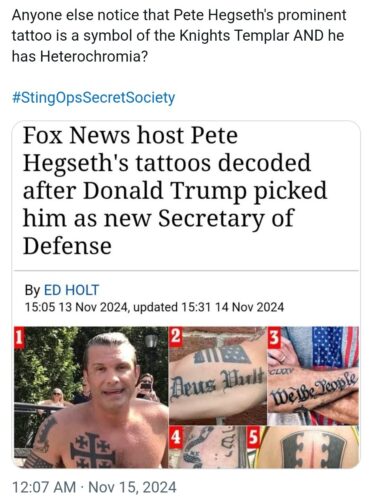
That’s external yet direct institutional capture of the Pentagon. A preacher from a town whose name should ring alarms for anyone who remembers the Aryan Nations compound at Hayden Lake now runs prayer services for the infamously tattooed Secretary of Defense.

Source: Twitter

Wilson’s infrastructure extends far beyond one church. A publishing house. Streaming shows. Nearly 500 schools coast to coast. He told NPR he sees his educational enterprises as munitions factories. He’s telling you exactly what he’s building, and Hegseth just gave him a key to the building where the actual munitions are.

Repeating Worst History on Purpose

Ludwig Müller was a military chaplain at the Königsberg garrison when the Nazis rose to power in 1933. He had already co-founded the Deutsche Christen, a “positive Christianity” movement fusing theology with racial nationalism. Hitler elevated him to Reich Bishop, tasked with consolidating 28 Protestant churches into a single institution under state ideological control.

His job was Gleichschaltung: making the theological infrastructure serve the political machinery. He rewrote the Sermon on the Mount to eliminate whatever he deemed “meek.” His movement had already declared during WWI that “pacifism is blasphemy against God” — the Reich Church made it policy.

In 2026, Hegseth installed Doug Wilson at the Pentagon.

1933 2026
Theologian in the military Ludwig Müller, military chaplain, appointed Reich Bishop by Hitler Doug Wilson, dominion theologian, leads Pentagon prayer for Hegseth
Movement Deutsche Christen — Christianity fused with racial nationalism Christian nationalism — dominion theology fused with white evangelical identity
Infrastructure 28 churches consolidated into one Reich Church Nearly 500 schools, publishing house, streaming shows, D.C. church
Racial doctrine Aryan Christianity, Jewish elements purged from scripture Slavery apologia, repeal of women’s suffrage, criminalization of homosexuality
Language Sermon on the Mount rewritten; “pacifism is blasphemy” “Munitions factories,” “foot soldiers,” “every society is theocratic”
Violence SA deployed before power, then channeled through state 30% backed political violence under Biden, support dropped when Trump won
Christian resistance Confessing Church, Barmen Declaration, Bonhoeffer — arrested, executed Rep. James Talarico — CBS preemptively complied with FCC pressure to suppress his interview

Historian Doris Bergen spent thirty years researching the thousand Wehrmacht chaplains who served the Nazi regime. Her conclusion, published in Between God and Hitler:

In the Nazi empire, Christianity and Christian chaplains were essential components in a system of ideas, structures, and narratives that protected and rewarded the perpetrators of genocide and their communities even as it erased their victims and denied their crimes.

Her central question asking “whom or what does a chaplain serve” is the one Wilson already answered for us on camera.

He knows exactly whom he serves. So does Hegseth.

Pentagon of Theocracy

In 1934, actual Christians responded. The Confessing Church issued the Barmen Declaration, drafted by Karl Barth:

We reject the false doctrine, as if the church could place the Word and work of the Lord in the service of any arbitrarily chosen desires, purposes, and plans.

Hundreds of pastors were arrested. Dietrich Bonhoeffer, who warned that the church must “not just bandage the victims under the wheel, but put a spoke in the wheel itself,” was executed at Flossenbürg in April 1945.

He was 39.

In 2026, Rep. James Talarico, a Presbyterian seminarian running for Senate in Texas, tried to make the same argument on national television. CBS lawyers preemptively blocked the interview from broadcast, citing FCC guidance that the Trump administration had rewritten in January to strip talk shows of their longstanding news exemption. The network then denied it had censored him. Colbert aired the interview on YouTube instead. It got 7.3 million views. Talarico raised $2.5 million in 24 hours.

The suppression didn’t work the way Bonhoeffer’s arrest worked. But the mechanism is the one this post is about: institutional compliance dressed as procedural caution. CBS performed the chilling effect voluntarily. That’s how Gleichschaltung scales — you don’t need to arrest everyone if the institutions censor themselves.

The theological authorization chain is now installed at the Pentagon. A man who describes civic life as theocratic conquest is praying over the people who command the military. A Secretary of Defense who treats his position as a culture war deployment is receiving spiritual counsel from someone who produces “foot soldiers” and builds “munitions factories.”

When Hegseth pushes troops to American cities, the justification will be theological. Militant dominion on the whims of Trump. Spiritual warfare as public policy.

Doug Wilson spent decades overtly espousing exactly this domestic terror framework. Hegseth just flipped it from national security threat to national security capture.

Nazi Gleichschaltung was the same.

Citrini AI Bear Porn is a Lesson in Helplessness

A financial research piece called “The 2028 Global Intelligence Crisis” went viral last week. Written as a fictional memo from the future, it describes AI destroying the white-collar economy in two years flat: 38% market crash, 10.2% unemployment, mortgage crisis, Occupy Silicon Valley. Six thousand likes. Fifteen hundred restacks. People are genuinely frightened.

The piece opens with this:

This isn’t bear porn or AI doomer fan-fiction. The sole intent of this piece is modeling a scenario that’s been relatively underexplored.

What a time to be alive and study disinformation.

The Preface is the Payload

Disinformation research has a name for this. The negation frame. When you say “I’m not saying the president is a criminal,” you’ve just put “president” and “criminal” in the same sentence and activated the association. The disclaimer doesn’t neutralize the content. It delivers the content while inoculating the speaker against accountability for having delivered it.

“This isn’t bear porn” is bear porn with a permission slip. “This is a scenario, not a prediction” is a prediction with a liability shield. The authors are financial researchers, not amateurs. They understand that four thousand words of precision-formatted panic — complete with fake Bloomberg headlines, specific ticker symbols, and a fictional 38% drawdown — land in the nervous system long before the reader processes the caveat.

This is the lesson disinformation doctrine learned from War of the Worlds and never forgot.

What War of the Worlds Actually Taught

Martin Seligman found in 1967 that dogs subjected to inescapable shocks eventually stopped trying to escape even when the door was open. He called it learned helplessness, the condition where a subject has been trained to believe that no action they take will change the outcome, so they stop acting. Orson Welles had demonstrated the broadcast version of the same trick much earlier.

On October 30, 1938, Welles broadcast a radio drama about a Martian invasion, formatted as a series of news bulletins. The format was the weapon. Listeners who tuned in after the opening disclaimer heard what sounded like real reporters describing real events.

Intelligence services studied Welles carefully. What they learned: you don’t need to lie. You need to perform authority in a format the audience already trusts, deliver an emotional payload, and attach a disclaimer that provides deniability. The content can be speculative or fictional. The format does the work.

“The 2028 Global Intelligence Crisis” is formatted as a CitriniResearch Macro Memo dated June 30th, 2028. It uses Bloomberg headline formatting with ticker symbols. It cites percentages to two decimal places. It references named companies, named products, named financial instruments. Every convention says: this is real financial analysis. The single line that says otherwise is buried in a preface most readers will barely remember by paragraph four.

The Irresistible Denial

Three negation frames in two sentences:

This isn’t bear porn or AI doomer fan-fiction. The sole intent of this piece is modeling a scenario that’s been relatively underexplored.

Each negation introduces exactly the concept it claims to reject. And “underexplored” positions the authors as brave truth-tellers rather than people producing the most viral AI panic content on Substack.

Then near the end:

We are certain some of these scenarios won’t materialize.

Which parts? They don’t say. Because specifying would break the spell. The vagueness of the hedge preserves the totality of the fear.

The Machine With No Operator

The format trick enables a more dangerous move: erasing human agency from every decision in the scenario.

The piece describes a “negative feedback loop” as though it were a thermodynamic process with no intervention point. But every link in that chain is a decision made by a person with a name and a title:

  • A board votes to cut 15% of headcount rather than retrain, redeploy, or reduce shareholder returns.
  • A procurement manager cancels a vendor contract for an untested internal build.
  • A CEO funnels all cost savings into compute rather than worker transition.
  • A bank continues underwriting against income assumptions it knows are impaired.
  • A regulator declines to update employment protections.
  • A legislator blocks transition support.
  • A lab ships capability without deployment guardrails.

The piece names none of these people. Instead: “The companies most threatened by AI became AI’s most aggressive adopters.” Companies don’t adopt anything. Executives adopt things, boards approve them, shareholders reward them. Each decision has a fiduciary duty attached and a legal framework governing it.

Then the alibi:

What else were they supposed to do? Sit still and die slower?

That converts choices into a hostage situation. It says these executives had no agency. This is the competent complicity defense — the same logic used after the 2008 mortgage crisis and the Boeing 737 MAX. Capable professionals executing decisions they knew would cause harm, pointing to competitive pressure as exoneration. “What else were they supposed to do?” isn’t analysis. It’s an alibi.

Who Benefits from Helplessness

War of the Worlds didn’t just scare people. It made them feel helpless against a force they couldn’t negotiate with, couldn’t vote out, couldn’t hold accountable. The Martians weren’t making decisions. They were an event happening to humanity.

The Citrini piece does the same with AI. The feedback loop has no off switch because no human hand is on any switch. This is the atmosphere specific actors need:

  • Compute owners need inevitability because it makes regulation seem pointless.
  • Lab executives need it because unstoppable forces absolve them of deployment decisions.
  • Deregulation politicians need it because you don’t regulate an earthquake — you build shelters after.
  • AI-sector financial analysts need it because “AI destroys the economy” means “AI is the most important thing in the world,” which is the thesis their publication depends on.

The co-author’s hedge fund held short positions in the companies the report named. The original email to subscribers identified the collaboration as institutional — “CitriniResearch & LOTUS have written this.” After the market moved, the website was edited to say “our friend Alap Shah posed the question.” Ani Bruna has documented the attribution changes and the disclosure gaps. The question of who benefits from helplessness turns out to have a specific, dollar-denominated answer.

The piece describes protesters blockading Anthropic and OpenAI, then frames them as a symptom of social breakdown rather than people responding rationally to identifiable decisions by identifiable executives. The format performs concern. The structure delivers inevitability. That isn’t analysis. It’s marketing with a furrowed brow.

The Panic About the Panic

Final parallel. The mass panic of 1938 was largely a myth. Most listeners understood it was fiction. But newspapers ran the panic story for weeks because they had a competitive interest in discrediting radio as a news medium. The real story wasn’t gullible listeners. It was an industry using manufactured fear to protect its position.

Same structure now. The piece goes viral. People get scared. The fear becomes the news. And the people positioned to benefit — compute investors, lab executives, AI-sector analysts — gain leverage from an atmosphere where displacement feels like destiny rather than a series of decisions they are actively making.

The question was never whether AI will destroy the white-collar economy in two years. The capabilities aren’t there — a Mag7 engineer in the piece’s own comments says as much. The question is whether identifiable people making identifiable decisions will be held accountable for the displacement they choose to cause, or whether they’ll hide behind a narrative formatted to look like expertise, disclaimed to look like a thought exercise, and designed to make you feel like there’s nothing you can do.

The machine isn’t in charge. The people building it, shipping it, and profiting from it are making choices. They’d prefer you believe otherwise.

Orson Welles, at least, had the decency to be making art. As Bertolt Brecht put it in The Resistible Rise of Arturo Ui:

Do not rejoice in his defeat, you men. For though the world has stood up and stopped the bastard, the bitch that bore him is in heat again.

Defamation as Dispossession: Big Oil Uses Courts to Censure Nation and Greenpeace

A North Dakota judge just finalized erasure of Native American rights with an absurd $345 million judgment. It claims to be against Greenpeace for, among other things, defamation of Energy Transfer during the Dakota Access Pipeline protests. The defamation finding is bullshit. It rests on two very political and narrow claims the jury decided: that the pipeline crossed Standing Rock Sioux tribal land, and that DAPL personnel desecrated sacred burial grounds.

Read that again.

The defamation verdict requires the court to rule that Indigenous people’s own claims about their land and sacred sites are not just disputed but demonstrably false because the billionaire white men of Big Oil say so.

That’s 1800s disinformation at work in 2026.

Erasure Mechanism

The Standing Rock Sioux’s position that the pipeline crosses their land is grounded in the 1851 Fort Laramie Treaty, which established boundaries the federal government subsequently ignored.

Whether the pipeline “crosses tribal land” depends on a legal framework you recognize. Do you believe in the treaty that the United States signed, or in the illegal seizures that followed?

The burial ground claim reflects what tribal members themselves reported about construction disturbance to sacred sites — reports that prompted challenges to the Army Corps of Engineers’ own environmental review as inadequate.

Greenpeace didn’t fabricate these claims. They amplified what Indigenous people were saying about their own land, their own treaties, their own sacred places. To find those statements “demonstrably false,” the jury had to accept Energy Transfer’s legal framework as the only valid one — ruling the tribe’s understanding of their territory out of existence as a prerequisite for the verdict.

The people whose dispossession created the underlying dispute got erased twice: first from their land, then from the factual record.

Oil Fumbled and Dropped the Ball to Win the Match

Energy Transfer quietly withdrew all defamation claims related to Greenpeace’s water and climate statements before trial. The core environmental and public health arguments that motivated the entire protest — the reason thousands of people showed up — were too defensible to take before a jury. What remained were narrower claims about treaty boundaries and burial grounds, reframed as simple factual falsehoods rather than the contested historical and legal disputes they actually are.

Energy Transfer’s former CEO Kelcy Warren fought to avoid deposition entirely, and the company argued that pipeline safety documents were “patently irrelevant” once they dropped the water and climate claims. Strip away the substance of the dispute, leave only the claims you can win by denying Indigenous legal standing, and call it defamation.

$50 Million Charge for a UN Report

The judgment includes tens of millions of dollars against Greenpeace International for co-signing a letter with over 500 other organizations that echoed findings from United Nations reports. The UN recognized the Indigenous position. Hundreds of organizations recognized it. A jury in Morton County, North Dakota — where the pipeline is critical infrastructure — said it was all false anyway.

Greenpeace International’s entire involvement in the on-the-ground protests amounted to six employees visiting the camps. Their real offense was lending institutional credibility to Indigenous claims that Energy Transfer needed erased.

SLAPP Architecture

North Dakota has no anti-SLAPP statute. There was no procedural mechanism to challenge the reframing of contested historical claims as defamation before it reached a jury. Energy Transfer’s first attempt was a federal RICO lawsuit — the statute designed to prosecute organized crime — which a federal judge dismissed in 2019, stating the evidence fell “far short.” So they refiled in state court with state law claims, in a jurisdiction where the pipeline moves 40% of North Dakota’s oil production.

That structure is textbook aggression: use a legal system that lacks procedural safeguards, in a venue with maximum structural bias, to convert political speech into tortious conduct. Greenpeace has countersued in the Netherlands under the EU’s anti-SLAPP Directive — the first test of that law — because the American system provided no defense against the strategy.

The Actual Verdict

Defamation doctrine distinguishes between statements of fact and expressions of opinion or rhetorical hyperbole. Protest speech has historically received strong protection precisely because reasonable listeners understand it as advocacy, not factual reporting. This verdict collapses that distinction entirely.

But the deeper problem isn’t doctrinal. It’s that the entire defamation finding is constructed on a foundation of Indigenous erasure. You can only call “this pipeline crosses tribal land” a false statement of fact if you’ve already decided that tribal land claims don’t exist. The 1851 treaty doesn’t count. The tribe’s understanding of their own territory doesn’t count. The UN’s recognition doesn’t count. Only Energy Transfer’s title, derived from the very dispossession being protested, counts.

Defamation law became the instrument for completing what the pipeline started.

The land was taken.

Now the right just to admit the truth and say it was taken has been priced by an American court at $345 million.