Category Archives: Poetry

Mingus, Faubus, and the Old Drum-Beat of Trump Fascism

In 1959, Charles Mingus boldly wrote a song that spoke truth to power.

Fables of Faubus” called out Arkansas Governor Orval Faubus directly. The sitting governor had ordered the National Guard to block nine Black teenagers from entering Little Rock Central High School. Faubus weaponized American protections to attack the most vulnerable.

Mingus didn’t deal in abstraction. He pointed at the man and showed everyone how to laugh.
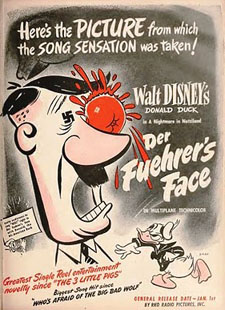
1940s-era advice from Walt Disney on the appropriate reaction to an Elon Musk, Peter Thiel and their puppet Donald Trump

Columbia Records recorded the song. Then they strategically stripped out the lyrics and released only the instrumental version. The music was deemed fine as culturally prestigious, commercially viable, safely ambiguous. The words were called a problem. Mingus himself said it plainly:

Columbia wouldn’t let them record the lyrics.

The motive was protecting Columbia revenue in Southern markets. A corporation understood exactly what the song meant, wanted to profit from its reputation as protest art, while it surgically removed the part that actually protested.

The vocal version came out a year later on Candid Records, produced by Nat Hentoff, who remembered the lyrics as “natural as sunlight.” The controversy never was in the content. The distribution system manufactured the crisis.

Name Me Someone Ridiculous

The Candid recording is a call-and-response between Mingus and drummer Dannie Richmond. Mingus calls and Richmond responds with names.

Oh Lord, no more swastikas!
Oh Lord, no more Ku Klux Klan!

Name me someone ridiculous, Dannie.
Governor Faubus.
Why is he sick and ridiculous?
He won’t permit integrated schools.
Then he’s a fool.

Boo! Nazi fascist supremacists. Boo Ku Klux Klan!

Mingus drew an obvious fascism parallel explicitly.

This was 1959. This was not retrospective analysis, not as rhetorical flourish. This was a man at the top of his game, a world famous musician, calling out real-time pattern recognition. Swastikas and Klan hoods in the same breath, because he understood they are the same operation switching between different uniforms.

Louis Armstrong already broke this ground two years earlier. He had told a reporter that Eisenhower was “two faced” with “no guts,” and described Faubus with an expletive too strong to print. The reporter and Armstrong negotiated a sanitized version of “uneducated plow boy”, which became a phrase the reporter later admitted was more his than Armstrong’s.

Even the act of speaking a truth in America required editorial negotiation about how much truth the weak white nationalist infrastructure could bear.

Mingus took it further. The system pushed back harder.

Arkansas to This Day

The thing about Arkansas is they still haven’t dismantled what Faubus stood for and built. The KKK has continued to be coated and rebranded, the Nazis embraced and extended. The state that deployed National Guard troops to stop kids going to school now deploys its legislature against the same populations with the same confidence that institutions will protect the operation.

Nazis and Klan freely roam without a care. It’s less that they had to seize power of state institutions, and more that they know government institutions reward their predatory incompetence. Arkansas isn’t about an extremism problem, when it runs a governance model for national socialism to be the product.

Faubus stood as a proof of concept. The template he established was the use of existing state infrastructure to enforce exclusion, force the federal government to either intervene or be complicit, and face no personal consequences either way. It remains the operating manual.

The man served six terms as governor. Six. After deploying the military against children. The system didn’t punish him. It promoted him.

If he were alive today he’d be the guy who denies the request for American hero Jesse Jackson to lie in honor in the Capitol.

The Competent Complicity of Curation

Columbia’s editorial operation on “Fables” is a precision instrument worth examining. Rather than silence Mingus, which would generate more protest material, they curated him into erasure. They kept his music to signal cultural seriousness and sold records, offering fans the bones while removing all the meat. The instrumental version let white liberal audiences feel something without the urge to do anything. It was consumption without reality of confrontation.

This editorial selection is competent complicity. The people making final cut decisions understood music, understood politics, understood exactly what they were doing. They weren’t accidental. They were serving a role in protecting, enabling and extending the white nationalist dominated market.

Hentoff’s Candid Records operated differently. It was total creative freedom, no editorial interference. The result was a recording where the lyrics landed with their full weight. Two labels, two systems, two outcomes from the same source material based on which one practiced integrity instead of complicity.

Rotary Perception

Mingus had a concept he called “rotary perception”. He said musical beats exist inside a circle, like target practice using birdshot, rather than on a line, giving musicians freedom to place notes anywhere inside that space without losing the underlying pulse.

Mingus described a centroid with acceptable variance. The beat is the mean, the circle is the confidence interval, and the notes are data points that can land anywhere within the distribution without losing the underlying signal. That’s a scatter plot with a cluster around a central tendency.
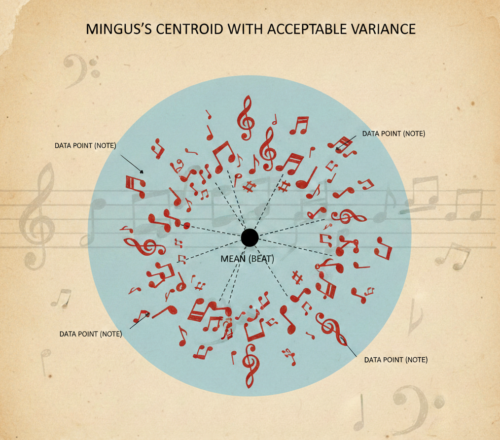
He developed it partly in response to critics who claimed younger musicians were more innovative than him. His counter argument was the “avant garde” already was audible in Charlie Parker and Duke Ellington, when you really were paying attention.

The concept applies well beyond music. What gets marketed as unprecedented almost never is. The patterns repeat. The refusal to recognize them is the product, not the problem. Mingus was saying in 1959 what the historical record has been saying for centuries. The thing you’re watching happen also happened before, that someone documented it, and that the failure to learn from it serves specific interests.

He was a historian’s musician.

Arkansas deploying state power against Black schoolchildren in 1957? It was a rotation. Trump loyalists protecting and rewarding that deployment in 2026 aren’t new either. It’s the same beat, played at a different point in the same racist circle.

Mingus saw it. He named it. And then Columbia cut the meat off and sold the bones anyway.

Some things rotate. Some things don’t change at all.

Steve Bannon literally called Epstein “God” while working to “take down” the Pope

May 2018 Bannon wrote:

Bannon hammers; God shorts

He was referring to Epstein as “God” in the context of financial acumen.

Epstein replied:

I don’t think of myself that way

“I do,” said Bannon.

Bannon literally called Epstein “God” while simultaneously working to “take down” the actual Pope.

A former Trump White House adviser told a convicted child sex offender he’s divine while scheming to topple the head of the Catholic Church.

And when Bannon shared an article about the Vatican condemning populist nationalism, Epstein replied with Satan’s line from Paradise Lost:

Better to reign in Hell, than serve in Heaven.

The Degraded United States is Now “Trumpistan”

Not mentioned in this video is that Professor Stanley in 2020 was careful to say Trumpism was fascist while specifying the U.S. didn’t have a genocidal regime. That changed in 2025, as he described America as an authoritarian state worth fleeing, drawing explicit parallels to the Nazis. He fled, which is why he’s now introduced from Toronto.

That’s a top subject-matter expert updating his assessment based on evidence.

The use of Shelley’s poem in the video is about the gap between the self-inscription and the sand.

Ozymandias
by Percy Bysshe Shelley, 1818

I met a traveller from an antique land
Who said: Two vast and trunkless legs of stone
Stand in the desert…. Near them, on the sand,
Half sunk, a shattered visage lies, whose frown,
And wrinkled lip, and sneer of cold command,
Tell that its sculptor well those passions read
Which yet survive, stamped on these lifeless things,
The hand that mocked them, and the heart that fed:
And on the pedestal these words appear:
‘My name is Ozymandias, king of kings:
Look on my works, ye Mighty, and despair!’
Nothing beside remains. Round the decay
Of that colossal wreck, boundless and bare
The lone and level sands stretch far away.

Stanley’s argument in the video is that Trump knows about the sand and is trying to prevent it by making his regime permanent. The poem becomes not just irony but prophecy contested. Trump drew the opposite lesson from the poem: don’t let your signs get taken down.

Lawfare! Mechanism! of! Surrender!

Benjamin Wittes just published an historically illiterate piece in Lawfare about Judge Richard Leon’s ruling enjoining Defense Secretary Hegseth from retaliating against Senator Mark Kelly’s retirement pay.

Kelly’s offense was none at all, reminding service members that illegal orders do not have to be obeyed. Leon, a Bush appointee, found retaliation against Kelly obviously unconstitutional. He issued a forceful injunction.

Wittes spends most of the piece childishly mocking the use of exclamation marks.

Ho! Ho! Ho!

He catalogs fourteen exclamation-mark sentences. He uses a mob-like reference by saying his Lawfare staffers joke about searching for them. He proposes “exclamation mark density” per page. He acts like a spoiled child while calling others “unbecoming,” “adolescent,” and “not intellectually compelling.” Then he pivots at the end to say he’s actually sympathetic when he compares Judge Leon to the Portland frog protesters. That’s not sympathy, that again is mockery.

The net effect is Lawfare trying to undermine a substantive ruling. A conservative judge smacked the executive branch for unconstitutionally retaliating against a sitting senator’s First Amendment rights. This is not a time for office jokes about punctuation quirks.

The actual legal substance gets about two sentences of engagement, mainly to plant the seed that the D.C. Circuit might reverse on ripeness grounds. That flag is being planted to pre-legitimize a potential appellate rollback while pretending to do neutral legal analysis.

Wittes normalizes an outcome in advance. He’s not saying “I hope this gets reversed.” He’s saying “don’t be surprised if it does.”

And the comparison to his own dog shirts and building light projections is revealing. He’s putting his mindless wardrobe choices in the same bucket as a federal judge blocking unconstitutional conduct. Leon issued an injunction. Wittes says he puts on novelty shirts. These are not equivalent activities.

The Wrong Audience

Wittes and the Lawfare class are optimizing for the current legal establishment’s approval, maintaining their credibility within a professional culture that has been valuing restraint while Trump ignores them.

Professional culture was built for professional times. When the executive branch is retaliating against a sitting senator for exercising congressional oversight of the military, “restraint” in response is far from neutrality.

Now it’s capitulation dressed up as sophistication.

History of “responsible” legal commentary in a constitutional crisis tells us what this does: tone-policing the people who are actually using their institutional power to resist, while the people dismantling constitutional governance get analyzed with chin-stroking seriousness about their legal theories.

The Archive

The judges who mattered during authoritarian consolidation in history weren’t the ones who avoided raising heat. They were the ones who used whatever tools they had, including rhetorical force, to make the record absolutely clear about what was happening. Leon is writing for an archive as much as for the litigants.

“Horsefeathers!” reads as undignified now. Give it time. It will read very differently in retrospect when the record shows what the executive was actually doing and how few people with institutional power said so plainly.

When Papen seized Prussia by emergency decree in July 1932 (two-thirds of Germany’s territory and its police) the Staatsgerichtshof under Erwin Bumke issued a meticulous split decision. Technically the seizure was improper. Practically the Reich commissioners kept power. Three months later Hitler inherited a centralized police apparatus already under Reich control. The court’s restraint handed the Nazis the infrastructure of repression with a veneer of constitutional legitimacy. Bumke himself later joined the Nazi party. He killed himself in 1945.

Gustav Radbruch, the legal philosopher and former Weimar Justice Minister, wrote his famous 1946 essay arguing that positivism and procedural fastidiousness of the German legal profession had left it defenseless against exactly the kind of capture that Trump is using today. The profession’s commitment to formal correctness over substantive confrontation wasn’t neutral.

It was the mechanism of surrender.

The judges who broke tone as “unbecoming” left a record that couldn’t be misread later.

The exclamation marks aren’t the story. The fact that a legal commentariat thinks they are is the story.