Category Archives: Poetry

Holding Facebook Executives Responsible for Crimes

Interesting write-up on Vox about the political science of Facebook, and how it has been designed to avoid governance and accountability:

…Zuckerberg claims that precisely because he’s not responsible to shareholders, he is able instead to answer his higher responsibility to “the community.”

And he’s very clear, as he says in interview after interview and hearing after hearing, that he takes this responsibility very seriously and is very sorry for having violated it. Just as he’s been sorry ever since he was a first-year college student. But he’s never actually been held responsible.

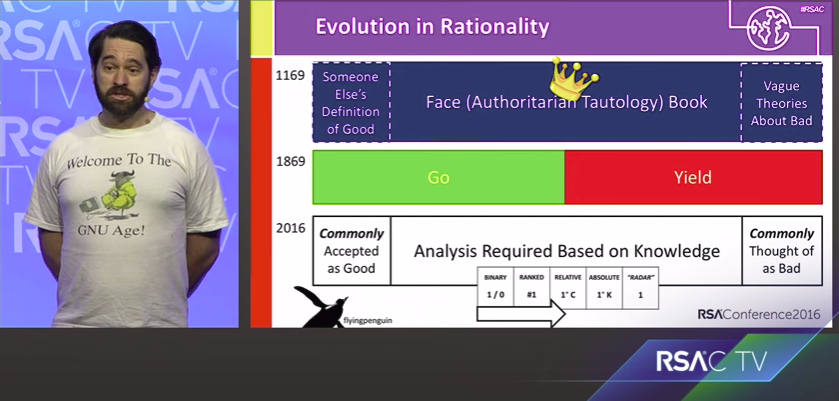
I touched on this in my RSA presentation about driverless cars several years ago. My take was the Facebook management is a regression of many centuries (pre-Magna Carta). Their primitive risk control concepts, and executive team opposition to modern governance, puts us all on a path of global catastrophe from automation systems, akin to the Cuban Missile Crisis.

I called it “Dar-Win or Lose: The Anthropology of Security Evolution”

It is not one of my most watched videos, that’s for certain.

It seems like talks over the years where I frame code as poetry, with AI security failures like an ugly performance, I garner far more attention. If the language all programmers know best is profanity, who will teach their machines manners?

Meanwhile, my references to human behavior science to describe machine learning security, such as this one about anthropology, fly below radar (pun intended).

Amazon’s About Face on GovCloud: “Physical Location Has No Bearing”

Amazon never seemed very happy about building a dedicated physical space, kind of the opposite of cloud, to achieve compliance with security requirements of the US federal government.

AWS provides customers with the option to store their data in AWS GovCloud (US) managed solely by US Persons on US soil. AWS GovCloud (US) is Amazon’s isolated cloud region where accounts are only granted to US Persons working for US organizations.

That’s a very matter-of-fact statement, suggesting it was doing what it had been told was necessary as opposed to what it wanted (destroy national security requirements as antiquated while it augers towards a post-national corporate-led system of control).

While that might have seemed speculative before now, Amazon management just released a whitepaper showing its true hand.

The other two “realities” are “Most Threats are Exploited Remotely” and “Manual Processes Present Risk of Human Error”…

I want you all to sit down, take a deep breath, and think about the logic of someone arguing physical location has no bearing on threats being exploited remotely.

First, vulnerabilities are exploited. Threats exploit those vulnerabilities. Threats aren’t usually the ones being exploited via connectivity to the Internet (as much as we talk about hack back), vulnerabilities are. Minor thing, I know, yet it speaks to the familiarity of the author with the subject.

Second, if physical location truly had no bearing, the author of this paper would have not bothered with any “remotely” modifier. They would say vulnerabilities are being exploited. Full stop. To say exploits are something coming from remote locations is them admitting there is a significance of physical location. Walls being vulnerable to cannon-balls does not mean cannons fired from 1,000 miles away are the same as from 1 mile.

Third, and this is where it truly gets stupid, “Insider Threats Prevail as a Significant Risk” again uses a physical metaphor of “insider”. What does insider mean if not someone inside a space delimited by controls? That validates physical location having bearing on risk, again.

Fourth, this nonsense continues throughout the document. Page six advises, without any sense of irony “systems should be designed to limit the ‘blast radius’ of any intrusion so that one compromised node has minimal impact on any other node in the enterprise”. You read that right, a paper arguing that physical location has no bearing…just told you that blast RADIUS is a critical component to safety from harm.

Come on.

This paper seems like it is full of amateur security mistakes made by someone who has a distinctly political argument to make against government-based controls. In other words, Amazon’s anti-government paper is an extremist free-market missive targeting US-based ITAR and undermining national security, although it probably thought it was trying to knock down laws written in another physical location.

Something tells me the blast radius of this paper was seriously miscalculated before it was dropped. Little surprise, given how weak their grasp of safety control is and how strong their desire to destroy barriers to Amazon’s entry.

The Chaos

by Dr. Gerard Nolst Trenité
(Netherlands, 1870-1946)

Dearest creature in creation,
Study English pronunciation.
I will teach you in my verse
Sounds like corpse, corps, horse, and worse.
I will keep you, Suzy, busy,
Make your head with heat grow dizzy.
Tear in eye, your dress will tear.
So shall I! Oh hear my prayer.
Pray, console your loving poet,
Make my coat look new, dear, sew it!

Just compare heart, beard, and heard,
Dies and diet, lord and word,
Sword and sward, retain and Britain.
(Mind the latter, how it’s written.)
Now I surely will not plague you
With such words as plaque and ague.
But be careful how you speak:
Say break and steak, but bleak and streak;
Cloven, oven, how and low,
Script, receipt, show, poem, and toe.

Hear me say, devoid of trickery,
Daughter, laughter, and Terpsichore,
Typhoid, measles, topsails, aisles,
Exiles, similes, and reviles;
Scholar, vicar, and cigar,
Solar, mica, war and far;
One, anemone, Balmoral,
Kitchen, lichen, laundry, laurel;
Gertrude, German, wind and mind,
Scene, Melpomene, mankind.

Billet does not rhyme with ballet,
Bouquet, wallet, mallet, chalet.
Blood and flood are not like food,
Nor is mould like should and would.
Viscous, viscount, load and broad,
Toward, to forward, to reward.
And your pronunciation’s OK
When you correctly say croquet,
Rounded, wounded, grieve and sieve,
Friend and fiend, alive and live.

Ivy, privy, famous; clamour
And enamour rhyme with hammer.
River, rival, tomb, bomb, comb,
Doll and roll and some and home.
Stranger does not rhyme with anger,
Neither does devour with clangour.
Souls but foul, haunt but aunt,
Font, front, wont, want, grand, and grant,
Shoes, goes, does. Now first say finger,
And then singer, ginger, linger,
Real, zeal, mauve, gauze, gouge and gauge,
Marriage, foliage, mirage, and age.

Query does not rhyme with very,
Nor does fury sound like bury.
Dost, lost, post and doth, cloth, loth.
Job, nob, bosom, transom, oath.
Though the differences seem little,
We say actual but victual.
Refer does not rhyme with deafer.
Foeffer does, and zephyr, heifer.
Mint, pint, senate and sedate;
Dull, bull, and George ate late.
Scenic, Arabic, Pacific,
Science, conscience, scientific.

Liberty, library, heave and heaven,
Rachel, ache, moustache, eleven.
We say hallowed, but allowed,
People, leopard, towed, but vowed.
Mark the differences, moreover,
Between mover, cover, clover;
Leeches, breeches, wise, precise,
Chalice, but police and lice;
Camel, constable, unstable,
Principle, disciple, label.

Petal, panel, and canal,
Wait, surprise, plait, promise, pal.
Worm and storm, chaise, chaos, chair,
Senator, spectator, mayor.
Tour, but our and succour, four.
Gas, alas, and Arkansas.
Sea, idea, Korea, area,
Psalm, Maria, but malaria.
Youth, south, southern, cleanse and clean.
Doctrine, turpentine, marine.

Compare alien with Italian,
Dandelion and battalion.
Sally with ally, yea, ye,
Eye, I, ay, aye, whey, and key.
Say aver, but ever, fever,
Neither, leisure, skein, deceiver.
Heron, granary, canary.
Crevice and device and aerie.

Face, but preface, not efface.
Phlegm, phlegmatic, ass, glass, bass.
Large, but target, gin, give, verging,
Ought, out, joust and scour, scourging.
Ear, but earn and wear and tear
Do not rhyme with here but ere.
Seven is right, but so is even,
Hyphen, roughen, nephew Stephen,
Monkey, donkey, Turk and jerk,
Ask, grasp, wasp, and cork and work.

Pronunciation — think of Psyche!
Is a paling stout and spikey?
Won’t it make you lose your wits,
Writing groats and saying grits?
It’s a dark abyss or tunnel:
Strewn with stones, stowed, solace, gunwale,
Islington and Isle of Wight,
Housewife, verdict and indict.

Finally, which rhymes with enough —
Though, through, plough, or dough, or cough?
Hiccough has the sound of cup.
My advice is to give up!!!

Originally transcribed by Pete Zakel

“My Lost Youth” by Longfellow

A curious thing about writing a poem is how it can suggest to the reader a topic while subtly communicating a tangent. Recently I was being peppered by questions of attribution in security that reminded me of Henry Wadsworth Longfellow’s poem:


		My Lost Youth

OFTEN I think of the beautiful town	 
  That is seated by the sea;	 
Often in thought go up and down	 
The pleasant streets of that dear old town,	 
  And my youth comes back to me.			5
    And a verse of a Lapland song	 
    Is haunting my memory still:	 
    'A boy's will is the wind's will,	 
And the thoughts of youth are long, long thoughts.'	 
 
I can see the shadowy lines of its trees,		10
  And catch, in sudden gleams,	 
The sheen of the far-surrounding seas,	 
And islands that were the Hesperides	 
  Of all my boyish dreams.	 
    And the burden of that old song,			15
    It murmurs and whispers still:	 
    'A boy's will is the wind's will,	 
And the thoughts of youth are long, long thoughts.'	 
 
I remember the black wharves and the slips,	 
  And the sea-tides tossing free;			20
And Spanish sailors with bearded lips,	 
And the beauty and mystery of the ships,	 
  And the magic of the sea.	 
    And the voice of that wayward song	 
    Is singing and saying still:			25
    'A boy's will is the wind's will,	 
And the thoughts of youth are long, long thoughts.'	 
 
I remember the bulwarks by the shore,	 
  And the fort upon the hill;	 
The sunrise gun with its hollow roar,			30
The drum-beat repeated o'er and o'er,	 
  And the bugle wild and shrill.	 
    And the music of that old song	 
    Throbs in my memory still:	 
    'A boy's will is the wind's will,			35
And the thoughts of youth are long, long thoughts.'	 
 
I remember the sea-fight far away,	 
  How it thunder'd o'er the tide!	 
And the dead sea-captains, as they lay	 
In their graves o'erlooking the tranquil bay		40
  Where they in battle died.	 
    And the sound of that mournful song	 
    Goes through me with a thrill:	 
    'A boy's will is the wind's will,	 
And the thoughts of youth are long, long thoughts.'	45
 
I can see the breezy dome of groves,	 
  The shadows of Deering's woods;	 
And the friendships old and the early loves	 
Come back with a Sabbath sound, as of doves	 
  In quiet neighbourhoods.				50
    And the verse of that sweet old song,	 
    It flutters and murmurs still:	 
    'A boy's will is the wind's will,	 
And the thoughts of youth are long, long thoughts.'	 
 
I remember the gleams and glooms that dart		55
  Across the schoolboy's brain;	 
The song and the silence in the heart,	 
That in part are prophecies, and in part	 
  Are longings wild and vain.	 
    And the voice of that fitful song			60
    Sings on, and is never still:	 
    'A boy's will is the wind's will,	 
And the thoughts of youth are long, long thoughts.'	 
 
There are things of which I may not speak;	 
  There are dreams that cannot die;			65
There are thoughts that make the strong heart weak,	 
And bring a pallor into the cheek,	 
  And a mist before the eye.	 
    And the words of that fatal song	 
    Come over me like a chill:				70
    'A boy's will is the wind's will,	 
And the thoughts of youth are long, long thoughts.'	 
 
Strange to me now are the forms I meet	 
  When I visit the dear old town;	 
But the native air is pure and sweet,			75
And the trees that o'ershadow each well-known street,	 
  As they balance up and down,	 
    Are singing the beautiful song,	 
    Are sighing and whispering still:	 
    'A boy's will is the wind's will,			80
And the thoughts of youth are long, long thoughts.'	 
 
And Deering's woods are fresh and fair,	 
  And with joy that is almost pain	 
My heart goes back to wander there,	 
And among the dreams of the days that were		85
  I find my lost youth again.	 
    And the strange and beautiful song,	 
    The groves are repeating it still:	 
    'A boy's will is the wind's will,	 
And the thoughts of youth are long, long thoughts.'	90

This could happen anywhere, despite being about a specific place. Supposedly in 1855 he set out to describe an idyllic life in Portland, Maine. And yet what city “beautiful town that is seated by the sea” does not have “pleasant streets” with “shadowy lines of its trees”? Is anyone surprised to hear of an old American shipping town with “black wharves and the slips” below “the fort upon the hill”?

Even more to the point, after a long vague description leaving the reader without any unique Portlandish details, the writer admits “there are things of which I may not speak”. Vague by design?

Ok, then, decoding the poem to suggests a series of fleeting (pun not intended) feelings that defy direct attribution to a particular city. Action words give away bundles of emotion from a young boy excited by a generalized theory of adventure. No real location is meant, which leaves instead the importance of stanza action lines (7th); they seem to unlock a message about generic youthful rotations: haunting, murmurs, singing, throbs, goes, flutters, sings, come, sighing, repeating. “Lost youth” indeed….