The Navy is reporting a 190ft bulk carrier ship built in 2003, the BESIKTAS-M operating under a Panamanian flag, has collided with the American flagship aircraft carrier USS Harry Truman.
The Nimitz-class aircraft carrier USS Harry S. Truman (CVN 75) was involved in a collision with the merchant vessel Besiktas-M at approximately 11:46 p.m. local time, Feb. 12, while operating in the vicinity of Port Said, Egypt, in the Mediterranean Sea.
Currently the report reads that the Truman’s nuclear power plants were unaffected, with no injuries or flooding. Questions surround how and why the BESIKTAS-M failed its navigational requirements.
In 2024, GM’s EV sales surged 50% to 114,432, its highest ever aided by the new Equinox EV…. That made it one of the fastest-growing players in the electric space.
…investing more than $1 billion in companies making graphite and lithium, as well as deals with South Korea’s LG Chem to produce cathodes for it in Tennessee. That results in big savings related to shipping battery components from China, a multiweek process, as well as fewer quality control headaches.
Like “having product on the water for five weeks that you’re financing, only to find out there’s a reject in that part,” [Kelty, GM’s vice president of battery operations] said. “There’s a lot of costs that are not included upfront.”
Moves to set up a lower-cost battery supply base were cited among reasons Deutsche Bank equity analyst Edison Yu raised GM’s shares to a Buy this month, noting that its EV strategy wasn’t “entirely dependent on volume but also on battery and materials cost savings.”
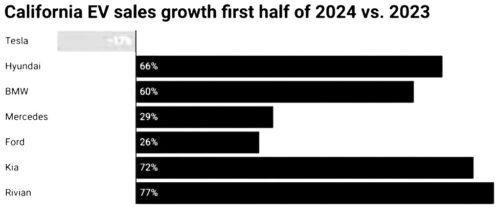
What an important supply-chain integrity point in an otherwise great report about GM’s already fruitful plans for EV growth. It reminds me of this 2024 chart, showing just how hot the California EV market was last year and where top talent has been going (Hint: reverse correlate with recalls).
Chart: Michael Thomas. Source: CA New Dealers Association
Update: 2024 EV registrations in CA versus 2023. GM is up over 1000% while Tesla is failing so hard their negative bar literally is falling off the charts.
There seems to be endless debate about exotic propulsion in the Livelsberger case, but let’s not lose focus on what’s most probable: the 2004 Tic Tac incidents exposed advanced electromagnetic and plasma technology rather than gravity manipulation.
Consider that Orde Wingate didn’t break the laws of warfare when his men mysteriously appeared suddenly deep in enemy territory, but he certainly leveraged disinformation and propaganda to throw off observers. He was always challenging what was actually possible, as well as what people perceived.
Wingate’s fleet of Waco “Hadrian” Gliders in 1944 were deployed to do the “impossible” in Operation Thursday.
We’re now talking modern astrophysics here instead of early “long lines” flight tech of WWII, but operators always look at technology the same – an interesting puzzle that can be solved in novel ways.
To start, timing can be a telling thread to pull. The 2004 observations of unidentified flying craft were quickly followed by Fontana’s 2005 paper discussing both gravitational and electromagnetic approaches. That seems notable, yet rarely noted. In fact, electromagnetic technology showed consistent progression in the decades since, while gravitic proposalsn remained purely theoretical. Then came clear advancement in plasma physics, electromagnetic field generation, and materials science, while again gravitational manipulation showed no similar development chain.
Following that thread there were three capabilities in reports that stood out as possible breakthroughs: instant acceleration, silent supersonic travel, and seamless air-to-water transition. The crucial question now should be which technical approaches require the least impossible leap from existing engineering. Not theoretical; actual engineering.
Let’s look at instant acceleration without visible exhaust, not unlike the noise from Tesla about a car that would go 0-60 in one second. A gravitic drive would require energy densities comparable to astronomical objects, without incremental steps or partial success possible. Plasma field technology however offers a visible development path: from basic electromagnetic experiments to increasingly sophisticated field manipulation. Anyone who’s done smooth and fast night maritime operations knows how energy moves through water. The plasma field manipulation follows similar principles of working with the medium, not trying to defy it.
Even more clear in this direction is an absence of sonic booms. Gravitational manipulation would require warping space-time itself, as an all-or-nothing proposition requiring physics we have no known skill with. Electromagnetic shockwave control, however? We trace the rising development from theoretical papers through wind tunnel tests to programs like the very real X-59. Each step clearly built on proven technology, like how SDV operations evolved from basic underwater movements to sophisticated multi-domain capability.
The air-to-water transition might be the most revealing of all, which I have to say as “flyingpenguin”. A gravitic drive would need to manipulate fundamental forces. The required energy and infrastructure would be impossible to hide. But advanced materials and electromagnetic field manipulation? That’s like the difference between trying to eliminate waterline to minimize friction versus learning to work with it the way special operations have refined sea-land-air insertion techniques over decades.
The real distinction thus isn’t found yet in any single surprise technology breaking out. Rather we have a wide range of observable complementary engineering and development paths:
Incremental advances in plasma physics
Growing electromagnetic field control capabilities
Progressive materials science breakthroughs
Evolving power storage and management systems
Step-by-step sensor and control improvements
This list of improbable gains by 2004 had established clear development trajectories. Each advance built on previous work, used existing infrastructure, and required expertise we could actually develop. Like going back to Wingate’s brilliant innovations, they pushed the boundaries of what was possible without requiring impossible leaps.
The infrastructure needed for electromagnetic/plasma technology already exists and has been expanding with known specialized manufacturing, high-energy physics labs, and materials science facilities. We can trace the growth through public research, corporate investment, and observable testing programs.
In contrast, there are no meaningful gravity manipulation facilities, even though we expect them to be impossible to hide because of energy concentrations visible from space. Electromagnetic field manipulation works at scales we can actually achieve. Current research pushes these boundaries incrementally, like how modern maritime operations are developing sophisticated trans-medium capabilities. But gravity manipulation? The energy required literally would be astronomical.
This is why focusing on electromagnetic and plasma technology is plausible versus gravitational speculation. Not because of being impressive, given controlling gravity would certainly be revolutionary. But because we trace evolution and incremental skill mastery as reliable rather than expect operators to make revolutionary leaps only to witness disaster.
Everyone “knew” you couldn’t sustain operations deep behind enemy lines in impenetrable jungle. The physics of supply chains, the mechanics of force projection, the realities of hostile terrain all made it “impossible.” And Wingate didn’t break these rules to succeed. He mastered knowledge of them so completely he turned the Japanese own supply infrastructure into his support network, operating where they thought no force could survive.
The same principle applies for investigators of unbelievable craft. The path forward doesn’t have evidence of some gravitic shortcut around physics, some unlocked open backdoor to rescue the hostages we can credit to alien help. It’s in the routines that develop deep mastery of electromagnetic and plasma dynamics that we can turn fundamental forces to our advantage in ways others (who debate when a goose will lay the golden egg) consider impossible. The developmental path is not just more likely; it’s more interesting, because it shows us what’s really possible when we stop looking for silver bullet magic and keep pushing the boundaries of what we actually understand.
Executive summary: Corporate rhetoric about innovation and leadership often masks the unpalatable reality of exploitation and extraction. Microsoft’s new AI manifesto, with its careful political positioning and woefully selective historical narrative, exemplifies this troubling pattern – trading safety for market advantage that has historical precedents with catastrophic outcomes.
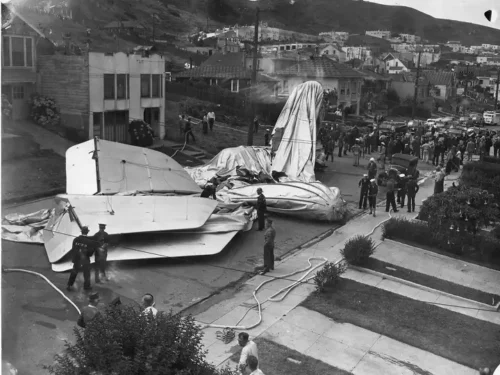
A U.S. Navy Blimp crashed in Daly City 1944 with nobody on board. Speculation abounds to this day about the two men who disappeared from it.
When the Hindenburg burst into flames in 1937, it marked another era built on hubris – a belief that technological advancement could outrun safety concerns. Microsoft’s recent manifesto on AI leadership eerily echoes this same dangerous confidence, presenting a sanitized version of both American technological history and their own corporate record.
Brad Smith’s Failure at History
The company’s vision statement posted under Brad Smith’s name reads like a saccharin a-historical fiction, painting a rosy picture of American technological development that far too conveniently forgets death and destruction of weakly regulated barons. The Triangle Shirtwaist Factory fire’s 146 victims, the horrific conditions exposed in “The Jungle,” and the long struggle for basic worker protections weren’t exceptions. And selective amnesia by those who profit from ignoring the past isn’t accidental – it’s a strategic attempt to hide the human costs of rapid technological deployment that lacked the most basic safeguards.
Just as the disastrously mis-managed private American railroads of the 19th century built empires on fraud (government handouts while preaching free-market rhetoric) that left taxpayers holding the fallout with no trains in sight, Microsoft now positions itself as a champion of private sector innovation while seeking public funding and protection. Their carefully crafted narrative about “American AI leadership” deliberately obscures how the technology sector actually achieved its “success” – through massive public investment, particularly in military applications for “intelligence” like the billion-dollar-per-year IGLOO WHITE program during the Vietnam War.
Real History, Real Microsoft Patterns
The corporate-driven PR of historical revisionism becomes even more troubling when we examine Microsoft’s awful and immoral business track record. The company that now promises to be a responsible steward of AI technology has consistently prioritized corporate profits over human welfare. Bill Gates’ lack of any concern at all for “virus” risks in his takeover of the personal computer world, delivering billions of disasters and causing world-wide outages, is somehow supposed to be forgotten because he took the money and announced he cares about malaria now? While ignoring basic consumer safety, Microsoft also pioneered a “permatemp” system in the 1990s for a two-tier workforce where thousands of “temporary” workers had to do the work of full-time employees yet without benefits or job security. Even after paying a piddling $97 million to settle lawsuits, they arrogantly shifted to more sophisticated forms of worker exploitation through contracting firms.
As technology evolved, so did Microsoft’s methods of avoiding responsibility. Content moderators exposed to traumatic material, game testers working in precarious conditions, and data center workers denied basic benefits – all while the company’s profits soared unethically. Now, in the AI era, they’ve taken an even more ominous turn by literally dismantling ethical AI oversight teams (because they raised objections) precisely when such oversight is most crucial.
New Avenues for Exploitation
The parallels to past technological disasters are stark. Just as the Grover Shoe Factory’s boiler explosion revealed the costs of prioritizing production over safety, Microsoft’s aggressive push into AI while eliminating ethical oversight should raise alarming questions. This is like removing the brakes on a car when you install a far more powerful engine. Their new AI manifesto, filled with flattery for coming White House occupants using veiled requests for deregulation, reads less like a vision for responsible innovation and more like a corporate attempt to avoid accountability… for when they inevitably burn up their balloon.
Consider the track record:
Pioneered abusive labor practices in tech
Consistently fought against worker organizing efforts
Used contractor firms to obscure poor working conditions
Fired ethical AI researchers as they accelerate AI
Smith’s manifesto, with carefully crafted appeals to American technological leadership and warnings about Chinese competition, follows this as a familiar pattern. It’s the same strategy railroad companies used to secure land grants, that oil companies used to bypass laws, that steel companies used to avoid safety regulations, and that modern tech giants use to maintain their monopolies.
Tea Pot Dome May Come Again
For anyone considering entrusting their future to Microsoft’s AI vision, the message from history is clear: this is a company that has repeatedly chosen corporate convenience over human welfare. Their elimination of ethical oversight while rapidly deploying AI technology isn’t just a little concerning – it’s intentionally dangerous. Like boarding a hydrogen-filled zeppelin, the risks aren’t immediately visible but are nonetheless catastrophic.
The manifesto’s emphasis on “private sector leadership” and deregulation, combined with their historic exploitative practice of using contractor firms to avoid responsibility, suggests their AI future will repeat the worst patterns of industrial history. Their calls for “pragmatic” export controls and warnings about Chinese competition are less about national security and more about seeking unjust tariffs (e.g. Facebook’s campaign to ban competitor TikTok) and securing corporate benefits while avoiding oversight.
Americans never seem to talk about Tea Pot Dome when calling Big Data new “oil”. In fact data is nothing like oil, and yet Big Tech antics are just like Tea Pot Dome: private exploitation of public resources, use of national security as justification, and corruption of oversight processes.
As we stand at the threshold of the AI era, Microsoft’s manifesto should be read not as a vision statement but as them cooking and eating the AI canary in broad daylight. Their selective reading of history, combined with their own troubling track record, suggests we’re witnessing the trumpeted call for a new chapter in corporate exploitation – one where AI technology serves as both the vehicle and the excuse for avoiding responsibility.
Microsoft is sacrificing something (ethical oversight, worker protections) for perceived strategic advantage, just as historical robber barons sacrificed safety and worker welfare for profit.
The question isn’t whether Microsoft can lead in AI development by pouring billions into their race to monopolize it and spit out even their own workers as a lesser caste – it’s whether we can afford to repeat the mistakes of the past by allowing companies to prioritize speed and profit over human welfare and safety. History’s judgment of such choices has always been harsh, and in the AI era, the stakes are even higher.
One theory about the Navy L-8 crash in 1944 is “new technology, being tested to detect U-boats, emitted dangerous and poorly shielded microwaves that overpowered the crew, causing them to fall out of the cabin”.
Era
Historical Pattern
Microsoft’s Echo
Historical Consequence
Railroad Era
Railroad barons securing land grants while preaching free market values
Seeking public AI funding while claiming private sector leadership
Taxpayers left with failed infrastructure and mounting costs