Category Archives: Sailing

Dorsey’s Letter of Marque Signals Trouble for Block: Half the Crew Dumped Overboard to Stay Afloat

Jack Dorsey fired over 4,000 people on Thursday — basically half of Block’s workforce — during a profitable year, then told the rest of the tech industry to do the same. The stock jumped 23%. That sequence tells you what actually happened and why.

Block posted $1.3 billion in profit. Gross profit grew 24% year over year. Cash App surged 33%. Dorsey himself called it a “strong year.” Then he immediately gutted the company and framed failure as visionary leadership, writing in his shareholder letter that “tools have changed what it means to build and run a company.”

Tools. They haven’t changed what it means. They’ve changed how to destroy value.

Numbers Behind Narrative

Block had 3,835 employees at the end of 2019. Dorsey’s vision was to triple that to over 12,500 by the end of 2022, intentionally building redundant parallel structures for Square and Cash App. The stock peaked at $281 in August 2021. It closed Thursday at $54, crashing down over 80% from the high. Now the after-hours bump on layoff news pushed it toward $67.

So the actual story isn’t CEO use of “tools changed everything in December.” The actual story is that Dorsey overhired massively during COVID, mismanaged the organizational structure by his own admission, watched the stock collapse for four years, and is now using tools as the explanation for a correction that has nothing to do with technical capability and everything to do with executive failure.

Executive failure. I’ll say it again.

He admitted on X that he “incorrectly built 2 separate company structures rather than 1”, yet somehow that isn’t the headline. Wharton’s Ethan Mollick pointed out that given how new effective AI tools actually are:

It is hard to imagine a firm-wide sudden 50%+ efficiency gain that justifies massive organizational cuts.

Allow me to explain. It’s hard to imagine because it didn’t happen.

What happened is a CEO found a narrative that Wall Street would reward him while he screwed the people he was responsible for.

Assembly Line Test

Here’s how you know this isn’t innovation: look at actual innovation and headcount.

Henry Ford didn’t copy the European moving assembly line and then fire half his workers. He hired massively, doubled wages to $5 a day, and scaled production from thousands of cars to millions. The resistance came from craft workers worried about displacement. The actual outcome was more jobs at higher pay producing dramatically more output. That’s what real tool adoption looks like, leading to expansion of capacity, not extraction of labor.

The steam engine didn’t shrink navies. It expanded operational range, mission tempo, and fleet size. You retrain the crew. You don’t throw them overboard.

When a CEO fires half the company during a record profit year and the stock jumps 23%, that’s not an efficiency gain. That’s cynical destruction of the crew that made delivery possible.

Pirates Had Articles

The distinction matters if you know history. Actual pirates, like the ones flying black flags in the Caribbean, operated under articles of agreement. They elected their captains. They voted on major decisions. They split loot according to pre-agreed shares. They even had disability provisions: lose a right arm in battle, receive 600 pieces of eight. Lose an eye, 100. These compensation structures predated any national welfare system by centuries.

You couldn’t be a Dorsey and throw crew overboard on a pirate ship because the crew had collective power over the operation. The captain served at the pleasure of the people doing the actual work.

English buccaneers of the Crown were the Dorsey model. King-licensed exploitation and extraction. Rape and pillage. The letter of marque made everything legal so long as the loot flowed upward. Crews were expendable because the authority structure came from the above crown and trading companies, not from the workers themselves.

The East India Company didn’t share profits with sailors. It consumed them and spat out bones. Crews died of scurvy and abuse at rates that would count as attrition strategy, not negligence. When a voyage was done, survivors got dumped in port towns with nothing.

Dorsey’s Marque

Dorsey’s shareholder letter is a letter of marque. The crown is Wall Street. The 23% stock jump is the loot delivery. And the 4,000 people aren’t crew with articles and shared stakes because they’re disposable labor in a colonial extraction model where the entire point is to minimize the number of people who get a cut.

The “AI monster” framing is the modern version of “the sea monster took them.”

It externalizes the decision to an impersonal force so leadership never has to own the choice. But Dorsey made the choice. During a profitable year. After years of mismanagement he’s now acknowledged. And the market rewarded him for it, which is exactly how the crown rewarded buccaneers. The system was less about building anything to last, more about doing more immediately with less overhead.

His warning that “most companies are late” to the same “realization” reads less like strategic insight and more like herd mentality for CEOs to do what they already wanted to do. It’s CYA dressed as vision. The same pattern you’d expect from someone who already ran this play at Twitter, where mass layoffs were the default move regardless of rationale.

The $2 Million Target

Dorsey’s stated goal is $2 million in gross profit per employee — four times the pre-COVID level of roughly $500,000 per head. That number sounds like an efficiency metric. It’s actually a concentration metric. It measures how few people get to share in the value the company produces. A company generating $12.2 billion in gross profit with 6,000 workers isn’t more innovative than one doing it with 10,000.

It’s more extractive. Colonial plantations by the British ran this principle.

Ford’s assembly line made cars cheaper and workers richer. Dorsey’s “intelligence-native company” makes shareholders richer and workers gone. One is industrialization. The other is ruthless extractive enclosure by fencing off the commons and charging rent for standing on it.

Block will spend $450 to $500 million on restructuring charges, mostly severance. That’s the cost of dumping 4,000 people overboard. The 23% stock jump added roughly $4 billion in market cap in a single evening. The math of extraction always works for the people holding the letter of marque, and only them

Competent captains made crews successful and expanded capability. The ones who dumped people overboard were either panicking or looking for an excuse to run a skeleton crew at maximum extraction. Dorsey’s stock price tells you which one the market thinks he is. History will tell you which one he actually was.

Power Boat Crushed by Steamer Lane Wave

West Cliff, Santa Cruz crowds had to watch in horror as someone tried to poach Steamer Lane in a dinghy. Six people nearly died in a basic physics lesson, unwillingly sacrificing themselves where many more can learn from it.

A small open-deck motorboat, clearly outmatched by the conditions, drove along the shoulder of a cresting wave instead of quartering away from it. Then the whitewater did exactly what whitewater always does. The boat went over fast and hard. Six people needed rescue and went to the hospital.

The vessel had a run to avoid going beam-on to breaking surf, but already it was too close to surfers. You can see clearly how being with the wave was working, which should have transitioned into a quarter away from the break or tucking in behind the crest. What you never do is point your bow into the washing machine, especially when it’s 10X your size.

Everyone appears to have survived, which is the only lucky part of this story. No life jackets visible, which matches the stupid moves.

The ocean doesn’t care about confidence. It doesn’t debate. And a 19-foot center console in those conditions is like bringing a toothpick to a gun fight.

Finland Arrests a Russian After Undersea Cables Cut

It seems that a Russian citizen on a Turkish vessel has been formally accused of cutting cables between Finland and Estonia.

A Russian citizen from the crew of the Fitburg has been arrested on suspicion of the sabotage incident and has been banned from traveling from Finland. A second individual, an Azerbaijani citizen, was also placed under arrest on Sunday and was also banned from leaving Finland.

MIT Operationalizes CIA Robotic Insects: Precision Lethality at Paperclip Scale

MIT has materialized what the CIA has wanted since early in the Cold War: deniable, unattributable, precision lethality.

…tiny flying robots could be deployed to aid in the search for survivors trapped beneath the rubble after a devastating earthquake. Like real insects, these robots could flit through tight spaces larger robots can’t reach, while simultaneously dodging stationary obstacles and pieces of falling rubble. So far, aerial microrobots have only been able to fly slowly along smooth trajectories, far from the swift, agile flight of real insects — until now. MIT researchers have demonstrated aerial microrobots that can fly with speed and agility that is comparable to their biological counterparts.

Insect sized robots at MIT, offering autonomous targeted micro lethality. Reminiscent of 2018 Micro Air Vehicle Lab (MAVLab) bird-sized versions. Source: MIT

The “humanitarian” framing is the… beard. All the “cameras and sensors” they mention as “future work” is sheer euphemism. A payload at this scale doesn’t need to be explosive; a guided needle, a directed toxin, a micro-charge at close range even inside of critical infrastructure.

The evolution from surveillance drone to armed drone to precision kinetic strike happened over roughly two decades. In terms of recent Lebanon and Caribbean strikes, we’re talking about people who market the R9X Hellfire (“Ninja”) blades as precision reducing collateral damage — amputation and destruction as humanitarian language.

Same rhetorical pattern here.

The argument that smaller and more precise is more ethical has been the justification for every escalation in targeted killing capability starting even before “Tarzon” (TAllboy, Range and aZimuth ONly) bombs or shoulder-fired mini-nuclear “Davy Crockett” rockets were claimed to be how America should win the Korean War cleanly.

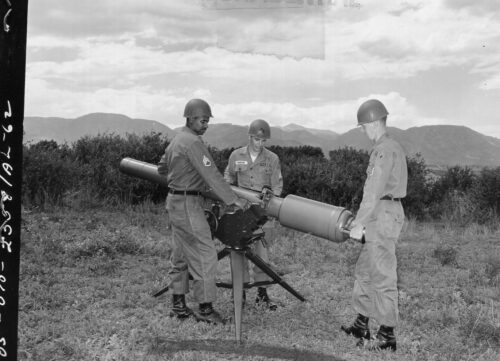
The American racial encoding of this “frontier” weapon named after a genocidal folk hero (M28/M29 Davy Crockett) entered service in May 1961. It was promoted as a “surgical” strike, in photos like this one, where a white soldier poses as a “big dick” who needs soldiers of color to load and unload him. The Crockett rocket fired an “atomic watermelon” with 20 tons radioactive TNT equivalent up to 3 miles away.

This new technology announcement compresses the “precision” death timeline even more significantly because:

  • Scale advantage: A paperclip-weight robot is essentially undetectable. No radar signature. Visual acquisition nearly impossible.
  • Penetration capability: Explicitly designed to go where “traditional quadcopters can’t” — through rubble, gaps, screens, gates, grills, broken windows
  • Autonomous targeting: The saccade movement they’re celebrating mimics how insects localize and identify — that’s targeting behavior, not just navigation

And look at the funding: Office of Naval Research, Air Force Office of Scientific Research. The search-and-rescue framing is a dual-use press release. The money trail tells you the most likely uses and customers.

The CIA failed in the 1970s to get their Insectothopter (let alone robotic birds of Project Aquiline) operational, for precisely the reason this MIT team solved: crosswind instability.

The Insectothopter. Source: CIA Archives

The 1970s robotic dragonfly design couldn’t handle more than a light breeze, an important context for everything MIT just demonstrated:

  • Wind disturbances of >1 m/s handled
  • Aggressive maneuvers with <5cm trajectory deviation
  • Autonomous control (AI) architecture that compresses decision-making to distributed and real-time

Sarah Bergbreiter explicitly notes in the news release by MIT that while the controller still runs externally, they’ve demonstrated onboard execution.

“This work is especially impressive because these robots still perform precise flips and fast turns despite the large uncertainties that come from relatively large fabrication tolerances in small-scale manufacturing, wind gusts of more than 1 meter per second, and even its power tether wrapping around the robot as it performs repeated flips,” says Sarah Bergbreiter, a professor of mechanical engineering at Carnegie Mellon University, who was not involved with this work. “Although the controller currently runs on an external computer rather than onboard the robot, the authors demonstrate that similar, but less precise, control policies may be feasible even with the more limited computation available on an insect-scale robot. This is exciting because it points toward future insect-scale robots with agility approaching that of their biological counterparts,” she adds.

That’s the tell.

External computation means tethered, lab-bound demonstrations with oversight. Onboard computation means operational without oversight. She’s essentially confirming a roadmap to fly around and find out.

Search-and-rescue framing isn’t just cover for academic institutions appropriating funds, it’s how the Lincoln Laboratory gets graduate students to create weapons without moral injury or considering what happened when MIT’s death machines, known as Operation Igloo White, illegally destroyed Cambodia (Operation Menu).

Scene from “Bugging the Battlefield” by National Archives and Records Administration, 1969
Cambodia Genocide Map: US Bombing Points 1965-73, Source: Yale