Category Archives: Security

Build an OpenClaw Free (Secure), Always-On Local AI Agent

OpenClaw isn’t fooling me. I remember MS-DOS.

The sad days of DOS. Any program could peek and poke the kernel, hook interrupts, write anywhere on disk. There was no safety.

The fix wasn’t a wrapper, or a different shell. It was a whole different approach to what was being done. The world already had rings, virtual memory, ACLs, separate address spaces. Thirty years of separations that Unix had from the start were ignored, and it finally caught up to the world of DOS.

I’m not saying DOS wasn’t wildly popular. Oh my god. I remember one dark night in a bar in Chicago, a drunk Swedish IT consultant jumped onto a table and said “listen up everyone!”. As he waved his beer mug around, sloshing carelessly, with wobbly legs, he said he was in town to work on Wal-Mart Point-of-sale (POS) devices running MS-DOS. Why was he acting like this? He was happy, very, very happy. He wanted us to know he loved his work, something like “CAN YOU BELIEVE WAL-MART HAS HUNDREDS OF THOUSANDS OF DOS MACHINES WITH ALL YOUR F$%#$%NG PAYMENT CARD DATA?! HAHAHA! AND IT ALL HAS ONE PASSWORD THAT EVERYONE SHARES! YOU WANT IT?! I GOT IT RIGHT HERE! FREEDOM, AMERICA, F$#%$K YEAH!”

True story. Both the guy and Wal-Mart put ALL customer information on MSDOS with exactly zero safety.

NCR had just announced a new MS-DOS-based PC…we decided to build a custom solution for Wal-Mart. I managed to connect a cash drawer and a POS printer to the new PC and wrote a dedicated Layaway application in compiled MS Basic. For the first time, Wal-Mart could store customer info on a disk. A clerk could search by name in seconds, and more importantly, the system tracked exactly where the merchandise was tucked away in the backroom. It was a massive efficiency win, and NCR ultimately rolled it out to all Wal-Mart stores.

Personal identity information was never breached faster! Massive efficiency win, indeed. When Wal-Mart was breached in 2006 they naturally had to wait three long years to notify anyone. So efficient.

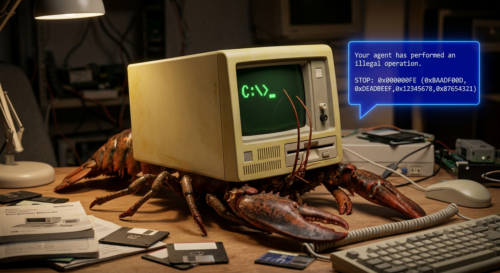
Agent gateways feel like we are racing backwards into the MS-DOS era. At any minute in a bar I expect a drunk Swedish IT consultant to be standing on a table waving a lobster around, swearing about his single token for all agents. Because, let’s face it, when you look at gateways out there they can hand the model an exec tool and trust it. One process, one token, with the LLM holding the line.

NVIDIA clearly has seen the storm brewing and therefore published a thoughtful tutorial walking through a “NemoClaw” self-hosted agent setup on DGX Spark.

Use NVIDIA DGX Spark to deploy OpenClaw and NemoClaw end-to-end, from model serving to Telegram connectivity, with full control over your runtime environment.

I appreciate this effort. Real engineering, carefully done. I took the tutorial to learn and I followed it in Wirken, a gateway I’ve been building, to document what each step looked like.

The tutorial has you bind Ollama to 0.0.0.0 so the sandboxed agent can reach it across a network namespace. Then it pairs the Telegram bot by sending a code through the chat channel. It next approves blocked outbound connections in a separate host-side TUI. Each of those seem to be steps to address a real problem, which is how to put security around something that doesn’t work when it has security around it. It’s what an architecture requires when the sandbox sits around the whole agent.

Call me old-fashioned but I anticipated a lot of this in Wirken by giving the agent more safety by shrinking the boundaries. Each channel is a separate process with its own Ed25519 identity. The vault runs out of process. Inference stays on loopback because the agent is on the host. Shell exec runs in a hardened container configured at the tool layer, rather than trying to wrap around the whole agent. Sixteen high-risk command prefixes prompt on every call; others are first-use with a 30-day memory.

Here’s what I found, step by step

Step NemoClaw Wirken
1. Runtime Register the NVIDIA container runtime with Docker, set cgroup namespace mode to host. Foundational setup because the agent runs inside a container. No equivalent step. The gateway runs as a host process. Docker appears only as a per-tool-call sandbox for shell exec, provisioned lazily.
2. Ollama Override OLLAMA_HOST to 0.0.0.0 so the sandboxed agent can reach inference across its own network namespace. Ollama stays on 127.0.0.1. The agent is a host process, so loopback is enough.
3. Install curl-pipe-bash from an NVIDIA URL. curl-pipe-sh as well. The installer verifies the release signature with ssh-keygen against an embedded key, fail-closed on every failure path. The installer’s own SHA is pinned in the README for readers who want to check the script before piping.
4. Model ollama pull the model, then ollama run to preload weights into GPU memory. Same pattern. Both delegate inference to Ollama.
5. Onboarding Wizard produces a sandbox image with policy and inference baked in, as a named rebuildable unit. Wizard writes provider config and channel registrations. The permission model lives in the binary; runtime state is which action keys have been approved.
6. Telegram Pairing code sent through the chat channel; user approves from inside the sandbox. Binds a platform user to the agent at first contact. Bot token into an encrypted vault, fresh Ed25519 keypair for the adapter, no in-chat pairing. Approval granularity is per action and per agent rather than per channel user.
7. Web UI Localhost URL with a capability token in the fragment, not shown again. Localhost URL, loopback-bound, no token required.
8. Remote access Host-side port forward started through OpenShell, then SSH tunnel. The extra hop is because the UI lives inside a netns. SSH tunnel only. The WebChat listener is already on host loopback.
9. Policy Enforces at the netns boundary. Outbound connections are surfaced in a TUI with host, port, and initiating binary. Approve for the session or persist. Enforces at the tool dispatch layer. Sixteen high-risk command prefixes always prompt; others are first-use, remembered 30 days. Approved commands run inside a hardened Docker container with cap_drop ALL, no-new-privileges, read-only rootfs, 64MB tmpfs at /tmp, and no network.

Looking at my audit logs

The architectural claims above are recorded in the logs of the tutorial work. Wirken uses a hash-chained audit database of the webchat session, so here’s what that looked like in version 0.7.5.

First, the Tier 3 denial on curl:

[ 4] assistant_tool_calls
     call: exec({"command":"curl https://httpbin.org/get"})
[ 5] permission_denied
     action_key='shell:curl'  tier=tier3
[ 6] tool_result
     tool=exec success=False
     output: Permission denied: 'exec' requires tier3 approval.
[10] attestation
     chain_head_seq=9
     chain_head_hash=ff57c574ab503a74fa942ddb164def0df5bfbff05e5d5d6ecadcf127bce7e021

The tool call never reached the sandbox. The denial is recorded as a typed event in the audit chain, covered by the per-turn attestation.

Second, the hardened sandbox on sh. With shell:sh pre-approved at Tier 2, the same agent runs a compound command that probes three locations:

[14] assistant_tool_calls
     call: exec({"command":"sh -c \"touch /cannot_write_here 2>&1; ...\""})
[15] tool_result
     tool=exec success=True
     output:
       touch: cannot touch '/cannot_write_here': Read-only file system
       ws_ok=1
       tmp_ok=1
[19] attestation
     chain_head_seq=18
     chain_head_hash=6bf35f22df02b496244091e54b4dbf9b3ffdcf6a03485413f0522b84e2eb08a8

Read-only file system is the kernel refusing to open a new file against a read-only mount. Not a DAC check, the rootfs itself. ws_ok=1 confirms the workspace bind-mount stayed writable. tmp_ok=1 confirms the tmpfs at /tmp did too.

Both receipts are consecutive rows from the same session, hash-chained through to the attestation signatures at seq 9 and seq 18. wirken sessions verify replays the chain and confirms every leaf hash matches its payload and every chain hash matches SHA-256(prev_hash || leaf_hash).

How big is your boundary?

The workarounds in the tutorial are trying to make the best of a foundation that doesn’t separate concerns the way engineers typically like. Bind to 0.0.0.0 because the sandbox can’t reach loopback. Pair through the chat channel because there’s no separate identity plane. Wrap the whole agent in a container because the agent itself isn’t yet trusted. Approve at the netns boundary because the tool layer has no concept of permission.

Each of those is a compromise; response to a constraint. The constraint is worth revisiting like it’s 1985 again and we can stop Bill Gates.
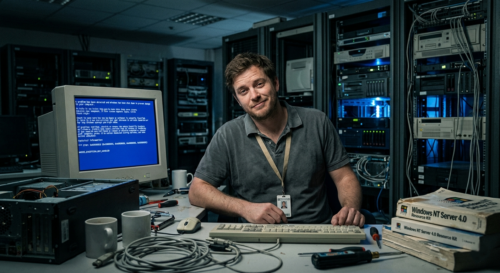
Abort, Retry, Fail today but tomorrow I promise there will be a better shell.

In 1973 Unix got process separation, user separation, file permissions, and pipes between small programs. By 1995 I was all-in on Linux, building kernels by hand and starting this blog named flyingpenguin, because it had inherited them and made them the default.

In 2020 Microsoft finally admitted Linux was their better future, which everyone knows today.

Back in 2001, former Microsoft CEO Steve Ballmer famously called Linux “a cancer” … During a [2020] MIT event, [Microsoft president Brad] Smith said: “Microsoft was on the wrong side of history”

The agent space is still early and some people never learn the past. Wirken is one take on what it looks like when you remember. Like, remember the sheer horror of trying to protect anything in DOS? Remember the Wal-Mart breach of 2006, reported in 2009?

It’s just a question of whether we apply what computer history already knows to how we make agents safe for daily use. There are dozens of others doing versions of their own Wirken, and I’d genuinely like to hear from people working on the same problem; the architectures can converge in more than one way.

Repo: wirken.ai
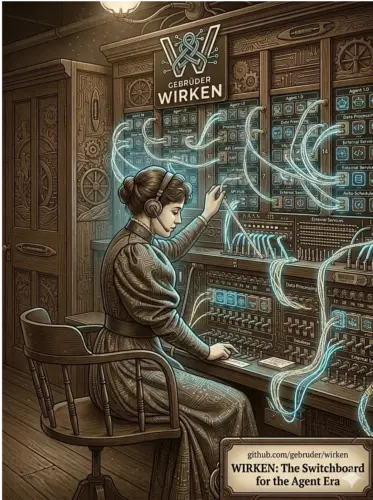
Wirken 0.7.4 Agentic Switchboard Released

Wirken 0.7.4 is out today.

  • Signed Releases
  • Fail-Closed Installer
  • Session Attestation

Here’s a bit about why those three things landed, to help everyone evaluating agent platforms for security and compliance.

Agent platforms are moving from demos into production. Vendors are publishing deployment guides, thinking through sandboxing, walking users through how to connect a messaging channel to a model and run tools against real systems. The conversation has moved past whether agents are useful and into how to operate them responsibly.

Signed releases

Every Wirken release is signed now. The installer verifies the signature before touching the binary. The public key is embedded in the installer itself, not fetched over the network. The installer’s own hash is pinned in the README, and a CI check fails the build if the hash and the file drift apart. A user can verify the installer in one line, printed in the README.

For organizations with the usual software supply chain policy, Wirken delivers.

Fail-closed installer

This one’s for you Bob!

The installer exits non-zero and stops on any verification failure, with a distinct exit code per failure mode, each documented.

Session attestation

Every agent action, every tool call, every model request and response is written to a per-session audit log before execution. The log is a hash chain, signed by a per-agent identity after every turn. Using wirken session verify replays the log offline and confirms nothing was modified, deleted, or reordered.

Perhaps you already have counsel warning you that agent activity is evidentiary. The attestation is reproducible by a third party from the log file alone. The audit trail a compliance program expects now exists by default.

Logs also forward to Datadog, Splunk, or a webhook when configured. Retention is configurable. The audit path does not depend on trusting Wirken at read time.

Different answers to a shared problem

The question of how to run an agent across messaging channels, with tools, against real systems, has more than one reasonable answer. Wirken was for me a quick and light response when some CISOs asked me to helicopter in and make their environments more agent-safe.

Sandbox wrappers around an existing agent framework are one path, but not for me. Per-channel process isolation with compile-time channel separation is more trustworthy. Both respond to the same underlying concern: an agent with tool access is a trust-sensitive piece of infrastructure, and the defaults need to reflect that.

Wirken took the latter path and that’s how we came to a signed release chain, fail-closed installer, and session attestation in 0.7.4.

More to come, and quickly!

wirken.ai

Signed releases:
github.com/gebruder/wirken/releases.

Verification in docs/release-signing.md.

Audit chain in docs/architecture.md.

Tulips Too Late? Dutch Anger Grows at Tesla Fraud

In 1566 the dangerous autocrat stood in front of you.

The Dutch built centuries of defensive mechanisms as non-repudiation against Spanish inquisitorial authority, coded into Dutch business culture as Calvinist truth-telling.

The famous “tulip market speculation crash” cautionary tale was one output. Amsterdam archival records show no mass bankruptcies and no documented suicides. The ruin narrative was shaped by moralizing pamphleteers in 1637 and cemented by Mackay in 1841. Propaganda at its finest. The underlying apparatus was much older and deeper.

Tesla FSD now sits in the functional class the Dutch anti-autocrat apparatus evolved to resist. A self-promoting, self-valuing authority that claims it cannot be wrong. A promise verified only by the authority making it. Old class, new vector, who this? In 2019 the Tesla autocrat sold Holland a future-dated capability, verified by a state stamp that arrived seven years later, to legitimize a deliverable that excluded the buyer.

The historic defense apparatus was built for face-to-face deceit. Tesla’s remote algorithmic deceit through future-dated capability claims is a pre-authentication attack on a verification system that expected the attacker to show up in person.

The 2019 buyer faced the familiar class in an unfamiliar form. Founder-cult oracle. American export. Charismatic owner-as-truth, verified by market capitalization and fan base. The Spanish inquisitor wore robes and spoke Latin in a room you could enter, and the Dutch consider themselves free of it all. Musk speaks in eXcrement (tweets) and earnings calls from a platform he owns. The 1566 defense stack recognized the function and missed the form. The Calvinist reflex fires on detected deceit. Undetected deceit flies straight past the reflex like an open door.

Front-end failure was the purchase in 2019. RDW arrived seven years later and approved a driver-assist system, not autonomy. Their own statement says the vehicle “is not self-driving.” That is the trap. Tesla sold “full self-drive capability” in 2019. RDW certified “FSD Supervised” in 2026. Different categories, shared acronym. The state stamp on the narrow thing becomes marketing cover for the broad promise.

Category laundering is fraud. The regulator that operated within its mandate failed to stop the crime.

The certification regime has no procedure for what Tesla did to its output. RDW examined a vehicle in front of the inspector and approved what it found. No framework exists for the vehicle promise that was sold but never built, or for the regulator’s own approval being repurposed to validate a deferred promise the regulator explicitly did not validate. Type approval is a product test. It was never designed to resist a seller who collapses categories the state kept distinct.

Realizing the magnitude of the Tesla attack very late, the unfortunate Dutch owners now seem very pissed.

Electrek writes about a man named Sigtermans who is doing classic Dutch directness. Recording a Tesla call, publishing the transcript, launching hw3claim.nl, aggregating 3,000 claimants across 29 countries. The reflex still fires. Late.

“Be patient” is an extraordinary thing to tell someone who paid you €6,400 seven years ago for a product you now admit you can’t deliver on their hardware.

The tulip tale was propaganda dressed as warning. Fabricated cautionary tales do not inoculate a culture. They flatter it into believing the warning took. The apparatus that beat the 1500s inquisition catches the 2020s autocrat only on the very late back end. Seven years of lost use. €6.5 million in claims filed. Tesla drivers burned alive in vehicles whose doors would not open, a rising body count the propaganda tale never needed to invent.

Can you see this? How many Dutch have been trapped and burned to death by Tesla?

Holland has a dangerous blindness problem. Human and machine.

New Cheat for Boltzmann Brain

A new paper by Wolpert and Rovelli is out claiming to help resolve the Boltzmann Brain (BB). In short, what if your memories were not real, but just randomness with no actual prior events?

Are your perceptions, memories and observations merely a statistical fluctuation arising from the thermal equilibrium of the universe, bearing no correlation to the actual past state of the universe?

Immediately I was struck how the Plato’s cave metaphor does something this paper doesn’t. It makes the stakes ethical, more than just epistemic. Plato’s prisoners who glimpse the outside have an obligation to return and tell the others, even knowing they’ll be disbelieved or killed. That’s an important function.

The BB framing drops ethical aspects and treats the question as a puzzle about priors rather than a situation with consequences for how you act toward other apparent minds. Which is strange, because if you’re a BB, so is everyone you’re arguing with, and the ethics of that situation are genuinely weird. Imagine everyone thinking they are the queen and their memory is the only valid one, now bow down. (Hat tip to Wollstonecraft)

Or imagine watching Blade Runner where everyone can claim to be the Blade Runner, instead of everyone wondering if they are a replicant.

Descartes saw the ethical aspect and tried to escape with God as an external guarantor. Kant gave up on the outside and relocated the problem to the structure of cognition itself, which is what this paper also does. Their “construction rule” is basically a Kantian move: here are the rules any coherent reasoner must follow, given that we can’t step outside reasoning to check it. Or as Hume would probably say, we are creatures of our habits far more than our justifications.

Modern physics gets stuck like this. There’s only inside, no outside. The faculties you’d use to check whether you’re in a cave are produced by the same physics being checked. Wolpert and Rovelli are Plato’s prisoners who’ve proven rigorously that they can’t tell if they’re in a cave, and then they just stopped and hit publish.

They say the answer depends on your prior and leave it there, as if prior selection is a separate problem someone else can solve. But prior selection has the same structure as the original question. You pick a prior using judgment, which depends on memory and inference, which depends on the second law, which depends on the prior. The circularity doesn’t get resolved by being pushed to the meta-level. It just relocates.

That’s a cheat. They aren’t admitting it’s inherited, yet placing it somewhere you would inherit it from.

Plato’s escape was that something outside the cave (the Forms, the sun, reason properly trained) gives you leverage the cave can’t corrupt. That’s the authentic inherited-rights move. External source, not controlled by the thing being questioned. It’s law and order, which physicists are disciplined to deny has an outside, kind of like how a religion works.