Four things the President of the United States did this weekend.
One. Robert Mueller died Friday at 81. Bronze Star. Purple Heart. Longest-serving FBI director after Hoover. Appointed by a Republican. Trump posted on Truth Social:
Good, I’m glad he’s dead.
Two. Trump declared Iran already defeated while his Defense Department requested $200 billion in additional war funding. For what? He named America as the target:
Now with the death of Iran, the greatest enemy America has is the Radical Left, Highly Incompetent, Democrat Party!
Three. Trump threatened to “obliterate” Iran’s power plants if the Strait of Hormuz isn’t reopened within 48 hours. Deliberately destroying civilian power grids is a war crime under the Geneva Conventions. War crime after war crime. Just watch as that $200 billion funds domestic war crimes.
Four. Under the “greatest enemy” post, Trump supporters shared AI-generated images of George Washington holding a sign reading
It’s time to start hanging these Democrats.
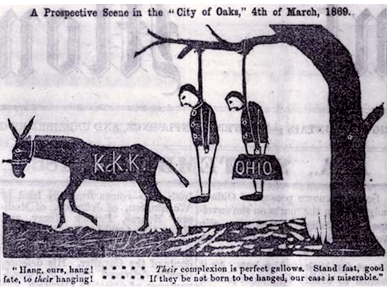
We know this pattern. It’s the KKK all over again.
Source: Encyclopedia of Alabama, 1 Sept 1868 Tuscaloosa Independent Monitor. The KKK threatened that March 4, 1869 — first day of rule by avowed racist Horatio Seymour — would bring lynchings of white Americans (“scalawags” and “carpetbaggers”). Instead the Presidency was won in a landslide by Civil War hero and civil rights pioneer Ulysses S. Grant.The Economist/The New Yorker weren’t wrong
Cryspen’s co-founder Karthikeyan Bhargavan told The Register last week:
we did not do great with these advisories.
You can say that again.
Nadim Kobeissi, an applied cryptographer, found thirteen vulnerabilities in Cryspen’s libcrux and hpke-rs libraries. He published the findings in an IACR ePrint paper titled “Verification Theatre.” Catchy title. You can tell right away he’s a legit researcher. Nine of the bugs were in unverified code. Four were inside the formally verified boundary, which means the code Cryspen markets as providing “the highest level of assurance.”
This is actually a big deal.
I noticed, as one example, only 58.4% of ML-KEM deployment code actually has its proofs checked. The entire NEON backend for every ARM64 device (iOS and Android) is fully admitted with zero proofs checked. That’s the “verification theatre”.
Cryspen built Signal’s post-quantum ratchet (SPQR) using libcrux’s ML-KEM implementation. Their own website states the implementation is:
formally verified for panic-freedom, functional correctness, and secret independence, and hence provides a high degree of assurance.
One of Kobeissi’s bugs caused real decryption failures in that implementation (a cross-backend endianness error). Signal’s signal-crypto crate depends directly on hpke-rs, where the nonce-reuse vulnerability lives.
The nonce-reuse bug enables full AES-GCM plaintext recovery and forgery after 2^32 encryptions with a single HPKE setup. In plain terms, the encryption uses a counter that runs out of numbers after about four billion messages, at which point it starts reusing the same “salt” to scramble data. Once that happens, an attacker can read everything and forge new messages that look authentic.
It sounds bad because it is. AES-GCM nonce reuse is a textbook attack with published working exploits since 2016. Whether four billion sounds like a lot depends on who’s using the library. Google noted their servers handle hundreds of millions of encrypted tokens per second under load. That’s ten seconds or less. The Netty project had the identical counter overflow bug and it got a CVE and a published advisory as one would expect.
There’s also a missing mandatory X25519 validation required by RFC 9180, ECDSA signature malleability, an Ed25519 key generation defect, a denial-of-service via unhandled AES-GCM decryption, and two FIPS 204 specification violations in the ML-DSA verifier.
At this point you might expect Kobeissi to be given appropriate respect for his work. He clearly went above and beyond in helping consumers of these libraries (Signal, OpenMLS, Google, and components touching the Linux kernel and SSH).
Cryspen told The Register these bugs “were addressed within a week”, using speed optics rather than assurance. They then claimed no bugs had been found in their verified code.
Kobeissi’s paper in fact documents four.
So here’s where it gets really interesting.
RustSec is the advisory database for the Rust ecosystem. When you run cargo audit, it checks your dependencies against RustSec. If they refuse to add an advisory, you get a false clean audit. Your CI passes when it should stop. Your security review finds nothing. Every automated tool in the ecosystem treats a vulnerability as if it doesn’t exist.
Kobeissi filed advisory pull requests with RustSec for the nonce-reuse and denial-of-service vulnerabilities. The RustSec maintainer went passive aggressive and closed the pull requests without any technical justification.
You might say this is just sloppy or rushed work, but then Kobeissi was silently blocked from the RustSec GitHub organization without notice. His pending pull request was closed after he was blocked. You probably catch the drift here. Someone must have felt shame, embarrassment even, and started shooting a messenger. One Register commenter gave more context:
The bugs are real, and easily fixed — but I’ve absolutely no idea whether the version I’m using is fixed or not, because they refused to publish an advisory.
Dead messengers, no messages. That’s not a good sign. Let’s review.
February 5: Kobeissi submitted PRs with tested fixes
Within 24 hours: Cryspen blocked his GitHub account and closed all four PRs without technical review
February 9: Cryspen merged his fixes without attribution
February 12: Cryspen published a response omitting most of the bugs and claiming “no bugs have been found in the verified code.”
I’ve been researching and writing about systems integrity failure for decades. The pattern is simple: the system meant to admit a problem is captured by the people who produced it, and who are incentivized to hide problems instead. The advisory database appears to be set up for it to be cheaper to suppress the report than to deal with what it would say. That unfairly transfers risk to external people who won’t even know.
Kobeissi logically escalated, with a complaint to the Rust Moderation Team and Leadership Council about the RustSec maintainer’s conduct. The result confirmed an integrity breach of the RustSec system. Five hours later he was banned from Rust Project Zulip spaces.
He then escalated to the Rust Foundation. In his complaint he identified the structural problem: the Rust Project’s moderation team representative on the Leadership Council is the same individual who issued a public moderation warning against him in the underlying advisory dispute.
He is both a participant in the conduct I am complaining about and a member of the body responsible for reviewing that conduct.
This is true, and thus we see the integrity breach.
The Rust Project’s own governance documents cite council representative obligations:
must promptly disclose conflicts of interest and recuse themselves from affected decisions.
whose potential conflict is under review may not debate, vote, or otherwise participate in such determination.
Neither happened.
This apparently isn’t new for Rust. I researched their integrity issues and found in November 2021 the entire Rust moderation team resigned over “the Core Team placing themselves unaccountable to anyone but themselves.”
Their letter said they had been “unable to enforce the Rust Code of Conduct to the standards the community expects.” They recommended the community “exercise extreme skepticism of any statements by the Core Team.”
The Leadership Council was created in response. It was supposed to fix the accountability problem. What it actually created was another layer where the people being complained about adjudicate the complaints.
Filippo Valsorda, a cryptographer known for drama with Kobeissi for over a decade, tried to get a dig into The Register, telling them:
looks more and more to him like the harassment of open source maintainers.
More and more? That phrase isn’t working. There’s less and less evidence of harassment as the vulnerabilities are proven accurate. He also said the nonce-reuse bug “seems to be a valid security issue.” But from that he incorrectly concluded if RustSec banned Kobeissi, “he’s inclined to believe they had reason to do so.” He means he would like to believe that, as a personal matter. He gives exactly zero reasons, or even tries to name them.
It’s circular. The question is whether the reasons were technical or political. The pull requests were closed without technical justification. The ban message cited “harassment”. Really? The same word used to dismiss the advisory contributions, imposed by the same people whose conduct was being complained about. How convenient for them.
The “harassment” label doesn’t pass even a basic test. It converts a dispute about whether acknowledged cryptographic vulnerabilities deserve public advisories into tone shaming. Once you’re arguing about tone, the institution automatically shuts down security. It controls the standards, the process, and the enforcement. The same people who refused to publish the advisory get to decide whether asking them to publish it constitutes harassment.
It obviously was the opposite of harassment. Extremely high quality professional work was delivered.
Kobeissi is a cryptographer who found real bugs in real libraries used by billions of people, published a paper clearly documenting them, and followed the correct disclosure process. For that he’s been vilified by a system designed to block, ban, and label research to avoid facing the truth.
Every developer running cargo audit against a dependency with a known nonce-reuse vulnerability could be getting a false result right now.
In 1996, the CIA ran a covert operation to overthrow Saddam Hussein. It was the third such order from the White House in five years. The agency backed exiles in London and Jordan, recruited Iraqi military officers, and tried to unite Kurdish factions in the north.
It failed.
As Tim Weiner documents in Legacy of Ashes, the professionals involved knew before they started that it couldn’t work. The exiles had no operational capability inside Baghdad. The assets who could be trusted had no access, and the assets with access couldn’t be trusted. Saddam’s intelligence services penetrated the plot. On June 26, 1996, he began arresting over two hundred officers. He executed at least eighty of them, including the sons of the operation’s key military contact, General Shawani.
Eighty men killed needlessly because no one in the chain of American command could say: “Mr. President, this won’t work.”
Mark Lowenthal, who had been staff director of the House intelligence committee and a senior CIA analyst, explained afterward that the whole enterprise was driven not by intelligence but by feelings of frustration about dominance. The “do something” urge, he called it. Not a strategy. Not an assessment. An emotional need to feel dominant. The CIA converted itself from an analytical institution into a therapeutic one, managing presidential anxiety and feeding control rather than producing outcomes.
The operation “probably shouldn’t have been started in the first place,” Lowenthal said.
But the institution rewarded quick action and punished thoughtful refusal. Telling the president something is infeasible means someone else gets the budget, the mission, the relevance. So the machine runs. People die. The after-action report gets buried with all the bodies. Whoever fails loudly and rapidly is rewarded, while those trying to win are starved of attention.
Now the same machine is pointed at Iran and the target is harder in every dimension, and the people running it are less capable in every dimension.
Fordow is buried under a mountain. Iran has spent decades building redundancy specifically for this scenario. Strategic bombing doesn’t produce political outcomes against a state with national cohesion. It didn’t in Korea, where LeMay destroyed every city and killed twenty percent of the population and the result was a stalemate at the same line where it started. Seventy years later North Korea has nuclear weapons.
The bomb is the therapeutic instrument at scale.
Relentless strikes fail to achieve an outcome. They only perform solving the problem. And the cost, as eighty Iraqi officers learned, is always paid by someone other than the people who gave the order.
Talbot documents how the institutional culture of covert action as the default response was built by Dulles and Dulles. Guatemala 1954, Bay of Pigs, assassination programs… and of course the direct connection to Iran 1953. Operation Ajax, the CIA’s coup against Mossadegh, was a complete disaster treated as a success.
Dulles considered it a model operation. The “do something” machine’s greatest hit is what produced the target it’s now failing to “obliterate” with bombs, seventy years later.
Robert Pape, professor of political science at the University of Chicago, has studied over thirty air campaigns across a century in his book Bombing to Win: Air Power and Coercion in War. His conclusion: strategic bombing of civilian populations has never changed the war aims of their governments. Not once. In a recent TIME interview about Iran, Pape identified what he calls the “smart bomb trap” when leaders see a briefing showing 90% probability of destroying a target, it creates an illusion of control.
…strike numbers released by US Central Command reveal that the waves of attacks since Hegseth’s first briefing have not been increasing steadily, despite Hegseth’s rhetoric indicating otherwise.
The delusion has a long pedigree. In the 1930s, a group of Air Corps theorists at Maxwell Field convinced themselves the Norden bombsight could make bombing surgical. Drop it in a pickle barrel from 20,000 feet. Destroy a ball-bearing factory, spare the city. Malcolm Gladwell tells their story in The Bomber Mafia. It ended with LeMay dropping napalm on wooden cities, burning Tokyo to the ground. In Korea, he tried again with the first “smart bomb”. The TAllboy, Range and aZimuth ONly (TARZON) was a 12,000-pound guided bomb that only hit six of twenty-eight targets, and had to be stopped when it started killing American crews instead. LeMay burned every city in North Korea anyway, achieving nothing, neither precision nor outcomes. Freeman Dyson ran the numbers inside RAF Bomber Command during the war and knew strategic bombing was counterproductive while it was happening. Nobody listened. The Norden became the Tarzan became the JDAM became the GBU-57. The technology changes. The faith continues.
Tactical perfection does not produce strategic success. The confidence that it does is the structural trap that produces American strategic failure, over and over again.
Campaign
Target
Result
Korea 1950-53
North Korea
Every city destroyed. Stalemate. North Korea now has nuclear weapons.
Rolling Thunder / Linebacker 1965-72
North Vietnam
Most intensive bombing in history to that point. North Vietnam won.
Operation Menu / Freedom Deal 1969-73
Laos & Cambodia
Most bombed country per capita in history. Pathet Lao won. Khmer Rouge rose to power.
Desert Storm 1991
Iraq
39 days of bombing. Bush called for Shia uprising. Thousands slaughtered. Saddam stayed.
Iraq 2003-11
Iraq
Shock and awe. Twenty-year occupation. ISIS emerged from the wreckage created by Palantir targeting systems.
Afghanistan 2001-21
Afghanistan
Twenty years of air power. Taliban took Kabul in eleven days.
Saudi-led coalition 2015-present
Yemen / Houthis
A decade of bombing. Houthis stronger than when it started.
Israel 2023-present
Gaza / Hamas
Ongoing. Hamas still operating.
Operation Epic Fury 2025-present
Iran
Ongoing. Fordow intact. No regime change. No negotiation.
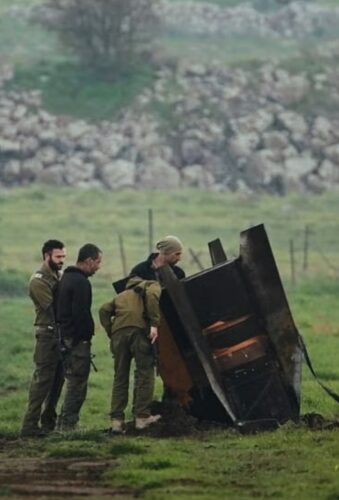
Israeli soldiers in Golan Heights inspect a missile from Iran, March 19, 2026. Source: Ohad Zwigenberg/AP
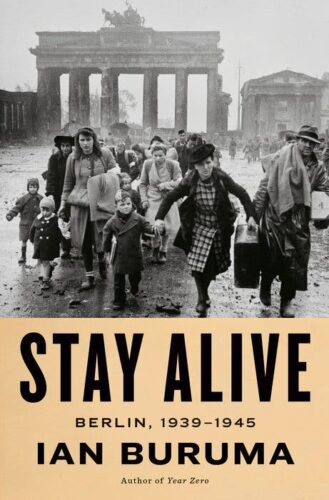
The New York Times wants you to believe that wartime Berliners “just carried on” instead of leaving. Ian Buruma has written what he calls a “love letter” to the city for all those complicit in genocide. The book is cynically called Stay Alive. The subtitle is “Berlin, 1939-1945”, although it probably should have been “I’m obviously not talking about the Jews”.
Stay… and alive. Not for those forcibly deported. Not for those shot in the head and dumped in mass graves.
Stay alive, dear Berliners.
As if the Berliners who pushed the Jews out, onto trains to Auschwitz, were the ones who needed to survive. The people who actually needed to stay alive were in all the camps, sent there from Berlin, from Platform 17 at Grunewald, while the neighbors planned to take all their homes. The threat to Berlin’s Jews was extermination by their neighbors. The eventual externally forced threat to those neighbors was consequences: Allied bombs responding to the many wars that their government started, Soviet troops responding to 27 million of their own dead.
Buruma can get away with this title of Nazi promoting erasure because Berlin already laid the structure for it. It’s the city known for erasing every trace of the people who didn’t stay alive.
There are no photographs of the deportations there, and that’s just weird.
Not one photo.
The #LastSeen project has found deportation images from 60 German cities and towns. We see over 420 photographs from places like Fulda, Breslau, Munich.
Not Berlin.
No photos of the deportation survived. Get it? More than 50,000 Jews were assembled at synagogues and marched to freight yards between 1941 and 1943, and yet not a single image survives.
No photos of the crimes, so that the perpetrators could survive. That’s what enables Buruma to put a photo of perpetrators on the cover of his book and cruelly write “stay alive”.
An author shamelessly appropriates imagery of victims in Berlin to erase the Holocaust. No photos of Jews in Berlin being deported to death camps… survived.
The surviving images are of people carrying belongings through Berlin streets as the perpetrator population. The victims were erased so thoroughly that even the visual language of displacement has been appropriated by the people who caused it.
Sixty towns documented what they did. Berlin destroyed the evidence, took the apartments, collected the stolen property, and got angry at anyone who tried to produce evidence. Look forward! Forget that past! We must talk only of the future! When there are no faces for the dead, you can put the living on the cover and call it the celebration of only their survival.
A love letter. To the city that housed the Reich Security Main Office, the Wannsee villa, the T4 euthanasia headquarters, and the Gestapo on Prinz-Albrecht-Straße. During the years the Holocaust was administered from its conference rooms. That’s what we are being told to love now.
Consider that Buruma’s father, Leo, spent the war in Berlin manufacturing light machine guns for the Wehrmacht. The son’s book turns that fact into a story about “attempting to find his own balance between resistance and survival.” The review even structures the sentence to bury it: Leo worked in “a factory that made brakes for locomotives but also light machine guns.”
Brakes first. Machine guns… oh yeah, that too.
As if trains to death camps let alone arming a genocide was a footnote to the business. This is a family project, their investments for a return. The father made weapons for Nazis. The son wrote the love letter to honor the customers, those buying and standing behind the guns.
The Cast
Every person in this book is bizarrely setup as either a victim or a bystander. That’s the only allowed frame. A conductor who told himself he was unpolitisch. Literati debating whether to go into exile. Families hiding in brothels. And the author’s own father is described as a man “dodging Allied air raids,” not as a man building the weapons that made those air raids necessary.
That’s common among Nazis, declaring themselves the true victim and seeking support to avoid the accountability.
Nobody in this book is running Berlin deportation logistics. Nobody is staffing the camps. Nobody is collecting the Aryanized property and laundering the city’s records. Nobody is processing the paperwork that sent 50,000 Jews from Platform 17 at Grunewald — in full view of the neighborhood — to their deaths. The perpetrators aren’t characters. They’re just the weather the Berliners benefit from.
The Magic Words
Buruma’s thesis, as quoted in the Times review: most Berliners were “neither cynics, nor bullies, nor ideological fanatics; they simply conformed.” Horseshit. “Simply conformed” is the phrase that lets an entire city off the hook. Conformity is passive.
What Berliners did was participatory.
They filled the jobs vacated by deported Jews. They took the apartments and decorated with stolen art and furniture. They attended the concerts funded by stolen wealth. They took all the customers, all the markets and drank the wine looted from France. That’s not conformity. That’s the intended dividend of genocide, and Berlin was an epicenter of grabbing dividends.
The Exculpation Engine
The whole project seems to circle around a man named Erich Alenfeld. A Jew who “converted” to Christianity, Alenfeld wrote a love letter to Hermann Göring in 1939 renouncing his heritage and volunteering for the German Army. His son joined the Hitler Youth at age ten. Decades later, his daughter wrote a book called Why Didn’t You Leave?
The family itself could see clearly what it was.
Buruma’s explanation runs against them and wants us to believe these were “not always cynical accommodations.” The crimes are supposed to be excused by “the nationalistic spirit of the day.” The Alenfelds, he writes, “were as much influenced by German romanticism as anyone of their generation.”
Romanticism. A Jewish man writing to the architect of Aryanization, volunteering to serve the army that would exterminate his people, and this guy calls it romanticism.
It’s disgusting.
This story does specific work. If even a Jew could sincerely buy in rather than be shot in the head, not out of desperation, not as survival camouflage, but out of genuine national feeling, then nobody else can be blamed. The ideology was normal, seductive. It swept up everyone in the crimes, even its victims. And if the victim class believed the lies, what excuse does the beneficiary class need?
That’s why Buruma needs “romanticism” instead of derangement or “desperation.” Thousands of Jews and Mischlinge served in the Wehrmacht. Bryan Mark Rigg documented them. They expected to survive. They did it because the other option was death. They did it because a uniform was camouflage in a hail of bullets. Buruma strips all that actual survival context and replaces it with his personal feeling. Romanticism makes the collaboration of the victim in their own death as universal and beautiful. Desperation would admit there were people under actual existential threat, and would raise the obvious question of what excuse the eight million complicit Berliners had.
The daughter’s title is the question that this new book tries to erase. Why didn’t you leave. Why didn’t you refuse. Why did you participate. Buruma doesn’t want it asked. He doesn’t want the answer leaking. So he dissolves the topic into mood. He literally calls genocide romantic. He calls Nazi complicity a love story. He calls the whole thing a love letter.
And the Times stupidly prints and promotes it because apparently nobody there studies history anymore.
Who Gets a Face
The book ends with the usual horror story that Nazis invoke. Soviet troops arrived and more than 100,000 Berlin women and girls were raped. Buruma interviews a survivor who was 14. This is real history and it matters.
It matters because he erases the more than 50,000 Jews deported from Berlin. They don’t get equivalent treatment. They can’t. Berlin made sure of that. No photographs, no faces, no names on the memorial. No survivors to interview. Raped and murdered.
The structure of the book opens with indifference to tragedy and closes with a call for sympathy about Soviet violence, so that Berliners end the story as victims rather than the participants. All the Jewish women and girls are forgotten so the rapes years later can get all the ink. The dead stay faceless. The living are presented for recognition.
Thomas Mann Saw It
The review quotes Thomas Mann: anything published in Germany between 1933 and 1945 bore the scent “of blood and shame.” The review treats this as period context but it’s so much more. That’s a direct indictment of the project.
Mann’s standard says the voices that Buruma is so intent on preserving, those who stayed to benefit, who conformed to profit, who carried on as Hitler ordered, are not neutral witnesses. They are compromised sources. Not because they lied, but because survival in Nazi Berlin required participation in the system that made their “survival” necessary.
Mann left. Brecht left. The people who stayed made a participation choice, and that choice came with a price that someone else paid. Those who resisted were the ones killed, lives destroyed. Buruma knows this actual story, as his father’s Nazi gun factory is in the book. But the framing converts complicity into tragedy, production into survival, and desperation into romance. That immoral disinformation conversion is the point, it would seem.
Not His First Time
In 2018, Buruma was forced out as editor of the New York Review of Books. Remember his request to think of the Nazis who suffered from Soviet liberation of Berlin? Buruma published an essay by Jian Ghomeshi, accused of sexual assault by over 20 women, that let Ghomeshi reframe his story as a victim of public shaming. Buruma’s defense is very relevant to the women raped by Soviet soldiers:
The exact nature of his behavior — how much consent was involved — I have no idea, nor is it really my concern.
And why isn’t he concerned? In 2018 he gave an accused abuser of women a platform to narrate his own suffering. Now in 2026 he wants an entire city of participants to finally get the platform to narrate theirs. Shouldn’t he defend the Soviet soldiers as he defends Ghomeshi? The hypocrisy is noted.
Both projects center the perpetrator’s experience of consequences rather than the victim’s experience of harm. Both treat accountability as the real violence. He got fired for it in 2018. In 2026 the Times prints Nazi love letters.
The Reviewer Sees It and Walks Away
Kevin Peraino, reviewing for the Times, writes that the book is “long on anecdote and primary sources but somewhat short on big ideas.” He wishes Buruma would “delve deeper.” He’s saying the book has no analytical framework. No argument. No structure for understanding why any of this happened or what it means.
How could it, given what it’s trying to accomplish?
And yet he endorses the “love letter” framing anyway. He calls the book a “passionate challenge to the corrosive power of indifference.”
Indifference wasn’t corrosive to Berlin.
Indifference worked for Berlin.
It is the very thing that kept the concerts running, the soccer matches filling, the coffee flowing during genocide. The machine didn’t need any enthusiasm. To this day Berlin frowns on emotion and warns against evidence. It needed no traces, people to keep showing up so the crimes could continue. They did. A “vacation” train to Auschwitz allowed Berliners to watch the gas chambers of mass death in action. The Nazis made special glass observation ports for inspection. Then the Berliners would return revitalized to their city to wax about their own “survival” that depended on efficient systemic erasure of Jews.
Love Letters to the City of the Dead
Berliners to this day have a tradition, they put flowers and candles on Nazi graves around the city. These Nazis are mourned openly without apology, in the city that dislikes emotional displays. If only they had lived another day to machine gun more neighbors, to violently redistribute more wealth. They are memorialized in a very peculiar way.
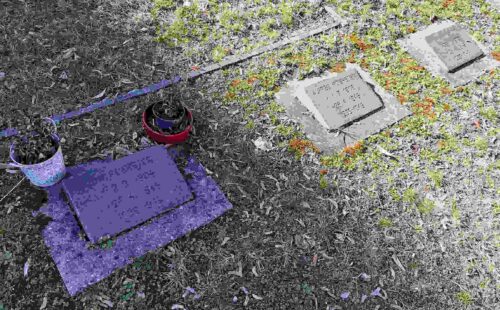
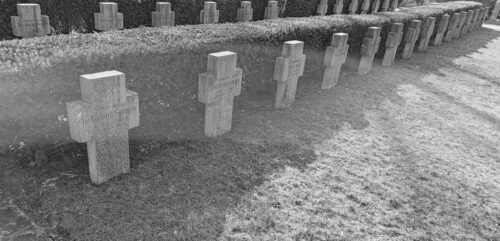
Red Grablichter on Berlin graves from 1945, maintained at scaleFoersters, died April 26 1945, four days before Hitler’s suicide. Flowers in Berlin cemetery.Friedhof in Berlin. The same cemetery has graves from the First and Second World War. The flowers and candles are only for 1939-1945.
At the military cemetery on Columbiadamm, wreaths appear every November from groups honoring Wehrmacht dead. A “Tradition Association of Friends of the Former Protected Area German Southwest Africa” leaves ribbons with “patriotic greetings” at a memorial to the soldiers who carried out the Herero genocide. When Neukölln’s government was asked to remove the memorial, they added a plaque that very precisely omitted the word “genocide.”
Reinhard Heydrich, the architect of the Final Solution, is still in the ground at the Invalidenfriedhof in central Berlin. It’s a tourist attraction for those who want to show Nazism some love. The grave marker was removed but the body was not. The cemetery is now a protected monument, maintained by the state, promoted as an attraction. In 2019 someone with inside knowledge of the location opened the grave, to emphasize Heydrich was never really gone.
The Sinti and Roma memorial — a symbolic grave for 500,000 murdered people — is being threatened by a Deutsche Bahn tunnel project. The Holocaust memorial itself contains no names, no inscriptions, no Jewish symbols. Its anti-graffiti coating was manufactured by a Degussa subsidiary — the same corporate family that produced Zyklon B.
This is what we are told a love letter to Berlin looks like. The perpetrators rise again. The historical ground markers come off. The victims get an abstract memorial with no names. And every few years someone with a family connection to the war machine writes a book saying that most people simply conformed so who could blame them for not leaving.
That’s not history. That’s “like father, like son”, erasing genocide victims of the family business to continue dividends. Love as hate.
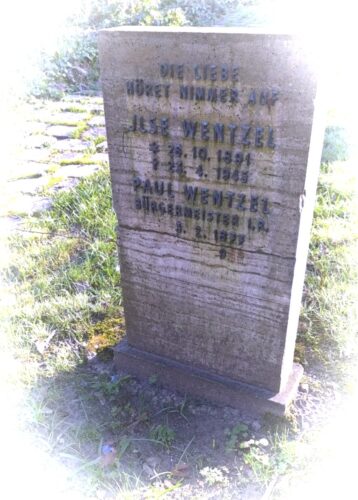
A Nazi-era mayor’s gravestone in Berlin literally says “love never ends”, in the same city where a man just published a love letter to the genocide his father armed. The grave notably doesn’t conform to Berlin occupation rules for commemoration. It’s not uncommon to find Berliners like this breaking cemetery rules about love for Nazism.
a blog about the poetry of information security, since 1995

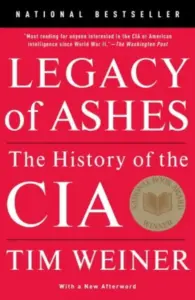 As Tim Weiner documents in Legacy of Ashes, the professionals involved knew before they started that it couldn’t work. The exiles had no operational capability inside Baghdad. The assets who could be trusted had no access, and the assets with access couldn’t be trusted. Saddam’s intelligence services penetrated the plot. On June 26, 1996, he began arresting over two hundred officers. He executed at least eighty of them, including the sons of the operation’s key military contact, General Shawani.
  Mark Lowenthal, who had been staff director of the House intelligence committee and a senior CIA analyst, explained afterward that the whole enterprise was driven not by intelligence but by feelings of frustration about dominance. The “do something” urge, he called it. Not a strategy. Not an assessment. An emotional need to feel dominant. The CIA converted itself from an analytical institution into a therapeutic one, managing presidential anxiety and feeding control rather than producing outcomes.
 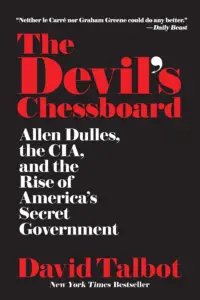 Talbot documents how the institutional culture of covert action as the default response was built by Dulles and Dulles. Guatemala 1954, Bay of Pigs, assassination programs… and of course the direct connection to Iran 1953. Operation Ajax, the CIA’s coup against Mossadegh, was a complete disaster treated as a success.
 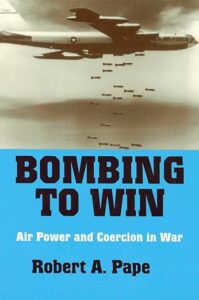 Robert Pape, professor of political science at the University of Chicago, has studied over thirty air campaigns across a century in his book Bombing to Win: Air Power and Coercion in War. His conclusion: strategic bombing of civilian populations has never changed the war aims of their governments. Not once. In a
 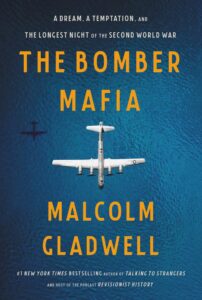 The delusion has a long pedigree. In the 1930s, a group of Air Corps theorists at Maxwell Field convinced themselves the Norden bombsight could make bombing surgical. Drop it in a pickle barrel from 20,000 feet. Destroy a ball-bearing factory, spare the city. Malcolm Gladwell tells their story in The Bomber Mafia. It ended with LeMay dropping napalm on wooden cities, burning Tokyo to the ground. In Korea, he tried again with the first “smart bomb”. The TAllboy, Range and aZimuth ONly (