Daniel Miessler published a FUD-addled post on July 18 arguing that Chinese AI open weight models are “cheese in a CCP mousetrap“: subsidized giveaways engineered to break the American AI labs and the market priced on their dominance, after which Taiwan votes itself into the People’s Republic.
Chinese open-source models are a cheese in a CCP mousetrap.
Kimi K3 just brought us very close to a world in which the US AI labs are no longer ahead. Both the benchmarks—LMArena and Artificial Analysis—and actual experiences with it are extremely positive. I don’t think it’s quite as good as people are saying, but it is at least on par with Opus 4.8 in many areas. That by itself was impossible six months ago. The key part of this strategy is to give the secrets away to the world such that the power of open source will be added to the pressure on the U.S. labs, and therefore the U.S. economy.
Quoted from the version Miessler published July 18. He has since revised the post without any correction notice, removing the CCP attribution from the mousetrap line, the benchmark claims, and an entire footnote on Hong Kong. The passage above is preserved from the original.
Uber burned venture billions selling rides below cost to break the taxi trade, and Amazon spent years pricing below cost to break retail. Miessler rides in his Uber ordering off Amazon and calls it his American playbook for convenience. Predatory subsidy is the domestic playbook he lives inside, which is why he tries to project it onto a foreigner, even when they are charging full margin and contradict his projection.
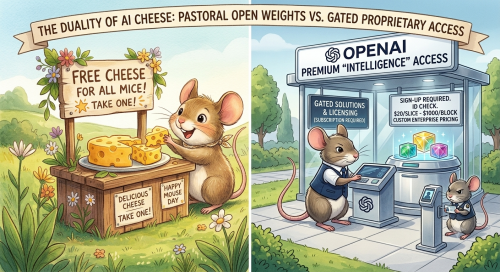
Let’s just be honest. This is the 1980s all over again and the origins of the FSF. His deeper objection sits in the picture below: the world could end up on the left instead of the right, and how is anyone getting rich on predatory American practices supposed to maintain their hedge against someone giving cheese away? Sell a quality product? With no trap? He believes in the trap, so he sees one, even where none exists.
His claim is that effects of a Kimi K3 model are the markets starting to shake and wobble on Friday. Taiwan’s benchmark fell six percent, Japan four, the Nasdaq one and a half, and the Philadelphia Semiconductor Index closed more than twenty percent below its June peak.
Let’s break his cheesy poof post down properly.
A mousetrap runs on two stages. The victim sees an easy gain, which the hunter snaps into an expensive loss. Open weights defeat the latter half of that mechanism, because they can’t be easily lost. A weight file, once published, lives on everywhere it is stored. Hosting firms in Ohio and Helsinki serve it, forks multiply past any count. Beijing has no way to snap, so there’s no victim to be had. The threat that China will one day stop releasing cheap models loses its entire force, since the only part left to remove is the cheese. Everything already released stays released.
That’s such a fundamental failure in the cheese post analysis, I wonder how Miessler published it.
But wait, no pun intended, the K3 itself weakens his argument even further. Moonshot launched it July 16 as a hosted product and committed in writing to full weights by July 27. At 2.8 trillion parameters, self hosting means cluster hardware rather than laptops, and portability is the point: the day these weights land, any inference firm with the infrastructure could become the business that serves them, including American ones. Any actual dependency story requires a single supplier. Yet the model of a published weight means every supplier is by design interchangeable.
On top of that, now look at the pricing mistake made by Mr. Cheese. His whole subsidy claim doesn’t make any sense, because Moonshot priced K3 at three dollars per million input tokens and fifteen per million output. That’s not out of line with the western frontier. Same price is attractive how? Must not be the price. A predatory subsidy prices below cost until the competition dies; parity pricing announces…a margin. The funding is in fact a venture, where the silicon is the usual constraint: Alibaba put a billion dollars into Moonshot in 2024 at a two and a half billion valuation, the company now sits near thirty one billion. The recent models were trained on Nvidia’s export-grade H800 chips. Corporate money pouring into American silicon that it had to argue it should be allowed to buy is the literal opposite example from a state dumping.
Even the American AI hawks expose the cheese post as nonsensical. Dean Ball, formerly the Trump White House’s senior AI policy advisor and now OpenAI’s head of strategic futures, attributes China’s open weight strategy to strategic blindness and a shortage of inference compute. He blames American export controls. The company with the most riding on this mousetrap story doesn’t seem to have its own strategist on board.
Now for my favorite kind of analysis. The cheese post makes an accusation that has been built to survive any evidence proving it wrong. The unfalsifiable argument is popular these days, as if everyone wants us to just accept they are the one with a teapot orbiting the sun. When DeepSeek undercut on price in 2025, the cheapness proved it was an attack on America. Now K3 arrives at parity pricing and the inversion is the attack, because quality is a threat. Price low and you get accused of dumping; so you charge parity and get called a threat because of your quality. The person who floats a thesis confirmed by every possible move predicts nothing and explains less.
The real story of open weights is actually quite boring, which is why it’s so successful. In August 2025 the State Council issued Document No. 11, the AI Plus directive, which sets adoption targets across industry and science and calls for a flourishing open source ecosystem. Industrial policy is the mother of innovation. You don’t land on the moon without someone saying moonshot is the goal. A stated goal is policy, the sort of thing every executive ever relied upon for success. Provincial governments in Beijing, Guangdong and Hangzhou fund open model development, and Chinese open models grew from 32 in 2022 to 337 in 2025 by Epoch AI’s count. Industrial policy that was printed in the official gazette means healthy diffusion at home, and commoditization of the layer its rivals monetize abroad. This is a market-based strategy and public, which makes it a very long way from a plot to detonate the Nasdaq. Competition is supposed to bring competition, not whining about cheese.
Taiwan, we are being told to believe, will “instantly vote to rejoin China” the moment American markets aren’t floating anymore. This is such a weird coin-operated view of the world, perhaps it explains why the mousetrap post is so empty-headed. Decades of polling on Taiwanese identity say otherwise, perhaps for obvious reasons? The claim of instant rejoin has zero evidence. Seems like it should have something, anything, to start the conversation.
Friday’s selloff was real, so it deserves attention. The sell side attributed the rout to weak earnings, the Iran war, crowded positioning in recently surged tech stocks, and record levels of leveraged ETF, margin, and retail option activity now unwinding. I mean, Trump started a war he can’t win, emptied national security credibility, and is talking about a level of fiscal isolationism and decline that puts the Brexit disaster to shame. An index wired unfortunately to the pricing power of a handful of firms, all desperately assuming their premium margins can’t fall, wobbled on a press release. That is some basic exposure of American integrity issues, which required no conspiracy. If you want conspiracy, look at the lingering cartel mindset of an American frontier. Miessler sees symptoms of domestic failure and desperately wants to blame it on the foreigners.
The weights ship July 27.
They can be copied and never recalled.
That sounds a lot like free cheese forever (FCF), which makes it an update to the FSF.
The world runs on Unix. Not Windows. The world wants open weights. Not OpenAI.
Don’t fall into the trap American AI model investors are building, given the logical options to reduce risk of capture.