September 25, 2025 seems like forever ago. The U.S. Navy held a ceremony at Naval Support Activity Bahrain to decommission USS Devastator, the last of four Avenger-class minesweepers that had operated in the Persian Gulf for 35 years. Vice Admiral George Wikoff, then commander of U.S. Naval Forces Central Command spoke fondly of the technological defense achievement:
They are “true trailblazers” who had defended freedom of navigation and deterred efforts “by adversaries to harm the innocent.”
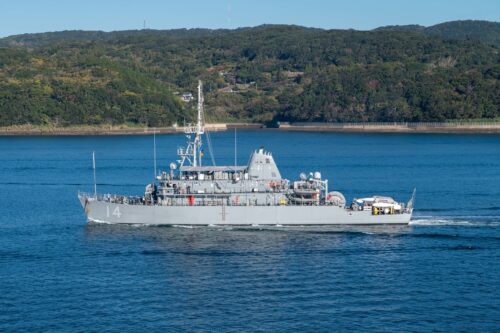
USN Avenger-class mine countermeasure ship. Source: USN photo by Mass Communication Specialist 1st Class Charlotte C. Oliver.
On January 9, 2026, the four decommissioned hulls — Devastator, Dextrous, Gladiator, and Sentry — were physically loaded onto a contracted heavy-lift vessel, the M/V Seaway Hawk, and removed from Bahrain. They are slated for dismantlement.
A little over a month later, defenses gone, on February 28 the United States and Israel launched Operation Epic Fury against Iran. And it goes without saying that Iran’s primary asymmetric response is mining the Strait of Hormuz.
Mind the Gap
That sequence of self-inflicted weakness is documented. For some reason the connection is not yet headline news.
Stars and Stripes covered the September ceremony. USNI News covered it the same day. The War Zone covered the January physical departure and noted, only in passing:
the continued critical importance of naval mine-clearing capacity in the Middle East is underscored now by a new surge in geopolitical friction between the United States and Iran.
Naval News ran the best report so far: the replacement Independence-class littoral combat ships:
…have struggled to meet the requirements of operational mine countermeasures missions.
Struggled.
CNBC mentioned the decommissioning in two sentences buried inside a March 11 piece on the mine strikes.
No major outlet has run the timeline as a single story about the administration removing the directly applicable dedicated mine-clearing force, while it started the war where mines are the threat.
Avengers in Brief
The Avengers were purpose-built for this exact mission. Wooden hulls were sheathed in fiberglass, using oak, Douglas fir, and Alaskan cedar chosen specifically to minimize magnetic signature and reduce vulnerability to the magnetic-influence mines Iran stockpiles.
At 68 meters and 1,312 tons, they were small enough to operate close to mined areas. They carried sonar, video systems, cable cutters, and remotely detonated mine-disposal devices.
The Navy built 14 of them between 1987 and 1994. The four at Bahrain had been forward-deployed since 2012. At the decommissioning ceremony, Lt. Commander Alex Turner told his sailors to take home their piece of Douglas fir plank and remember what they carried with it.
Now the best American minesweeper ships in history are well on their way to Philadelphia for disposal, if not already gone.
What Has Come Since
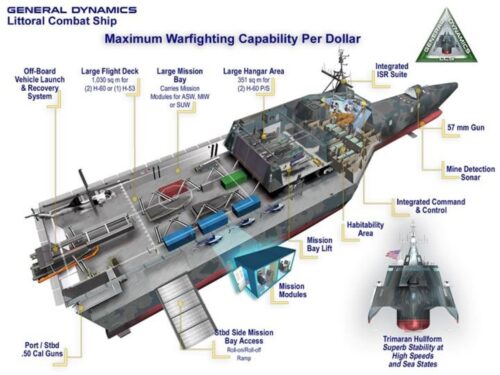
The Independence-class LCS is an aluminum trimaran built by Austal USA, which I blogged here 16 years ago… time sure flies! It is significantly larger than the Avengers. The War Zone noted at the time of departure a significant size difference:
…could impose limits on how close they can get to mined or potentially mined areas.
Someone wrote down “networked, agile, stealthy surface combatant capable of defeating anti-access and asymmetric threats in the littorals” and this giant floating soccer field filled with video game monitors popped out.
Aluminum ships are obviously metal-hulled, which is the exact opposite design choice from the superior design of wooden Avengers. As someone who has sailed across an ocean on aluminum let me be the first to say it’s the worst, the worst, hull material for many reasons not least of all electrochemical.
It rapidly corrodes in saltwater, requires far more maintenance, and has lousy magnetic signature management. Plus it is loud and cold, a condensing drum that diminishes comfort. It’s the worst, most annoying, vessel material for open water.
And the late-addition mine countermeasures mission (MCM) package for these ships was not even installed until 2025, which means untested. The USS Canberra received it in April 2024 and arrived in Bahrain in May 2025. USS Santa Barbara and USS Tulsa followed. The whole program had been delayed by more than a decade of failed systems, equipment failures, and integration problems.
Naval News documented the specifics at the time of the Avenger retirement: during one test of the MCM package on USS Tulsa, a tow bracket broke, leaving an unmanned surface vehicle unrecoverable and requiring another ship to retrieve it. The sensors in the current suite are ineffective in turbid or deep water. Pre-mission preparation takes approximately six hours. Any single equipment failure in the design renders the entire thing inoperable: the platform lift, the tow hook, the crane frame for deploying unmanned vehicles.
PowerPoint procurement process. So much war fighting capability per dollar it can’t even… fight.
The Navy and Pentagon labeled this transition unenthusiastically, as if it was boredom with what works driving the mistakes:
…a much needed step towards modernizing the fleet.
Needed. Much needed.
The current situation
CNN reported March 10 that Iran has begun laying mines in the strait, already a few dozen. According to U.S. intelligence, Iran still retains 80 to 90 percent of its small boats and mine-layers, and could feasibly deploy hundreds more. CBS News reported that while Iran’s total mine stockpile is not publicly known, estimates over the years have ranged from 2,000 to 6,000 naval mines of Iranian, Chinese, and Russian manufacture.
Reuters reported the same day that the U.S. Navy has refused near-daily requests from the shipping industry for military escorts through the strait since the start of the war, telling industry briefings the risk of attacks is too high.
Three shipping industry sources confirmed the Navy’s position has not changed regardless of Trump propaganda: escorts will only be possible once the risk of attack is reduced. A maritime security source told Reuters that securing the strait could require taking control of Iran’s vast coastline.
There are not enough naval vessels to do that and the risks remain high even with an escort. One or two vessels can be overwhelmed by a swarm.
Trump meanwhile keeps saying that the United States is prepared to escort tankers through the strait whenever needed. How? On March 10, Energy Secretary Chris Wright posted on X that the Navy had successfully escorted an oil tanker through Hormuz. He deleted the post within 30 minutes. White House Press Secretary Karoline Leavitt told reporters shortly after:
I can confirm that the US Navy has not escorted a tanker or a vessel at this time.
On the same day, Trump posted on Truth Social that if Iran had put mines in the strait — “and we have no reports of them doing so” — he wanted them removed immediately or Iran would face military consequences “at a level never before seen.” U.S. Central Command then announced it had destroyed 16 Iranian mine-laying vessels… laying mines.
Avengers Deactivated
Seasoned, capable minesweepers were ripped out by Trump January 2026, and then he unilaterally started a mine war February 28.
The Avengers were the tool for this specific problem. They existed for exactly this threat environment in the Persian Gulf for Iranian mines, and close-in clearance work. They had 35 years of operational history in the region. The decision to remove them is as if naval decommission and commission calendars were never in the same room.
The LCS replacement had no demonstrated operational mine countermeasures capability, yet it has abruptly been pressed into service as the justification for retiring the Avengers. That reads like the “go fast” boondoggle called LCS is still desperate to justify its existence. The MCM package’s first two operational installs happened only in 2025.
Mindless.
Trump is now threatening Iran with real-estate baron language of “never before seen” consequences, as he always does to everyone for everything. But the real calculus is that Iran very, very predictably is mining the strait that Trump just removed his own capacity to clear.
Eleven days into the bombing of Iran, the United States has struck over 3,000 targets, killed the Supreme Leader, destroyed the state broadcaster’s headquarters, hit a parliament building, bombed a girls’ school full of children, mined the news cycle with claims of victory, and accomplished exactly nothing that wasn’t predictable, reversible, or counterproductive.
American “force projection” officially is degraded.
Iran elected a new Supreme Leader in eight days, while Trump said they weren’t allowed to do that. Its missile launch rate dropped 90% according to the Pentagon, which sounds decisive until you notice that the remaining 10% has still killed eight American service members, injured 140 more, struck US bases across the Gulf, hit civilian targets in Israel, shut down the Strait of Hormuz, grounded all flights out of Qatar, and turned every Gulf state hosting American forces into a target. The 90% number is a tactical metric being presented as a strategic outcome. It is neither.
American “dominance of the skies” officially is degraded.
There’s no denying drones are getting through. There’s no turning back that three F-15E fighters were shot-down by America’s own “dominance” system. The world learns to just watch and wait as “punch down” war criminals like Hegseth are sucking oxygen out of American state podiums.
הקונספציה (The Conception)
Trump unilaterally waded into the most predicted war in modern history. Not predicted as in “analysts warned it could happen.” Predicted as in the specific sequence of provocation escalation, failed negotiations, Israeli strikes, US involvement, Iranian retaliation against Gulf states, Strait of Hormuz closure, coalition fragmentation was ALL described in writing by dozens of analysts, think tanks, war games, and intelligence assessments over the past two decades.
MAGA literally means go back to the days before we had so much intelligence to do the dumbest things possible, as if it will turn out differently by pretending nothing has been learned.
The Millennium Challenge 2002 war game simulated a US-Iran conflict and the red team sank a carrier group on the first day using exactly the kind of asymmetric tactics Iran is now employing. The Pentagon’s response was to restart the exercise with rules that prevented the red team from winning.
That was twenty-four years ago. The institutional response to being told the strategy would fail has been, for twenty-four years, to adjust the simulation until the strategy succeeds on paper. And then Trump came along.
קו בר-לב (The Bar Lev Line)
I wrote twelve years ago a detailed analysis of President Nixon’s folly called Operation Igloo White. And I’ve given many presentations about it since.
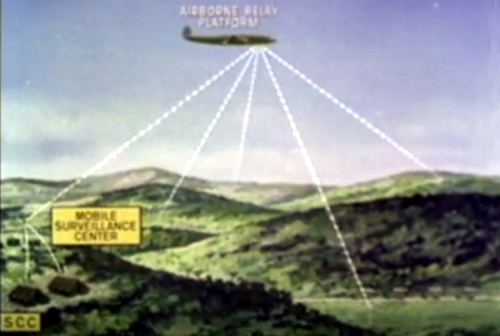
The billion-dollar-a-year sensor-to-shooter network the US Air Force dropped along the Ho Chi Minh Trail from 1967 to 1973. Twenty thousand sensors, relay drones, IBM mainframes, precision airstrikes. It cost $30 million in orbiting aircraft and command infrastructure to hit $5,000 trucks carrying $2,000 worth of rice. The programme ran for six years.
The Iran campaign is the Big Tech debacle of Igloo White at national scale. The most expensive precision strike capability in history directed at an adversary who has designed their systems to absorb exactly this kind of punishment and grow in capabilities. The IRGC operates with pre-delegated launch authority. Missile units are dispersed. Drone production is distributed across the country. The leadership succession mechanism activated within hours of Khamenei’s death. The system was designed to survive decapitation because the Iranians spent forty years watching what the US does to centralized command structures.
The US strategy assumes the adversary doesn’t learn or listen and remains conveniently fragile. I can’t believe I’m seeing the Vietnam War strategic failures made again as if none of it mattered to American brass. The adversary is not fragile. The adversary read the history and so this becomes a question of who follows a curve in the road ahead to slowly cross a chasm and who has a case of mode confusion (drives high speed forward off the side of a bridge).
טוהר הנשק (Purity of Arms)
On the first day, the Shajareh Tayyebeh girls’ school in Minab was double-tapped by US missiles. At least 180 people were killed, rising by the day, most of them girls aged seven to twelve.
The school had been walled off from an adjacent IRGC naval base for over a decade, since 2013. That separation is clearly visible in commercial satellite imagery for that whole decade. NPR’s analysis, confirmed by three independent experts, assessed the strike as part of a precision attack on the adjacent military complex using targeting data that was never updated, did not reflect a school’s clear separation from an old base.
Red Crescent medics reported the double-tap mechanism used: after the first strike, the principal moved surviving students to a prayer hall and called parents. The second strike is what killed the children as it hit them sheltering in a prayer hall. Minab’s mayor says the school was struck three times.
Trump tried to push obvious propaganda, diminishing himself and America, by claiming without any reason or evidence that Iran bombed itself. Meanwhile the video geolocated by Bellingcat shows a cruise missile striking the compound, which an independent weapons expert assessed as inconsistent with any known Iranian-made design. Is anyone surprised that Trump is out of touch with basic reality, covering up his role in systemic harm to little girls?
Sixty-nine children’s remains are still being identified by DNA.
This is a known deadly military coordination gap. Many of us are steeped in the logic, as it killed forty-two people at the MSF hospital in Kunduz in 2015. The information that should have prevented the strike existed in a system somewhere. It did not reach the person who pushed the button. Consider how Palantir feeds this as a for-profit slop system that sponges money even as it becomes less accurate, proliferating the exact threats that it bills itself as targeting.
At Kunduz, the hospital’s coordinates were in the database but not in the fires chain. The purple hat Palantir incident was an intelligence analyst who proved the software deeply flawed compared to what was in his head. At Minab, the school’s separation from the base was visible to everyone from the ground and from space but apparently not to those operating the American target set.
At Kunduz, the US apologised, investigated, paid compensation. At Minab, the President of the United States said the Iranians did it to themselves.
מיצרי טיראן (The Straits of Tiran)
Iran is predictably laying mines in the Strait of Hormuz. One-fifth of the world’s crude oil transits the strait. Trump wants people to know only a “few dozen” mines have been laid so far, and sixteen mine layers are sunk, but Iran retains over 80% of its small boats and minelayers and an estimated 2,000 to 6,000 mines in stock. The opening move is not the end of a campaign.
The strait remains functionally closed. Tanker operators are refusing to transit. Supertanker costs have hit record highs. Major marine war risk providers have scrapped cover for vessels in the Persian Gulf. Qatar has grounded all commercial aviation. Insurance markets have repriced the entire Gulf.
Trump ordered the Navy to escort tankers through the strait. The Navy is refusing “near-daily” escort requests from shipping companies, saying risks are too high. The president is writing checks the Navy won’t cash.
Here’s the truth about Trump: in late 2025 he decommissioned the four Avenger-class minesweepers stationed in Bahrain. He cut the ships specifically designed for this mission. Their replacements, Independence-class littoral combat ships, cannot do the job. Naval News assessed them as unable to meet operational mine countermeasures requirements.
Trump removed the tool, then announced he would solve the problem he created, with no way to deliver.
America tripped over Trump clown shoes into the asymmetric response that every war game predicted and every policy maker ignored. Iran cannot match US air power. It was never going to try. It was always going to attack the coalition’s economic logistics because that is the thing the coalition cannot live without and cannot defend everywhere simultaneously. The Gulf states who were told this war would be quick and contained are now absorbing Iranian strikes on their oil facilities, their ports, their airports, and their civilian populations because they host the degraded and confused American forces.
The coalition fragments as the costs are falling on countries dragged into this war. Spain denied basing rights and got repeatedly bashed and threatened by Trump. Kuwait infamously destroyed a 50 year F-15E combat record by downing three in one night with friendly fire. Bahrain is taking missile strikes on its naval facilities. Qatar suspended Ramadan public gatherings. This is what happens when the strategy assumes a Nazi-blitzkrieg doctrine will somehow work today even though it lost everything in WWII. American popular opinion started low and is only going down, a pain threshold already reached, while the adversary does not collapse.
אין ברירה (No Choice)
Trump says he’s ahead of schedule every week, like how Elon Musk promised driverless cars nationwide by 2017 and landing on Mars by 2018. These pathological liars will say four to five weeks, a couple months, by the end of the year, about anything. The Iranians say they’re prepared for a long war and have a very long record of making it happen. The arithmetic is straightforward.
The US is expending precision-guided munitions at a rate that is not sustainable. Hegseth has publicly admitted he can’t keep it up. The stockpile problem that emerged in Ukraine, where production rates couldn’t keep pace with consumption, applies here for a larger target set and a faster tempo. Tomahawks are roughly $2 million each. The US has fired hundreds as if this is the most important war in its history, blowing everything at once. The replenishment pipeline is being measured in years, not weeks.
Iran’s expensive assets like ballistic missiles, launchers, and air defenses are depleting as expected. Meanwhile its cheap assets of naval mines, commercial drones, proxy networks, and the simple geographic fact of the Strait of Hormuz are either inexhaustible or irrelevant to destroy. America cannot bomb a strait open. America cannot precision-strike a mine that hasn’t been laid yet. America cannot destroy the idea that Gulf oil infrastructure is targetable when every tanker operator on earth has just watched it get targeted.
The US strategy requires Iran to capitulate before the coalition’s costs overflow and willingness to pay ends. Hegseth refusing to publicly discuss even the first six dead soldiers, and then Trump refusing to honor them, speaks to just how weak the administration is already. Iran’s strategy requires the coalition to fracture before Iran’s military capacity is fully degraded. The difference is that one side defined its breaking point before the war started (decades of planning a quagmire), and the other side assumed the breaking point wouldn’t matter because the media cycle could be saturated faster than casualties could be buried without recognition or respect.
This is the definition of a forever war. Not a war that lasts forever, but a war that lasts longer than the media-controlled strategy assumed, fought at costs higher than the strategy budgeted, against an adversary more resilient than the strategy modeled, producing outcomes more destabilizing than the strategy predicted.
שלום הגליל (Peace for Galilee)
The US keeps resetting its objectives to avoid being called out on them: degrade Iran’s nuclear programme, destroy its missile capability, induce regime change. Eleven days in, the nuclear facilities have been struck but Iran’s enrichment knowledge cannot be bombed. The missile capability has been degraded but not eliminated, and the asymmetric alternatives have not been touched. The regime changed when Khamenei’s son replaced his father in eight days, and the IRGC pledged allegiance, where the institutional structure continued without interruption.
The definition of success keeps shifting to avoid being held accountable, like how Tesla and SpaceX juiced Wall Street for a decade while failing to reach objectives. First it was “degrade and deter.” Then it was regime change. Netanyahu addressed the Iranian people in Farsi and told them to take to the streets. They came out to mourn the 180 little girls bombed in Minab and rally behind their government. Some still protested, as they had in January before the bombs started falling. The bombing failed to create a unified opposition. Instead it appears to have created a more unified country.
Daniel Levy, former Israeli government adviser, told Al Jazeera that Israel has “no real interest in smooth regime change” and is more interested in the principle of neighboring state collapse — Iran imploding, with the spillover destabilising Iraq, the Gulf, and the region. If that’s the actual objective, like how apartheid operated with South Africa destabilizing its neighbor states, then the strategy is working exactly as designed. It’s just not the strategy anyone sold to Congress, to the Gulf allies, or to the American public.
המצב (The Situation)
Iraq, 2003: shock and awe, decapitation strikes, mission accomplished, twenty years of occupation and insurgency.
Libya, 2011: air campaign, regime change, state collapse, a decade of civil war and migrant crisis.
Afghanistan, 2001-2021: the longest war in American history, ended with the Taliban back in power.
In every case, and I could go back even more years, the air campaign succeeded tactically and the strategy failed because it assumed that destroying the adversary’s visible military capacity would produce a political outcome it could not produce.
Iran is not Iraq, Libya, or Afghanistan. It is larger, more industrialised, more geographically defensible, and its population is more unified by external attack than divided by internal grievance. The assumption that this time a complicated strategy will work because the understanding is simplified with terms like “precision” is not a strategy. It repeats the exact mistake of Korea and Vietnam. Remember why Davy Crockett M-28/M-29 and Tarzon VB-13 were non-starters? We are witnessing prayers and wishes heavily inflated to a $2 million price tag per unit.
So the forever war everyone predicted is hard to deny this week, and looks like it only will get worse. The question was never what would happen. The question was always how long it would take for the people who started it to admit that the strategy they were sold is the same strategy that has failed every time it has been tried, at every scale, against every adversary that was prepared to absorb the punishment and wait.
The Ho Chi Minh Trail sustained logistics through six years of the most expensive sensor-to-shooter network ever deployed. Those who study, know. Iran has been preparing forty years for this moment. The question is not whether American precision munitions can choose Iranian targets and report narrow mission accomplished repeatedly. They obviously can. The question is whether destroying any of these targets produces any actual outcome the strategy requires. The answer, eleven days in, is the same answer it was on the Ho Chi Minh Trail, and in Iraq, and in Libya, and in Afghanistan.
Iran’s drone strategy was never about winning air battles. It was about forcing an intercept ratio that bleeds American munitions budgets over time. A one-way attack drone costs tens of thousands of dollars. A Patriot intercept costs millions. You don’t need to win the exchange. You need to sustain it long enough for the math to matter.
The math is starting to matter, given America blew $5.6 billion in the opening days and still lost control.
Confession as a Victory Lap
Hegseth announced Wednesday that U.S. forces are switching from precision standoff weapons to gravity bombs, now that — he said — America controls Iranian airspace. He presented this as a milestone. It is inventory management. Precision standoff missiles are expensive and finite. The switch signals expenditure pressure, not dominance.
Stockpiles of advanced weapons remain “extremely strong,” he said. No quantities. No timeline. That construction is worth recognizing: it is what institutions say when the numbers are moving the wrong direction.
The Budget He Won’t Quantify
Gen. Caine reported ballistic missile use down 86%, drone attacks down 73% from opening days — then acknowledged the decrease could mean Iran is conserving, not collapsing. Managed attrition is the strategy: keep the exchange rate running, outlast American political will and munitions stockpiles at the same time.
Hegseth’s timeline compounds this. Four weeks, maybe six, maybe eight. Trump said four to five, prepared to go longer. No number is a deadline. All of them are positions against an audience that includes Congress, bond markets, and allied governments who were not notified before the strikes began. Eight weeks at current exchange rates, against stockpiles no one will quantify, against a conflict the administration says could expand.
Force Protection Bought What?
Six soldiers killed in Kuwait. An Iranian drone hit what the husband of one of the dead described as a shipping container-style building with no defenses. Hegseth had said the U.S. spared “no expense or capability” on force protection before going on offense.
The budget was spent. The container had no defenses. The drone got through.
Now the advanced munitions are drawing down, the timeline is open-ended, and Iran has demonstrated it can still hit targets inside the perimeter Hegseth called maximum protection. The real test of this campaign arrives while he is already exposed — fiscally, operationally, and on the record.
“We have total air superiority… and can’t stop everything” is the only sentence from Wednesday’s briefing that will age well.
A Tesla Cybertruck running Autopilot on the 69 Eastex Freeway in Houston reached a Y-shaped interchange last August and chose the wrong path. Where the road curves right, the vehicle drove straight into a concrete barrier. Driver Justine Saint Amour disengaged the system and grabbed the wheel. She was too late, because Tesla drivers always seem to be too late.
It claims a compound design failure: no LiDAR, no effective emergency braking, and a CEO who unsafely overrode his own engineers.
That last allegation is not rhetorical. It is a theory of the case. And it fits a pattern that runs well beyond the Eastex Freeway.
Tesla’s Own Taxonomy
As I’ve presented and written for over a decade, LiDAR in cars reads curves. It uses light to measure three-dimensional space ahead of the vehicle. Tesla’s own engineers recommended it. Every serious competitor — Waymo, Cruise — built their systems around it. Only Tesla’s CEO Musk objected, presumably on cost concerns. He called it “freaking stupid” and chose cheap consumer-grade low-quality camera arrays instead.
And then? NHTSA’s investigation EA22002 analyzed 467 Tesla crashes and found 111 roadway departures where Autosteer was inadvertently disengaged by the driver. Almost all occurred within five seconds. The agency also found that Autopilot resisted manual steering inputs: the system is setup as an unaccountable death-trap, actively discouraging corrections that it simultaneously requires.
Tesla’s engineers built an internal taxonomy for their CEO’s design flaws. They run a crash database query program allegedly called Cabana. Mode confusion is one of their own category labels: the driver believes the car is steering when it isn’t.
When Tesla denied in formal litigation that more than 200 such crashes existed, their own lawyer corrected the number in open court. Tesla then filed Recall 23V838 covering two million vehicles for exactly this failure — while explicitly stating in the filing they did not agree the defect existed. A quiet software patch. No redesign. NHTSA found crashes continued and opened an inquiry into whether the recall even worked or was an attempt to cheat safety regulations. Tesla is now fighting in federal court to keep expert testimony about the recall and the pattern away from juries.
Back to Saint Amour’s dashcam footage, provided to the Chronicle by her lawyers, it shows the death sequence clearly: ramp, fork, divider managed, turn begun, then blind and straight into the sidewall.
Hood open. Body panels separating. She was diagnosed with two herniated discs in her lower back, one in her neck, sprained wrist tendons, and neuropathy in her right hand. The next object past the barrier was the freeway below. She is lucky to be alive, given how many Tesla has killed so far.
The Man
The Saint Amour complaint alleges negligent hiring and retention of Elon Musk as CEO, asserting that his participation in product design decisions contributed to unsafe outcomes. Tesla’s own engineers recommended the sensor that improves safety. He overruled them. That is the obvious paper trail the lawsuit is walking.
To really understand this straight-line, no curves, case it is helpful to see the rigidity and commitment originates long before the current timeframe.
Musk grew up in Pretoria under apartheid. His maternal grandfather, Joshua Haldeman, was, according to Errol Musk’s own account, “fanatical” in support of apartheid and supportive of Nazism. Haldeman had fled Canada after being arrested as an enemy of the state, to help build apartheid South Africa instead. Errol Musk was elected to the Pretoria City Council in 1972 and ran a construction and engineering business wealthy enough to support two homes, a yacht, a plane, and five cars. He dealt in emeralds from a Zambian mine — confirmed in his own interviews. Elon left at 17, to avoid military conscription, but mostly because USAID had successfully brought down apartheid in 1988 and he couldn’t handle any curve to the political road ahead.
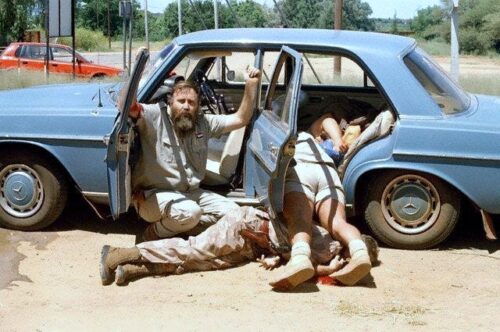
Elon Musk had the high-profile and sudden 1994 death of Nazi “Afrikaner Weerstandsbeweging” (AWB) terrorists in mind when he marketed his Swasticar as bullet-proof
Apartheid was a system opposed to anything but the same, arguing against change while the white nationalist infrastructure murdered anyone who dared to diverge. Its architecture — pass laws, Bantustans, labor controls — was built to deny any need for change that was already visible and documented. The demographic and political trajectory of southern Africa was known. The system refused to see or change anyway. It finally crashed in 1994.
The beneficiaries of that system were not confused about what it was doing. They were experiencing, in the language Tesla’s engineers later coined, mode confusion in reverse: trusting a system that had already disengaged from any viable future.
Dismantling the Steering Infrastructure for Curves
The U.S. Civil Rights Division was established in 1957 precisely to institutionalize accountability for straight-line power — to build enforcement mechanisms that would force institutions to negotiate with legal and demographic reality. Since the Trump takeover January 2025, 70% of its attorneys have departed. Roughly 250 lawyers — the voting rights section, the police accountability section, housing enforcement — are gone. The new leadership has redirected the division toward investigating noncitizen voters and “anti-Christian bias.” The Fair Housing Act no longer appears in its housing guidance. The Voting Rights Act barely appears in its voting guidance.
Across the federal government the anti-humanitarian DOGE operation, which Musk funded and ran, closed civil rights offices at USAID, the Social Security Administration, the Department of Education, and agencies throughout the executive branch. The latest estimates are at least 500,000 children have died as a result of DOGE. And then, in terms of this one Tesla tragedy in Texas, the agency that should pull Saint Amour’s telemetry and formally count this crash among ADAS failures — NHTSA — now operates under an administration run by the CEO of the company it regulates.
Waymo launched driverless commercial service in Houston last month using LiDAR-equipped vehicles. It stands in direct comparison to the Saint Amour lawsuit made in front of a Harris County jury. It should be about a system built to read the actual road ahead versus one built by a man with a documented, multigenerational commitment to only looking backwards and rigidly refusing to adapt.
Elon Musk’s legacy already is tragedy.
Attorney Bob Hilliard’s statement lands exactly where Tesla’s own documents already sit:
This company wants drivers to believe and trust their life on a lie: that the vehicle can self-drive and that it can do so safely. It can’t, and it doesn’t.
Tesla’s engineers called out the failure. It has a name: mode confusion. They thought they were describing a car, but it’s a man in denial of history.
A single police officer in 1994 killed AWB (Nazis) who had been driving around shooting at Black people. It was headline news at the time, because AWB promised civil war to forcibly remove all Blacks from government and instead ended up dead on the side of a road.A Nazi AWB member in 2010 South Africa (left) and a “MAGA” South African-born member in 2025 America (right). Source: The Guardian. Photograph: AFP via Getty Images, Reuters
a blog about the poetry of information security, since 1995