Category Archives: Security

Epstein Connection to Khmer Loot Reveals Blood on MoMA Hands

Looting vulnerable populations and laundering their assets through institutional prestige has a long, documented history.

Look at how Prussia strip-mined the Ottoman territory and built their Pergamon museum around the loot. Look at how the Nazis then systematized that art theft across occupied Europe. The hunt for all the stolen works continues eight decades later.

Don’t look too hard in the estates around the Wannsee.

Powerful actors extract cultural wealth from people in crisis, then use institutional credibility to convert stolen goods into legitimate collections.

Enter Epstein.

Leon Black paid a convicted sex trafficker over $150 million for “financial advice” on looting. That trafficker’s files contain an inventory of Black’s $27.7 million collection of Southeast Asian antiquities, which happen to be objects extracted from Cambodian sites during conflicts that killed roughly two million people.

The supply chain for these objects runs through mass violence, displacement, and exploitation of vulnerable populations.

It brings to light Douglas Latchford’s network, which depended on local labor operating under coercion or desperation in conflict zones to loot these sites. Trafficking in looted cultural property produced by conditions indistinguishable from trafficking in persons. Latchford published one of Black’s pieces in a book, corresponded about selling bronzes to Black, and when an Australian museum canceled a purchase over insufficient provenance, redirected the same piece toward Black. He was indicted for fraud and conspiracy in trafficking Cambodian artifacts. His family returned the collection to Cambodia. The Metropolitan Museum returned 14 sculptures. The US government returned 30 objects.

Black still has his, somehow.

Epstein’s files contain the inventory of these looted acquisitions. I mean Epstein had operational visibility into Black’s holdings. The same Epstein whose own operation depended on exploiting vulnerable people. The financial plumbing connects both trafficking streams together. The wealth extracted through cultural looting in conflict zones, is managed by an operation funded through sexual exploitation.

Black’s spokesperson offers the standard laundering fallacy: looting was done “through a well-regarded and highly reputable art dealer.”

Yeah, we get it. Trump and Epstein were well-regarded. Latchford was reputable too right up until his indictment. An Australian museum canceling a purchase for insufficient provenance, followed by Latchford redirecting that piece to Black, shows conscious avoidance that normally triggers trafficking statutes.

The “reputation” defense works the same in every laundering operation from 1880s Berlin to 1940s Paris to 2013 New York. Buy through a middleman to claim distance from the act. Hire a hit man to say you didn’t do the hit.

Black “cooperated” with a DOJ inquiry five years ago. And then? Somehow he remains a MoMA trustee, a known Epstein associate who now shows up flaunting the files.

…art insiders were wide-eyed to see Black, as well as fellow Epstein pal Glenn Dubin, stride into a private party, apparently hosted by the [MoMA] institution itself…. Black…stepped down as chairman of the museum in 2021 after protest from artists and workers over his connections to Epstein. On Tuesday, a rep for Black told us, “Mr. Black was proud to be at the dinner….” Both Black and Dubin have galleries in MoMA named after them.

The Nazis looted art and trafficked underage girls, building their white man’s empire atop mass suffering. The Epstein network does the same. Black represents how an institutional playbook for elites converts mass atrocity into cultural capital even today.
Cybertruck Officially 17X Less Safe Than Ford Pinto

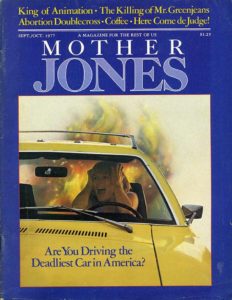
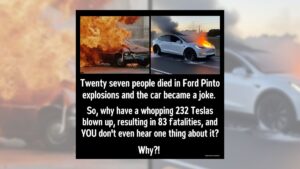
While Tesla was busy confessing to the California DMV that Autopilot was never real, FuelArc ran the numbers on the Cybertruck’s fire fatality rate against the Ford Pinto — the historic benchmark for corporate greed killing customers.

The Cybertruck is 17 times worse.

SEVENTEEN TIMES WORSE THAN A PINTO

Five fire fatalities in 34,438 vehicles gives the Cybertruck a fatality rate of 14.52 per 100,000 units.

The Ford Pinto, across a decade of production and 3.17 million vehicles, managed 0.85.

The Pinto became a national scandal.

The Cybertruck army of Elon Musk adherents sent a death threat to the journalist who did math.

The NHTSA still hasn’t crash-tested the Cybertruck. Tesla still hasn’t released official delivery numbers. And the company that just admitted its entire “driverless” branding was a lie is simultaneously selling an untested vehicle that burns its occupants at a rate that would have gotten any other manufacturer shut-down and hauled before Congress.

The Pinto at least had the excuse of being a Ford, and cheap.

The Cybertruck, marketed as a “survivalist” design, costs six figures for a barely operational bucket of half-baked bolts that kills faster than the Pinto.

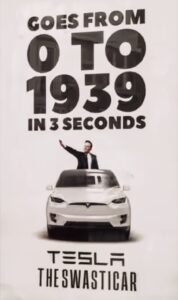
Tesla Confesses to DMV That Autopilot is a Lie, in Order to Keep Selling Deadly Swasticars

Tesla accepted every correction, then sued to erase the record that forced them.

Tesla officially admitted it never had Autopilot. Not on Twitter. Not in SEC filings. In the most boring and quiet way possible: compliance with a California DMV order to stop lying to the public.

On February 17, 2026, the California DMV announced that Tesla had removed “Autopilot” from its marketing and discontinued it as a standalone product in the US and Canada.

This followed a December 2025 ruling by an administrative law judge (ALJ) who found that Tesla’s use of the term was misleading and violated state law. The ALJ called Full Self-Driving a name that is “actually, unambiguously false.”

And water is wet.

The DMV’s own language is unsparing when you see how they officially describe vehicles equipped with those ADAS features:

…could not at the time of those advertisements, and cannot now, operate as autonomous vehicles.

Elon Musk lied. He never, ever corrected the lies, even as hundreds were killed.

Tesla had every opportunity to fight.

They could have contested the findings, challenged the ALJ’s authority, appealed through administrative channels. Instead they quietly complied within the 60-day window, stripped the branding, and restructured their entire ADAS product line around the order. All on the same date.

Their compliance is a HUGE confession.

The Lawsuit That Explains Everything

Four days before the DMV announced Tesla’s compliance, Tesla filed suit in Los Angeles Superior Court to erase the ruling entirely. The company alleges the DMV “wrongfully and baselessly” labeled it a false advertiser.

Tesla’s legal argument is that no California customer was ever actually confused about whether their car could drive itself. This is a company that accepted the marketing was indefensible, made every change the state demanded, then sued to eliminate the official record that forced those changes.

They don’t want the word “Autopilot” anymore, because the ruse is up. They want the finding gone. They want their victims to be at fault.

The reason is straightforward.

Tesla has told investors it has 1.1 million “FSD subscribers” and its entire valuation thesis depends on becoming a robotaxi company. A formal, on-the-record finding of false advertising about self-driving capabilities is a powerful staff of justice handed to every plaintiff’s attorney in the country. The lawsuit is all about liability containment.

The Damage Already Done

The liability is real. A federal judge just upheld a $243 million verdict against Tesla in a fatal Autopilot crash — the first major plaintiff victory in an Autopilot wrongful death case. Tesla had rejected a $60 million settlement before trial.

Since that August 2025 verdict, the company has quietly settled at least four additional crash lawsuits rather than let more juries hear the evidence.

In January 2026, Tesla was sued over a Model X crash that killed an entire family of four when the vehicle allegedly veered into oncoming traffic. A separate class-action involves customers who bought Full Self-Driving expecting their cars to become robotaxis and now want refunds. NHTSA launched a probe in October 2025 into 2.88 million Tesla vehicles after connecting 58 incidents to FSD, including vehicles running red lights and driving into oncoming lanes.

Dozens more cases are working through the courts, because Tesla is a death trap based on lies.

The Defense That Convicts

Tesla’s arguments in the lawsuit deserve attention for what they reveal.

First:

It is impossible to buy a Tesla equipped with either Autopilot or Full Self-Driving Capability without seeing clear and repeated statements that they do not make the vehicle autonomous.

This is an admission that the product names were always misleading enough to require disclaimers, which existed precisely because the branding said something the technology couldn’t deliver.

I’ve written before how this directly contributed to mass death. No marketing would have been far better than the fraud of claiming a capability, and then warning against it. It’s like walking into a room and saying “I’m not going to accuse this person of murder” and then pretending you never said anything people should think.

Second: the DMV had known about the “Autopilot” branding since 2014 and “Full Self-Driving” since 2016, and therefore shouldn’t be able to act now. This is the argument that you’ve been getting away with a crime for so long that your crimes should be legalized. Tesla tried this same defense in 2023. It didn’t work then either.

The ALJ addressed the consumer confusion argument directly in her ruling. The DMV’s authority to regulate vehicle advertising:

…does not depend on evidence that any particular advertising actually has deceived or harmed any person.

The state can act to prevent deceptive advertising. It doesn’t need to wait for a body count, though Tesla has provided one anyway.

Supervised Self-Driving

Tesla’s retreat position is “Full Self-Driving (Supervised)” as an obnoxious oxymoron that exists because they needed language that preserved the FSD brand while denying FSD has any brand value. It’s like selling a life preserver (concrete shoes) and then shrugging at all the drowned victims. Supervised self-driving is driving with a huge marketing budget and propaganda office working round the clock. The parenthetical does the liability shift while the product name does the toxic selling.

Meanwhile, Tesla is building the fraud of a Cybercab (1950s science fiction of no steering wheel and no pedals) on the premise that full autonomy is imminent. The company that just admitted it can’t call its current system “Autopilot” because that overstates its capabilities is simultaneously manufacturing a car that pretends to have no manual controls at all.

This is a contradiction Tesla is betting everyone and especially investors won’t care about.

What Compliance Means

Tesla complied with the DMV order, removed the branding, restructured its product line, and then sued to pretend none of it happened. The sequence tells you everything. The marketing was false. The technology was oversold. People died in cars they were told could drive themselves. The state called it what it was. Tesla accepted the correction and is now trying to shred the receipt.

The ALJ noted in her decision that without the threat of suspension, Tesla offered:

…no reason for the DMV to expect that respondent will alter the Autopilot name, or will act to avoid continuing its misrepresentations to the public.

She is right.

Tesla didn’t stop because it agreed. It stopped because California is its largest EV market and a 30-day sales ban was unacceptable. Compliance was a business decision. The lawsuit is the tell that it was never a moral one.

Autopilot is gone because a judge ruled it was always a lie and Tesla chose market access over defending the claim.

That’s the core admission. Tesla is and has always been fraud. Elon Musk is worthless.

Everything else is lawyering.

Trump Supreme Court Rules He Can Destroy Election Ballots He Dislikes

The Committees of Correspondence existed because the British Crown controlled colonial mail and used it for surveillance. The first thing revolutionaries built was a secure postal network outside royal control. Benjamin Franklin, fired as colonial postmaster for sympathizing with rebels, became the Continental Congress’s first Postmaster General in 1775. The Constitution puts postal authority in Article I, Section 8, alongside coining money and raising armies. The Post Office Act of 1792 criminalized mail tampering and subsidized newspaper delivery so political information reached every citizen. Mail sanctity was the precondition of the republic.

Kings intercept mail.

Kings destroy mail.

That’s what made them kings.

The entire American founding was organized around the principle that a government which controls who receives information and whose voice reaches the public square is a tyranny.

Trump thinks he will be king.

On Tuesday, the Supreme Court sided with his tin-pot crown.

The Ruling

The infamously corrupt Justice Clarence Thomas, writing for a 5-4 majority in USPS v. Konan, held that Americans cannot sue the Postal Service when its employees deliberately steal or destroy their mail.

That’s right, under Trump Americans now have no recourse when their post office targets them and destroys or tampers with their mail.

The case began when Lebene Konan, a landlord in Euless, Texas, alleged that local carriers intentionally refused to deliver mail to her tenants for two years simply because a Black woman leased rooms to white people. She sued under the Federal Tort Claims Act, which waives government immunity for certain lawsuits but bars claims “arising out of the loss, miscarriage, or negligent transmission of letters or postal matter.” The 5th Circuit ruled the obvious: that provision covers accidents. Congress wrote it to shield routine delays from litigation, and ONLY routine delays.

Thomas then performed the kind of linguistic integrity breach that would get a first-year law student failed. He tortured language until it served an authoritarian end.

He swapped in a synonym that changes the meaning, then pretended the synonym was there all along. “Loss” became “deprivation.” And since you can be deprived of something when someone steals it, stolen mail has merely been “lost.”

By this logic, a mugging is merely the involuntary transfer of assets. Slavery is simply waking up one day in chains.

Newspaper Archaeology

The “miscarriage” analysis was bolder. Thomas needed to show that ordinary English speakers use the word to describe intentional withholding of mail. The government’s lawyers found zero examples. So Thomas did his own research and produced two citations: an 1893 article from the Carbondale Leader and a 1911 piece from the Kansas City Star. Two newspaper clippings, twenty years apart, at least thirty years before the FTCA was enacted.

As Sotomayor noted in dissent, if this usage were common, better evidence would exist than century-old small-town journalism the justice dug up himself. The opinion reflects a decision made before the reasoning was assembled.

The Quiet Part

Every Republican-appointed justice signed on except Neil Gorsuch, who joined Sotomayor’s dissent. The ruling arrives eight months before midterm elections in which millions of Americans will vote by mail. USPS processed nearly 100 million mail ballots in 2024. Several states conduct elections entirely by mail.

The FTCA created a deterrent: if a postal worker destroyed your ballot, you could sue. The lawsuit was the mechanism of accountability — it uncovered misconduct, generated public records, and created professional consequences. That deterrent is gone. A court will dismiss the case before any investigation begins.

Trump has installed his own man atop the Postal Service. He controls the Justice Department. The federal agencies that would normally investigate ballot destruction answer to a president who has openly telegraphed his intent to undermine the next election. The Supreme Court just removed the one remaining civil remedy available to individual voters whose ballots are deliberately destroyed.

Thomas Against Thomas

Thomas has previously written about the “risk of fraud” posed by mail voting, specifically citing the danger of “stealing absentee ballots.” He identified the correct threat vector. Then in Konan, he eliminated one of the few legal tools designed to deter exactly that threat.

This is a pattern. The same court that treats hypothetical fraud as grounds for restricting voting rights treats actual fraud — committed by government employees against voters — as immunized activity. The risk is only legible when it justifies making voting harder. When it justifies accountability, it disappears.

Margaret Schaack laid this out in the University of Chicago Law Review last year: a ruling for the government in Konan would deny “direct recourse to potential litigants whose ballots are stolen,” embolden postal workers to interfere with elections, and disincentivize USPS from preventing intentional misconduct.

The court ruled for the government anyway.

The founders built a republic on the principle that mail belongs to the people, and a government that tampers with it is a tyranny.

Mail theft is a federal crime.

The Supreme Court just ruled that when the government commits it, the people have no recourse.

The Crown wins, apparently. The midterms are in November.