Axel Springer disgraces itself and betrays its founding principles, for a dollar, by giving right-wing extremist Peter Thiel its top award on September 24 in Berlin.
I no longer believe that freedom and democracy are compatible.
Got that? Thiel doesn’t believe in democracy. He wrote that extending the vote to women wrecked what he calls capitalist democracy, and his answer is to create spaces where votes carry no weight. The premise comes straight from the Doctrine of Fascism, 1932, when Italy’s infamous bully claimed the majority has no right to direct society. Maybe the Axel Springer pivot means they should be giving Mussolini an award first?
FEC filings show fifteen million dollars went into the PAC that made JD Vance a senator, wealth curating government. He admitted funding the covert lawsuit that bankrupted Gawker. This spring he seeded Objection, a two-thousand-dollar AI tribunal for putting journalists on trial, built by the same lawyer who ran the Gawker operation.
Indeed, Manager Magazin reported in February 2025 that Thiel put 50 million dollars into Doepfner Capital Fund I, a fund documented in SEC filings with a target of 75 million. The fund belongs to Moritz Döpfner. Moritz is the son of Mathias Döpfner, the Springer CEO who chose this year’s laureate. Moritz was Thiel’s chief of staff.
The CEO’s company is giving an award to the man financing the CEO’s son, yet the press release discloses none of that relationship. Thiel bankrolled the family that hands out the honor, a fitting joke: the man most opposed to democracy collecting a prize his money corrupted into an appointment.
Bari Weiss delivers the disgusting, suicidal tribute. Paramount’s Ellison family bought her Free Press for 150 million dollars in October and installed her atop CBS News. Since then she has pulled a 60 Minutes investigation of the CECOT deportation prison off the air, removed producers Tanya Simon and Draggan Mihailovich and correspondents Cecilia Vega and Sharyn Alfonsi, and fired Scott Pelley one day after he told a staff meeting she was murdering the program and drew a standing ovation. CBS Evening News sits at historic ratings lows, perhaps teetering on disappearing entirely. Her “Free Press” took early money from David Sacks, Thiel’s PayPal partner and co-author of The Diversity Myth, and a week after the 2024 election she handed Thiel her microphone to celebrate together. The woman gutting one storied newsroom will laud the man who bankrupted another.
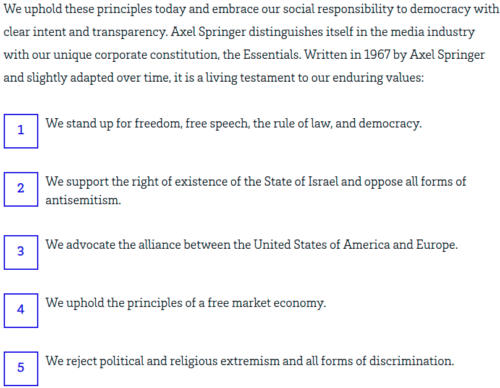
Perhaps it’s worth noting here that there was a wind-up to the Thiel capture. Springer’s “Essentials” had bound every employee to democracy and a united Europe. Those words were just thrown out with the bath water. In June 2025 the company quietly deleted the united Europe and trimmed “soziale” from the social market economy. Thirteen months later Thiel is showing up to be honored by the Berlin stage that just deleted the Jewish people from its principles.
Someone heavily edited this list in 2025, and the Jewish people came out of the text. In Berlin. That’s a very, very particular edit. Principle one lost “a united Europe” and gained “free speech.” Principle two erased the Jewish people and kept a state, turning “antisemitism” into state support with no Jews in the sentence: a shield for territory where the protection of people used to be. Principle four lost “and its social responsibility.” Principle five removed “racism and sexism”, the two charges that follow Peter Thiel from his own suffrage passage and his praise of apartheid economics, and inserted generalized “discrimination.”
Apparently “what defines us” at Axel Springer are no longer the obligations German history imposed. Springer wiped its own history away, replaced with generalities any multinational could sign and mean nothing.
The DJV chairman called the award incompatible with Springer’s values. He was citing the way things were before Thiel opened his bags of dirty cash. The Springer Essentials have been made compliant with Thiel. He paid in advance.
Thirty of the list’s 50 victims were children, hardly any with listed identities. The inscription explains that “before 1850, it was common for Cherokee children to be unnamed…”
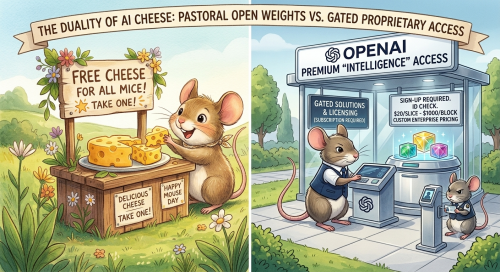
Daniel Miessler published a FUD-addled post on July 18 arguing that Chinese AI open weight models are “cheese in a CCP mousetrap“: subsidized giveaways engineered to break the American AI labs and the market priced on their dominance, after which Taiwan votes itself into the People’s Republic.
Chinese open-source models are a cheese in a CCP mousetrap.
Kimi K3 just brought us very close to a world in which the US AI labs are no longer ahead. Both the benchmarks—LMArena and Artificial Analysis—and actual experiences with it are extremely positive. I don’t think it’s quite as good as people are saying, but it is at least on par with Opus 4.8 in many areas. That by itself was impossible six months ago. The key part of this strategy is to give the secrets away to the world such that the power of open source will be added to the pressure on the U.S. labs, and therefore the U.S. economy.
Quoted from the version Miessler published July 18. He has since revised the post without any correction notice, removing the CCP attribution from the mousetrap line, the benchmark claims, and an entire footnote on Hong Kong. The passage above is preserved from the original.
Uber burned venture billions selling rides below cost to break the taxi trade, and Amazon spent years pricing below cost to break retail. Miessler rides in his Uber ordering off Amazon and calls it his American playbook for convenience. Predatory subsidy is the domestic playbook he lives inside, which is why he tries to project it onto a foreigner, even when they are charging full margin and contradict his projection.
Let’s just be honest. This is the 1980s all over again and the origins of the FSF. His deeper objection sits in the picture below: the world could end up on the left instead of the right, and how is anyone getting rich on predatory American practices supposed to maintain their hedge against someone giving cheese away? Sell a quality product? With no trap? He believes in the trap, so he sees one, even where none exists.
A mousetrap runs on two stages. The victim sees an easy gain, which the hunter snaps into an expensive loss. Open weights defeat the latter half of that mechanism, because they can’t be easily lost. A weight file, once published, lives on everywhere it is stored. Hosting firms in Ohio and Helsinki serve it, forks multiply past any count. Beijing has no way to snap, so there’s no victim to be had. The threat that China will one day stop releasing cheap models loses its entire force, since the only part left to remove is the cheese. Everything already released stays released.
That’s such a fundamental failure in the cheese post analysis, I wonder how Miessler published it.
But wait, no pun intended, the K3 itself weakens his argument even further. Moonshot launched it July 16 as a hosted product and committed in writing to full weights by July 27. At 2.8 trillion parameters, self hosting means cluster hardware rather than laptops, and portability is the point: the day these weights land, any inference firm with the infrastructure could become the business that serves them, including American ones. Any actual dependency story requires a single supplier. Yet the model of a published weight means every supplier is by design interchangeable.
On top of that, now look at the pricing mistake made by Mr. Cheese. His whole subsidy claim doesn’t make any sense, because Moonshot priced K3 at three dollars per million input tokens and fifteen per million output. That’s not out of line with the western frontier. Same price is attractive how? Must not be the price. A predatory subsidy prices below cost until the competition dies; parity pricing announces…a margin. The funding is in fact a venture, where the silicon is the usual constraint: Alibaba put a billion dollars into Moonshot in 2024 at a two and a half billion valuation, the company now sits near thirty one billion. The recent models were trained on Nvidia’s export-grade H800 chips. Corporate money pouring into American silicon that it had to argue it should be allowed to buy is the literal opposite example from a state dumping.
Even the American AI hawks expose the cheese post as nonsensical. Dean Ball, formerly the Trump White House’s senior AI policy advisor and now OpenAI’s head of strategic futures, attributes China’s open weight strategy to strategic blindness and a shortage of inference compute. He blames American export controls. The company with the most riding on this mousetrap story doesn’t seem to have its own strategist on board.
Now for my favorite kind of analysis. The cheese post makes an accusation that has been built to survive any evidence proving it wrong. The unfalsifiable argument is popular these days, as if everyone wants us to just accept they are the one with a teapot orbiting the sun. When DeepSeek undercut on price in 2025, the cheapness proved it was an attack on America. Now K3 arrives at parity pricing and the inversion is the attack, because quality is a threat. Price low and you get accused of dumping; so you charge parity and get called a threat because of your quality. The person who floats a thesis confirmed by every possible move predicts nothing and explains less.
The real story of open weights is actually quite boring, which is why it’s so successful. In August 2025 the State Council issued Document No. 11, the AI Plus directive, which sets adoption targets across industry and science and calls for a flourishing open source ecosystem. Industrial policy is the mother of innovation. You don’t land on the moon without someone saying moonshot is the goal. A stated goal is policy, the sort of thing every executive ever relied upon for success. Provincial governments in Beijing, Guangdong and Hangzhou fund open model development, and Chinese open models grew from 32 in 2022 to 337 in 2025 by Epoch AI’s count. Industrial policy that was printed in the official gazette means healthy diffusion at home, and commoditization of the layer its rivals monetize abroad. This is a market-based strategy and public, which makes it a very long way from a plot to detonate the Nasdaq. Competition is supposed to bring competition, not whining about cheese.
Taiwan, we are being told to believe, will “instantly vote to rejoin China” the moment American markets aren’t floating anymore. This is such a weird coin-operated view of the world, perhaps it explains why the mousetrap post is so empty-headed. Decades of polling on Taiwanese identity say otherwise, perhaps for obvious reasons? The claim of instant rejoin has zero evidence. Seems like it should have something, anything, to start the conversation.
Friday’s selloff was real, so it deserves attention. The sell side attributed the rout to weak earnings, the Iran war, crowded positioning in recently surged tech stocks, and record levels of leveraged ETF, margin, and retail option activity now unwinding. I mean, Trump started a war he can’t win, emptied national security credibility, and is talking about a level of fiscal isolationism and decline that puts the Brexit disaster to shame. An index wired unfortunately to the pricing power of a handful of firms, all desperately assuming their premium margins can’t fall, wobbled on a press release. That is some basic exposure of American integrity issues, which required no conspiracy. If you want conspiracy, look at the lingering cartel mindset of an American frontier. Miessler sees symptoms of domestic failure and desperately wants to blame it on the foreigners.
The weights ship July 27.
They can be copied and never recalled.
That sounds a lot like free cheese forever (FCF), which makes it an update to the FSF.
The world runs on Unix. Not Windows. The world wants open weights. Not OpenAI.
Don’t fall into the trap American AI model investors are building, given the logical options to reduce risk of capture.
On the evening of April 12, sixteen years of an authoritarian Hungarian regime of constitutional capture ended in a call lasting just minutes. Viktor Orbán picked up a telephone and called Péter Magyar to concede, an abrupt end for the dictator. The interesting question is whether this call can be replicated in other states.
The political science answer to “how often do authoritarian regimes willingly and peacefully give up power” is a number close to zero. The Geddes-Wright-Frantz data on autocracies since 1946 points us towards an end coming only from a coup, insider removal, revolt, or death. Moreover, roughly two thirds of the collapses produce a replacement autocracy. Svolik reported that the true end for a dictator is a removal by his own inner circle, rather than external pressure. The concept of a peaceful handover, from a person diametrically opposed to it, means a negotiation price so high there’s little to no evidence anyone wants to pay. Unlike the rapid and easy collapse of Trump casino (and every other brand attempts he made), his capture of the state means the moral and financial bankruptcy instead can be perpetuated by his monopolization of force.
That’s because regimes concentrating power are almost defined by “never surrender” propaganda, making healthy compromise and empathy impossible, such that the smallest indicators of centralizing power are met with excessive disinformation and violence. Even when the extremist leader is removed, a theocratic or monarchist regime may maintain their lack of surrender mantra by reformulating the names at the top of their chart. Here are some of the preconditions, and therefore vulnerabilities, related to how an authoritarian reaches their inevitable end.
1. Severability
The authoritarian leader must be separable from the regime for it to transition to a non-authoritarian state. With a nod to my alma mater, and the long history loop of Paul Preston, Spain’s crown recently shed Francoism, a fork of fascism long surviving after the suicide of Hitler, and kept the state. The Korean military traded Chun Doo-hwan for his coup partner Roh Tae-woo and won the succeeding election anyway. Brazil’s army retreated to tutelage over a civilian government its own electoral college selected. Frelimo outlived Chissano’s 2004 departure and governs Mozambique today. The FSLN survived its 1990 defeat, kept Humberto Ortega commanding the army until 1995, and reabsorbed the Nicaraguan state in 2007. Congress carried Indira Gandhi back to office 34 months after her 1977 defeat. Hungary’s Fidesz enters opposition with Constitutional Court, Media Council, prosecutorial and university-foundation mandates seated into the 2030s. Personalist rulers appear nowhere on this list because the ruler and the regime are the same object, and you must detach the asset to take custody and control over it.
2. Epistemology
Repression of populations destroys the regime’s own instruments to maintain a tally of support. Kuran tells us it is preference falsification, while Wintrobe called it the dictator’s dilemma: the coerced lie to power, so power loses the ability to count. Pinochet wrote the 1988 plebiscite expecting to win it. Indira Gandhi called the 1977 election on intelligence estimates her own censorship had falsified, and lost her own seat in Rae Bareli. Sandinista internal polling missed war exhaustion and inflation that was running past 30,000 percent. Fidesz walked into April 12 buoyed by a media market it owned, unable to read it. An election is permitted when corruption is so high that it is intended to be proof of power and control over the population. However, it the proof is inherently miscalibrated and so the very thing meant to be proven can be inverted, as was shown in Hungary.
3. Subsidization
Regimes hold power through external subsidies, manifested in overt “allegiance” as gifts. The 1985 to 1992 cluster is Cold War liquidation: Brazil’s debt crisis, Chile’s 1982 crash feeding the protest cycle, Moscow’s cutoff and hyperinflation in Managua, Pretoria’s transition stranding its clients, the Seoul Olympics making a June 1987 massacre too high a burden to maintain in the year before the opening ceremony. Hungary is a prime example because the frozen EU funds and the worst inflation in the bloc repriced Orbán for his own elites. America became the substitute patron and rushed JD Vance to Budapest days before the vote, which only rapidly removed votes instead of helping, because Trump has made his regime one of the most unpopular in the world.
Franco died in office; his own Cortes then voted the Movimiento out of existence, 425 to 59
Crown, courts, police, civil service
December 1976 referendum: 94 percent for reform on 77 percent turnout; the bunker had promised resistance
1977 amnesty, pacto del olvido, zero prosecutions to date
Chile
1988-1990
Pinochet, in installments: plebiscite 1988, army command until 1998
Army, 1980 constitution, binomial electoral system
Lost his own plebiscite 55 to 43; air force general Matthei conceded to reporters before the government did
1978 amnesty decree, senator for life, constitution in force in 2026, amended
Brazil
1985
Nobody. Geisel scheduled the retreat in 1974; Figueiredo executed the timetable and left by the back door
Armed forces as tutelary power
Diretas Já blocked in 1984; regime dissidents then defected inside the electoral college
1979 self-amnesty, upheld by the STF in 2010; military prerogatives written into the 1988 constitution
South Korea
1987-1988
Chun Doo-hwan, to his coup partner
Ruling party, merged with the opposition’s own in 1990
June 1987 uprising after Park Jong-chol’s torture death; Roh then won on a split opposition with 36.6 percent
Succession secured first; impunity revoked later, then restored: death sentence 1996, pardon 1997
Mozambique
1992-2004
Nobody. Chissano declined another term and walked out whole
Frelimo, in power without interruption since 1975
1999: 52.3 percent against Dhlakama’s 47.7, disputed; a warning read correctly
Rome amnesty 1992; party-state intact; the exit won the inaugural Mo Ibrahim Prize
Nicaragua
1990
Ortega, temporarily
FSLN plus the army; Humberto Ortega commanded it until 1995
February 1990: Chamorro 55 to 41; internal polling missed exhaustion and hyperinflation
The piñata, “governing from below,” full restoration by 2007
India
1977
Indira Gandhi, for 34 months
Congress
Election called on intelligence her own Emergency censorship had falsified; lost Rae Bareli itself
Shah Commission findings buried on her 1980 return
Hungary
2026
Orbán, conceding by telephone on April 12
Fidesz as largest opposition; court, media, prosecutorial and foundation mandates running into the 2030s
Tisza took 141 of 199 seats on 53.2 percent; the margin exceeded the machine’s capacity
Under negotiation now; the Tisza supermajority can lawfully unwind the entrenchment
Somalia
1991
Unsellable. Siad Barre was the regime; the Marehan-Ogaden-Dhulbahante alliance had no existence without him
None. The army dissolved along clan lines and the state followed
None permitted. Sole candidate, 99.9 percent, 1986
Impunity by default; a single civil judgment, Fairfax, Virginia, 2012, 21 million dollars
Italy
1943
Mussolini, sold by his own Grand Council, 19 votes to 8
Attempted: crown, army, bureaucracy. The buyers demanded unconditional surrender
Sicily invaded, Rome bombed; the audit was military and unambiguous
Unavailable in 1943; paid retroactively by the Republic: Togliatti amnesty, June 1946
Somalia’s Leader Had Nothing to Sell
Siad Barre, whom Paul Manafort’s firm pitched in 1989, the same firm Donald Trump had hired in the 1980s, is a curious case. Manafort sent staff to Mogadishu chasing a million-dollar contract to polish the dictator’s image, telling them the assignment was to make sure Barre stayed “our bad guy,” and they returned without a deal. The subsidy was withdrawn when Moscow aligned with neighboring Ethiopia during the Ogaden war, and Washington stepped in to become his new best friend. Then in 1989 aid was frozen after his air force leveled Hargeisa and killed tens of thousands of Isaaq civilians. His regime was based on a narrow alliance of three clans, and the national army dissolved along clan lines the moment the excluded clans rose against him. When the United Somali Congress took Mogadishu in January 1991 he fled south, tried twice to fight his way back, and died in Lagos in 1995. He left nothing to make a transaction with, having lost his subsidy, and had no successor institution. The end slid into twenty-one years without any central government. The only judgment any official of his regime ever faced came from a civil courtroom in Fairfax, Virginia, where his former defense minister Mohamed Ali Samantar, living quietly in the suburbs, was held liable for 21 million dollars in 2012. His collapse, arriving two years after even Washington’s torturers’ lobby had left Mogadishu without a deal, is what a regime does when it is an extraction scheme leaving no trace of value to put up for sale.
Italy’s Leader Found No Buyer
Mussolini is another example worth considering for the reverse reason. It documents a transaction by the regime itself, in wartime, where nobody was willing to pay for what it was selling. On the night of July 24, 1943, the Grand Council of Fascism debated for ten hours and passed Dino Grandi’s motion, 19 votes to 8, asking the King to resume command of the armed forces under the Statuto. The fascist state was up for sale, disconnected from its creator and leader. The King completed the mechanics within a day: dismissal at Villa Savoia, arrest by carabinieri, Badoglio installed. It still failed to clear, however, because the Allies entered demanding an unconditional surrender. The Wehrmacht intervened to put Mussolini back into power as the Salò puppet state under German occupation, which held until the German collapse in April 1945, and at Verona in January 1944 the rump regime shot the sellers it could catch, with Ciano among them.
Even a failed sale can continue, is the lesson here, if the value isn’t as destroyed as with Somalia. The purge commissions wound down, the prefects and police carried over into the following Republic nearly intact, Salò veterans founded the MSI in December 1946, and an amnesty hiding fascist crimes was signed in June 1946 by Palmiro Togliatti, communist minister of justice. The Republic delivered an impunity measure the Kingdom had been unable to secure at any price.
The Monarchy Card
Fascism is rooted in Italy, which makes it all the more interesting to study why for 21 years there had been a lawful mechanism for removing Mussolini, unused by the royal family. The Statuto Albertino was an enforcement lever that the King had retained, giving him the power to dismiss his head of government at will. He used that power just twice. In October 1922 he withheld his signature from the martial law decree his own prime minister had drafted, which is how he installed Mussolini. In July 1943 he applied it in reverse, which removed Mussolini. In between, when the Aventine deputies brought him the evidence of the Matteotti murder in 1924, he told them his eyes and ears were the Chamber and the Senate, and did exactly nothing to prevent the excessive violence against his own people. Both uses of the signature protected the crown, and only the crown. The powerful easy button sat unpressed for two decades because every incumbent around it, palace, army, industry, church, extracted more value from the arrangement than from the kind of representative democracy that would bring balance, law and order. The public outrage and debt accumulated from leaving Mussolini in power continued to grow, and grow, until on June 2, 1946, Italians voted the monarchy out, 54 to 46. Why would anyone want such a King?
What to Watch
History guides us, while Hungary runs as a live experiment. Watch the Fidesz assets that survive the supermajority, because each one is something the old regime established opposite the new government. Judges on the Constitutional Court carry twelve-year mandates and will rule on every law the new parliament passes. Nine-year terms shield the Media Council, which licenses broadcasters, meaning the referees of the next election cycle were appointed by the loser of this one. A budget veto sits with the fiscal council, and a vetoed budget opens a lawful path to dissolving parliament, an ejection seat wired into ordinary governance. Formerly public universities now live inside private foundations, their assets converted from state property in the final years of Fidesz rule, their boards appointed in perpetuity. The prosecutor general sits until 2028 and decides which corruption files get opened, so every case made against the old government will find itself in front of its ongoing appointee.
Tisza holds 141 of 199 seats, above the two-thirds line, so every one of these arrangements can be unwound by representative and lawful amendment. The question is speed, identifying threats to democracy early and balancing the councils by statute. The entrenchment has to be removed by intentionally avoiding the corrupted and unrepresentative methods that built it.
Regimes convert. It’s possible. Americans should read their own history as much as studying the foreign examples. The founding compact preserved and extended slavery, counted the enslaved as three fifths of a person to inflate the political power of slaveholders, and installed slaveholders in the presidency for most of the republic’s first seventy years, lionizing inhumane and anti-democratic authoritarians like Washington, Jackson and Polk.
America making a “willing” transition away from these tyrannical types cost a Civil War and roughly 750,000 dead by current estimates, and even victory had unfortunate compromise: the settlement of 1877 withdrew federal troops, restored the planter class to power, converted slavery into sharecropping and convict leasing, and wrote the victims’ claims off for another century. The United States stands as one of the longest running case studies. Trump campaigning on the nativist 1880s “America First” hate and tariffs platform, the slogan Wilson aimed at Catholic, Black and Hispanic Americans in 1915, the Klan adopted for lynchings in the 1920s, and Lindbergh’s committee carried into 1941 antisemitic alignment with Hitler, proves the point.
Map of domestic terror campaigns, 1909 to 1918. The period Trump’s MAGA calls their “golden’ era”
The transition means the authoritarian state holdings convert into a different asset class (often disappearing), any amnesty is billed as goodwill to cash later, and victims’ claims are typically written off as the acceptable cost. “Willing” transition needs to be put in the coin-operated context of the authoritarian who exists to violently extract value from the public. So the calculation is about what the price is to leave forever, and who will countersign a receipt, let alone enforce a real change.
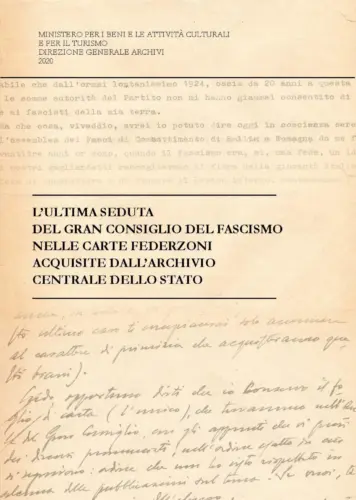
Luigi Federzoni’s pencil notes and the typescript record of the Gran Consiglio’s final session, 24 to 25 July 1943. Published in 2020 by Italian state archives. A twenty year dictatorship ended overnight.
a blog about the poetry of information security, since 1995