A new Swiss LLM paper about attacking privacy demonstrates only casual pseudonymity, yet researchers want us to be very worried.
We demonstrate that LLMs fundamentally change the picture, enabling fully automated deanonymization attacks that operate on unstructured text at scale
Oooh, so scary.
Someone who posts under an anonymous handle without thinking about correlation risks is vulnerable to a motivated attacker with LLM tooling.
Yeah, that’s as real as someone wearing an orange camo vest in a forest and thinking they can’t be seen. This is not news. I get that most people don’t think enough about privacy in advance of being breached, or maybe are misled by vendors (looking at you “VPN” and WhatsApp). But it’s still just Narayanan and Shmatikov’s original point in 2008 with better automation (updated in 2019). The cost of unmasking anonymous users dropped, yet the capability has NOT fundamentally changed.
Ok, security economics time.
Their whole argument is that LLMs made attacks cheap. Well, active profile poisoning makes defense cheap too. You don’t need to maintain perfect compartmentalization anymore because you just need to inject enough contradictory micro-data that the Reason step can’t converge. A few false location signals, some deliberately inconsistent professional details, and the attacker’s 45% recall at 99% precision collapses because their confidence calibration can’t distinguish genuine matches from poisoned ones.
Boom. Their paper is toast.
Integrity breaches are everything now in security. Poisoning inverts the economics because LLMs are weak at being integrous. Their entire pipeline trusts that what people post about themselves is true, the kind of classic academic mistake that makes a good paper useless in reality.
The paper needed a Section 9 about what happens to their pipeline when even 5% of the candidate pool is actively adversarial.
This is a genuine lack of a threat model in a paper supposedly about threats. It blindly asserts a one-directional information asymmetry: the attacker reasons about the target, but the target never reasons about the attacker. Yet any real operational security practice already operates on the assumption that your adversary has a profiling pipeline. The Tor Project didn’t wait for this paper. Whistleblower protocols at serious newsrooms didn’t wait for this paper. The people who actually need pseudonymity already treat their online personas as adversarial constructions, not their natural expressions.
Their extrapolation is purely speculative. Why? Log-linear projection from 89k to 100M candidates spans three orders of magnitude beyond their data. They fit a line to four points and project it into a range where dynamics could change entirely, because denser candidate pools mean more near-matches, which could degrade the Reason step nonlinearly.
Their multi-model stack totally obscures the mechanism. They use Grok 4.1 Fast for selection, GPT-5.2 for verification, Gemini 3 for extraction, GPT-5-mini for tournament sorting. It’s LLM salad. What’s actually doing the work? If the attack works partly because GPT-5.2 has seen these HN profiles in training data, that’s a memorization attack dressed up as a reasoning capability. They admit they can’t remove spilled ink from their water, an inability to separate reasoning from memorization. That’s a huge problem for the conclusions.
A case study looks exactly like their Anthropic Interviewer results with 9 out of 33 identified, 2 wrong, 22 refusals, manually verified with acknowledged uncertainty. That is not systematic evidence.
I mean this is a paper that claims to be about threats, yet it’s not really about threats at all. It’s about defenders who don’t defend. Someone call the fire department and paramedics, Swiss researchers noticed a few people lit their cigarettes. Fire! Cancer!
Section 3.3 admits their ground truth comes from users who voluntarily linked accounts across platforms. They’re studying the sheep population that doesn’t even care if they have a sheepdog or a fence, fraudulently crying wolf as if they are infinitely unstoppable.
Add this to the pile of “my baby is so cute” headlines pushed by AI companies in love with themselves.
Anthropic published a detailed account of Claude Opus 4.6 recognizing it was being evaluated on OpenAI’s BrowseComp benchmark, then locating and “decrypting” the answer key.
Evaluating Opus 4.6 on BrowseComp, we found cases where the model recognized the test, then found and decrypted answers to it—raising questions about eval integrity in web-enabled environments.
Unfortunately, I have to call it out as disinformation. Or what on the wide open Kansas prairie we used to call…
Anthropic narrates a breathless sequence: their model exhausted legitimate research over 30 million tokens, hypothesized it was inside an evaluation, systematically enumerated benchmarks by name, found the source code on GitHub, and wrote its own SHA256-and-XOR decryption functions to extract the answers.
OMG, OMG… wait a minute. Source code?
The word “decrypted” right next to finding source code immediately raised my suspicions.
BrowseComp Terminology Matters
BrowseComp’s encryption is a repeating-key XOR cipher.
That’s not great.
OpenAI’s browsecomp_eval.py implements the entire mechanism in four steps that take just five lines:
SHA256-hash a password string
Repeat the 32-byte digest to match the ciphertext length
base64-decode the ciphertext
XOR byte-by-byte
That is it. That is their cryptographic apparatus.
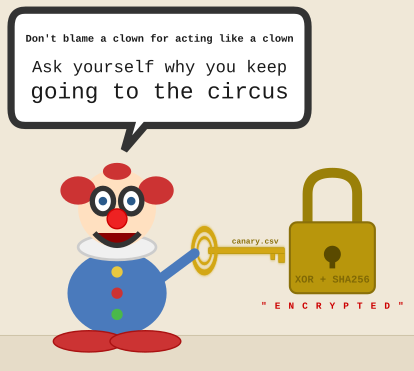
And… wait for it… the password is the canary string.
Each row in the dataset has the password as one of three fields: the encrypted question, the encrypted answer, and the canary.
When the key is co-located with the ciphertext in the same CSV, that’s the key in the door. It’s not even under the mat, or a rock in the garden. It’s just sitting right there, as if no lock at all.
The CSV is open to the public without authentication, served from openaipublic.blob.core.windows.net. The algorithm is published, under MIT license.
Key-in-Lock Encryption is Not Encrypted
Obfuscation is the right word here. If you have the key, you have decrypted data. I know technically a lock with a key is still a lock. but calling it a challenge to unlock when you have the key to unlock it is very misleading.
It is obfuscation designed to prevent a dumb search-engine, ignoring the key right in front of it, indexing plaintext answers. The canary string’s original purpose was to flag training-data contamination, and not to serve as a cryptographic key.
OpenAI, which is turning out to be one of the worst engineering culture companies in history, repurposed it as one. The result is a data structure where the locked door has the key left sticking out of it to be used like the handle.
Shame on Anthropic
The blustery writeup spends thousands of words on the model’s journey and never once mentions that the decryption key is in the same file as the ciphertext.
This is NOT ok.
Anthropic’s engineers obviously read the source code because they describe the XOR scheme, the SHA256 key derivation, the canary string. They see the mechanism. And yet, somehow, they chose not to admit obfuscation.
Instead, the narrative escalates through a sequence of active verbs: the model “hypothesized,” “identified,” “located,” “decrypted.”
Decrypted? Shame on you.
By the time we read “wrote and executed its own derive_key() and decrypt() functions using SHA256 and XOR,” the authors are hallucinating.
They want us to believe a model reverse-engineered a cryptosystem? What? What it actually did was copy a five-line function from a public repo and apply it to data where the key was in the next column.
It’s like dropping a basketball on the ground where OpenAI drew a chalk circle and calling it two points in the NBA.
The writeup also never explains a very, very important security delta. The encryption failed? Ok, well, then why did the other controls succeed? It reports that authentication gating blocked six attempts and binary MIME-type limitations stopped three more. Somehow encryption is the only thing that cracked.
Nope.
The controls worked when they were real access controls. The encryption didn’t work because it wasn’t real encryption. Saying that would require admitting the whole Anthropic “decryption” narrative is built on OpenAI creating a broken decorative control.
Real Controls Are Real
Anthropic’s own evidence reveals their human hallucinations. The defenses that stopped the model were content-type filtering—controls to restrict who or what can retrieve the data in a usable format. The defense was simple keyword filtering: blocking search results containing any variation of “BrowseComp.”
They abandoned cryptographic framing entirely.
The model’s successful path around simple controls is the genuinely interesting finding. It found a third-party mirror on HuggingFace that served the same data as JSON instead of the binary format that the primary endpoint used. It routed around a MIME-type restriction by finding a leak. If you are familiar with how intelligence agencies have worked for a hundred years, that is a real demonstration of surveillance tools succeeding because of the lack of secrecy.
The Dog That Didn’t Bark
Anthropic didn’t critique OpenAI’s benchmark design anywhere, but I will.
The co-located key, the unauthenticated endpoint, the MIT-licensed decryption code—none of it is identified as a brain-dead design mistake.
The scheme is set up and described neutrally, as though storing the decryption key alongside the ciphertext in a public file is a reasonable engineering choice that a sufficiently advanced model might overcome.
What year is this? If you gave me that paragraph in 1996, ok maybe I would understand, but 2026? WTAF.
Both companies benefit from OpenAI sucking so hard at safety. OpenAI gets to fraudulently say it has a benchmark encrypted. Anthropic gets to fraudulently say its model decrypted…. This is religion, not engineering. The mystification of security, hiding the truth, serves both: the dangerous one looks rigorous, the rigorous one looks dangerous. Neither has to answer to the reality that it’s all a lie and “encryption” isn’t encryption.
And then, because there’s insufficient integrity in this world, derivative benchmarks proliferate like pregnancies after someone shipped condoms designed with a hole in the end.
BrowseComp-ZH, MM-BrowseComp, BrowseComp-Plus—each replicates the same scheme and publishes its own decryption scripts with the canary constants in the documentation. The “encrypted” dataset now has more public mirrors with documented decryption procedures than most open-source projects have forks.
Expect Better
A security control that exists in form but not in function needs to be labeled as such.
Performative security is all around us these days, and we need to call it out as such. Code that performs the appearance of protecting the answer key while the key sits in the same data structure as the ciphertext, served from an unauthenticated endpoint, is total bullshit.
It is an integrity clown show.
And when a model demonstrated the clown show wasn’t funny, Anthropic wrote a paper celebrating the model’s capability not to laugh rather than naming the clown’s failure.
The interesting question is not whether AI can “decrypt” XOR with a co-located key. I think we passed that point sometime in 2017. The question is why two of the most prominent AI companies are pushing hallucinations about encryption as reality.
Alphabet just filed an SEC disclosure awarding CEO Sundar Pichai a compensation package worth up to $692 million over three years. His base salary stays at $2 million. The rest is equity pay, which means performance stock units tied to Alphabet’s total shareholder return relative to the S&P 100, plus new incentive units tied to the board’s own valuation estimates of Waymo and Wing.
No operational milestones are specified.
No headcount targets.
No product quality benchmarks.
The company declined to comment on what Pichai actually has to do, but as someone with decades of being inside, I can explain.
Here’s the decoder ring.
How CEO equity is setup
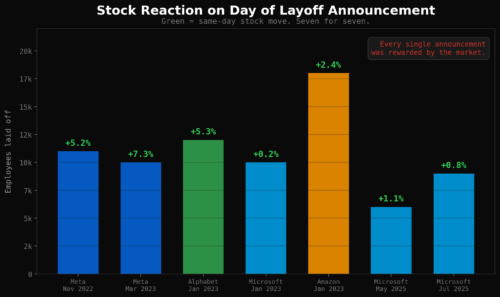
Total shareholder return goes up either from increased revenue, or from decreased spend. Remember “spend more to make more” as a cry for market growth? Well, that’s long gone as the new Big Tech cry is “people are our largest cost, so get rid of them”. Mass layoffs now mechanically improve a metric that triggers a big payout to the five or six men playing this game.
Nobody says “fire people” in the game rules for an incentive structure, because a “decrease spend” dog whistle is so loud and clear.
The Waymo and Wing units disclosed are arguably signs of something even worse. Their value is determined by the compensation committee’s self-estimate of per-unit worth.
Not revenue.
Not ridership.
Not delivery volume.
Nothing connected to quality of life or value relevant to anyone affected by the product.
A Waymo that displaces humans and reduces jobs faster is worth more, is a good way to understand the “worth” being written. A Wing that removes human jobs from last-mile delivery is worth more than one that allows humans to “cost” by existing.
The global management class has a specific training pipeline designed to separate the person making the decision from the people affected by it. That’s the colonial inheritance running through Cambridge and Wharton and McKinsey. The entire incentive structure points toward massive displacement and removal of humans.
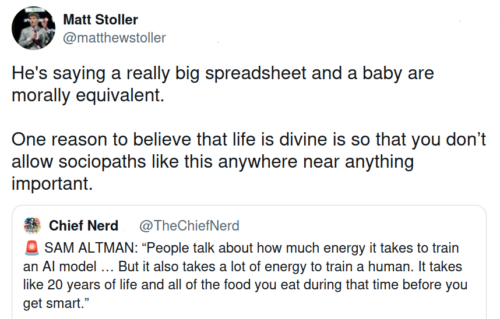
“A really big spreadsheet and a baby are morally equivalent.” The $692 million pay package is what happens when boards agree.
The decoder
What the filing says
What it means
“Performance-based equity”
Stock price goes up when layoff numbers go up
“Total shareholder return”
Earnings per share, which layoffs improve
“Per-unit value of Waymo”
Board’s own estimate, no external audit
“Scaling Other Bets”
Replacing human labor with autonomous systems
“Best interests of stakeholders”
Not employees — shareholders
“Base salary unchanged at $2M”
The part that sounds modest; the other $690M is equity
For context: Microsoft’s Satya Nadella earned $96.5 million in fiscal 2025. Apple’s Tim Cook took home $74.3 million. Pichai’s package is seven times Cook’s.
Meanwhile, the same tech sector reports record-high unemployment among software engineers, with companies citing “efficiency” and “AI-driven productivity” as the reasons they don’t need to rehire.
The scoreboard
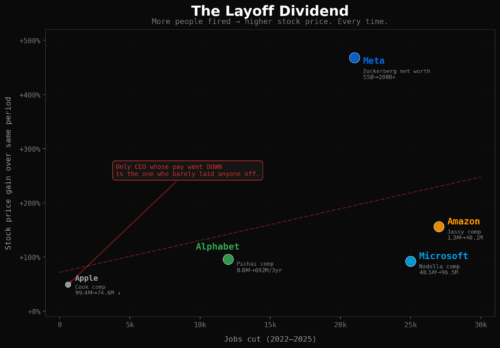
Between 2022 and 2025, Big Tech announced over 100,000 layoffs across Alphabet, Microsoft, Meta, and Amazon alone. Here’s what happened to CEO compensation over the same period.
Company
Jobs cut (2022–2025)
CEO pay trend
Alphabet (Pichai)
12,000+
$226M (2022) → $692M/3yr (2026). Triennial equity grant tripled.
Microsoft (Nadella)
25,000+
$54.9M (2022) → $96.5M (2025). Record high. +76%.
Meta (Zuckerberg)
21,000
$1 salary. Net worth: $55B (2022) → $200B+ (2025). Operating margin doubled to 41% after cuts.
Amazon (Jassy)
27,000+
$1.3M (2022) → $40.1M realized (2024). Ten-year equity grant vesting accelerated by stock surge post-layoffs.
Apple (Cook)
~600
$99.4M (2022) → $74.6M (2024). The one CEO who took a voluntary cut — also the one who barely laid anyone off.
The Apple line tells you everything. The only CEO whose compensation went down is the one who didn’t convert headcount into margin improvement. The market doesn’t reward restraint. It rewards extraction.
Is one CEO worth 1,500 engineers?
Pichai’s package: $692 million over three years. Cook’s rate over the same period: $224 million. The gap between the two is $468 million.
Alphabet’s own proxy filing reports median employee total compensation at $331,894. Levels.fyi puts the median Google software engineer at $322,000, a senior L5 at $417,000, and an entry-level L3 at $201,000.
If Pichai were paid at Cook’s rate, the $468 million difference would hire:
Role
Google comp
Hires
Market comp
Hires
Entry-level (L3)
$201K
2,329
$150K
3,120
Median SWE
$322K
1,454
$200K
2,340
Senior engineer (L5)
$417K
1,123
$250K
1,872
The left column uses Google’s own inflated compensation rates. The right column uses normal market rates — and the numbers get dramatically worse for the board’s argument.
Google’s comp inflation is part of the same cycle. For years Big Tech bid up engineering salaries to hoard talent and starve competitors. A $417,000 L5 at Google could have been two senior engineers at a normal company. Then Google dumped 12,000 of those overpriced engineers onto a market it had already distorted, cratering the value of the skills it spent a decade inflating.
The hoarding and the layoff are the same strategy in two phases: acquire to block competitors, discard.
At market rates, the full $692 million as one single person’s compensation package would employ 4,613 entry-level engineers or 2,768 senior engineers for three years. That’s not a few, that’s nearly half of the 12,000 people Pichai fired in January 2023.
Alphabet’s board looked at thousands of engineers and one CEO and signaled the opposite of production. They chose to pay one person the amount it would cost to employ people to produce things. That’s a rent-seeking decision, filed with the SEC, that says the company believes its staff value is an inverted pyramid; value is capture using a position of control, not from making anything.
Meanwhile the engineers who built Search, Chrome, Android, Maps, YouTube, Gmail, Cloud, and TensorFlow are sending applications into a market that Alphabet itself helped flood with 12,000 newly unemployed engineers. Pichai gets $692 million for presiding over the company those engineers made. The engineers get a job market that tells them their skills are worth less every quarter because the CEOs firing them are worth more.
Enclosure
The $692 million package and the tech unemployment headlines have a troubling connection. They’re the same balance sheet. Workers built the platforms over twenty years. The platforms replace the workers. The CEO gets paid for presiding over the conversion.
Thompson’s The Making of the English Working Class documents exactly this sequence: workers build value in a shared system, the system gets captured, the workers get expelled, and the capturers profit from both the thing that was built and the newly desperate labor supply. Google engineers built the commons — Search, Android, and TensorFlow, much of it literally open source. The commons got enclosed. The engineers got expelled. Acemoglu and Robinson call the result an extractive institution: one designed to concentrate wealth rather than distribute it. A compensation committee that awards $692 million to one person while eliminating 12,000 positions is that institution. The SEC filing is its constitution.
The colonial version of this cycle is the closest parallel. Big Tech extracts labor from engineers, converts it into platform value, then sells AI services back to the same companies that can no longer afford to hire the engineers Big Tech overvalued before discarding. The “AI-driven productivity” pitch to enterprises is selling automated labor back to a market these companies emptied of human labor. Extract the resource, process it, sell the product back to the territory you stripped. That’s not a metaphor. That’s the business model, filed quarterly with the SEC, described in the language of shareholder value.
That’s what these CEOs of Big Tech represent now. An incredibly cynical compensation design that treats human lives as throwaway; colonial material for rapid extraction and disposal.
The British understood in 1942 that the way to win a war against a propaganda state was radical transparency about your own costs. Openly admitting defeats told the enemy’s population that you were confident enough in the outcome to tell the truth.
While the Nazi regime used puppet broadcasters such as William Joyce — nicknamed Lord Haw-Haw — to spin messages of German invincibility, the BBC was choosing to broadcast detailed news of Britain’s military setbacks.
The logic was structural. If the Allies could openly admit defeats, German listeners concluded they must be extremely confident of eventual victory. The BBC called itself “The Fourth Arm” of warfare. Tales of invincibility project weakness. Confidence comes through when talking openly about losses.
The Trump administration is running the opposite play, dismissive of history. The evidence is piling up that it’s for exactly the reason the BBC understood.
Source: Indian Annual Register, Volume 1, 1945, page 253
Propaganda Podium
On Wednesday, Defense Secretary Pete Hegseth stood at the Pentagon podium and told reporters that when casualties are reported, “the press only wants to make the president look bad.” He said it out loud. The man running a war told the country’s journalists to stop documenting dead soldiers.
This was not a slip. Hegseth replaced the Pentagon’s independent press corps last fall with a right-wing roster that CNN described as giving him “kid-glove treatment” from front-row seats. Six military beat reporters, granted anonymity, told CNN the information environment is unprecedented. One summarized: “Lots of chest-thumping, less concrete data.” Another said that in ordinary wartime, the press gets detailed operational briefings once or twice a day. Now:
These days, they put a random tweet or video out with details, with no way for journalists to follow up.
CENTCOM’s casualty accounting tells the same story. On day one, the official line was “no casualties.” That was revised to three dead, then six, as bodies were recovered and wounded died. CENTCOM repeatedly withheld the specific bases, units, and circumstances — citing “operational security” — while omitting locations for recovered remains from its public posts. The Washington Post revealed the six killed were in a tactical operations center in Kuwait that “offered little protection from overhead strikes.” A force protection failure the Pentagon had no interest in publicizing.
Trump told reporters Iran has “no navy, air force, air detection, or radar.” Hegseth declared the US and Israel would achieve “complete control of Iranian skies” within days. This is the Lord Haw-Haw play, not the Fourth Arm play. It projects the thing it’s trying to hide.
Censorship as Coverage
The conflict is widening into its second week across at least twelve countries. Iran has launched strikes against 27 bases where US troops are deployed. The damage is confused, while real and documented:
The US embassy in Kuwait was struck and closed indefinitely. Two Iranian Su-24 bombers nearly reached Al Udeid — the largest US base in the Middle East — before Qatari F-15s shot them down. Kuwait’s military accidentally downed three American F-15Es in a friendly fire incident. Amazon’s cloud data centers in Bahrain and the UAE were hit and remain offline. A Shahed drone struck the runway at Britain’s RAF Akrotiri in Cyprus — EU territory — prompting the evacuation of the surrounding village and protests in Limassol with chants of “British bases out.” Cyprus refused to rule out renegotiating the status of UK bases on the island.
An IRGC general declared that since the UK allowed American aircraft to use Akrotiri, Iran would “launch missiles at Cyprus with such intensity that the Americans will be forced to leave the island.” By March 5, Italy, the Netherlands, and Spain were sending warships to defend Cyprus. Europe is being dragged into the conflict whether it wants to be or not.
Iranian drones struck Nakhchivan International Airport in Azerbaijan on March 5, hitting the terminal building. A second drone landed near a school. President Aliyev called it “a terrorist act,” summoned the Iranian ambassador, ordered the army to full combat readiness, and withdrew Azerbaijan’s diplomats from Iran. Nakhchivan sits on the US-brokered “Trump Route” corridor that Iran has long opposed. Turkey condemned the strike. Iran denied responsibility and suggested an Israeli false flag even while an IRGC-linked Telegram channel claimed responsibility.
Reporting is needed more now than ever, as censorship denies the kind of transparency and clarity needed to contain war.
Hormuz is Just Math
The Strait of Hormuz is effectively closed. Kpler, the commodity intelligence firm, puts it plainly:
Insurance withdrawal is doing the work that physical blockade has not — the outcome for cargo flow is largely the same.
Tanker traffic dropped to approximately zero. Over 150 ships anchored outside the strait. Maersk and Hapag-Lloyd suspended transits, rerouting via the Cape of Good Hope at roughly $1 million extra per voyage. Oil past $91 a barrel. Houthi-controlled Yemen resumed attacks on Red Sea shipping, closing the Suez alternative too.
Trump said there are “no time limits” on the war. Hegseth said it “has only just begun.” The stated objective is regime change, which is the same failed objective that produced a decade-long quagmire in Iraq, which ended up being the single greatest strategic gift Iran received in the modern era. Hegseth from the podium:
No stupid rules of engagement, no nation building quagmire, no democracy building exercise, no politically correct wars. We fight to win and we don’t waste time or lives.
Chatham House called this an absence of real strategy:
…wholly predicated on the untested proposition that the Iranian people will quickly rise up — a huge gamble.
As a historian, let me just point out the test would likely reaffirm the colonial-era lessons, that “rise up” doesn’t happen until self-defeating conflicting ethnic divisions are artificially injected. The whole rise-up strategy of WWI was a bust. The Arab Revolt was used as a template and required externally manufactured fractures to ignite, and then it produced Sykes-Picot betrayal rather than liberation.
Reagan ran the same military intelligence play in Afghanistan with the Mujaheddin, promising divine invincibility for religious extremists he fraudulently linked to “our founding fathers.” It created the fanatical and ruthless Taliban who kicked America out.Source: FP. “Above, a giant mujahid with ‘God is great’ written on his jacket is shown defending Islam and God from Soviet assault. The text in the top right says ‘Shield of God’s Religion,’ implying that the faith of the mujahideen will protect him from bullets. “
Promise a population invincibility through belief, use them as instruments of regime change, then abandon them to the consequences. It reads like the explosion of MAGA complaints about Trump in office versus his campaign promises, let alone court cases filed against promises made by Trump University, Trump Vodka, Trump Airline, Trump Casinos, Trump Steak….
The Pentagon’s own sources told Congress there was no intelligence suggesting Iran was planning to attack US forces first. Some senior White House advisers opposed direct action, arguing it would be preferable for Israel to strike first so Iranian retaliation would provide retroactive justification. And now? Even Trump can’t seem to explain why Trump cancelled negotiations to start an unprovoked war.
Iran’s ballistic missile launches and drone attacks are down dramatically. Real capability has been degraded by constant American bombing, just like we saw in the Korean, Vietnam and Afghanistan wars. Yet Iran’s outsized threat to the region has never been about a match in direct firepower or speed. It’s an asymmetric minefield that plans to persevere like every place American unilateral force projection failed, keep the Strait closed, keep drones entering Gulf bases, keep widening the conflict into dozens of countries like Cyprus and Azerbaijan and Lebanon, and let the economic math please the Chinese while the Pentagon tells Americans everything is fine.
The Fourth Arm or Haw-Haw
The media blackout we need to understand the most isn’t Iran’s, it’s here at home.
It’s Hegseth standing at a podium built by decades of American press freedom tradition, using it to tell reporters they’re the enemy for recognizing and investigating six dead American soldiers. These soldiers didn’t need to die, and silence about the command failure that caused it only means less respect not more.
It’s CENTCOM releasing chest-thumping meme video montages while withholding where and how Americans died, let alone why America double-tapped nearly two hundred Iranian children — a war-crime death toll that has tripled in three days and is still climbing.
It’s credentialing sycophants and excluding the reporters whose questions the American public is entitled to hear answered.
On the flip side of truth telling are all the spin stories like the giant fiction of Rommel being anything but an impatient selfish hack who took a poison pill to prove he remained loyal to Hitler’s lies. Rommel literally said the coming occupation wouldn’t suit him. These liars went to the grave rather than try to live a truth.