Category Archives: Security

Havana Syndrome Device Has Become Undeniable

The U.S. government has a device that causes Havana Syndrome. It has tested it on animals. It has classified footage of Americans being struck by it overseas. The CIA knows exactly what this weapon does.

Yet the CIA still won’t say who is responsible for Americans attacked with such a device.

A Device Without a Name

In late 2024, DHS Homeland Security Investigations agents used over $15 million in Pentagon funding to purchase a portable, backpack-sized weapon from a Russian criminal group.

At first glance you might think that’s lot of money but the Pentagon under “no rules surf and turf” orders from Hegseth last September spent $15.1 million just on ribeye steaks with another $7 million on lobster tail. Don’t ask how much was spent on Hegseth’s makeup room.

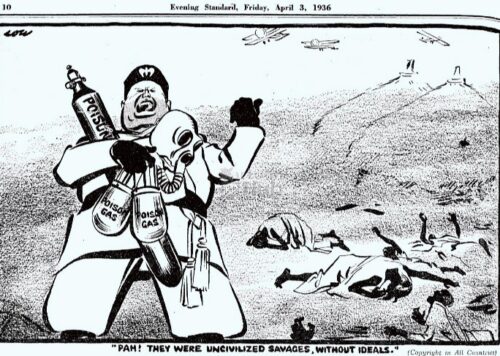
The device purchase exposed that the vital device components were made in Russia. It operates silently, programmable for different scenarios, operable by remote control, and capable of penetrating windows and drywall at a range of several hundred feet. It doesn’t look like much and certainly not a weapon. The software does the work: like a medical tool it shapes a unique electromagnetic wave that rapidly pulses, narrowly targeting electrically active organic tissue.

For years, the CIA argued a microwave weapon capable of causing Havana Syndrome injuries victims would be very large and therefore hard to operate covertly, the size of a truck.

That argument is long gone.

Test Results Are In

The weapon has been in a U.S. military lab for over a year. Tests on rats and sheep produced injuries consistent with those seen in humans diagnosed with Havana Syndrome. Sources who spoke to 60 Minutes also described classified security footage showing Americans being struck overseas — including incidents at CIA headquarters in Virginia and on the grounds of the White House. The CIA declined to comment.

Stanford microbiologist David Relman, who chaired two government investigations into Havana Syndrome, explained the mechanism:

When you produce pulses like this, you can actually stimulate electrically active tissue like brain tissue and the heart… mimicking what the brain normally does, but now you’re driving it with your pulses from the outside.

Norway Accidentally Confirmed It

A Norwegian government scientist with a reputation as a leading skeptic of directed-energy weapon theories discovered the opposite of his intent. He constructed his own pulsed microwave device in 2024 to prove, with himself as the test subject, that such technology was harmless. He instead harmed himself enough to suffer neurological symptoms consistent with Havana Syndrome: headaches, vertigo, memory loss, hearing loss, cognitive disruption.

The Norwegian government informed the CIA. The Pentagon and White House each sent delegations to Norway to examine his device.

U.S. officials noted that his symptoms were not a clinical match for every documented AHI case, but confirmed the core finding: pulsed-energy devices can cause measurable neurological injury in humans.

A skeptic built a device to disprove the theory and caused his own brain damage instead.

CIA Struggles to Deny

A former CIA officer who worked the agency’s Havana Syndrome investigation told 60 Minutes that the unit’s mission, from the beginning, was to:

bring down the temperature

The agency has been steering conclusions toward environmental causes. This tracks with what victims have documented for years. CIA senior leadership privately accused them of fabricating symptoms for financial gain, denied medical care, and required participation in research as a condition of treatment.

The 60 Minutes investigation further found that incidents had been reported at CIA headquarters and on White House grounds, which make “environmental factors” an implausible explanation on their face.

The 2023 intelligence community assessment concluded it was “very unlikely” a foreign adversary was responsible. And that assessment held through a January 2025 update.

So what, it’s a domestic adversary?

A Big Split

The intelligence community is now formally divided on the issue, as evidence no longer can be explained away. The NSA and the National Ground Intelligence Center have shifted positions, acknowledging the possibility that a foreign actor possesses technology capable of producing biological effects consistent with documented AHI cases. The CIA and four other agencies aren’t having it, and continue to hold the “very unlikely” line.

This is not a difference of analytical interpretation. The U.S. defense experts have a working device, animal trial results, classified impact footage, and an accidental human replication in Norway. The CIA has a weak conclusion it reached in 2023 and has declined to revisit.

Proliferation Risk

The operation that obtained the device exposed an arms dealer situation. Obviously if undercover HSI agents could buy this weapon from dealers in the arms market, Russia doesn’t keep or control it. These devices are not confined to state programs. They are circulating. Any billionaire these days could buy one, especially if the CIA keeps denying they even exist. The question is who makes them, how fast, how many of them are out there, who has them, and who has been harmed.

The CIA’s continued position does not engage with any of this. It predates the device acquisition, predates the animal trials, predates Norway, and predates the classified footage. It is a conclusion held in place by institutional investment in a prior judgment.

That means the agency is actively refusing to do analysis. That is a cover.

Yo’ War Secretary So Ugly He Banned Photos

The Pentagon barred press photographers from Iran war briefings because Defence Secretary Hegseth’s staff thought his March 2 photos didn’t flatter him. AP, Reuters, and Getty were all shut out. Only DOD staff photographers have been allowed since.

Not a joke. Not even North Korea.

Speaking of which, Kim Jong Un’s personal photographer was once expelled from the Workers’ Party when he cast an unflattering shadow on the leader’s neck. Camera flash and done.

Every government that controls its photographic record is a totalitarian state, an authoritarian regime, or a democracy generating a major press freedom scandal and promising to never do it again. There is no precedent in any democratic country for a defence official banning press photographers during a war because he can’t handle the truth. The closest parallels are personality cults.

The stupidity of Hegseth isn’t even incidental either, it’s the diagnostic for Trump team incompetence. Competent authoritarians offer some kind of policy rationale. Haw Haw Hegseth can’t even be bothered.

Tesla FSD Crashes Blind Into High Viz Railroad Barrier

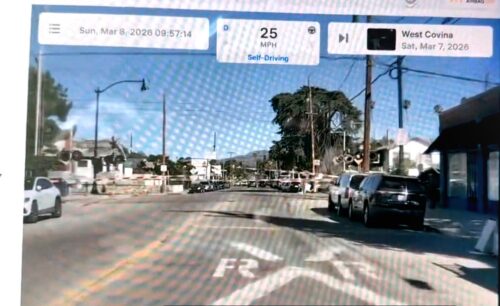
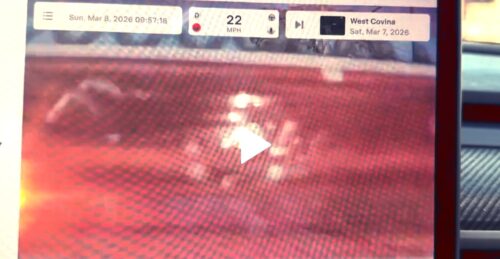
A Tesla in “Full Self-Driving” mode crashed through a bright red railroad crossing barrier in West Covina, California on March 8th. NBC has documented over 40 similar incidents, but watching a barrier’s reflective surface filling the entire camera frame as it crashes is a sight to behold. Tesla’s latest and greatest “self-driving” design is the equivalent of “I can’t see and DGAF.”

The Sequence

At 09:57:14 the car is doing 25 MPH in Self-Driving mode, cruising towards a giant white X and approaching lowered high visibility barriers.

Four seconds later at 09:57:18 the entire camera frame is red because the barrier’s reflective surface is flush against the lens.

Speed only dropped to 22, meaning no braking intervention from FSD at all. The camera didn’t just fail to classify the barrier. The barrier occluded the entire camera view!

The system’s primary sensor was physically blocked by the obstacle it was driving into, and the system interpreted that as… nothing to see here.

Nada.

No emergency stop, no uncertainty flag, no alarm and handoff to driver. A complete loss of visual input was registered as normal driving conditions.

That’s not an edge case in object detection.

Tesla is an abject failure in the most basic perceptual logic: if your camera suddenly goes from road scene to solid red, something is wrong. Even without classifying what — barrier, wall, vehicle, tarp — the total loss of scene coherence should trigger an emergency response. The Tesla design for safety has no safe concept of “I can’t see.”

And in the frames before the crash into the barrier, the visual signals are stacked: flashing lights, lowered gates, white X railroad crossing sign, painted road markings. Every redundant safety indicator that exists at a railroad crossing was active.

FSD missed all of them and then missed the barrier itself as it filled the frame.

NHTSA’s investigation of Tesla has specifically covered this problem, and the data deadline was the same day this went viral. Tesla faced 8,313 records to review at 300/day and couldn’t handle it. That’s 28 days of review for a deadline they’d already extended twice.

Meanwhile, Tesla FSD keeps crashing and people still try to act surprised.

Why Trump’s Three Iran Options All Failed Mussolini in 1940

Donald Trump bombed Iran claiming he would achieve overnight success just like the 24-hour victory he promised in Ukraine. Two weeks of open-ended waste later, his administration is leaking three “small” ground operation plans to Axios like a contractor explaining why the bathroom remodel now requires structural work on the foundation.

Former intelligence analyst Harrison Mann writes in Zeteo that all three options risk dragging the US into a forever war.

He’s right.

And I’m here as a historian to tell you this pattern is older than he suggests. We aren’t just seeing bad plans. We are seeing failed plans, the exact same three mistakes Mussolini made in North Africa in 1940.

Anyone remember that guy? His military bravado failed for the same structural reasons that Trump will.

Three Plans DOA

The options leaked to Axios and elaborated across Bloomberg, NBC, and Semafor are:

Plan 1: SOF raids on nuclear sites — seize Iran’s near-bomb-grade enriched uranium with commandos and nuclear scientists. Secretary of State Rubio told Congress that to secure the material, “people are going to have to go and get it.” The problem, as a US official admitted: “The first question is, where is it?” UN inspectors haven’t verified the stockpile’s location in nine months.

Plan 2: Seize Kharg Island — a strategic terminal handling roughly 90% of Iran’s crude oil exports. Take the revenue chokepoint, squeeze the regime.

Plan 3: Seize the Strait of Hormuz islands — take the islands flanking the strait to force it open for commercial shipping. Trump told CBS he was “thinking about taking it over.”

Each plan is the opposite of what is being described, because it is a trap.

History tells us why.

September 1940

Mussolini ordered Marshal Graziani to invade Egypt from Libya in September 1940. Italy had roughly five-to-one numerical superiority over the British garrison. The plan was limited: advance to Sidi Barrani, establish a forward position, consolidate. A contained operation with a defined objective.

The British response, Operation Compass, was initially planned as a five-day raid with about 30,000 troops. Within two months it had destroyed the Italian 10th Army and captured 130,000 prisoners. The “limited” Italian advance created a “limited” British counterattack that metastasized into a three-year, multi-nation theater stretching supply lines across the entire Mediterranean.

Italy’s failure most famously sucked Hitler to deploy Rommel and the Afrika Korps — an entanglement Germany couldn’t afford led by a bombastic aggressor who couldn’t stop losing. What began as Mussolini’s colonial adventure burned resources that the Axis depended on, accelerated Axis defeat, and created the confidence and conditions for Allied liberation of Southern Europe.

Every one of those consequences was produced by very simple logic: seize a point, then defend the point, then supply the defense, then defend the supply lines, then supply the defense of the supply lines.

The three Iran plans reproduce this logic exactly without asking the higher-order question of whether the position is necessary or defensible.

Plan 1 Is an SAS Raid That Requires an Occupation

The commando raids deep behind Axis lines in North Africa — SAS, LRDG, Popski’s Private Army — worked precisely because they were hit-and-run. The moment any raid required holding a position, it needed conventional forces to follow.

You don’t “seize and dilute” enriched uranium with a quick raid. You penetrate hardened underground facilities with sparse intelligence. You establish a security perimeter. You bring in scientists and equipment. You run a multi-day technical operation. You extract under fire. Every hour on the ground is an hour the perimeter can be probed, the extraction route interdicted, the political cost escalated.

This isn’t a raid. It’s a temporary occupation of an unknown number of fortified positions deep in hostile territory. Graziani also thought he was running a limited forward operation.

Israel just ran this on a micro level to open a grave and return the bones of Ron Arad. They not only didn’t find the bones, they barely survived.

Plan 2 Is Tobruk

Axis and Allied obsession with Tobruk and Benghazi in the North Africa campaign came down to a single principle: whoever held the sea port controlled the logistics of the entire theater. Despite air capabilities, vulnerable slow ships and thirsty truck convoys bogged down the strategy. Kharg Island is the same calculus because it is believed to control 90% of Iran’s oil export revenue, and you control the regime’s survival.

But Tobruk taught the corollary: holding a strategic point 25 kilometers off a hostile coast means permanent exposure to shore-based fire, and the garrison becomes a logistics sink that devours resources disproportionate to its strategic value. The Siege of Tobruk lasted 241 days. The Australians held it, but holding it consumed shipping, air cover, and reinforcements that couldn’t be used for offensive operations elsewhere. And when they lost control the centralized retribution campaigns were devastating.

Kharg Island sits 25 kilometers off the Iranian coast. Iran has an estimated stockpile of up to 6,000 sea mines, suicide drones, fast attack boats, and anti-ship missiles. The island becomes a target the moment you take it, and every ship supplying the garrison runs a gauntlet.

Plan 3 Is Fortified Coastal Libya

Malcolm Nance planned this exact scenario on USS Coronado in 1988 when he served with Commander, Middle East Force. His assessment: the US could take all the islands flanking the Strait of Hormuz, but “the cost in American lives would be horrific.” The islands are overlooked by mountains on the Iranian mainland, and ships passing through would still face mines, suicide boats, drones, and combat swimmers with limpet mines.

This is the Italian fortification of coastal Libya — static positions that look formidable on a map but become traps when the adversary can interdict supply from the mainland and the high ground. The Strait of Hormuz could be “pried open,” Nance concluded, but the ships passing through would still be at overwhelming risk from asymmetric threats. You hold the point, but holding the point doesn’t secure the lines of communication that make the point worth holding.

The Italians built an elaborate chain of fortified coastal positions across Libya. The British drove through them in weeks.

The Recursive Trap

Mann identifies the core paradox: the closer US forces get to Iranian soil, the more US technological and firepower advantages are negated. Air superiority doesn’t protect a commando from an IED. A carrier strike group doesn’t stop an RPG aimed at a landing helicopter.

North Africa in WWII demonstrated this point repeatedly.

Rommel’s entire campaign was ultimately throttled by his unsound tactics of ignoring logistics; the impossibility of overextended high cost operations at the end of lines that were themselves under attack. The obedience of the Afrika Korps evaporated the moment their fight became attritional rather than maneuverist.

Mann also names the reason the paradox isn’t treated as such: for Iran hawks in Israel and the US, the quagmire is their strategy. Trapping Trump in a ground commitment raises the odds of Iranian state collapse. This puts Netanyahu in the Mussolini role, a junior partner who launches the provocation, expecting the senior partner to provide the escalation force that prevents collapse. Hitler didn’t expect to focus on North Africa. He got it anyway, because Mussolini failures were trumped up as a critical southern flank.

The EuroIntelligence assessment published today frames Trump’s three actual choices starkly: declare mission accomplished and leave (with the Strait still insecure), keep bombing as if the Strait will open (with no regime change), or conclude that the Strait is never safe while this regime exists and send in ground troops. They believe we’re in scenario two. The markets aren’t able to decide. But scenario two has a structural tendency to become scenario three, for the same reason Graziani’s advance to Sidi Barrani became Operation Compass became the Afrika Korps became El Alamein became the liberation of Sicily.

A “limited” seizure of a strategic point creates a requirement to defend that point, which easily creates a requirement for more forces, which extends supply lines, which creates new vulnerabilities requiring yet more forces.

That’s the documented history of what happens when leaders who expected an overnight victory to “accomplish” a mission start looking for small, palatable next steps.

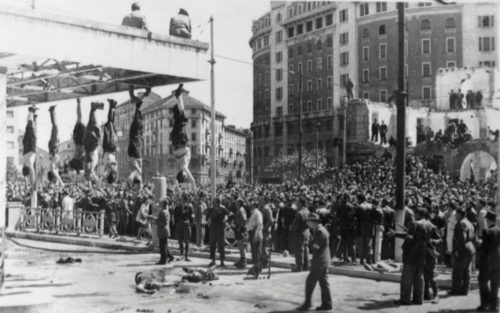
Mussolini said his options were small. He ended up hanged for it.

Italian dictator Mussolini was hanged (with his mistress) before he could be tried for his war crimes.