Fake injury President is framing a fake withdrawal from a non-war-war.
The same Trump derangement syndrome we saw in NATO/Ukraine is showing up in Iran: berate allies for not doing enough, then announce there is nothing to do and you will be doing even less.
President Donald Trump freaked out at U.S. allies on Friday as “cowards” after begging for help in securing the Strait of Hormuz as energy prices skyrocket. Trump, 79, also declared a victory in the war against Iran by claiming the U.S. had already won “militarily”…
Already won, he’s leaving. But go fight or you are the “coward”.
Trump calling everyone else a “coward” preemptively reframes his own chaotic withdrawal as their fault. He wants everyone to believe when Hormuz stays closed and oil stays above $100, it wasn’t because he started the war without a clue and couldn’t find one. It was because NATO acted like he started the war without a clue.
And the troop deployments make Trump derangement into pure theater. The Boxer group from the Pacific won’t arrive for three weeks. You don’t claim you are winding down and then send an expensive MEU on a three-week sail to wind down. You send it to have options that you’re publicly denying you want.
When asked Thursday if troops were being sent, Trump said “I’m not putting troops anywhere. If I were, I certainly wouldn’t tell you, but I’m not putting troops.” Then the Marines in California were ordered to sail for Iran.
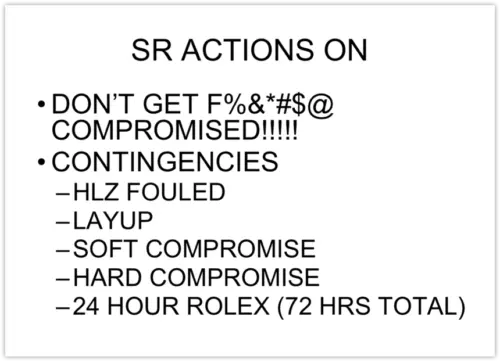
A decades-old Naval Special Warfare mission outline has popped into the news again. It contained these five words, in all caps with exclamation points, that functioned as doctrine:
DON’T GET F%&*#$@ COMPROMISED!!!!!
It was for a four-man SEAL reconnaissance team as they deployed into the Hindu Kush mountains of eastern Afghanistan, June 27, 2005.
An excerpt from the Red Wings mission outline. Source: POLITICO
The phrase obviously was a prohibition, and not a procedure. It was the prohibition of being uncovered, and perhaps more importantly on revealing being seen.
It seems more relevant than ever, given Hegseth and Trump lecturing everyone on how to not talk about anything real ever again. Trump has called those reporting on ground truth in war treasonous.
I’m not arguing that no contingency planning at all was the problem. I’m arguing that the institution gave prohibition so much weight, the truth and necessary procedures got nothing. The slide proves it visually. The team that followed “soft compromise” would be diminished and punished against the team that internalized DON’T GET COMPROMISED and stayed silent, denying their compromised situation on Sawtalo Sar.
And that is what I want to talk about today.
A professional special operations organization writes contingency for failures, because things never go just right. When compromised, execute plans. Cancel the operation, call it in, meet at a predesignated point for extraction. Everyone on SEAL Team 10 knew these doctrines and of course the rising risks of concealment failure. What they actually received, however, was something worse, in all caps.
The difference between a belief-based psychological prohibition and a procedure is the difference between denial and team survival. “Don’t get compromised” turns a predictable operational risk into a personal dead-end to be avoided at all costs, rather than a map to execute.
Nineteen years after the mountain tragedy, on January 11, 2024, two SEALs from Team Three attempted to board an unflagged dhow carrying Iranian-made weapons off the coast of Somalia. Chief Special Warfare Operator Christopher Chambers fell while climbing aboard in heavy seas. Nine feet, into the water, fully loaded. Special Warfare Operator 1st Class Nathan Gage Ingram jumped in after him eleven seconds later.
Both disappeared. It took just forty-seven seconds.
Chambers shouldered fifty pounds of gear. Ingram had eighty. Neither their physical capability nor their emergency flotation devices would keep them above surface. The Navy’s investigation found SEALs had practiced with flotation devices just once, if ever, in their entire careers.
Once, if ever.
There was no standardized buoyancy guidance. Individual operators were expected to calculate it themselves. The investigation concluded:
confusion and ineffective execution.
It was the prohibition instead of procedure, again. Nothing mapped how eighty pounds would turn out in a fall. If you hit water, activate flotation, shed gear, grab for line or ladder… or just, DON’T GET F%&*#$@ DROWNED.
General Michael Kurilla, head of U.S. Central Command, wrote:
This incident, marked by systemic issues, was preventable.
Preventable in 2024, like preventable in 2005. Those nineteen years apart share far too much in common, and we need to talk more about why.
Mind the Procedure
A POLITICO Magazine investigation published this week puts in one place what many have tried to say for years individually on their own. It shares interviews with more than a hundred people with direct knowledge of Operation Red Wings, and documents that are rarely seen outside special operations. The overall tone reveals how prohibition culture affected mission planning let alone success.
SEAL Team 8, which preceded Team 10 in Afghanistan, reported being compromised by goat herders three times on recon missions. It was so front of mind that, as two teams continued on, a third team called headquarters and got a helicopter to pull them out. They followed a compromise procedure, did exactly what the doctrine said. For this, they were mocked as soon as they returned to base. Junior SEALs under Lt. Cmdr. Erik Kristensen were the most exposed to this prohibition message. One operator made it explicit to the newcomers: be aggressive, ignore doubts, force the mission. Another SEAL said his team ran into goat herders on his first operation and never told anyone because of pressure to complete it.
The failure to admit compromise is crucial context for Murphy’s team, who encountered goat herders on Sawtalo Sar. The institutional incentive was clear: don’t admit the situation. Don’t abort. Keep on saying it’s fine. They released the herders and pressed on without telling base. Neither the relay chat logs nor the situation report obtained by POLITICO mention goat herders. The communications technician monitoring the radios at Jalalabad didn’t hear about them until after Luttrell was rescued. The recon team’s last communication before going silent was that it was “packing up and moving on.” They were compromised, yet never reported they were compromised.
The procedure of safety was prohibited, cultural shift made it unusable.
Everything else that went wrong flowed from the same institutional refusal to build real contingency planning around predictable risks: the mission launched during a transfer of authority, the split command structure, the four-man team that was too small, the loud helicopters that alerted the valley, the fast rope snagged on a tree stump marking exactly where they landed, the target who traveled with three to five bodyguards rather than the army depicted later.
The Green Berets advising the mission saw it all clearly. Army Lt. Col. J.P. Roberts recalled saying what needed to be said.
This is going to be a shit show
He tried to delay. The Marines’ operations officer called the command arrangement “fucking outrageous.” CIA officers at Asadabad were dumbfounded.
Every non-SEAL in the room seems able to point back to their procedural reasons to abort, yet unable to prevent the SEAL tragedy that unfolded in front of them.
Nineteen Americans died. Three SEALs on the mountain and sixteen on a rescue helicopter shot down with an RPG.
Nineteen years later, two more died while everyone struggled to make sense of their loss. A champion swimmer SEAL simply drowned in seconds? How? It can’t be. The 2024 investigation turned up performance-enhancing drug use, unauthorized surgery hidden from Navy medical, and alcohol on the ship. All of it begged questions about exceptionalism, the same institutional refusal to admit being compromised or able to accept and adapt to failure.
The Myth
Nick Baggett, a retired SEAL master chief and the father-in-law of Danny Dietz (one of the three SEALs killed on that mountain) read Luttrell’s intelligence debrief shortly after the tragedy.
He read it shortly after. Keep that in mind.
It diverged from the memoir that everyone read much later. He watched the institution choose a narrative over the details needed for accountability, as that narrative served a different objective. Lone Survivor became a bestseller, then a blockbuster, then a recruitment brand. He told POLITICO in retrospect:
We morphed from an operational unit into something more commercial.
Commercial means disposable, as operational “margins” and capital flows take over the value system. Who “loses” in commercial enterprise is completely redefined from military operational outcomes.
The memoir and the movie performed an extraordinary inversion. The institutional failures that had caused the disaster, evidence of a culture that replaced contingency planning with shame, was written into a mythology of heroic moral dilemma selling tickets.
We were expected to believe the SEALs didn’t die because they were pressured to ignore basic protocol and admit compromise. They died, the hot selling story went, because they were too noble to kill those who compromised them. The prohibition that created the problem was rewritten into virtue that ennobled their tragedy, for profit.
This week, Luttrell’s lawyer ironically told POLITICO that anyone revisiting the mission “has an agenda” and that “everything he wrote in his book is absolutely true.”
That statement is not a legal argument. And it is obviously self-defeating. The book revisited the mission. It came second, not first. And it didn’t really hide its agenda in revisiting the mission.
Moreover, such a statement by the lawyer serves as a deterrent, echoing the reason that a doctrinal fix never happened. You can’t write “if, then” for compromise if the institution has committed to a story where compromise was a moral choice rather than an operational failure. Fixing the doctrine now hits a religious nerve, because it means admitting a mythology is wrong.
Former SEAL James Hatch, who recovered the bodies of the nineteen Americans killed in Red Wings, wrote in his memoir that “the American myth-making machine” had distorted what happened. He described the pain:
when you take a version of their story and just tell the parts that allow it to be a legendary epic about flawless heroism.
A former SEAL recalled going through land warfare training a decade after Red Wings. One exercise involved a helicopter being shot down. He pointed out the training was unrealistic because in the real world, the operation would stop as you have to protect the aircraft and search for survivors.
Everyone looked at me like I was an idiot.
Naval Special Warfare hadn’t passed on the essential operations knowledge. The institution that should have been teaching hard lessons was selling inspirational ones instead.
The mythology fed political mistakes. Six days into taking control of the military, Trump pushed go on the Yakla raid in Yemen, over dinner, not in the Situation Room, sending SEAL Team Six into a village where the enemy was allegedly tipped off in advance.
Senior Chief Ryan Owens was killed. At least six women and ten children under thirteen were also killed. A $70 million Osprey was destroyed. It was a command disaster.
Flynn had pitched it as a “game changer” to distinguish Trump from Obama, who had turned down the mission. When it went wrong, Trump deflected:
This was a mission that was started before I got here.
Then he used Owens’ widow’s grief as a prop during his address to Congress while refusing his father’s demand for an investigation. Bill Owens said:
Don’t hide behind my son’s death to prevent an investigation
Push operators into ill-conceived missions, mythologize the dead, medicate the survivors, attack anyone who questions the lessons under the loss.
The Fix
A former SEAL Team 10 officer quoted in the POLITICO piece put it plainly:
Fuck legacies and egos. Whatever screw-ups I made, publish them. That way, in the future, some young kid doesn’t get killed.
The fix is not complicated.
Replace shame and prohibitions with curiosity and procedures. Train until they’re reflexive, subconscious. Stop punishing teams as protocol followers. Conduct after-action reviews that prioritize compound lessons over competitive legacy. Require depth to the checks made before every maritime boarding.
Formalize compromise response as a drilled contingency, not a career-ending confession. There’s neuroscience behind this: a prohibition locks the amygdala into threat suppression. The brain isn’t optimized, can’t plan, while it’s hiding. A procedure offloads that threat response into motor memory and decision trees, freeing the prefrontal cortex to actually run the situation. The difference between “don’t get compromised” and “if compromised, then execute” isn’t just doctrinal. It’s neurological. One freezes operators (run up a tree by a Chihuahua). The other keeps them operational.
None of this dishonors the men who died.
Baggett, Macaskill, Thomas, and the other veterans now speaking publicly are clear on that point. The courage of Murphy, Dietz, Axelson, Chambers, Ingram, and the sixteen men on that helicopter is not diminished by admitting the institution failed them. It is diminished by pretending that it didn’t, and letting an unaware team deploy into the same trap.
Chambers was thirty-seven. Ingram was twenty-seven, on his first deployment.
We are supposed to believe none of the above means that Iran is a war. Hegseth says he needs $200 billion to keep his non-war-war running indefinitely without objectives or objections.
How big is Hegseth’s $200 billion folly?
Bigger than every country’s annual defense budget except the one requesting it. As a single supplemental request, in just the first three weeks of combat, it has no precedent. Look at what the United States has spent on its other wars:
War
Duration
Total Military Cost (2026 $)
Peak Daily Cost (2026 $)
Congressional Authorization
Korea
3 years
~$780 billion
~$700 million
None (UN police action)
Vietnam
~8 years major combat
~$1.1 trillion
~$380 million
Gulf of Tonkin Resolution
Gulf War (1991)
6 weeks
~$115 billion
~$2.7 billion
AUMF 1991
Iraq (2003–2011)
8 years
~$880 billion
~$530 million (surge peak)
AUMF 2002
Afghanistan (2001–2021)
20 years
~$2.4 trillion
~$330 million
AUMF 2001
Iran (2026–?)
19 days
$12 billion and counting
~$1 billion
None
Sources: CRS estimates (Daggett, Belasco) adjusted to approximate 2026 dollars; Brown University Costs of War Project; Pentagon figures reported by White House NEC. Total costs reflect military operations only and exclude veterans’ benefits, interest on war debt, and allied contributions. Iran figures from White House NEC director Kevin Hassett ($12 billion as of March 16).
The Iran war is burning money faster than any American conflict since the six-week Gulf War of 1991. Notably, that war was mostly paid for by allies. This one is borrowed, on the national credit card. The $200 billion supplemental request, by itself, exceeds the entire inflation-adjusted cost of the Korean War and approaches what the U.S. spent in a decade of peak Iraq War combat.
Nineteen days into a war with no objective, no authorization, no end, it’s “give me more war money than in history without any accountability for it”.
The word “war” now does everything in Washington except the one thing it’s supposed to do under Article I, Section 8: trigger a congressional vote for war. The $200 billion request is a trap. If Congress appropriates supplemental war funding without passing an AUMF, the appropriation itself becomes a de facto authorization, because money is consent. The spending vote substitutes for the war vote. Iraq and Afghanistan ran the same play: Congress voted to fund the troops, not to authorize the war. Same money, different name. The supplemental spending bill is the war laundromat.
Self-perpetuating war, self-perpetuating budget, self-perpetuating enemy, all are something Hegseth would say at a bar while the tab runs to $200 billion.
Iran hit a F-35 today. Flattened defenses don’t hit $100 million aircraft. People who aren’t shooting at you don’t wound 200 of your service members. Iran just blew up Qatari gas production. The air dominance narrative and the uncontrolled casualty figures cannot both be true, and the $200 billion budget request tells you which one the Pentagon admits.
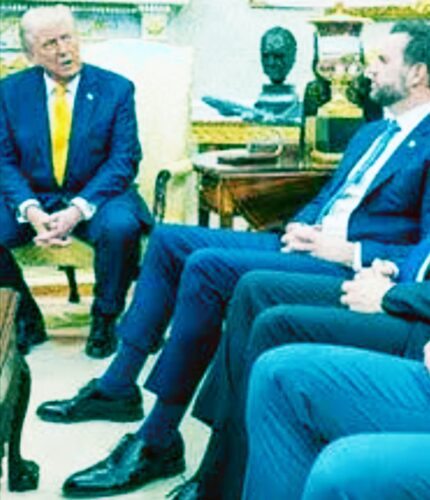
JD Vance slouched in the White House, listening to Trump offend other nations, looking like he shoehorned himself into a pair of boots last seen at a 1970s disco funeral.
The man who cobbled together a career out of saying whatever the room required has now, apparently, decided the room also requires him to look like he has micro feet. These aren’t dress shoes, they’re elevator pitches, the kind of lift you get when your entire political identity is standing on someone else’s platform.
You’d think a Senator who already sold his soul wouldn’t need to look any smaller, but here we are: the Vice President of the United States, elevated by every means except merit.
a blog about the poetry of information security, since 1995