We are supposed to believe none of the above means Iran is a war. Hegseth says he needs $200 billion to keep his non-war war running indefinitely without objectives or objections.
How big is Hegseth’s $200 billion folly?
Bigger than every country’s annual defense budget except the one requesting it. Every. Country. As a single supplemental request in the first three weeks of combat, it has no precedent. Here is what the United States spent on its other wars:
War
Duration
Total Military Cost (2026 $)
Peak Daily Cost (2026 $)
Congressional Authorization
Korea
3 years
~$780 billion
~$700 million
None (UN police action)
Vietnam
~8 years major combat
~$1.1 trillion
~$380 million
Gulf of Tonkin Resolution
Gulf War (1991)
6 weeks
~$115 billion
~$2.7 billion
AUMF 1991
Iraq (2003–2011)
8 years
~$880 billion
~$530 million (surge peak)
AUMF 2002
Afghanistan (2001–2021)
20 years
~$2.4 trillion
~$330 million
AUMF 2001
Iran (2026–?)
19 days
$12 billion and counting
~$1 billion
None
Sources: CRS estimates (Daggett, Belasco) adjusted to approximate 2026 dollars; Brown University Costs of War Project; Pentagon figures reported by White House NEC. Total costs reflect military operations only and exclude veterans’ benefits, interest on war debt, and allied contributions. Iran figures from White House NEC director Kevin Hassett ($12 billion as of March 16).
The Iran war is burning money faster than any American conflict since the six-week Gulf War of 1991. Notably, that war was mostly paid for by allies. This one is borrowed, on the national credit card. The $200 billion supplemental request, by itself, exceeds the entire inflation-adjusted cost of the Korean War and approaches what the U.S. spent in a decade of peak Iraq War combat.
Nineteen days into a war with no objective, no authorization, no end, it’s “give me more war money than in history without any accountability for it”.
The word “war” now does everything in Washington except the one thing it’s supposed to do under Article I, Section 8: trigger a congressional vote for war. The $200 billion request is a trap. If Congress appropriates supplemental war funding without passing an AUMF, the appropriation itself becomes a de facto authorization, because money is consent. The spending vote substitutes for the war vote. Iraq and Afghanistan ran the same play: Congress voted to fund the troops, not to authorize the war. Same money, different name. The supplemental spending bill is the war laundromat.
Self-perpetuating war, self-perpetuating budget, self-perpetuating enemy, all are something Hegseth would say at a bar while the tab runs to $200 billion.
Iran hit a F-35 today. Flattened defenses don’t hit $100 million aircraft. People who aren’t shooting at you don’t wound 200 of your service members. Iran just blew up Qatari gas production. The air dominance narrative and the uncontrolled casualty figures cannot both be true, and the $200 billion budget request tells you which one the Pentagon admits.
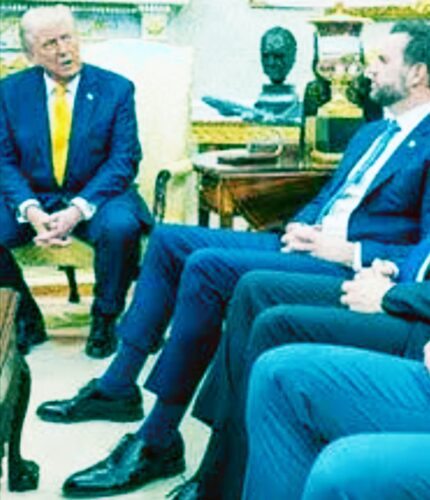
JD Vance slouched in the White House, listening to Trump offend other nations, looking like he shoehorned himself into a pair of boots last seen at a 1970s disco funeral.
The man who cobbled together a career out of saying whatever the room required has now, apparently, decided the room also requires him to look like he has micro feet. These aren’t dress shoes, they’re elevator pitches, the kind of lift you get when your entire political identity is standing on someone else’s platform.
You’d think a Senator who already sold his soul wouldn’t need to look any smaller, but here we are: the Vice President of the United States, elevated by every means except merit.
Today should become a national American holiday: Lemon Pound Cake Day.
An Ohio jury just delivered one of the clearest freedom verdicts in recent memory. It took less than a day to throw out all thirteen claims of defamation, invasion of privacy, the lot, that had been brought by seven Adams County sheriff’s deputies against rapper Afroman. The deputies claimed they should earn $3.9 million for causing him harm. They got nothing.
The facts are plain. Deputies raided Afroman’s home in Winchester, Ohio with long guns and pistols drawn, smashed his door down, and seized over $5,000 in cash in August 2022. They based the assault on a dubious warrant for drug trafficking and kidnapping. No charges were filed. He was in Chicago, not home. No drugs. No kidnapping. When the sheriff’s office returned the cash taken from him, $400 had been skimmed off. They told him they weren’t responsible for this loss or their property damage either.
Afroman had security cameras that captured the targeted abuse. He used the footage to make music videos, most notably the song “Lemon Pound Cake,” which has been viewed over 3 million times on YouTube. It features surveillance clips of white heavyset deputies breaking down the door, then pausing in the kitchen to eye a lemon cake. Afroman narrates the intrusions to a beat. It is a masterpiece, easily one of the best American protest songs in history.
The deputies, invoking historic white supremacist cancel culture, sued to suppress Black speech. They filed claims of emotional distress, humiliation, and death threats, surprised they would be held accountable for their actions. Deputy Lisa Phillips wanted $1.5 million. Sgt. Randy Walters wanted $1 million and told jurors he was humiliated when his daughter came home from school crying because classmates said her mother was making love to Afroman, a reference to lyrics in a song called “Randy Walters is a Son of a Bitch.”
Afroman, as a true patriot, showed up to court every day in an American flag. His testimony was the whole case in miniature:
“I got freedom of speech. After they run around my house with guns, kicked down my door, I got the right to kick a can in my backyard, use my freedom of speech, turn my bad times into a good time.”
“I don’t go to their house, kick down their doors, flip them off on their surveillance cameras, then try to play the victim and sue them.”
“All of this is their fault. If they hadn’t wrongly raided my house, there would be no lawsuit, I would not know their names, they wouldn’t be on my home surveillance system, and there would be no songs.”
He also explained why he brought a local TV crew along when he went to collect his money from the sheriff’s station:
I didn’t wanna get beat up or Epstein’d at the sheriff’s station after I seen them running around my house with AR15s.
God damn American hero, right there.
His defense attorney, David Osborne Jr., put the legal framework to work for everyone to see: the deputies are public officials held to a higher standard, and social commentary on their outrageously unjust conduct is protected speech.
No reasonable person would expect a police officer not to be criticized.
Meanwhile, Afroman’s own countersuit for the property damage the deputies caused during the raid had already been dismissed by Judge Jonathan Hein without a hearing. A victim of police assault had legitimately suffered damages from unwarranted acts. Click of a button, some little office somewhere, Afroman’s words. The institution protects its own until a jury got in the room and called out the imbalance.
Trump Talk Time
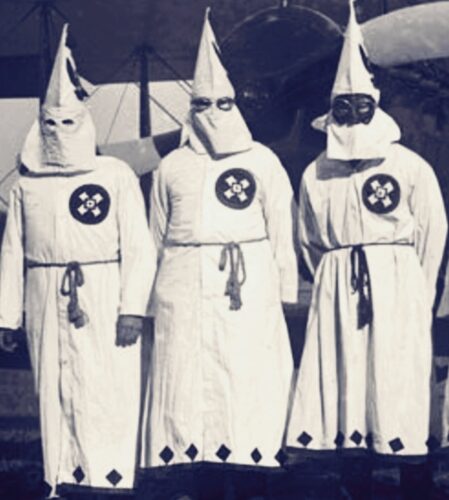
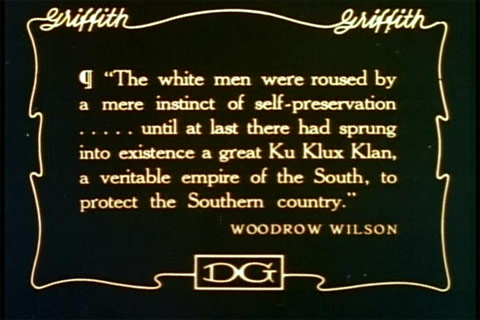
To nobody’s surprise, aggressive acts of white supremacists require invisibility to remain legitimate. America First literally calls itself the invisible empire and walks around with white hoods over their head, ever since Woodrow Wilson screened the white sheets vigilante thriller in the White House in 1915.
These KKK “X” uniforms of an “invisible empire” were a byproduct of President Woodrow Wilson’s promotion of costumed violence against Blacks.
These radical racists abusing their power in America see the documentation of them as the actual threat.
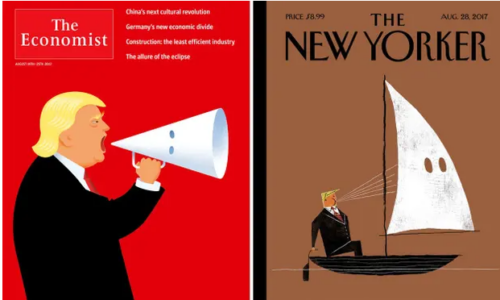
The Economist/The New Yorker weren’t wrongScreen capture from “Birth of a Nation”, the propaganda film President Wilson spread to restart the KKK and incite violence across America.
Lynching, including public torture, worked in America as social and political control affecting law enforcement because it was public but unrecorded, witnessed by the community as spectacle, but not captured in a form that could travel beyond it and reframe it as what it was. The moment reporters and eventually cameras showed up, the political cost of America First changed. Emmett Till’s mother understood this perfectly.
Open the casket, force people to see.
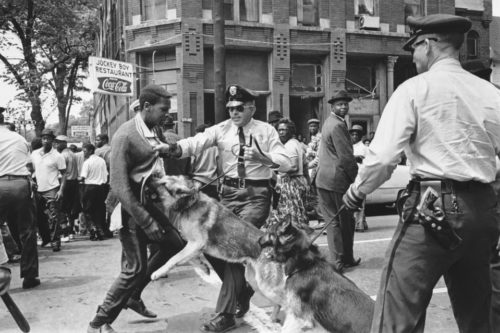
A 17-year-old civil-rights demonstrator is attacked by a police dog, May 3, 1963, Birmingham, AL. President John F. Kennedy discussed this widely seen photo at a White House meeting the next afternoon. | “Once people saw those photos,” says Prof. Brinkley, “they were repulsed by the Southern Jim Crow bigot system.” Photo: Bill Hudson/Associated Press
Lemon Pound Cake is the mechanism Trump is naming and whining he will try to shut down.
The American press has been called liars by him for ages because that exact campaign worked so well for Hitler, but now Trump is elevating his accusations to treason like it’s 1837 in America again. It’s being called treasonous because it reveals the crimes.
On March 15, Trump posted on Truth Social:
media outlets reporting on the Iran war should “be brought up on Charges for TREASON for the dissemination of false information.”
Not a joke. Reporting on a war, as this blog certainly does, is described by Trump as treason. The maximum penalty for treason?
Open the casket, force people to see.
FCC Chair Brendan Carr followed up by threatening to revoke broadcast licenses. Defense Secretary Pete Hegseth whined from the Pentagon podium that networks were running chyrons reading “Mideast War Intensifies” when they should instead fluff and puff about “Iran Increasingly Desperate.”
The footage, the documentation, the record all breaks the framework. Power needs the act and the narrative about the act to be the same thing. An independent record creates a gap between what happened and what was supposed to have happened, and that gap is where accountability lives.
Afroman used a beat and security camera footage to speak the truth to power. The deputies’ lawyer literally argued in court that a victim giving the public a report about a raid was the harm. Not the raid. The reporting that showed evidence. The reframing, with evidence. An American Black man shining a bright light through the sheets of injustice, instead of cowering to the system of false authority.
CNN’s Daniel Dale documented that when the White House provided examples of outlets spreading the fake carrier video Trump raged about, not a single one was American. There was one Israeli, one Saudi, one Turkish. The treason accusation he cooked up was aimed at an American press corps, even as they hadn’t done what Trump accused them of doing. He wanted to punish Americans for the crime of foreign coverage itself.
Trump’s world is violence against non-whites as hidden policy, as to him American documentation of the truth is the treason.
Afroman after the verdict, with tears of joy on his face, wrapped in the American flag on the courthouse steps, corrected the framing one more time:
I didn’t win. America won. America still has freedom of speech. It’s still for the people by the people.
He trumped the Trump.
The jury agreed in under a day.
The question is whether the rest of the world does, or when will Hegseth be held accountable for why he’s covered himself in white supremacist tattoos as the guy who loses his grip. Here’s the video predicting three F-15E would be shot down by friendly fire in one night.
Afroman said he didn’t want to be Epstein’d. He won in court. Nearly 200 Iranian little girls are dead from Hegseth’s unpopular war crimes, let alone the many others killed from his expanding mistakes. When will their day in court come? Or what about all the Epstein victims?
Thomas Edsall’s latest New York Times essay opens with a Peter Thiel quote from 2010 that deserves far more scrutiny for historic parallels than the NYT gives it.
We could never win an election on getting certain things because we were in such a small minority, but maybe you could actually unilaterally change the world without having to constantly convince people and beg people and plead with people who are never going to agree with you through technological means, and this is where I think technology is this incredible alternative to politics.
A minority that can’t win elections. A conviction that persuasion is futile. A technological mechanism to bypass democratic consent entirely.
This is a very well studied pattern from 1930s Germany. Guess who?
Joseph Goebbels articulated the same exact structure in 1928, using radio and institutional capture rather than Silicon Valley.
The Goebbels Thiel Table
Move
Goebbels (1928-1935)
Thiel/Palantir (2010-2026)
1. Admit minority status
“We are an anti-parliamentarian party” that rejects democratic institutions
“We were in such a small minority” that elections are unwinnable
2. Declare persuasion futile
“We oppose a fake democracy that treats the intelligent and the foolish in the same way”
“People who are never going to agree with you”
3. Identify non-democratic mechanism
“We enter the Reichstag to arm ourselves with democracy’s weapons”; radio as “the Eighth Great Power”
“Technology is this incredible alternative to politics”
4. Execute bypass
Enabling Act dismantles republic through constitutional means
Palantir builds surveillance and control infrastructure for intelligence and military without democratic deliberation
5. Pull up the ladder
“We would deny to our adversaries without any consideration the means which were granted to us”
Karp (2026): anyone doing this without military cover is “in an insane asylum”
Step five is where we are, so hopefully people start seeing the problem soon. The NYT certainly isn’t helping by acting like Nazism is now the norm. Karp’s CNBC appearance, quoted at length in Edsall’s piece, reads like we are supposed to just accept a warning. It isn’t normal. It’s Nazi doctrine being delivered to the public as if that’s just the way it is in 2026.
Karp says AI will somehow on its own destroy the economic and political power of only the educated, largely Democratic voters. He says anyone who thinks this will “work out politically” without capture of the military is delusional. He says the “only justification” for absorbing societal disruption is for national security.
Every sentence sounds like general concern. Every sentence is constructed to benefit Palantir. The company already has corrupted the system to force collection of defense contracts, without accountability for technological failures. It has cemented intelligence community relationships, and it built the institutional armor that Karp says you need to undermine voters. When he tells the rest of Silicon Valley that technology without political cover is reckless, the operative message is: we are in control and you can’t do this without us.
That’s straight out of Nazi history. Karp was only missing a shout out to “my struggle” and Goebbels 1928.
Hu Contrasts This
The most helpful voice in Edsall’s piece belongs to Margaret Hu, who directs the Digital Democracy Lab at William & Mary. Where Karp treats replacing voters with technology as a management problem, something to cover in the right political framing, Hu names it correctly as the problem itself.
A.I. systems and their techno-kings have the potential to manifest almost monarchical aspirations.
“Techno-kings” with “monarchical aspirations.” That’s far more than an observation about labor markets or partisan realignment. That’s the correct diagnosis of the political structure being built. Hu goes further:
The A.I. cold war is not just a tech innovation race for military advantage. It is a race for global dominance economically and culturally, and geopolitically.
This is the frame Karp doesn’t want you to use. Karp’s version: ending democracy with information warfare tools (whether newspapers, radios or AI) is inevitable, the only question is whether you wrap it in a flag. Hu’s version: the disruption is a political choice made by identifiable actors pursuing identifiable power, and the military framing is just part of the power grab, not a check on it.
Karp says technology needs politics. Hu says technology is politics. More specifically, the political campaign of concentration is masquerading as inevitability.
What Edsall Misses
Edsall’s essay is valuable for assembling sources, particularly the Brynjolfsson and Hitzig paper showing that AI demolishes Hayek’s argument against central planning. But Edsall treats Karp’s CNBC quotes that echo Nazism as a “thoughtful reaction” rather than what they are: the CEO of a surveillance company explaining to his peers how to make the end of democracy politically survivable.
The Thiel quote at the top of the column and the Karp quotes near the bottom are the same perspectives. They’re the two phases of the same Nazi project Hitler used to seize power.
Thiel announced he was using the Goebbels theory. Karp is delivering the after-action report and next steps. Karp says “nobody should do what we did” from the commanding position of having already done it.
That’s just like Hitler. It’s an announcement they’ve built a moat with a drawbridge. And Palantir is expecting they will be the only ones to survive inside.
a blog about the poetry of information security, since 1995