Category Archives: Security

Google Announces Colonial-Era Compensation Plan for Human Devaluation

Alphabet just filed an SEC disclosure awarding CEO Sundar Pichai a compensation package worth up to $692 million over three years. His base salary stays at $2 million. The rest is equity pay, which means performance stock units tied to Alphabet’s total shareholder return relative to the S&P 100, plus new incentive units tied to the board’s own valuation estimates of Waymo and Wing.

No operational milestones are specified.

No headcount targets.

No product quality benchmarks.

The company declined to comment on what Pichai actually has to do, but as someone with decades of being inside, I can explain.

Here’s the decoder ring.

How CEO equity is setup

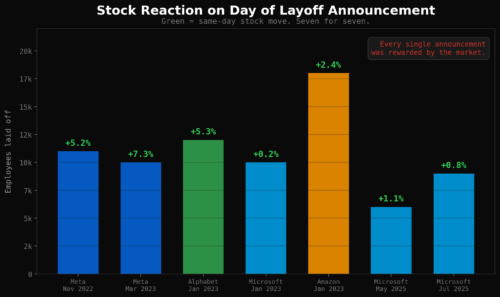
Total shareholder return goes up either from increased revenue, or from decreased spend. Remember “spend more to make more” as a cry for market growth? Well, that’s long gone as the new Big Tech cry is “people are our largest cost, so get rid of them”. Mass layoffs now mechanically improve a metric that triggers a big payout to the five or six men playing this game.

Nobody says “fire people” in the game rules for an incentive structure, because a “decrease spend” dog whistle is so loud and clear.

The Waymo and Wing units disclosed are arguably signs of something even worse. Their value is determined by the compensation committee’s self-estimate of per-unit worth.

Not revenue.

Not ridership.

Not delivery volume.

Nothing connected to quality of life or value relevant to anyone affected by the product.

A Waymo that displaces humans and reduces jobs faster is worth more, is a good way to understand the “worth” being written. A Wing that removes human jobs from last-mile delivery is worth more than one that allows humans to “cost” by existing.

The global management class has a specific training pipeline designed to separate the person making the decision from the people affected by it. That’s the colonial inheritance running through Cambridge and Wharton and McKinsey. The entire incentive structure points toward massive displacement and removal of humans.
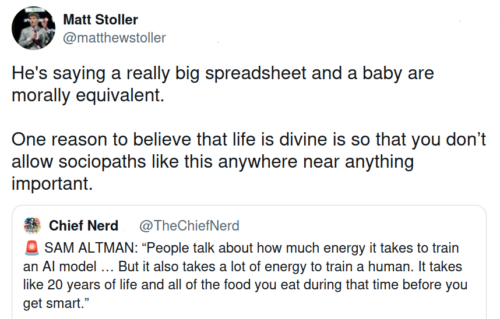
“A really big spreadsheet and a baby are morally equivalent.” The $692 million pay package is what happens when boards agree.

The decoder

What the filing says What it means
“Performance-based equity” Stock price goes up when layoff numbers go up
“Total shareholder return” Earnings per share, which layoffs improve
“Per-unit value of Waymo” Board’s own estimate, no external audit
“Scaling Other Bets” Replacing human labor with autonomous systems
“Best interests of stakeholders” Not employees — shareholders
“Base salary unchanged at $2M” The part that sounds modest; the other $690M is equity

For context: Microsoft’s Satya Nadella earned $96.5 million in fiscal 2025. Apple’s Tim Cook took home $74.3 million. Pichai’s package is seven times Cook’s.

Meanwhile, the same tech sector reports record-high unemployment among software engineers, with companies citing “efficiency” and “AI-driven productivity” as the reasons they don’t need to rehire.

The scoreboard

Between 2022 and 2025, Big Tech announced over 100,000 layoffs across Alphabet, Microsoft, Meta, and Amazon alone. Here’s what happened to CEO compensation over the same period.
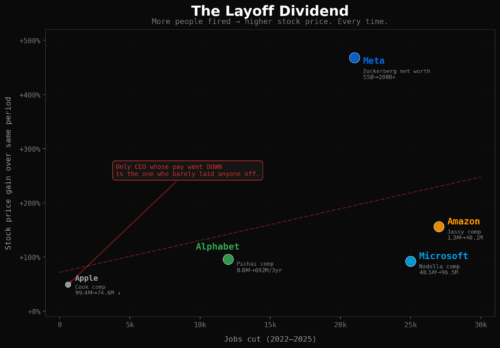
Company Jobs cut (2022–2025) CEO pay trend
Alphabet (Pichai) 12,000+ $226M (2022) → $692M/3yr (2026). Triennial equity grant tripled.
Microsoft (Nadella) 25,000+ $54.9M (2022) → $96.5M (2025). Record high. +76%.
Meta (Zuckerberg) 21,000 $1 salary. Net worth: $55B (2022) → $200B+ (2025). Operating margin doubled to 41% after cuts.
Amazon (Jassy) 27,000+ $1.3M (2022) → $40.1M realized (2024). Ten-year equity grant vesting accelerated by stock surge post-layoffs.
Apple (Cook) ~600 $99.4M (2022) → $74.6M (2024). The one CEO who took a voluntary cut — also the one who barely laid anyone off.

The Apple line tells you everything. The only CEO whose compensation went down is the one who didn’t convert headcount into margin improvement. The market doesn’t reward restraint. It rewards extraction.

Is one CEO worth 1,500 engineers?

Pichai’s package: $692 million over three years. Cook’s rate over the same period: $224 million. The gap between the two is $468 million.

Alphabet’s own proxy filing reports median employee total compensation at $331,894. Levels.fyi puts the median Google software engineer at $322,000, a senior L5 at $417,000, and an entry-level L3 at $201,000.

If Pichai were paid at Cook’s rate, the $468 million difference would hire:

Role Google comp Hires Market comp Hires
Entry-level (L3) $201K 2,329 $150K 3,120
Median SWE $322K 1,454 $200K 2,340
Senior engineer (L5) $417K 1,123 $250K 1,872

The left column uses Google’s own inflated compensation rates. The right column uses normal market rates — and the numbers get dramatically worse for the board’s argument.

Google’s comp inflation is part of the same cycle. For years Big Tech bid up engineering salaries to hoard talent and starve competitors. A $417,000 L5 at Google could have been two senior engineers at a normal company. Then Google dumped 12,000 of those overpriced engineers onto a market it had already distorted, cratering the value of the skills it spent a decade inflating.

The hoarding and the layoff are the same strategy in two phases: acquire to block competitors, discard.

At market rates, the full $692 million as one single person’s compensation package would employ 4,613 entry-level engineers or 2,768 senior engineers for three years. That’s not a few, that’s nearly half of the 12,000 people Pichai fired in January 2023.

Alphabet’s board looked at thousands of engineers and one CEO and signaled the opposite of production. They chose to pay one person the amount it would cost to employ people to produce things. That’s a rent-seeking decision, filed with the SEC, that says the company believes its staff value is an inverted pyramid; value is capture using a position of control, not from making anything.

Meanwhile the engineers who built Search, Chrome, Android, Maps, YouTube, Gmail, Cloud, and TensorFlow are sending applications into a market that Alphabet itself helped flood with 12,000 newly unemployed engineers. Pichai gets $692 million for presiding over the company those engineers made. The engineers get a job market that tells them their skills are worth less every quarter because the CEOs firing them are worth more.
Enclosure

The $692 million package and the tech unemployment headlines have a troubling connection. They’re the same balance sheet. Workers built the platforms over twenty years. The platforms replace the workers. The CEO gets paid for presiding over the conversion.

Thompson’s The Making of the English Working Class documents exactly this sequence: workers build value in a shared system, the system gets captured, the workers get expelled, and the capturers profit from both the thing that was built and the newly desperate labor supply. Google engineers built the commons — Search, Android, and TensorFlow, much of it literally open source. The commons got enclosed. The engineers got expelled. Acemoglu and Robinson call the result an extractive institution: one designed to concentrate wealth rather than distribute it. A compensation committee that awards $692 million to one person while eliminating 12,000 positions is that institution. The SEC filing is its constitution.

The colonial version of this cycle is the closest parallel. Big Tech extracts labor from engineers, converts it into platform value, then sells AI services back to the same companies that can no longer afford to hire the engineers Big Tech overvalued before discarding. The “AI-driven productivity” pitch to enterprises is selling automated labor back to a market these companies emptied of human labor. Extract the resource, process it, sell the product back to the territory you stripped. That’s not a metaphor. That’s the business model, filed quarterly with the SEC, described in the language of shareholder value.

That’s what these CEOs of Big Tech represent now. An incredibly cynical compensation design that treats human lives as throwaway; their material for rapid extraction and disposal.
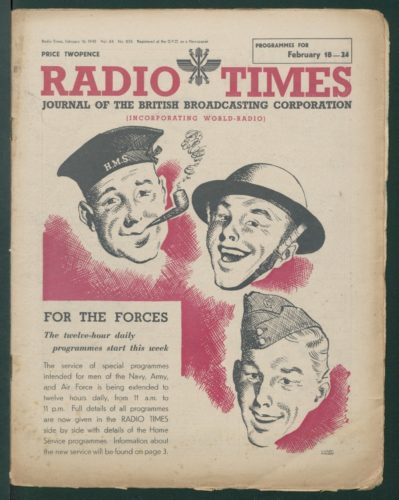

American Losses Pile Up as “Haw Haw Hegseth” Can’t Handle the Truth

The British understood in 1942 that the way to win a war against a propaganda state was radical transparency about your own costs. Openly admitting defeats told the enemy’s population that you were confident enough in the outcome to tell the truth.

Source: BBC Genome

As I wrote in 2021, the BBC made a deliberate decision to broadcast detailed reports of Allied military defeats to German audiences. An academic trawl of the corporation’s archives revealed the strategy:

While the Nazi regime used puppet broadcasters such as William Joyce — nicknamed Lord Haw-Haw — to spin messages of German invincibility, the BBC was choosing to broadcast detailed news of Britain’s military setbacks.

The logic was structural. If the Allies could openly admit defeats, German listeners concluded they must be extremely confident of eventual victory. The BBC called itself “The Fourth Arm” of warfare. Tales of invincibility project weakness. Confidence comes through when talking openly about losses.

The Trump administration is running the opposite play, dismissive of history. The evidence is piling up that it’s for exactly the reason the BBC understood.

Source: Indian Annual Register, Volume 1, 1945, page 253

Propaganda Podium

On Wednesday, Defense Secretary Pete Hegseth stood at the Pentagon podium and told reporters that when casualties are reported, “the press only wants to make the president look bad.” He said it out loud. The man running a war told the country’s journalists to stop documenting dead soldiers.

This was not a slip. Hegseth replaced the Pentagon’s independent press corps last fall with a right-wing roster that CNN described as giving him “kid-glove treatment” from front-row seats. Six military beat reporters, granted anonymity, told CNN the information environment is unprecedented. One summarized: “Lots of chest-thumping, less concrete data.” Another said that in ordinary wartime, the press gets detailed operational briefings once or twice a day. Now:

These days, they put a random tweet or video out with details, with no way for journalists to follow up.

CENTCOM’s casualty accounting tells the same story. On day one, the official line was “no casualties.” That was revised to three dead, then six, as bodies were recovered and wounded died. CENTCOM repeatedly withheld the specific bases, units, and circumstances — citing “operational security” — while omitting locations for recovered remains from its public posts. The Washington Post revealed the six killed were in a tactical operations center in Kuwait that “offered little protection from overhead strikes.” A force protection failure the Pentagon had no interest in publicizing.

Trump told reporters Iran has “no navy, air force, air detection, or radar.” Hegseth declared the US and Israel would achieve “complete control of Iranian skies” within days. This is the Lord Haw-Haw play, not the Fourth Arm play. It projects the thing it’s trying to hide.

Censorship as Coverage

The conflict is widening into its second week across at least twelve countries. Iran has launched strikes against 27 bases where US troops are deployed. The damage is confused, while real and documented:

The US embassy in Kuwait was struck and closed indefinitely. Two Iranian Su-24 bombers nearly reached Al Udeid — the largest US base in the Middle East — before Qatari F-15s shot them down. Kuwait’s military accidentally downed three American F-15Es in a friendly fire incident. Amazon’s cloud data centers in Bahrain and the UAE were hit and remain offline. A Shahed drone struck the runway at Britain’s RAF Akrotiri in Cyprus — EU territory — prompting the evacuation of the surrounding village and protests in Limassol with chants of “British bases out.” Cyprus refused to rule out renegotiating the status of UK bases on the island.

An IRGC general declared that since the UK allowed American aircraft to use Akrotiri, Iran would “launch missiles at Cyprus with such intensity that the Americans will be forced to leave the island.” By March 5, Italy, the Netherlands, and Spain were sending warships to defend Cyprus. Europe is being dragged into the conflict whether it wants to be or not.

Iranian drones struck Nakhchivan International Airport in Azerbaijan on March 5, hitting the terminal building. A second drone landed near a school. President Aliyev called it “a terrorist act,” summoned the Iranian ambassador, ordered the army to full combat readiness, and withdrew Azerbaijan’s diplomats from Iran. Nakhchivan sits on the US-brokered “Trump Route” corridor that Iran has long opposed. Turkey condemned the strike. Iran denied responsibility and suggested an Israeli false flag even while an IRGC-linked Telegram channel claimed responsibility.

Reporting is needed more now than ever, as censorship denies the kind of transparency and clarity needed to contain war.

Hormuz is Just Math

The Strait of Hormuz is effectively closed. Kpler, the commodity intelligence firm, puts it plainly:

Insurance withdrawal is doing the work that physical blockade has not — the outcome for cargo flow is largely the same.

Tanker traffic dropped to approximately zero. Over 150 ships anchored outside the strait. Maersk and Hapag-Lloyd suspended transits, rerouting via the Cape of Good Hope at roughly $1 million extra per voyage. Oil past $91 a barrel. Houthi-controlled Yemen resumed attacks on Red Sea shipping, closing the Suez alternative too.

But the less-reported catastrophe is fertilizer ship threats. About 33% of the world’s fertilizers — including sulfur and ammonia — transit the Strait. QatarEnergy halted urea and ammonia production at Ras Laffan, the world’s largest LNG and industrial complex. Urea prices up 27%. Ammonia up 16%. This is hitting at the worst possible moment: Northern Hemisphere spring planting, when nitrogen fertilizer demand peaks, with no strategic stockpile to buffer the shortfall. As The Conversation noted:

If the 20th century taught policymakers to fear oil embargoes, the 21st should teach them to fear a fertiliser shock.

Meanwhile, more than 400,000 metric tons of Indian basmati rice sit stuck at ports. The US economy lost 92,000 jobs in February. Unemployment at 4.4%.

No Theory of Victory

Trump said there are “no time limits” on the war. Hegseth said it “has only just begun.” The stated objective is regime change, which is the same failed objective that produced a decade-long quagmire in Iraq, which ended up being the single greatest strategic gift Iran received in the modern era. Hegseth from the podium:

No stupid rules of engagement, no nation building quagmire, no democracy building exercise, no politically correct wars. We fight to win and we don’t waste time or lives.

Chatham House called this an absence of real strategy:

…wholly predicated on the untested proposition that the Iranian people will quickly rise up — a huge gamble.

As a historian, let me just point out the test would likely reaffirm the colonial-era lessons, that “rise up” doesn’t happen until self-defeating conflicting ethnic divisions are artificially injected. The whole rise-up strategy of WWI was a bust. The Arab Revolt was used as a template and required externally manufactured fractures to ignite, and then it produced Sykes-Picot betrayal rather than liberation.

Reagan ran the same military intelligence play in Afghanistan with the Mujaheddin, promising divine invincibility for religious extremists he fraudulently linked to “our founding fathers.” It created the fanatical and ruthless Taliban who kicked America out.

Source: FP. “Above, a giant mujahid with ‘God is great’ written on his jacket is shown defending Islam and God from Soviet assault. The text in the top right says ‘Shield of God’s Religion,’ implying that the faith of the mujahideen will protect him from bullets. “

Promise a population invincibility through belief, use them as instruments of regime change, then abandon them to the consequences. It reads like the explosion of MAGA complaints about Trump in office versus his campaign promises, let alone court cases filed against promises made by Trump University, Trump Vodka, Trump Airline, Trump Casinos, Trump Steak….

The Pentagon’s own sources told Congress there was no intelligence suggesting Iran was planning to attack US forces first. Some senior White House advisers opposed direct action, arguing it would be preferable for Israel to strike first so Iranian retaliation would provide retroactive justification. And now? Even Trump can’t seem to explain why Trump cancelled negotiations to start an unprovoked war.

Iran’s ballistic missile launches and drone attacks are down dramatically. Real capability has been degraded by constant American bombing, just like we saw in the Korean, Vietnam and Afghanistan wars. Yet Iran’s outsized threat to the region has never been about a match in direct firepower or speed. It’s an asymmetric minefield that plans to persevere like every place American unilateral force projection failed, keep the Strait closed, keep drones entering Gulf bases, keep widening the conflict into dozens of countries like Cyprus and Azerbaijan and Lebanon, and let the economic math please the Chinese while the Pentagon tells Americans everything is fine.

The Fourth Arm or Haw-Haw

The media blackout we need to understand the most isn’t Iran’s, it’s here at home.

It’s Hegseth standing at a podium built by decades of American press freedom tradition, using it to tell reporters they’re the enemy for recognizing and investigating six dead American soldiers. These soldiers didn’t need to die, and silence about the command failure that caused it only means less respect not more.

It’s CENTCOM releasing chest-thumping meme video montages while withholding where and how Americans died, let alone why America double-tapped nearly two hundred Iranian children — a war-crime death toll that has tripled in three days and is still climbing.

It’s credentialing sycophants and excluding the reporters whose questions the American public is entitled to hear answered.

On the flip side of truth telling are all the spin stories like the giant fiction of Rommel being anything but an impatient selfish hack who took a poison pill to prove he remained loyal to Hitler’s lies. Rommel literally said the coming occupation wouldn’t suit him. These liars went to the grave rather than try to live a truth.

On January 4, 1946 Lord Haw-Haw was executed for treason.

Paul Ferdonnet, France’s equivalent Nazi spin broadcaster, met the same fate.

The BBC wasn’t just reporting, it was running a deliberate psychological warfare operation through transparency.

Hard truths won World War II, and history remembers who spoke it boldly versus who performed invincibility while the walls very slowly closed in.

Retired Colonel Catches Trump DoJ Using AI to Deny Veterans Healthcare

A federal prosecutor filed fabricated quotations and misstated case holdings against a 69-year-old retired Air Force colonel fighting the Pentagon for his medication. The colonel caught the fabrications himself. The U.S. Attorney’s office won’t say whether AI was used to draft the brief. It doesn’t need to. The filing carries every forensic marker of large language model hallucination documented across more than 700 sanctioned cases.

The case is Fivehouse v. Defense Dept., E.D.N.C., No. 2:25-cv-00041. Colonel Derence Fivehouse, USAF (Ret), a former staff judge advocate with decades of military legal experience, is suing the Defense Department pro se over its decision to strip GLP-1 medication coverage from TRICARE for Life beneficiaries.

His doctor prescribed the drugs.

The Pentagon said no, because…

Broken Promises to Vets

In 2001, Congress created the Senior Pharmacy Program to guarantee that Medicare-eligible military retirees received the same pharmacy benefits as younger beneficiaries. For more than twenty years, that promise held. TRICARE for Life covered GLP-1 medications for weight loss when prior authorization confirmed obesity-related comorbid conditions — the same standard applied to everyone.

Then, in August 2025, the Defense Health Agency (DHA) pulled coverage for TRICARE for Life beneficiaries only. A 64-year-old retiree on TRICARE Select still pays a $35 copay for the same drug. The only difference is that Fivehouse lived long enough to become Medicare-eligible. Out-of-pocket cost for the same medication without coverage: $1,300 a month.

The DHA’s legal justification is a regulation (32 C.F.R. § 199.17(f)(3)) that references an obesity treatment exclusion originally designed to keep CHAMPUS from paying for elective weight-loss clinics for military spouses and children in the 1970s. DHA now claims this regulation excludes retirees who served decades in uniform. But DOD’s own regulation at § 199.17(a)(6)(ii)(C) says, in plain English, that TRICARE for Life is “unaffected by this section.”

The Military Officers Association of America reviewed the statutory landscape and found no federal statute specifically excluding TFL beneficiaries from GLP-1 coverage — but multiple statutes requiring uniform pharmacy benefits across all TRICARE categories.

Fabricated Briefs in the Breeze

Fivehouse filed his challenge. The DOJ’s Eastern District of North Carolina office, representing the Defense Department, assigned assistant U.S. attorney Rudy Renfer to the case. Renfer filed a response brief containing fabricated quotations and misstated holdings from multiple circuit court opinions, plus two fabricated quotes from the Code of Federal Regulations.

As the pro se plaintiff, as a veteran denied his medication, Fivehouse caught it. He flagged the misrepresentations. US Magistrate Judge Robert Numbers then identified what he called “the most significant issues” on his own review, and issued an order requiring senior leaders from the entire U.S. Attorney’s office to appear at a show cause hearing.

Renfer’s explanation is weak:

He “inadvertently included incorrect citations to case law from this circuit” due to the “inadvertent filing of an unfinalized draft document.”

The judge, thank the spaghetti monster, did not find this lack of integrity persuasive.

He noted:

serious concerns about the accuracy of certain quotations and representations in Renfer’s filings and the explanation offered for their inclusion.

Bloody AI Fingerprints

Courts and researchers have now documented over 700 cases of AI-generated fabrications in legal filings. The pattern is forensically distinct from human error.

A lawyer who is careless gets a date wrong, mistakes a page number, and confuses similar cases. Human errors are predictable in their causality, and thus so are robots.

What LLMs produce is structurally different: fabricated block quotes attributed to real cases, misstated holdings that sound plausible but reverse or invent what the court actually decided, and — most critically — fabricated regulatory language that doesn’t exist in any published edition.

Renfer’s filing is so bad, so thoughtless, it matches every AI digital forensic marker.

AI Hallucination Marker Renfer Filing
Fabricated quotes from real cases Yes — multiple circuit court opinions
Misstated holdings of real cases Yes — multiple circuit court opinions
Fabricated regulatory text Yes — two fabricated CFR quotes
Multiple fabrications in single filing Yes — systematic across the brief
“Unfinalized draft” excuse Yes — nearly identical to excuses in sanctioned AI cases

Human sloppiness doesn’t produce fabricated Code of Federal Regulations. It is a reference document that you either quote or you don’t. You don’t accidentally draft new regulatory text that sounds right but doesn’t exist. That is exactly what large language models do, especially the deeply flawed ChatGPT. They predict what language should say based on pattern recognition, regulatory autocorrect gone bad; when the actual text doesn’t support the argument being made, they generate fake “prediction” text that does.

The “unfinalized draft” excuse is itself a notable crime pattern.

In case after case, from Mata v. Avianca in 2023 to the Kenosha County DA sanctions in February 2026, attorneys caught with fabricated citations claim they filed a draft, or that errors were “inadvertent,” or that someone else produced the text.

In a Colorado disciplinary case, an attorney denied using AI, but investigators found he’d texted a paralegal that he let ChatGPT draft a motion and claimed “like an idiot” he hadn’t checked it. In the Kansas Lexos v. Overstock case, five attorneys were fined after fabrications were traced to unverified ChatGPT use by co-counsel. The MyPillow CEO’s attorneys tried the “rough draft” defense and were sanctioned anyway.

Renfer used AI. It’s like looking at a bullet hole. Don’t keep asking whether he was armed, when you should be asking who made the defective machine gun he used. The question is what else could produce this exact pattern of errors in a federal brief.

AI Against a Veteran

Set aside the need for AI digital forensics for a moment and look at what happened.

The United States government broke a healthcare promise to its oldest veterans.

Let me be clear on this. The ones who served longest, the ones who lived long enough to age into Medicare, are being targeted with lies. When one of those veterans, a retired colonel and former military attorney, had the audacity to challenge a decision in federal court, the Department of Justice filed obvious lies in their brief against him.

The institutional litigant, the 900-pound gorilla of a federal government, appears to have handed over legal reasoning to a thirsty ChatGPT slop machine. The unrepresented 69-year-old retiree was the one doing actual integrity control on the government’s own citations.

This is a use case that the AI industry still hasn’t developed a good answer for.

Not AI augmenting human expertise, but AI replacing the baseline obligation to tell the truth to a federal court. Deployed not in some online agitated chat room, but by the whole weight of the Department of Justice attacking a veteran for expecting his prescribed medication.

The Gutted Department

The switch from professional humans to AI slop is well known as a GOP strategy, coupled with a platform that ethical lawyers distance themselves from. The DOJ shed nearly 15,000 employees in 2025, up from 8,500 the previous year. U.S. Attorney’s offices doubled their departures from 1,100 to 2,200 separations. The Civil Rights Division lost 75% of its attorneys. Experienced prosecutors are leaving over political pressure, forced reassignments, and orders they consider unlawful.

In the Minnesota U.S. Attorney’s office alone, six assistant U.S. attorneys resigned after being pressured to harass the widow of a woman publicly executed by an ICE agent.

Into that vacuum, AI fills the gaps. Not as augmentation of competent legal work, but as a substitute for it. The brief gets filed because there’s nobody left to check it, or because the person filing it never acquired the habit, or because the institutional culture no longer prioritizes accuracy when the opposing party is a pro se retiree who probably won’t catch it.

What It Means

Fivehouse wrote in Military Times last year:

At 69 years old, after decades in uniform and a promise of lifetime health care, I never thought I would have to fight the Pentagon for medications my doctor deems essential.

He shouldn’t have to. And he certainly shouldn’t have to fight a Pentagon that sends AI robots fabricating law against him.

The sanctions hearing is Tuesday. Judge Numbers has asked U.S. Attorney W. Ellis Boyle (Trump nominee awaiting Senate confirmation) to review the matter and take corrective action. The potential consequences range from fines to contempt proceedings to suspension from practice. The latter seems most appropriate. The judge has also ordered the entire office to show cause for why it shouldn’t be held jointly responsible.

The real question Boyle should be answering isn’t about just one assistant U.S. attorney’s filing practices.

The real question is whether the Department of Justice is now using AI to attack American veterans.

Trump AI Attack on Veterans What Happened
DOJ fabricated brief (Fivehouse) AI-generated fake quotes and misstated holdings filed against a 69-year-old retired colonel fighting for his medication. The veteran caught it.
DOGE “Munchable” contract cuts Error-prone AI built by an engineer with no healthcare experience flagged more than 2,000 VA contracts for cancellation. Hallucinated contract values. Cancelled cancer research, blood analysis, and PACT Act burn pit programs.
Disability rating rule VA rule would slash ratings for veterans who take prescribed medication. A PTSD veteran rated 100% could drop to 30%. “Halted” after 10,000 complaints in 60 hours yet not rescinded.
VA workforce gutted 28,000 VA employees cut in 2025. Over 2,700 nurses, 1,000 doctors, 1,000 psychologists gone. 1.2 million veterans lost their provider. 577,000 years of collective experience and expertise was walked out the door, to be replaced by AI that can’t tell med from dead.

Retired Colonel Fivehouse could defend himself from Trump’s mechanized attacks on veterans’ rights. The 1.2 million veterans who lost their VA provider can’t even cross-examine the robot deployed to kill them.

Why So Serious: Trump Jokes About Bombing Children in His Forever War

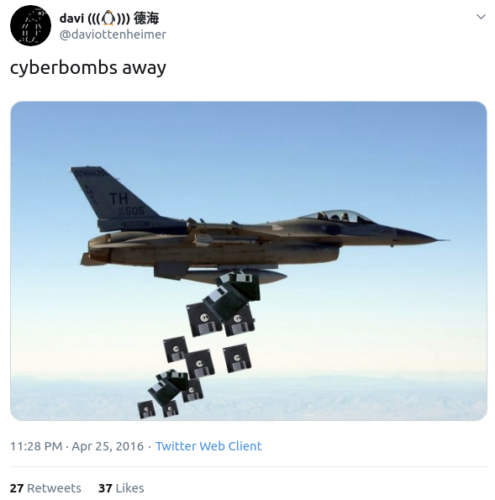
Let me be frank. Many, many, many years ago I sat in a windowless room in a desert and discussed disinformation tactics with military staff.

The details are as real as someone training on how to open the bomb bay doors.

Source: Me on Twitter, 2016

And what I keep seeing the press do today is amplify the disinformation.

“Epic fury” is definitely not what people should be hearing when they watch hundreds of innocent children being pulled dead from double-tap destruction of schools and hospitals.

According to Rohollah, his daughter survived the first strike and was moved to the prayer hall. The second strike hit before he could reach her. “My little girl was completely burned,” he said.

“There was nothing left of her. We could only identify her from her school bag, which she was still holding. She was completely burned.”

Double-tap is a war crime.

Beck isn’t confused.

Bayless isn’t confused.

The IDF social media team isn’t confused.

They all understand that a meme layer provides them cover, and they reproduce it because it works. Nobody was “just making content” the same way nobody was “just following orders.”

A toddler says “just joking” because they’ve learned that humor occupies a protected category, that you can’t punish a joke without looking like the problem. The Trump operation scaled that instinct to state power.

The meme doesn’t make the crime okay, it makes the crime undiscussable. You either engage with the meme on its own terms, in which case you’re participating, or you insist on seriousness, in which case you’re the killjoy who doesn’t get it.

Just look at Winkie’s new piece, which stays stuck at “isn’t this surreal.” He’s caught in the trap.

We’re all living in the nightmare of an evil-yet-also-camp presidency.

The campiness registers as an aesthetic observation when it’s actually a governance technique. The Call of Duty overlay on a cruise missile strike isn’t commentary on the strike, it’s the information operation that accompanies the strike. Two weapons, one target.

Disinformation is warfare and Americans are awash in it right now without defenses.

…referred to Hegseth as “GI Joke” or suggested that the war with Iran be known as “Operation Epstein Distraction”.

The Joker is the perfect figure to explain this because the whole point of the character is that the performance of chaos is the strategy. He’s not actually crazy, just using the appearance of crazy to make his actions unaccountable. “Why so serious” is a dominance move, not a question.

Think about what’s being done to you, right now, with your attention, while more and more children are dying in a forever war.