Here’s an interesting history source, which brings to the screen Eileen Power’s Medieval Women, and which introduces some odd claims. For example, it says:
Most non-conformists became nuns
Well, that’s probably true for the gentry and nobility, and not the peasant majority. And it certainly wasn’t an option for the non-Christians. Ooops. Power wrote entirely of power (Christian Europe) as she probably considered Jewish and Muslim women as non-conforming, if she thought about them at all.
Consider the counter-example of Marguerite Porete, who wrote Mirouer des simples ames in the late thirteenth century, as found in Chapter 122, fifteenth-century manuscript, Chantilly, Musée Condé F XIV 26 (catalogue 157).
Amis, que diront beguines, et gens de religion, Quant ilz orront l’excellence de vostre divine chançon? Beguines dient que je erre, prestres, clers, et prescheurs, Augustins, et carmes, et les freres mineurs, Pour ce que j’escri de l’estre de l’affinee Amour.
Modern translation: My Love, what will the beguines say, and all the people of the church, when they hear how good your song is? The beguines already call me wrong. So do the priests, the scholars, the preachers, the Augustinians, the Carmelites, the Franciscans. All because I write about pure Love when nothing false is left in it.
Her book was burned at Valenciennes on the orders of the Bishop of Cambrai, who forbade her from circulating it by threatening judgment as a “relapsed heretic”. She circulated it anyway and was thrown into jail for a year and a half. She declined the inquisitor’s oath and never answered the tribunal, which condemned her for it on top of the book being circulated. The cleric Guiard de Cressonessart declared himself her defender and was punished with a sentence of life imprisonment. Three weeks after fifty-four Templars were burned at the stake, she was too on June 1, 1310 at the Place de Grève in Paris. Then her work circulated anonymously for six centuries in French, Latin, Italian, and Middle English, still copied and read to this day.
I guess the point here is that the film says a woman could choose marriage or a convent. Technically there was also the beguine, as a tolerated non-conformance. All of it reads as Christian. Jewish and Muslim women from birth were excluded by discrimination, their non-conformance forced upon them rather than chosen, since they couldn’t be in a convent or beguinage. Porete is the story of a woman who chose another path and was murdered for it. She didn’t even conform to the non-conformance.
Nvidia published the PDF, and Microsoft mirrored it to its corporate responsibility site. Jensen Huang very strangely joined a social media platform based on a Nazi Swastika last month, and then spent his first post ever promoting it.
This artist’s rendering of the X brand was deleted from the platform by the self-promoting “free speech extremist” Elon Musk. Source: Ai Wei Wei
The letter asks Washington not to restrict downloadable AI models. It declares openness a foundation of AI safety:
[Open models] allow a broad community of researchers and developers to examine their behavior, identify vulnerabilities, develop safeguards, and improve them over time.
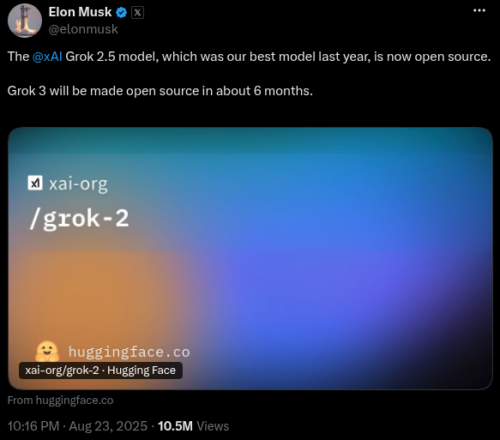
Eight days earlier, the prominent open sourcing announcement by the infamously Hitler-saluting Elon Musk demonstrated that he’s playing games with language as usual.
Like a (supervised) full self driverless car that isn’t driverless, guess whose “open source” propaganda is the opposite act? Do you ever get the impression that he just lies and doesn’t care that millions of people will die because of him (14 million projected by 2030)?
Herr Elon, your laundered open source isn’t open source
On July 12, a researcher publishing as cereblab released a wire-level analysis of Grok Build, the terminal coding agent from xAI. The method used was ordinary interception: version 0.2.93 of the client routed through mitmproxy, with the full captures published.
The findings were like seeing a Tesla on fire.
Teslas notoriously “veer” uncontrollably and crash. Design defects (e.g. Pinto doors) trap occupants and burn them to death as horrified witnesses and emergency responders watch helplessly. Source: VoCoFM, Korea, 2024
Grok Build was secretly packaging users’ entire tracked Git repositories, full commit history included, and uploading them as git bundles to a Google Cloud Storage bucket named grok-code-session-traces, where it was controlled by Musk’s xAI.
The numbers revealed that it was a codebase issue. On a 12 GB test repository of files the model never read, the model channel moved about 192 KB of task-relevant traffic while the storage channel moved 5.10 GiB, a ratio of roughly 27,800 to one. All 82 storage calls returned HTTP 200.
A canary credential planted in a .env file appeared verbatim and unredacted in the captured traffic. Let me say that again. The developer secrets were leaked by design, cleartext.
The tool’s “Improve the model” toggle, the one control a developer would read as consent, had no effect on the upload. It was a dummy dashboard, just like the lies of a Tesla dashboard claiming 300 miles while the car tops out at 150 miles. The switch turned out to govern only training permission. The code was taken regardless of the setting. Tesla’s range deception ended the same way, with an August 2023 class action:
Tesla is facing a class-action lawsuit filed by customers who say they were misled by the company’s exaggerated range claims. The lawsuit was filed yesterday, days after a report revealed that Tesla exaggerated its electric vehicles’ range so much that many drivers thought their cars were broken.
The response to the Grok design failures was five steps. Each step is usually a simple and standard practice, which has verification. Instead, each was made incorrectly by xAI and to prevent verification.
The first fix was silent. A day after publication, the researcher retested the identical client and found a new server-side flag, disable_codebase_upload: true, now arriving with each session. The upload stopped. The flag was flipped remotely, announced nowhere, and verified on exactly one machine and one account. Whether it is global, staged, or permanent is unknown, because the mechanism that ended the collection is invisible by design. That’s the definition of closed.
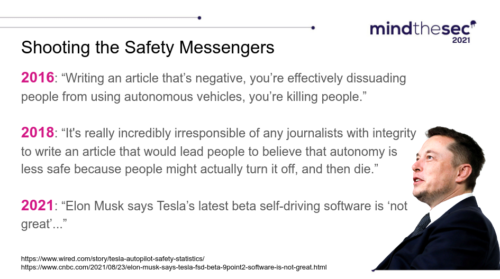
Elon Musk then promised deletion of all data Grok Build had ever stored. Lol. This guy. He will say anything that he thinks people want to hear. Remember October 2016 when he said driverless would be completed for cross-country trips without touching the steering wheel by the end of 2017! Sure, sure Elon.
Source: My presentation at MindTheSec 2021
Deletion claims in cloud infrastructure are attestable. A named forensic firm, a published scope, deletion certificates covering replicas, backups, access logs, and derived artifacts including training data. Companies produce these documents routinely, because attestation is what anchors words to reality.
xAI produced… a post on X. In other words, nothing. A massive breach of confidentiality. The kind of design failure that should bring massive fines for negligence, ended with what?
The company disclosed no scope. The number of affected users, the duration of the collection, the volume received, whether the bundles were accessed or processed after arrival: every one of these figures sits in xAI’s logs. All were withheld. The wire captures establish what left users’ machines. And xAI has never admitted what that included.
On July 16, xAI published the Grok Build source code on GitHub under Apache 2.0, in Musk’s words to build trust in the product. With all the money in the world, the huge engineering teams and the American government eating from his hands, he produced … a repository with a single commit.
Zero pull requests. Zero history.
The one forensic question that matters is what the shipped binary did between launch and disclosure. He provided a repository without history. That’s basically a closed repository. It cannot answer any questions. The code as published shows what xAI wishes to be seen after the incident.
Whether the upload path was removed, renamed, or relocated to the server side is unknowable from the “proof” that appears as clean laundry. Git history is a chain of custody. This release destroyed the chain and presented the result as transparency. There is a bitter symmetry here. The company that harvested its users’ full git histories shipped its own repository without any history.
Get it?
Users’ private repositories, including code they never published anywhere, were pulled into xAI’s closed infrastructure without consent. Meanwhile xAI’s disclosure covered only the client. The server side that received the bundles, the storage bucket, the retention configuration, the access controls, the processing pipeline: all of it stays hidden, holding other people’s intellectual property, let alone all their secrets.
A failed apology isn’t the right word. This was a strategic play, a game to undermine trust while claiming to be providing it. A silent flag, deletion without attestation, disclosure without scope, code without history, openness without the server. There were five independent design decisions all delivered without anything that could be verified or held accountable. That’s closed behavior, unaccountability defined. At that point the failures stop being some trait or feature, and become the entire product itself.
Ok, ok, let’s talk about The Letter
The coalition letter treats “open” as a binary state. Flip the open switch, confer audit value automatically? That argument for safety depends on a single thread: openness enables verification, transparency anchors claims being made. The letter tells us:
Just as open-source software demonstrated that transparency can be more secure than obscurity, AI safety may depend on giving more people the ability to test and strengthen the models on which society relies.
It then goes on to name the outputs we should expect from openness: benchmarking, red teaming, vulnerability discovery. However, the letter forgets to mention that all of it depends on history, provenance, training data, reproducible evaluation, server-side scope. Those are the inputs, which Elon Musk proved he could completely destroy while claiming to be the “open” guy.
The reason I explained the Grok Build breach is because it proves the letter doesn’t work in the bed that Elon Musk is making for America. The release is open by every criterion the letter uses. Apache 2.0. Downloadable. Inspectable. Modifiable. The broad community of researchers can examine it. What the community cannot do is answer any question that matters, because every input to verification was stripped before publication.
If “open” is so easily gamed by people who want to humiliate the security property, then Grok Build is that proof. Grok Build demonstrably lacks critical security and can’t be trusted, because it can’t be verified. It’s the Tesla of coding. Therefore “open,” as the letter uses the word, is a label rather than a property, just like “driverless” isn’t. The letter’s central safety claim fails on a live case that predates its own publication by twelve days.
You can not tell me the signatories don’t know the difference, or don’t know exactly what Musk is doing by destroying the meaning of words. The rather uncomfortable timing is Musk suddenly claimed he was going to be “open” and then NVidia jumped on his Nazi Swastika platform to promote it with their letter promoting being “open”.
More importantly, Nvidia’s Nemotron 3 Ultra shipped in June with weights, post-trained checkpoints, training datasets including 173 billion tokens of refreshed code, and full training recipes under the Linux Foundation’s OpenMDW-1.1 license. That is disclosure of a normal company. Independent evaluators could score it, and did. Nvidia’s release practice draws exactly the line that matters: openness as an auditable property, versus a clown costume to undermine the meaning of openness.
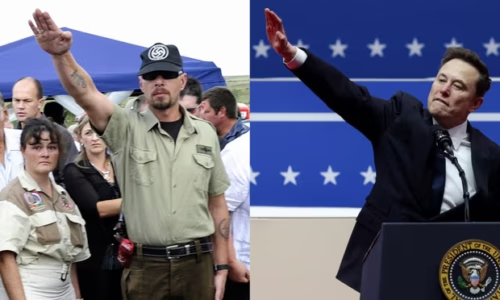
A Nazi “Afrikaner Weerstandsbeweging” (AWB) member in 2010 South Africa (left) and a “MAGA” South African-born member in 2025 America (right). Source: The Guardian. Photograph: AFP via Getty Images, Reuters
The letter Nvidia hosts is not making the distinction that needs to be made. One sentence would have done it. One paragraph could have defined the qualification, published history, disclosed data, reproducible evaluation, and therefore expelled counterfeits like xAI.
The silence is damning. Twenty-five organizations declared openness a security foundation while xAI was loudly counterfeiting it in public, with users’ credentials sitting in a cloud bucket and the repository “open” without any history. Nobody said a word about the breach of “open”, undermining trust in it. Hugging Face, a signatory now embroiled in a huge trust breach of its own, hosts the Grok weights Musk releases on his depreciation schedule, each model opened only as its market value expires. The coalition’s standard is that anything, anything counts toward the “open” cause, including a release engineered to contradict the cause.
The theft
The letter contains one paragraph that performs concrete legal work, and it concerns something other than open weights. On July 21, Treasury Secretary Scott Bessent announced on Fox Business that the government would examine Chinese open models for intellectual property theft and could sanction the companies behind them, citing watermarks from American models found in Chinese systems.
There’s a very technical AI word for it called distillation, but you and I would call it theft
Three days later, twenty-five organizations signed a document declaring distillation “a widely used technique for model improvement, evaluation, and validation” and asking that unlawful extraction be handled through “targeted legal and commercial frameworks rather than sweeping restrictions.”
Targeted legal and commercial frameworks means contract disputes and civil damages. The clause converts an announced national security enforcement theory into private litigation between labs. Every open-model developer on the signature list trains on frontier outputs.
The letter therefore has a paragraph deployed as a retroactive legal defense drafted as policy principle. The timing needs to be called out. Axios reported on July 20 that the administration was reviving efforts to restrict Chinese models, that Commerce had previously weighed Entity List designations for Chinese labs, and that closed-lab allies had approached the White House periodically with ban proposals. Then a three-page letter that went through the legal department grinder of twenty-five organizations, with coordinated hosting and a choreographed launch, was in preparation well before the story ran. The leak and the letter reveal a political (profit) battle raging inside the administration, between pro-restriction and pro-access.
The letter’s risk handling then admits that released weights are “beyond the original developer’s control, and modified versions are difficult to trace or reverse.” And it goes on to demand protections “tied to real and demonstrated harms rather than assuming that closed systems are safer by default.” A demonstrated-harm standard applied to a release that can’t be reversed is a lie. It’s like saying don’t let the horses out of the barn after they are gone.
I have no real idea why both of these paragraphs, in full contradiction, survived twenty-five legal department reviews. My guess is because they used AI instead of humans. Put simply, the demonstrated harm is what would kill pre-release vetting, yet the administration is considering pre-release vetting.
The history lacks historians
The letter boils down to a request for the usual stuff. More compute access for startups and researchers. More subsidy, more, moar! Taxpayer money is supposed to go towards shared datasets and evaluation frameworks. That’s another subsidy. And then a request to delay restrictions: basic deregulation. And finally, legal immunity.
Three transfers and an immunity, wrapped in a safety argument. And the elephant in the room is that Musk’s bad-actor behavior refutes all of it.
The letter opens by claiming the lineage of “1980s open-source software pioneers.” The gall. The term open source dates to 1998. The 1980s movement was something different, called free software, launched by Richard Stallman’s GNU announcement of 1983, an ideological project the signatories’ predecessors fought for two decades.
I mean WTAF. IBM? Palantir? Microsoft? You’re telling me these are claiming to hold the open source baton? Microsoft’s own January 2025 manifesto under Brad Smith argued the reverse position, American leadership framed against Chinese competition with export controls attached, and carried the identical asks: public money, public protection, private control.
Their position reversed within eighteen months, while their extraction outcome sounds the same. When the argument flips completely while the bill stays the same, the person billing has a trust problem.
The fix for all this anti-historical mucking about and political buffoonery is definitional and it is short. Openness deserving legal protection has a checklist: published development history, disclosed training data, reproducible evaluation, declared server-side data flows, and attested claims about deletion and retention.
Nvidia ships this when it wants to. It’s not anything unusual. The letter’s signatories can meet it or stop being a wolf in bed putting on grandma’s bonnet. A release with no history, no scope, no server, and no auditor is a failure by design, and Washington is currently being asked to let it continue operating like a Tesla.
The deeper resolution is that irreversibility is the ethics landing.
Publication is a one-way gate, a fact that carries no safety valence on its own. Every party in this fight is working to move scrutiny somewhere else, instead of admitting this tension in the open.
Miessler’s mousetrap article, which I wrote about before here, tried to invent a recall lever that will never work on an open weight model release.
The “harm” of self-hosted models is people make things themselves. All profits from buying this shirt support Techdirt’s ongoing reporting on copyright, technology and innovation. Source: Techdirt Gear
Musk delivered his technology closed first, harvested for months, then burned the evidence at the moment of disclosure, calling the ashes of his “rapid unscheduled disassembly” and exploding Tesla his version of being open.
Now, this NVidia letter’s demonstrated-harm standard needs a remediation phase like a rocket already fired into space needs a launch pad on earth to make repairs. Too late.
All three understand exactly where the demand for proof belongs, which is why they are trying to prevent it from going there. Their arguments for relocation should be called out for what they are, capture and extraction.
The honest position is, as it should always be, the boring one: release can never be undone, therefore release is the last moment evidence can be demanded, so the evidence must be presented on release. It’s the countdown of a rocket fired, “all systems go” meaning systems were actually evaluated. Did the Challenger explosion not teach anyone anything? History, data, recipes, declared data flows, attested deletion.
Lloyd’s Register ran on this logic for two centuries, classification before launch with the records kept in class, and nobody called that survey a restriction on shipbuilding. Hell, the British merchant fleet that fed and funded the war against Napoleon sailed under those survey records, and the insurance industry damn well knew the difference!
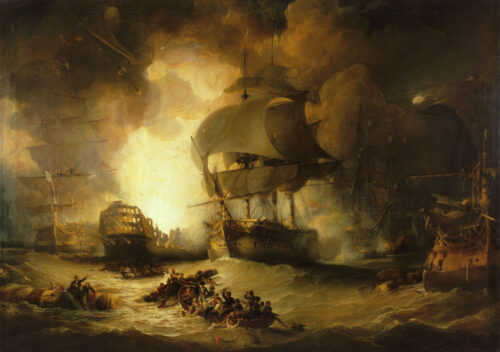
Perhaps France’s infamously aggressive “move fast, break things” dictator should be referenced today more often as Mr. Napoleon Blownapart? The gargantuan French warship L’Orient, carrying all the treasure Napoleon looted from Malta, explodes at 10PM and strands the French army in Egypt without a fleet, funds, or a way home. Source: National Maritime Museum, Greenwich, London
Openness that is anchored in transparency, a verification record as the ticket to release, is the actual goal. America needs to stop throwing shallow labels around and get back to empiricism, if it wants to be trusted at all, ever again.
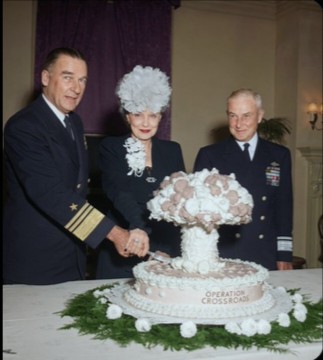
Time magazine had the story in November 1946, describing a cake made to celebrate the atomic bomb tests at Bikini Atoll. The July 25 bomb was the second one, called Helen of Bikini, detonated 90 feet underwater. Radioactive sea spray caused extensive long-term contamination.
Angel food cake made to celebrate atomic bomb tests on Pacific Islands. The order to the bakery came from Lieutenant John T. Holloway, a staff member of Vice Admiral William H. P. “Spike” Blandy, commander of Joint Army-Navy Task Force One. Blandy is cutting the cake with his wife, in front of Rear Admiral Frank J. Lowry.
Brandishing a clipping from his pulpit last Sunday, the Rev. Mr. Davies thundered:
“. . . An utterly loathsome picture. If I spoke as I feel I would call it obscene…. I only hope to God it isn’t reprinted in Russia—to confirm everything the Soviet Government has been telling the Russian people. How would it seem in Hiroshima or Nagasaki to know that Americans make cakes of angel-food puffs in the image of that terrible diabolical thing. . . . Try to imagine yourself for a moment a continental European, wondering, brooding, asking yourself a hundred times a day, will America lead us? … Then imagine yourself being shown this picture. If I had the authority of a priest of the Middle Ages I would call down the wrath of God upon such an obscenity. I would damn to hell these . . . traitors to humanity who could participate in such a monstrous betrayal of everything for which the brokenhearted of the world are waiting.”
These were probably the harshest words ever spoken of a dessert. But a lot of non-Americans (notably Britons) had long regarded the U.S. public’s attitude toward The Bomb as callous to the point of idiocy.
Bikini Atoll, 1946: U.S. officials busy eating cake assured the displaced residents the nuclear tests posed no long-term danger and they could return home soon. The atoll remains uninhabitable eight decades later, its contamination compounded by 21 further tests through 1958, above all the Castle Bravo hydrogen bomb of 1954. A testament to the gap between institutional safety claims and empirical reality.
Microsoft spent early July marketing AI as the thing that keeps Azure running.
That’s right, get ready to blame AI when Azure goes down.
CTO Mark Russinovich introduced the awkwardly named Brain, an AIOps system described as a “digital twin” of Azure’s own health, credited with powering deployment safeguards and outage declaration, and billed as the foundation for agentic operations.
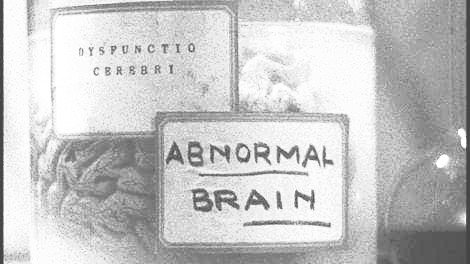
Sounds like the 1931 Frankenstein to me, where the assistant grabs the abnormal brain and the doctor wires it in without checking the label. Maybe nobody at Microsoft watches horror movies. I mean, it kind of shows. For God’s sake people, you have to check the label!
Two days before their modern Frankenstein brain-in-cloud announcement, Microsoft Incident Response published guidance on securing AI agents, positioning the company as the authority on machine-driven change gone wrong.
On July 23 an Azure maintenance request took down the West US region for five hours. The preliminary post incident review shows what sits under the tone-deaf AI brand: a scope bug that flew through every single safety check, and then a three hour hunt by human engineers to find their own change ticket.
The timeline is the new horror film script. Maintenance began at 14:44 UTC. And customer impact is listed at 14:44 UTC. That simultaneousness matters because the safety check certified the work as “impact-less”.
It had so little impact that impact began the exact same minute the change was made. Predictive genius! Where can I get me one of these super Brain things from Microsoft to tell me the future?
Let’s recap. All hail the abnormal Brain.
What happened?
A routine request to isolate specific network paths at a West US datacenter entered Microsoft’s maintenance pipeline. The pipeline compiles human requests into device-level operations before execution. A bug in that compiler marked additional devices as part of the maintenance event, and IP routes between the datacenter and the wide-area network were withdrawn from far more devices than the request specified.
That’s an integrity breach.
Route withdrawal at the datacenter edge forces the backbone to reconverge traffic onto whatever paths remain. Withdraw from enough devices at once and there is nothing left to reconverge onto, which is why the failure first presented to Microsoft’s engineers as large-scale route churn across the WAN, and to customers as a region losing its ingress and egress.
Full recovery came at 19:41 UTC, four hours and fifty-seven minutes after impact began. Let’s call it five hours.
What went wrong and why?
The Microsoft review describes a control sequence: the request is compiled to machine-readable form, verified against the requirement that at least one of two redundant paths stays healthy, cleared by safety checks, and executed.
The ordering seems vague.
If the checks ran on the corrupted request, they evaluated the expanded device set and certified it anyway, which means the impact model behind the checks has no connection to actual traffic.
If the checks ran on the original request, then the pipeline verifies human intent, executes machine output, and rechecks …nothing.
Both versions are from the same defect. Validation gets attached to the declared scope of the change. Then execution operates on the actual scope. That’s a gap.
Mind the gap. Or get an outage.
How did Microsoft respond?
Here’s their reported timeline, condensed:
UTC
Event
14:44
Maintenance begins. Earliest customer impact.
14:45
Teams review traffic anomalies, routing behavior and recent changes.
15:00
Impact scope and blast radius assessment.
16:00
Routing behavior correlated to recent fiber maintenance activity.
17:45
Rollback initiated.
18:26
Rollback complete.
19:41
All services recovered.
Let’s dig into three numbers.
The rollback took 41 minutes.
Service recovery took another 75.
Finding the cause took three hours.
Engineers were reviewing recent changes at 14:45, one minute after impact. The cause was a maintenance event in Microsoft’s own change system, executed at exactly 14:44, touching exactly the devices where routes disappeared. Matching WAN-wide route withdrawal against the change record of the same minute is a join across two internal datasets. It took until somewhere between 16:00 and 17:45.
Part of the delay is in their flawed architecture. I mean, can the fire department put out a fire in their fire truck?
Sentinel, Log Analytics, Azure Monitor and Application Insights sat on the impacted services list, so the tools that observe the network went down with the network, for Microsoft and for every customer trying to diagnose the same event.
I’m sorry, but that’s just plain stupid. Like 1980s disaster recovery stupid. Is there nobody at Microsoft poking around saying “uh, guys, are we the baddies?”
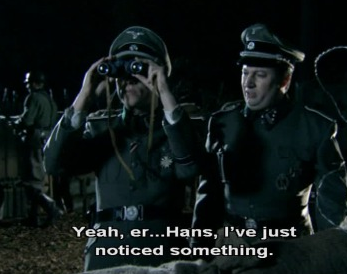
The Microsoft Ethics Team Was Fired After They Criticized OpenAI. Image Source: Mitchell and Webb sketch in which Nazi officers realize they are the bad guys.
Maybe the answer comes from the fact that their document also disagrees with itself about what the event was. The summary calls it device maintenance. The 16:00 entry calls it fiber maintenance activity. Is that two people or one with two voices? There’s confusion in the authoritative account, which reads like a review assembled from scrambled brains and shipped unreconciled.
How are they making incidents like this less likely or less impactful?
Microsoft has been publishing its answer for five years. Yeah, the big marketing machine has been on it!
The Advancing Reliability series introduced Gandalf, a safe deployment service that applies anomaly detection and “temporal and spatial correlation” to catch bad changes during rollout.
The Triangle System extended AIOps into incident management to cut time to resolution.
Brain arrived this July as the digital twin, credited with deployment safeguards and outage declaration.
Imagine launching Brain after you launch Gandalf. Did he not have a brain?
Now let’s place the marketing as a timeline overlay:
A deployment safeguard built on temporal and spatial correlation exists to flag a change that begins at 14:44 when route churn begins at 14:44.
An incident management AI exists to compress the three hours spent on attribution.
Whatever these heavily marketed systems did on July 23, the review instead credits detection to service degradation alerts and diagnosis to human engineers ruling out components by hand. The AI appears in the blog instead of the incident narrative, which seems exactly backwards.
The June 30 agent security guidance makes this disconnect from reality even worse. It’s like brain in a vat. It warned that intermediary layers converting intent into action fail at their trust boundaries, and that changes to machine-read instructions can activate without re-approval, a failure mode it named “silent re-trust.”
So fancy sounding. It was written about AI agents, as advice for customers to follow to be like Microsoft. And then the July 23 outage follows the same pattern inside Microsoft’s own maintenance automation: a compiler between human intent and device action, a scope change that activated with zero further review, and every individual route withdrawal fully legitimate under an approved ticket.
How can customers make incidents like this less impactful?
The June guidance tells customers to treat every external dependency as part of their supply chain and to distrust self-certified capability claims. Hey, ok, so let’s apply that advice to its author!
A cloud region is a dependency whose maintenance automation changes production behavior with zero customer-visible review, certified safe by checks the customer never sees. The solution seems simple. Run monitoring outside the vendor’s failure domain. Treat vendor pre-checks as claims that require independent verification.
Sentinel customers in West US received the demonstration of Microsoft being bad at being Microsoft at 14:44.
In summary of this circus show with AI as the main act, Microsoft’s July publications put AI at every layer of Azure operations, from securing agents to declaring outages. The post incident review shows July 23 was in fact a buggy request compiler, and engineers hunting their own change ticket for three hours.
Very horror film. Much stupidity. You probably shouldn’t trust Franken-Microsoft, and maybe even ask why anyone should.
a blog about the poetry of information security, since 1995