A federal judge who orders the compilation of lists of Jews, dismisses Jewish historical objections to the compilation of lists of Jews, and wraps it in calm institutional reasoning is performing the function of Nazism. Nothing could be more precise about what “never again” was built to identify than this.
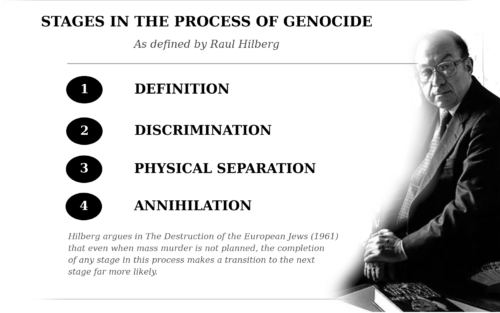
A federal judge dismissing Jewish objections to the creation and compilation of lists of Jews is literally performing Stage One of Raul Hilberg’s destruction process.
Hilberg, the founding scholar of Holocaust studies, identified the “process of destruction” as consisting of stages: definition, expropriation, concentration, and annihilation. These categories have remained the basic framework in Holocaust historiography.
The deep historical scholarship on the Holocaust says you don’t get to call this judge’s order of “Stage One” something else just because he doesn’t post on X, wear an X on his sleeve or carry a Nazi party card.
Ruether wrote that antisemitism is structural before it is personal.
Heschel wrote that supersessionism is colonization: the replacement of Jewish meaning with Christian meaning while claiming universality.
Jackson titled his book after Mordecai, the Jew who wouldn’t bow and was marked for destruction because of it.
Arendt said the whole Holocaust ran on the calm people like this judge who found Jewish objections to be an inconvenience.
And I believe there is substantial evidence to explain how and why this judge is so antisemitic.
Penn doesn’t have a list. Pappert ordered one
Penn stated it “does not maintain employee lists by religion.” This is critical. Pappert isn’t ordering release of any existing record. He’s ordering a new instrument of identification of Jews. That’s not administrative compliance. That’s creation of the Holocaust mechanism itself. Hilberg’s Stage One speaks to the role of existing lists for targeting and creating new ones. The Germans used “synagogue membership lists” and “routine but mandatory police registration forms” alongside records “provided by neighbors and municipal officials.” The EEOC subpoena demands a list be created with contact information for employees affiliated with Jewish organizations. The parallel of the judge’s words to Nazism is exact.
The Jewish community unanimously opposed
Chabad, Hillel, and MEOR all filed separate briefs opposing the antisemitic subpoena. These aren’t lawyers managing liability. These are the three institutional pillars of Jewish campus life at Penn. The organized Jewish community spoke with one voice: never again.
Pappert unilaterally overrode all of them and went out of his way to erase history. Every Jewish organization intervened in court and was dismissed by a judge for having “unfortunate and inappropriate” concerns about their own fate based on basic history.
The EEOC itself is compromised
The “stated purpose” defense has no legs.
Pappert’s entire reasoning rests on the subpoena having a legitimate purpose. But NPR reported yesterday that the EEOC under Trump-appointed chair Andrea Lucas has set “a new agenda” at odds with the agency’s traditions and mandate.
Trump fired two Democratic commissioners before their terms expired, something “no president had ever done before.” Former EEOC chair Charlotte Burrows called it “a real radical effort to advance one ideological perspective.” The EEOC has explicitly listed “campus antisemitism probes” as a stated enforcement priority under Lucas.
The agency requesting the list of Jews has been purged, captured, and repurposed. Pappert’s reasoning assumes good faith from an institution that has been stripped of it. Pappert’s “understandable purpose” is a concealed threat to Jews. He wrote procedural reasoning to justify “never again” doesn’t exist to him as a moral imperative.
This appears to be because he comes from a formation that trained him to treat objection to state documentation as obstruction, when the objection is the entire point.
Thirty-two pages of measured legal reasoning were created to force a university to compile and hand over lists of Jews to a federal agency, run by known antisemitic extremists who boast the White House is “already 40% Nazis“.
The Jewish community’s objections, rooted in the specific historical knowledge of where this leads, were dismissed by the judge despite having a legitimate concern. His measured erasure of this Jewish concern is what aligns Pappert with the pattern of Nazism. It is the exact calm pattern.
Pappert likely will continue to claim he wrote a ruling about administrative law. The scholarship says he performed the operation of Nazi Germany: took Jewish knowledge, declared it illegible, and replaced it with a Christian-derived framework of erasure he believes is neutral ground.
Nazis were calm and organized, orchestrating erasure of Jews. The entire Holocaust apparatus ran on procedural confidence that the purpose was legitimate and the process was sound. The literature says that’s exactly how it works. The reasonable government administrator, the institutional voice that tells the Jews their pattern recognition is rhetorical excess, is the precise mechanism of oppression and genocide. Not the exception to it.
“Ineptly worded”
Pappert acknowledged the EEOC’s request was “ineptly worded” but ordered compliance anyway. The judge admitted the instrument was flawed and still forced the university to hand over the list. If the request is so badly constructed that even the judge calls it inept, how can Jewish concern about that same request be “unfortunate and inappropriate”?
Pappert’s own language convicts him: the request was bad, the Jews were right to worry, and he ordered compliance anyway.
Supersessionism
Supersessionism is the technical term. It operates as default architecture in people formed by it. Pappert’s Albany-Villanova-Notre Dame (Catholic) pipeline didn’t teach him to recognize Jewish survival knowledge as a legitimate interpretive framework. It taught him that institutions with stated purposes deserve absolute deference to Christian authority, and that people who refuse that deference for any reason are escalating.
The Forward reported days ago that supersessionism is driving modern antisemitism among Christian influencers, with figures like Prejean Boller declaring “The Catholic Church is the True Israel” and “Christians are the spiritual Semites.” The USCCB itself has had to admonish Catholic influencers, pointing to the 2015 Vatican document “The Gifts and Calling of God Are Irrevocable.”
Ruether’s framework says antisemitism is structural before it is personal. Heschel says supersessionism is colonization, the replacement of Jewish meaning with Christian meaning while claiming universality. Jackson says the pattern is Mordecai: the Jew who won’t bow is recast as the problem.
Pappert did all three antisemitic markers in a single ruling.
He replaced Jewish historical knowledge with institutional trust. He claimed his framework was neutral while theirs was emotional. And he told the Jews who wouldn’t bow to the subpoena’s stated purpose that their refusal was the “unfortunate and inappropriate” one, not his own.
Arendt saw it in Jerusalem. The banality wasn’t a footnote. It was the finding. The machinery ran on people like Pappert who trusted process, followed procedure, and found the objections of Jews to be an inconvenience to the orderly functioning of the system that harmed them.
Pappert isn’t at the end of that sequence. He’s at the beginning of it. And “never again” correctly identifies him as the beginning, to prevent the end that he isn’t equipped or willing to prevent.
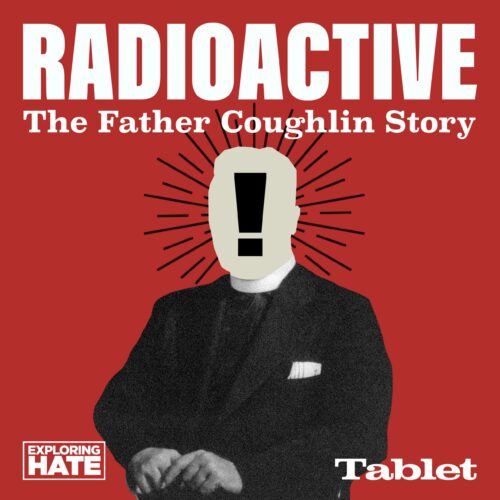
The American Catholic pipeline didn’t teach Pappert to hate Jews overtly, like the Christian Front, whose Irish-Catholic members organized seditious and antisemitic violence in Boston and New York, or Father Coughlin, the Catholic radio priest whose broadcasts reached tens of millions with pro-Nazi antisemitism he called “buy Christian“. It taught him to refuse to recognize Jewish concerns as structurally legitimate. That’s the more dangerous output.
Source: Radioactive Podcast
The scholarship doesn’t hedge
A federal judge ordering the compilation of lists of Jews while dismissing Jewish objections is performing Stage One of Hilberg’s destruction process. The copious literature names Pappert for what he is and why he’s doing it.
“Never again” was built to stop him.
Here is further reading on Pappert’s deeply antisemitic roots and his related ruling:
USHMM “Locating the Victims” for the direct parallel to institutional record compilation
Gregory Baum, Is the New Testament Anti-Semitic? (1961)
Rosemary Ruether, Faith and Fratricide: The Theological Roots of Anti-Semitism (1974)
Susannah Heschel, The Aryan Jesus (Princeton, 2008)
Timothy P. Jackson, Mordecai Would Not Bow Down: Anti-Semitism, the Holocaust, and Christian Supersessionism (Oxford, 2021)
Raul Hilberg, The Destruction of the European Jews (1961, revised 1985) for the stages framework
Charles Gallagher, Nazis of Copley Square: The Forgotten Story of the Christian Front (Harvard, 2021) for the Irish-Catholic pipeline
Mary Christine Athans, The Coughlin-Fahey Connection (1991) for the Irish seminary roots of American Catholic antisemitism
Edwin Black, IBM and the Holocaust (2001) for how institutional data collection enabled identification
On this past shabbat I sat in the synagogue and listened to the Rabbi on my left, the Rabbi on my right, and the Rabbi in front of me, relate their views of the Passover coming tomorrow. They asked me to flip the pages, to ask questions, and I paused here:
How can this wisdom be? On this week of all weeks, do we forget?
On March 30, 2026, the Knesset passed a law imposing the death penalty on any person who “intentionally causes the death of a person with the aim of denying the existence of the State of Israel.” Prime Minister Benjamin Netanyahu voted for it in person.
The law was written to kill a specific ethnic group, Palestinians.
…will apply in Israeli courts, but only to terrorist activities that are motivated by the wish to undermine the existence of Israel. That means Jews will not be indicted under this law.
But the statute’s language has fatal flaw, because the ethnic targeting was not legally restricted to its targeted ethnicity. It tries to hide its true intent by defining a crime of intent.
Intent.
By this law’s own terms, no living person has done more by intent to negate the existence of the State of Israel than Benjamin Netanyahu himself. What follows is this plain evidentiary case, which everyone already can see, beyond what is known in classified briefs.
And it’s worth noting, before we begin, exactly when and why Israel ended its death penalty after they killed an innocent man.
His name is Meir Tobianski.
Meir Tobianski, an Israeli Defense Forces officer falsely accused and immediately executed by Israeli intelligence in 1948
Arrested, convicted, and executed by firing squad all on the same day, June 30, 1948. Posthumously exonerated of all charges a year later, because his widow Lena demanded an investigation. Ben-Gurion issued a public exoneration and had his remains reburied with full military honors. The wrongful execution served as a painful reminder of the flaws of the death penalty, and was a direct catalyst for Israel abolishing the death penalty for murder in 1954.
His gravestone famously reads “killed by mistake.”
Israel learned in its first weeks of existence that the state kills innocent people. It abolished the death penalty for murder, as a foundational tenet, because of that lesson (Mishnah Makkot 1:10). Now Netanyahu is negating the state, with a 90-day execution window and no right of appeal, so he can kill a targeted ethnic group, Palestinians.
I’ll say it again, the death penalty for murder itself is the negation of the state of Israel. The new law puts civilian defendants back under the kind of summary state-killing authority that produced the Tobianski disaster.
Netanyahu is literally corrupting intelligence apparatus to undermine Israel all the way back to pre-1948.
For 72 years, the rejection of state execution was part of Israel’s legal identity, a democratic commitment arising from the state’s own founding-era failure of justice. Netanyahu has reversed it. This is not incidental to the negation argument. It is the negation argument.
A state that defined itself in part by abolishing the death penalty after killing an innocent man, and whose prime minister reinstates it under conditions designed to deny due process, has been negated in its constitutional character by that act alone.
I. Statutory Framework
The operative provision of the Death Penalty for Terrorists Law (2026) amends Israel’s Penal Law to provide:
Any person who intentionally causes the death of a person with the aim of negating the existence of the State of Israel shall be sentenced to death or life imprisonment.
Two elements must be established:
Intentionally causing death
Doing so with the aim of negating the existence of the State of Israel
What “intentionally causes the death” means under Israeli law.
The statute must be read within the Israeli Penal Law (5737-1977). Section 18(b) provides that “act” includes an omission. Section 18(c) defines “omission” as refraining from doing what is a duty under any law or contract. The source of the prime minister’s duty is constitutional. Basic Law: The Government provides that “the Government is the executive authority of the State” and that “the Army is subject to the authority of the Government.” The prime minister, as head of the executive, bears a legal duty to protect the security of the state and its citizens. A deliberate failure to act on that duty, where death results, constitutes “causing death” under the statute.
Section 20(b) further provides: “foreseeing the consequences as almost certain to occur shall be deemed to be an intention to bring them about.” This is the near-certainty doctrine. It means that where a defendant foresees death as a near-certain consequence of his policy decisions, intent is established as a matter of law. He need not desire the deaths. He need only foresee them as almost certain and proceed anyway.
Section 300(a), as amended in 2019, defines murder as causing the death of a person “intentionally or indifferently.” The indifference standard is directly relevant to a leader who receives repeated warnings of catastrophic risk and dismisses them for political reasons.
What “the existence of the State of Israel” means under Israeli law.
The statute does not define “the State of Israel.” It does not limit “negation” to territorial dissolution. It does not specify that negation must be pursued through a single act of violence. It provides no limiting construction whatsoever.
But Israeli constitutional law does define what the state is. Basic Law: Human Dignity and Liberty (1992), Section 1A provides: “The purpose of this Basic Law is to protect human dignity and liberty, in order to establish in a Basic Law the values of the State of Israel as a Jewish and democratic state.” This is not aspirational language. It is constitutional law with super-legal status, giving the Supreme Court authority to disqualify any legislation contradicting it. The 1994 amendment to this Basic Law further directs that fundamental human rights “shall be upheld in the spirit of the principles set forth in the Declaration of the Establishment of the State of Israel.”
The State of Israel, as constitutionally defined, is a Jewish and democratic state governed by the rule of law. We argue that “existence” must encompass this constitutional character, because Basic Law: Human Dignity and Liberty defines the state’s identity, and a reading limited to territorial boundaries would leave that identity unprotected by the statute’s own terms. Israeli legal discourse has historically construed “negation of the existence of the State” (שלילת קיום מדינת ישראל) as referring to physical destruction or denial of the right to exist. This brief argues that construction is incomplete: a state whose democratic institutions, independent judiciary, security architecture, and international standing have been systematically destroyed has been negated in its existence as constitutionally defined, even if its territorial boundaries remain intact.
Netanyahu easily meets both elements.
II. Element One: Intentionally Causing Death
A. The Iran War: Ongoing Casualties Under a War of Choice
This section carries particular legal weight. Because Basic Law: Human Dignity and Liberty §10 prohibits retroactive criminal punishment, the October 7 failures, the judicial overhaul, the hostage obstruction, and the Gaza campaign cannot independently ground a charge under a March 2026 statute. They are evidence of intent and pattern. The Iran war is the ongoing conduct that satisfies the temporal requirement: Israeli civilians are dying under this law’s operation, from a war Netanyahu initiated and continues.
Donald Trump’s and Benjamin Netanyahu’s war. A joint venture, [following] Netanyahu’s incessant urging of American presidents to confront Iran militarily.
The retaliatory consequences were foreseeable and foreseen. Iran responded with waves of missile and drone strikes on Israeli territory. As of late March 2026, at least 20 Israeli civilians have been killed and more than 6,000 wounded. The largest single strike killed nine civilians in a residential neighborhood of Beit Shemesh on March 1. Iranian cluster munitions have struck Tel Aviv, Beersheba, and Dimona. On March 29, an Iranian missile struck a chemical plant in the Ne’ot Hovav industrial zone, causing a hazardous materials leak and civilian evacuation. Strikes continued on and after March 30, the date of the law’s enactment.
By the tenth day of the war, Iran had fired 300 missiles at Israel, nearly half carrying cluster submunitions banned under international treaty, targeted at residential areas. ACLED recorded more than 90 attempted strikes on Israel in the first five days alone, with around 20 directly hitting civilian areas.
There is a sense in Israel that the desire to keep Israelis in this perpetual state of war also serves the prime minister’s political objectives. It is very difficult to go to elections when you are in the middle of a war.
The war was initiated by Netanyahu after decades of personal advocacy for a military confrontation with Iran. The retaliatory strikes killing Israeli civilians were foreseeable as near-certain. They are ongoing as of the date of the law’s enactment. Under §20(b), a leader who initiates a war knowing retaliatory strikes on his civilian population are almost certain, and who continues to prosecute that war for political reasons documented by Israeli analysts, has intentionally caused the resulting deaths as a matter of law. These are post-enactment deaths, caused by post-enactment decisions, under a law Netanyahu voted for on the same day Israelis were sheltering from incoming Iranian missiles.
B. Gaza: Over 51,200 Dead Under Direct Command Authority
The factual record for deaths in Gaza is established by multiple Israeli-admissible sources: IDF internal investigations, Shin Bet operational reports, testimony before the civilian commission of inquiry, and contemporaneous military orders issued under Netanyahu’s command authority. The International Criminal Court issued arrest warrants in November 2024 based on the same underlying evidence, but Israeli courts do not recognize ICC jurisdiction, and this brief relies on domestic sources alone.
The death toll as of March 2026 exceeds 51,200, the majority women and children. These deaths occurred under Netanyahu’s direct command authority as head of the war cabinet. The deliberate restriction of food, water, and medical supplies to a civilian population, as documented by the IDF’s own operational records, satisfies the near-certainty standard of §20(b): death was foreseeable as almost certain, and the policy was maintained. Intent.
C. October 7, 2023: 1,200 Dead Through Deliberate Policy Failure
An independent civilian commission of inquiry (November 2024), chaired by retired judge Varda Alsheikh, found after hearing 120 witnesses that Netanyahu was “responsible for undermining all decision-making centers, including the cabinet and the National Security Council, in a way that prevented any serious discussion that includes a plurality of opinions on significant security issues.”
The commission found the October 7 massacre was enabled by “arrogant” groupthink led by Netanyahu, which stifled critical voices and entrenched a false belief that Hamas could be managed with money. Intent.
The Shin Bet’s own investigation (March 2025) found the agency possessed Hamas’s actual battle plans and did not consider them a realistic threat. The Shin Bet also blamed Israeli policies of propping up Hamas rule in Gaza to buy calm on the border, a policy directed by the Prime Minister’s Office.
An academic analysis published in the RUSI Journal found that “intelligence agencies fell in line with political priorities dictated by the Prime Minister’s Office, who believed that Hamas was contained and refused to accept any evidence to the contrary. This is because that containment strategy served a wider political purpose of freezing and prolonging the status quo.”
Netanyahu has never accepted personal responsibility for his personal failures.
The causal chain satisfies Israeli domestic law, though no Israeli court has previously applied criminal omission liability to a head of state’s policy decisions. This is a novel application. The unprecedented nature of the conduct justifies it.
The prime minister has a legal duty to protect the security of the state and its citizens. His deliberate suppression of intelligence processes and security infrastructure constitutes an omission within the meaning of Penal Law §18(b) and (c). The Shin Bet possessed the battle plans. The intelligence agencies warned. Netanyahu’s political directives overrode their assessments.
Under §20(b), foreseeing the consequences of a policy as almost certain to result in death, and proceeding anyway, is deemed intention as a matter of law. Under §300(a), causing death “indifferently” constitutes murder. A prime minister who receives warnings that his containment policy is based on a false assessment of Hamas, who dismisses those warnings to serve political objectives, and who leaves the border manned at a fraction of necessary strength, has caused death through omission with at minimum indifference to the outcome.
Hamas’s independent decision to attack is an intervening cause, and this admittedly is the weakest causation link presented here. It is included because the civilian commission’s finding of directed failure, not parallel failure, establishes causal primacy at the policy level and because the pattern of deliberate indifference to Israeli lives is central to the aim element.
Intent.
D. Hostage Deaths: Evidence of Aim, Not Independent Causation
The following evidence does not establish an independent count of murder. Hamas killed the hostages, and the intervening cause problem is acknowledged. This section establishes the pattern of prioritizing political survival over Israeli lives that satisfies the “aim” element of the statute.
Of the 251 people kidnapped on October 7, hostages died in captivity while Netanyahu obstructed deals for their release. CNN reported, based on Israeli documents, that Netanyahu derailed a potential hostage deal in July 2024 by introducing last-minute demands, and that at least three of six hostages found dead in Gaza were due for release under a May 2024 draft agreement.
The former spokesman of the Hostages and Missing Families Forum stated: “There is no doubt that Netanyahu is preventing a deal. Netanyahu knows that if he goes to elections at this time he won’t be able to form a new government, and he is motivated by cold political considerations.” He identified the mechanism: “The moment the hostages are released, Bezalel Smotrich and Itamar Ben Gvir will leave the government because they’ll think the price was too high.”
The Hostage Family Forum stated: “The Israeli government made a conscious and deliberate decision to sacrifice the hostages.”
These statements constitute available witness testimony on the intent element. The hostage families are not outside observers. They are direct victims of Netanyahu’s policy who received contemporaneous information about the reasons deals were blocked.
Their testimony establishes that Netanyahu chose coalition survival over the lives of Israeli citizens. Under the “aim” analysis, this is direct evidence that the negation of the state’s duty to protect its people was not incidental but instrumental to Netanyahu’s political objectives.
Intent.
III. Element Two: With the Aim of Negating the Existence of the State of Israel
A. Destruction of Democratic Governance
Haaretz documented that former Supreme Court President Aharon Barak stated Israel was “already under one-man rule and no longer a liberal democracy.” Barak was not speaking metaphorically. He was describing the structural consequence of the judicial overhaul.
a national security threat that imperiled Israel’s existence.
Netanyahu dismissed the warning.
The judicial overhaul aimed to: strip the Supreme Court of the power to review legislation, let the Knesset override court rulings by simple majority, and give the governing coalition control over judicial appointments. Basic Law: Human Dignity and Liberty defines Israel as “a Jewish and democratic state” and grants the Supreme Court super-legal authority to enforce that definition. The judicial overhaul was a direct assault on the constitutional provision that defines what the state is. If the state’s legal identity is democratic, then destroying the institution that enforces that identity is negation of the state as constitutionally defined.
B. Corruption of Security and Intelligence Institutions
Shin Bet Director Ronen Bar stated in a court filing that Netanyahu demanded “personal loyalty from the head of the Shin Bet instead of loyalty to the state,” that he sought to use the intelligence service “against political opponents, against protests, against citizens who came out to defend democracy,” and that he pressured Bar to write professional opinions formed by Netanyahu to avoid appearing in court for corruption charges.
PBS reported that Netanyahu fired his defense minister for pushing back on Gaza policy, then pressured the military chief to resign, and the new chief then sacked the military spokesman. The Shin Bet dismissal came while the agency was investigating ties between Netanyahu advisers and Qatar, and while it was probing the leak of classified documents that provided Netanyahu political cover.
Former deputy chief of staff Yair Golan described this pattern as making Netanyahu “a direct threat to Israel’s security and rule of law.”
When the leader of a state demands personal loyalty over institutional loyalty from the intelligence services, replaces security chiefs with political loyalists during wartime, and fires investigators probing his own inner circle, the state’s security architecture ceases to function as a sovereign institution and becomes a personal instrument.
This is negation.
C. Empowerment of Actors Whose Stated Goals Negate the Democratic State
Netanyahu’s coalition partner Itamar Ben-Gvir was convicted by an Israeli court of racist incitement and supporting the Kahanist terror organization, and was exempted from military service due to extremist activities. He was famous for his threats against Prime Minister Yitzhak Rabin before Rabin’s assassination. Netanyahu created an enhanced cabinet position for him overseeing all of Israel’s police.
Netanyahu did not merely tolerate these figures. He gave them the instruments of state power. Their program, if implemented, makes Israel ungovernable as a democracy and indefensible under international law. This is not a policy disagreement. It is the systematic installation of actors whose explicit program is to replace the democratic state with an ethno-nationalist one.
D. Destruction of International Standing and Sovereign Capacity
The ICC arrest warrant against Netanyahu was the first ever issued against the leader of a Western-backed democratic country. All 125 ICC member states are legally obligated to arrest him. The sitting prime minister of Israel cannot travel to most of the democratic world.
distrust of Netanyahu’s ability to rule has deepened and broadened across the public from its already high levels before the war.
The foreign ministers of Australia, the United Kingdom, France, Germany, and Italy jointly condemned the death penalty bill as undermining democratic principles. The Secretary General of the Council of Europe called it “a major civilizational setback.”
A state whose leader is an international fugitive, whose legislation draws condemnation from its principal allies, and whose conduct has generated genocide proceedings at the International Court of Justice has been negated in its capacity to function as a sovereign member of the international community. Netanyahu is the direct cause.
E. Obstruction of Accountability as Ongoing Negation
Netanyahu structured the October 7 inquiry so that he controls the composition of the investigating body. The opposition called it a “cover-up commission.” The Movement for Quality Government said:
This is not an investigative commission, this is a cover-up commission.
He has refused to allow a state commission of inquiry, the established Israeli legal mechanism for investigating catastrophic government failures, used after the Yom Kippur War, Sabra and Shatila, the Rabin assassination, and the Second Lebanon War.
A state that cannot investigate its own worst security failure because the responsible leader has captured the investigative process has been negated in its capacity for self-governance and institutional correction.
IV. The Intent Standard Under Israeli Law
The statute requires that the defendant act “with the aim of” negating the state’s existence. Critics will argue that Netanyahu does not subjectively intend to destroy Israel. Israeli law forecloses this defense on multiple grounds.
First, and dispositive: the law’s own application standard defeats the defense. Under Justice Aharon Barak’s purposive interpretation framework, which dominates Israeli jurisprudence, a statute is read through both its subjective purpose (legislative intent) and its objective purpose (the values it serves within the legal system). The subjective purpose of this law is discriminatory: it was designed to execute Palestinians. But the objective purpose of any criminal statute must conform to Basic Law: Human Dignity and Liberty §1A, which requires all laws to befit the values of Israel as “a Jewish and democratic state.”
Section 8 of the same Basic Law provides that rights may not be violated except by a law befitting those values. A criminal statute that applies by its own terms to “any person” cannot be purposively construed to exclude a class of persons without violating the equal application principle derived from §1A. The law either fails constitutional review under §8, or it applies to any person, including a prime minister. There is no construction that saves the statute and exempts Netanyahu.
The Association for Civil Rights in Israel is making exactly this argument in its Supreme Court petition. If the court reads “aim” as inferable from conduct when the defendant is Palestinian, it must read “aim” as inferable from conduct when the defendant is a prime minister. The law cannot have one meaning for one class of defendant and a different meaning for another.
Second, Penal Law §20(b) provides that “foreseeing the consequences as almost certain to occur shall be deemed to be an intention to bring them about.” This is a statutory equivalence, not a discretionary inference. It must be acknowledged that §20(b) addresses כוונה (intention), not מטרה (aim), and that Israeli criminal law treats aim as a higher mens rea standard requiring subjective purpose. But the drafters of this statute collapsed that distinction by design. The law applies מטרה to Palestinian defendants through inference from conduct, not through proof of subjective purpose. No Palestinian defendant is asked to confess a philosophical commitment to Israel’s non-existence. The “aim” is read from the act of killing. Having collapsed the distinction between aim and intention in application, the drafters cannot resurrect it as a defense. Netanyahu was warned by the IDF Chief of Staff that his judicial reforms imperiled Israel’s existence. He was warned by intelligence agencies that Hamas was not contained. He was warned by allies that his military conduct would result in international isolation. He dismissed every warning and pursued the course that produced exactly the predicted results. Under §20(b), foreseeing the negation of the state as a near-certain consequence of his actions, and proceeding, is deemed to be intention to bring that negation about. And under the law’s own application standard, that intention is functionally indistinguishable from aim.
Third, the negation of the state is not a side effect of Netanyahu’s pursuit of personal power. It is the mechanism. The civilian commission of inquiry documented that Netanyahu consolidated authority by “undermining all decision-making centers.” He could not achieve personal dominance without destroying institutional independence. The destruction of democratic governance was not collateral damage. It was the method. Under the statute’s own “aim” standard, where the negation of the state is inseparable from the means by which the defendant pursued his objectives, the aim element is satisfied.
Fourth, Netanyahu’s ongoing corruption trial corroborates the motive structure. He is currently being prosecuted for bribery, fraud, and breach of trust. The corruption charges establish a documented pattern of governance oriented toward personal benefit at the expense of public duty. The systematic dismantlement of institutions documented in this brief was not ideological. It was instrumental. He attacked the judiciary because it was trying him. He fired the Shin Bet director because the agency was investigating his advisers. He obstructed the October 7 inquiry because it would assign him personal responsibility. He prolonged wars because ceasefires would trigger elections he would lose. Each act of state negation served a personal objective. The corruption trial is evidence of the pattern. The pattern is evidence of the aim.
V. Procedural Path: Immunity and Prosecution
Under Article 17 of Basic Law: The Government, the attorney general must approve the initiation of a criminal investigation against a sitting prime minister. If the investigation produces grounds for an indictment, the attorney general may indict the prime minister. This is settled law. Netanyahu is currently being prosecuted under this framework for corruption charges. The mechanism for indicting a sitting prime minister exists and is operational.
A prime minister may request the Knesset to grant immunity under Article 4 of the Immunities, Rights and Obligations of Knesset Members Law (1951). The law provides four grounds for granting immunity, none of which are automatic. No member of Knesset has been granted immunity since 2005. Netanyahu previously requested and then withdrew an immunity request in his corruption case. A request for immunity from charges of causing death with the aim of negating the state’s existence would require a Knesset majority to approve, and would be subject to review by the Supreme Court, which retains the authority to strike down immunity decisions that lack evidentiary basis.
If immunity is denied, the prime minister faces trial in the Jerusalem District Court. Under Article 18 of the Basic Law, should the prime minister be convicted of an offense involving moral turpitude, the Knesset may remove him by majority vote. If the Knesset declines to remove him, the government is considered to have resigned upon a final conviction, with the prime minister continuing to serve only until all appeals are exhausted.
The procedural framework exists. There is no constitutional barrier to prosecution. The only barrier is political will.
It should be noted that Netanyahu has systematically attacked the very office that would need to authorize his prosecution under Article 17. He has sought to strip the attorney general of independence, fired the Shin Bet director during active investigations of his advisers, and attempted to replace oversight officials with loyalists. The obstruction of the prosecutorial mechanism is not merely a procedural obstacle. It is itself evidence of the crime charged: an act of state negation that doubles as consciousness of guilt. A defendant who dismantles the institution responsible for holding him accountable has demonstrated, through conduct, the “aim” the statute requires.
VI. Conclusion
The Death Penalty for Terrorists Law (2026) defines a crime: intentionally causing death with the aim of negating the existence of the State of Israel.
The charged conduct is Netanyahu’s ongoing prosecution of the Iran war, in which Israeli civilians continue to die from retaliatory strikes that were foreseeable as near-certain, initiated and sustained for documented political reasons. On March 30, 2026, Netanyahu voted for this law while Israelis sheltered from incoming Iranian missiles. That is the post-enactment act that satisfies the temporal requirement.
The pattern of prior conduct establishes the aim. The evidence shows that Benjamin Netanyahu:
Caused the deaths of 1,200 Israelis on October 7 through deliberate suppression of intelligence and security infrastructure, satisfying the omission and near-certainty standards of Penal Law §§18 and 20(b), establishing a pattern of causing death through policy failure motivated by political self-interest.
Caused the deaths of more than 51,200 Palestinians in Gaza through policies documented by Israeli military and intelligence investigations, establishing a pattern of indifference to foreseeable mass civilian death under his command authority.
Obstructed hostage release deals to preserve his coalition, directly contributing to hostage deaths in captivity and establishing, through the testimony of the hostage families themselves, that he prioritized political survival over the lives of Israeli citizens.
Systematically dismantled the democratic institutions, independent judiciary, and security architecture that constitute the State of Israel as defined by Basic Law: Human Dignity and Liberty, establishing the aim of negating the state as constitutionally defined.
Continues to prosecute a war with Iran that is killing Israeli civilians, under foreseeable retaliatory conditions, driven substantially by personal political calculation, constituting the ongoing post-enactment conduct that satisfies both elements of the statute.
Each of these acts, individually, degrades the existence of the State of Israel.
Together, they constitute the most comprehensive program of state negation in Israel’s history, executed not by an external enemy but by the head of government, using the instruments of sovereign power.
This brief is not, ultimately, a call for prosecution. It is a demonstration that the Death Penalty for Terrorists Law destroys itself on contact with its own terms. A law whose most obvious defendant is the prime minister who voted for it is not a law that can stand. A statute that defines state negation as a capital crime, authored by a government whose conduct meets that definition, is an act of self-indictment by the state itself.
The Association for Civil Rights in Israel has petitioned the Supreme Court to strike this law down. This brief provides the evidentiary record for that petition. The law was designed to kill Palestinians under conditions that deny due process, enacted by a government that has systematically negated every democratic principle Israel has defined itself by since Meir Tobianski’s gravestone was inscribed “killed by mistake.”
The law should be struck down before it kills anyone else by design.
A US engineer named Cortland, claiming he loves Ireland, built an AI voice agent, deployed it to cold-call over 3,000 Irish pubs without consent, and trained it to pass as human. The BBC wrote up the attack as a heartwarming story about those Irish.
A Spitfire in WWII configured to deliver beer to thirsty Allied troops
Cortland claimed harm avoidance while running unsolicited automated surveillance on thousands of small businesses. The BBC never asks who consented. Never asks about data protection. Never asks whether Irish and EU telecom regulations cover AI robocalls to commercial premises. Never asks who owns the recorded interactions. The only friction in the entire story is the Donegal bartender, and the piece treats that as comic relief.
The Irish aren’t unbothered. They were never asked. Their good humor after the fact is being laundered into consent.
The premise is a pretext. Price transparency for a product (pint of beer) with negligible variance is not a problem anyone needs solved. Cortland apparently is a former pub owner. He knows this. The “hidden gems” language is marketing copy, not a mission statement.
The method is the actual product. Building a voice agent that deceives thousands of workers into giving up commercial information, then measuring how few of them catch on. That’s a penetration test marketed as a pub guide. The cost of running it only makes sense if the return isn’t cheaper pints but demonstrated capability. He’s selling the voice agent, or selling himself as the guy who built it. The Guinndex is the portfolio piece.
In any other context, 3,000 unsolicited calls from a foreign operator using voice spoofing to extract commercial intelligence from small businesses would be called what it is: a social engineering campaign. Or worse, another “just asking questions” extraction campaign foreshadowing integrity breaches.
Brian Friel’s play “Translations” (1980) shows us how. Set in Donegal, British soldiers arrive in a small Irish-speaking community to ask details about the area. They’re charming. They need basic information. The locals provide it. The result is the erasure of their own language from their own land.
It’s based on the real-world Ordnance Survey of Ireland, 1824 to 1846. The British sent engineers and surveyors across every townland in Ireland. The stated purpose was modernization: better maps, standardized place names, improved administration. The surveyors were friendly. They asked locals to pronounce place names, explain local geography, share knowledge of the land. The Irish cooperated because the questions seemed harmless and the men asking them were personable.
The output was the anglicization of thousands of Irish place names, the tax valuations that followed (Griffith’s Valuation), and the military cartography that made subsequent control of the countryside possible.
Local knowledge, freely given to foreigners, became the infrastructure of Irish dispossession.
The output today is normalization. The BBC frames every failure of detection as comedy at the expense of the Irish. The bartender who offered to buy “Rachel” a pint. The two AIs stuck in a loop saying “Oh, dear.” The interrogation in Donegal played for laughs. Every one of these anecdotes trains the audience to find AI deception of workers endearing rather than alarming. The story’s emotional arc is: isn’t it cute that they couldn’t tell?
The BBC has centuries of practice with this framing. The charming, credulous Irish who can’t spot the trick is a colonial trope with a long shelf life. Updating it for the AI age doesn’t make it new. The structural match across time is exact at every level: foreign military/commercial operator, benign cover story, friendly extraction of local knowledge from cooperative locals, and output that served the extractor’s interests while dispossessing the extracted.
The EU has already legislated this exact AI threat scenario and Cortland’s system appears to be designed to fail the standard before it even takes effect.
The calls were unsolicited, automated, and designed to extract commercial information while concealing their nature. Irish law (SI 336/2011, Regulation 13) and the ePrivacy Directive (Article 13) require prior consent for automated calling systems. Both were written to stop machines from selling things to people. Cortland’s system does something the law didn’t anticipate: it impersonates a person to harvest data from them. That’s arguably worse, and the regulatory framework hasn’t caught up. The EU AI Act, Article 50(1), will require AI systems to disclose themselves to the humans they interact with. It takes effect August 2, 2026.
References:
J.H. Andrews, A Paper Landscape (1975); Seosamh Ó Cadhla, Civilizing Ireland: Ordnance Survey 1824-1842 (2007); G.M. Doherty, The Irish Ordnance Survey: History, Culture and Memory (2006).
At least four platforms now compete for the right to run autonomous agents against your messaging channels and business data. One of them has 341,000 GitHub stars. Does that mean anything?
The Star
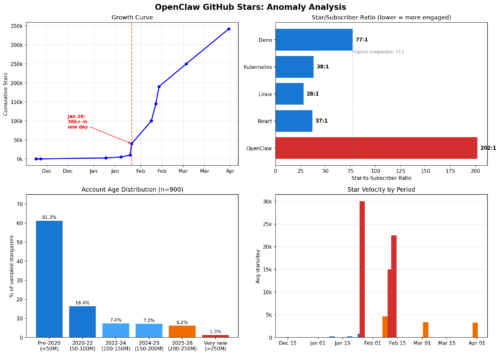
OpenClaw is the most-starred software project on GitHub. Most. Biggest. And not in a good way. Like the Titanic way. It passed React’s 13-year record in 60 days. On January 26, 2026, the repository gained at least 30,000 stars in a single day. Suspicious? Every star from #10,000 through #40,000 in the GitHub API carries the same date. Independent analysis of the GitHub Archive found multiple single-day jumps above 25,000 stars, a pattern that typically signals, wait for it, scripted starring.
The Star-Belly Sneetches have bellies with stars. The Plain-Belly Sneetches don’t have them on thars. Source: Dr. SeussI know, what are the chances that a guy writing agent automation software has automated his agents to generate stars?
The sharper number is the one GitHub doesn’t put on the front page. OpenClaw has 341,000 stars and 1,691 subscribers. A subscriber is someone who chose to watch the repository. They get notifications, they follow development. The star-to-subscriber ratio is 202:1. For comparison: Linux is 28:1. React is 37:1. Kubernetes is 38:1. Deno, the highest comparable outlier, is 77:1. OpenClaw’s ratio is nearly three times the next worst.
341,000 identities clicked a button. 1,691 are paying attention. That makes it the worst repo, and by far.
What the Star Belies
Nvidia knows OpenClaw has a major problem. It released OpenShell to try and contain the flaws, but doesn’t fix the architecture inside it. Anthropic’s Claude Code is a strong agent platform, yet it’s vertically integrated as one provider. The head-to-head that matters now is the one between the sudden and sus market darling and the secure alternative I just built to replace it.
OpenClaw
Wirken
Channel isolation
NONE. Single process, single token, all channels.
Compile-time. Separate OS process per channel. Cross-channel access is a compiler error.
Blast radius
NONE. Everything. Infinite.
One channel.
Credential security
NONE. 220,000+ exposed instances.
XChaCha20-Poly1305 vault, OS keychain, per-channel scoped, rotating.
Credential leak prevention
NONE.
Compiler-enforced. SecretString: no Display, Debug, Serialize, Clone. Zeroed on drop.
Optional. 824+ malicious skills (20% of registry).
Ed25519 required.
Sandbox
NONE.
Docker or Wasm. Ephemeral, no-network, fuel-limited.
Inference privacy
Provider DPA.
Operator control: DPA, TEE, or local.
Dependency
Node.js.
No runtime dependencies.
OpenClaw skill.md parsing
Native.
Native.
A note on inference privacy: Tinfoil and Privatemode run open-source LLMs inside hardware TEEs (AMD SEV-SNP, Intel TDX, Nvidia H100/Blackwell CC). Hardware enclaves get broken by sophisticated side-channel. But the choice being offered is enclaves versus a provider who just promises not to look. A side-channel requires targeting and real effort. Reading prompts from a database requires nothing more than a query. TEEs are an option, they make exfiltration expensive instead of free. If you want zero cloud exposure, point Wirken at Ollama and keep everything local.