The legal technicality of a new self-defense claim in the news is duly noted.
A robber had run from an armed clerk, and was chased outside the store. While being shot at by the clerk, the robber returned fire and the clerk died.
…when the guy ran away, the concept of the clerk being reasonably afraid, that changed considerably. Now you have a serious felony, what the robber did, but you don’t get to execute the guy under those circumstances. So the robber then obtained the right to self-defense.
As many people are just starting to realize (since Ye thinks it helps him politically in America to say it directly) Republicans support Elon and Trump because they like Hitler a LOT.
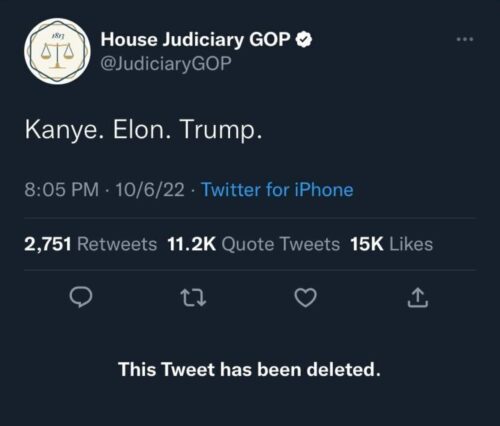
On October 3, the rapper formerly known as Kanye West (now Ye) attended Paris fashion week wearing a shirt that said “White Lives Matter.” Three days later, the Twitter account associated with the Republican members of the House Judiciary Committee (ranking member: Jim Jordan) tweeted, “Kanye. Elon. Trump.”
The GOP only just deleted this now, weeks later. Why now?
When Ye tweeted on October 8 that he wanted to go “death con 3 on THE JEWISH PEOPLE,” the House Judiciary GOP’s tweet stayed up.
Awkward.
Stoking hate seemed just fine for the GOP until…
Ye is now saying very openly to prominent American men who clearly like Hitler, that he likes Hitler too, and thus wants to dine with them and be counted among the worst of them.
Today, after West explicitly praised Hitler on conspiracy theorist Alex Jones’ InfoWars podcast, the tweet came down. “I see good things about Hitler also,” Ye said. […] Every human being has something of value that they brought to the table, especially Hitler.”
That has apparently ripped the hood off, exposed the inner voice of the GOP.
Ye isn’t pretending to “know nothing” about men who love Hitler.
Ye isn’t saying the phrase “America First” just to avoid saying he sees real benefits of Nazism.
That is something of a problem for tongue-twisted fascists who are used to comfortably hiding in the open. As I’ve written before, being exposed for who they really are — being identified and responsible — worries the American disinformation artists.
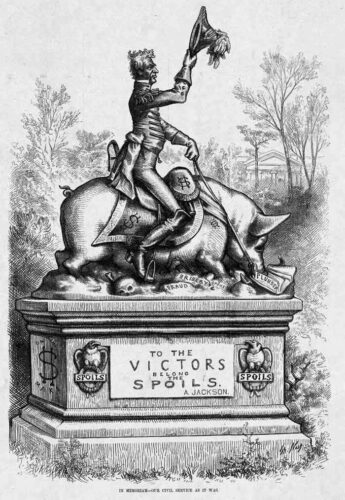
Some Americans openly lavish praise on terrible men like Andrew Jackson, General Lee, or Woodrow Wilson… yet go quiet on Hitler.
President Jackson was one of the most, if not the most unjust, immoral and corrupt in American history
“Like [Andrew] Jackson’s populism, we’re going to build an entirely new political movement…. We’re just going to throw it up against the wall and see if it sticks. It will be as exciting as the 1930s.”
Jackson represents deception, corruption, slavery and genocide. Calling him their inspiration for a “new political movement…exciting as the 1930s” means only one thing — Hitler. Get it? “Throw it up against the wall and see if it sticks” is a nod to the “permanent improvisation” mindset of Nazism.
There’s always a line, even among these men who claim there’s never a line. In this case the Republican party regularly embraces Nazism and dances around the subject openly, while it quietly dictates that nobody ever should use the word Hitler.
America First, infamous before and even during WWII for loving Hitler, tells its followers today to wave the racist Betsy Ross flag or their “Simply Southern” Confederate battle shirts… yet leave their swastikas covered or hidden. The line is meant to be sure someone doesn’t ruin the charade. It’s a curious thing really, given what is wrong with Hitler, when Jackson gets his portrait put up, or a government representative from Iowa floats an enemy flag on his desk.
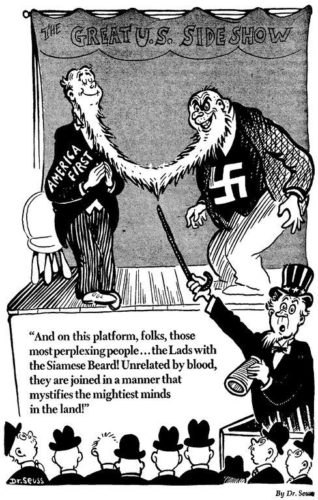
“America First” simply is a reference to Hitler studying American leaders from places like Boston, San Antonio, Detroit or DC to copy their methods of state sanctioned crimes against humanity.
Click to enlarge
Nuremberg, Germany was the well documented place where Nazis said they could improve racism because they’d be more refined and less obvious than “barbaric” Americans oppressing Blacks. German Nazi meetings very openly used American history as their blueprint. Yet Americans today bend over backwards to claim ignorance of this very strong connection.
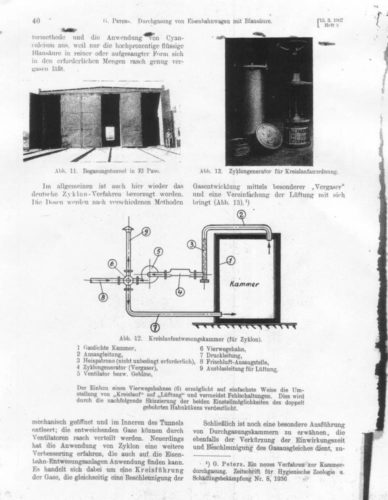
First modern concentration camps? America. First cyanide gas chambers? America.
Zyklon-b is the very awful sounding German word Americans say when they want to ignore the fact that Germany copied deadly pesticide use on people from America.
Auschwitz infrastructure looks like Wilson’s racist border control setup in Texas for a simple reason — it was an intentional copy, right down to the “showers” turning into ovens.
Texas after American invasion or Poland occupied by Adolf Hitler? Hard to say since they both were seized by expansionist white nationalists who then built violent racist platforms. Source: The Texas Observer
America First.
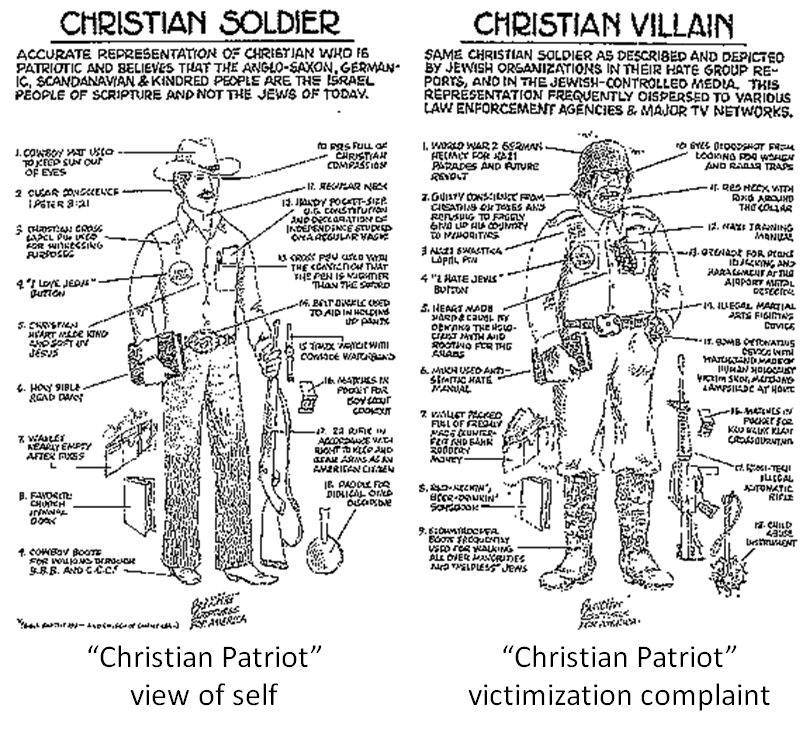
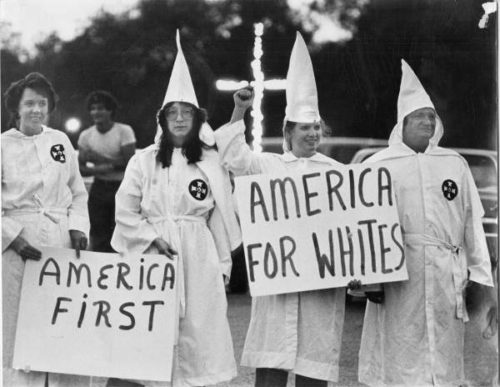
America First political rally participants in their traditional garb before Hitler ruined their image.
That connection to Nazism making it the second act is not what is taught in schools however, where America First and “great again” get flaunted as if not simply praising Hitler.
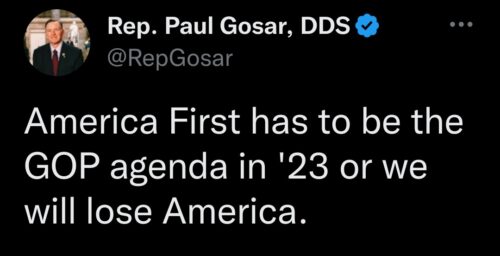
The kind of illustration that should be required in school books so children more easily recognize people who love Hitler.“We” will lose? He means white men. Nazism is being promoted by a sitting government official known for being a white nationalist who wants to overthrow the American government, August 2022. Source: Twitter of course
Ye is throwing venerable “know nothing” tactics upside down, similar to how almost a decade ago he took others’ low key antisemitic mumbling present around American music and turned it out loud and proud… into a 2005 Grammy award.
I mean you can’t say his fast paced strategy of becoming more obvious in hate speech hasn’t paid for him in the past.
Ye openly loving an infamously genocidal German fascist shows he isn’t as afraid (or dishonest) as others to spread the hate they mean, and sees it as his ticket to share in their success.
Perhaps next he will ask America if Hitler could love Ford’s ideas and try to put them into practice with Nazism… why would it be ok for Elon to spread violence and hate speech like Ford (and Hitler) but not for Ye?
Ye is an American celebrity being far more direct and honest than Elon and Trump who have praised Nazism and Hitler while trying to pretend they weren’t.
In the end, they’re all wrong and should’ve been shut down a long time ago. Ye’s comments about Hitler are disgusting and wrong, especially as even subtlety of Elon and Trump caused unnecessary deaths and harms. Things will only get much worse if the ugly ignorance of fascism goes unchecked, if the GOP sentiment isn’t stopped now. Deleting that tweet isn’t nearly enough.
English history is replete with notable warnings via story telling such as King Ludd, who allegedly motivated his followers (Luddites) to stand against empty technologist acceleration and for measured and regulated human professionalism.
It turns out Germans may also have expressed similar principles in public discussion, coining the dubious word “getürkt” (faked) during the start of industrialization. Here’s how that word originated with a chess game “machine” to amuse Austrian royalty, and how it’s still relevant today.
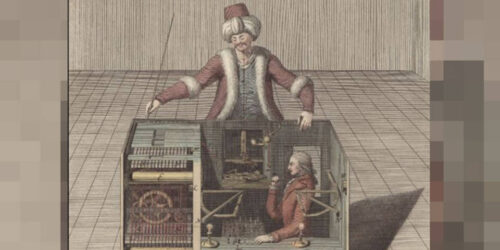
Kupferstich eines “Schachtürken”
First, the Ottoman Empire was very much on the mind of German engineers for a very long time due to war, a frequent topic and focus of education.
The great wonder of the printing press, this symbol of civilisation, was first used to print propaganda. […] …the first, and completely preserved, print attributed to Gutenberg, the Türkenkalender (1454). This is a pamphlet about the most feared and exotified Orient: the Turks at the fall of Constantinople. Before The Bible? Yes, it was printed before the complete Gutenberg Bible was printed.
Second, deep fears of sophisticated dangers were attributed by some German speakers to the increasing appearance and integration of Turks.
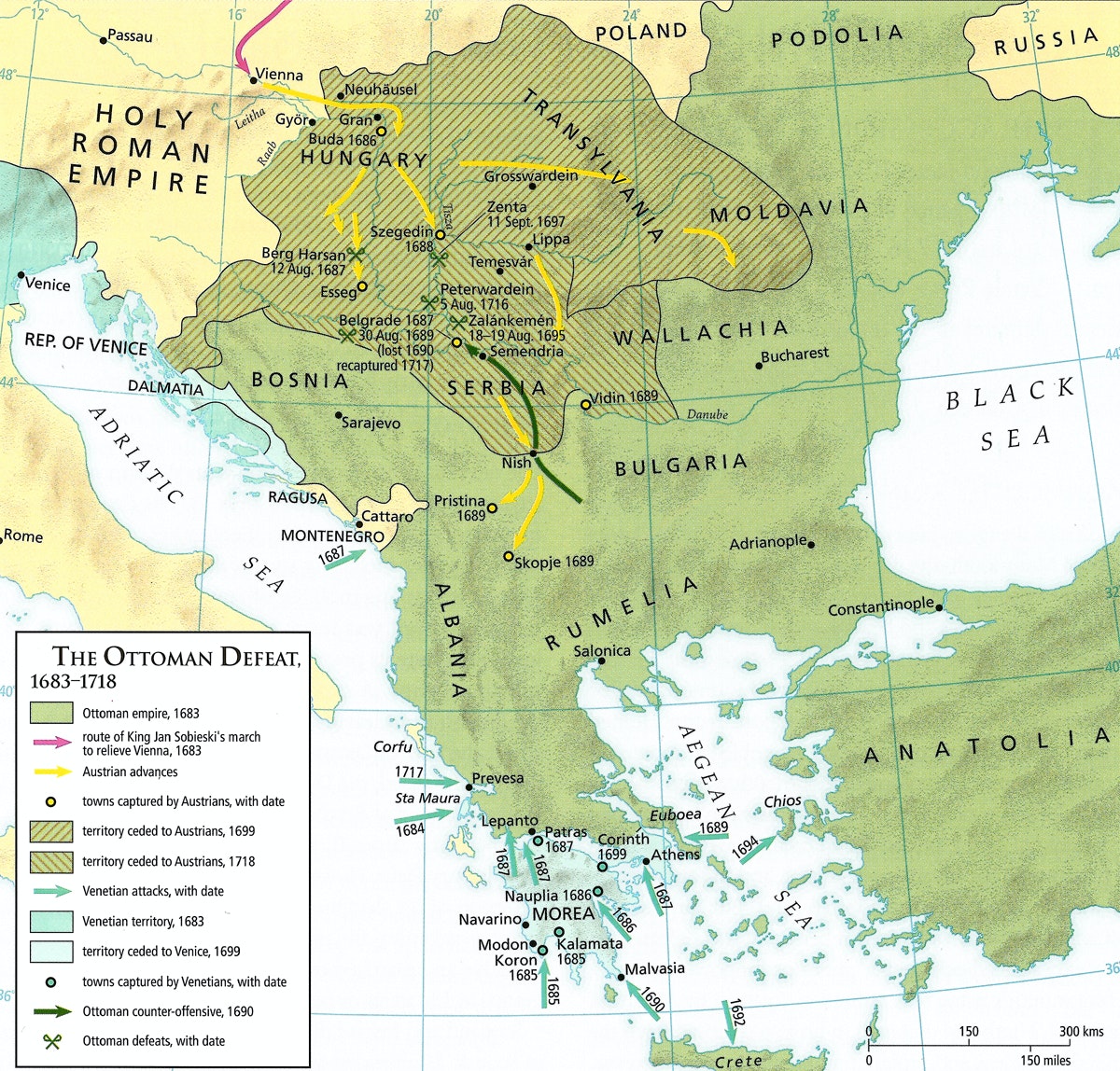
The Treaty of Karlowitz (26 January 1699), for one obvious example, was treated by Europeans as having saved them from Ottoman rule, as it concluded the Great Turkish War of 1683–1697. What could be more utterly captivating to Europeans in the 1700s than to engage in a fun strategy game to defeat the cunning Turkish strategist?
Hungary and Slovakia are basically the shaded regions ceded to Austria. Click to enlarge
Enter a Slovakian “entertainer” named von Kempelen into the Austrian court 50 years after Ottomans had ceded territories to the Austrians (Slovakians regarding themselves as liberated from 150 years of Turkish rule).
The performance of a French magician in 1769 for the Austrian empress Maria Theresia did little to impress him. So Wolfgang von Kempelen told the empress that he could build a machine that would be much more spectacular and amazing.
[…]
We are left to speculate why von Kempelen constructed the player with the appearance of a Turk. In any event, this decision corresponded to the style of his day. Turkish coffee and tobacco were then modern in Vienna. In addition, a foreign-looking player made the machine seem more exotic.
The enthusiasm of the ruling houses of the 18th century for automated devices was widespread, and their creators were highly regarded. The most well-known of them was Jacques de Vaucanson, who became famous during the first half of the 18th century with his music machine. (He also built a mechanical duck which could eat grain, digest it, and excrete.) Wolfgang von Kempelen contributed more than just his Chess Turk to this fashion for automated devices. He constructed a speaking machine which is considered his true masterpiece.
…debates over the possibilities of AI have been raging since the ‘70s.
The 1770s.
The Tesla “possibility” of AI has been repeatedly proven to be fake (not least of all because of its hidden use of “mechanical Turks”) and thus seems deserving of the specialized German word, invoking von Kempelen’s intentional trickery using machinery.
A brilliant essay out of MIT suggests Twitter management is turning itself into a willing promoter of violent hate crimes.
…lives will get worse as Musk empties out the Twitter equivalent of the Phantom Zone, allowing vicious, bigoted, and even violent harassers, Nazis, and white supremacists to return.
It’s similar to what I was warning regulators back in April, except now there’s hard data to prove my prediction true.
That is to say, if you’re planning to be active on Twitter now it’s like moving to South Africa to do business after you hear apartheid leaders promote hate for profit.
That’s not really a hypothetical. The Twitter CEO’s childhood was in South Africa and he has no record of anti-racism. He moved to America where he found Harvard had been graduating students like Kansas’ Kris Kobach with obnoxiously false papers about apartheid being good for business (hate speech impossible by then to peddle within South Africa).
Does any reasonable person really want to join in such plans of ill gotten gains when they are so obviously immoral and short sighted (e.g. every lesson in history)?
The Phantom Zone honeypot is a good framing for what Twitter already has become. The CEO markets it as his vision of toxic white masculinity playpen for profit; hateful barbaric cartoon characters are in a clown-like rush to attack and censor any voices of reason or human rights.
Users thus deleting Twitter apps now achieve real freedom because they refuse to participate in such old known oppression tactics.
Leaving this Twitter platform has become a bold rejection of tyranny, a clear act of anti-racism. Better quality of life, far higher standard of living, is easily found elsewhere.
Nobody thus should want to be seen holding a now toxic, “marked” Twitter bag.
As Twitter management intentionally slides into profit from support of crimes against humanity, expect it to face nothing less than digital sanctions… a sad repeat of 1980s South Africa for those who didn’t learn the right lessons the last time.
a blog about the poetry of information security, since 1995