Voxer founder, Tom Katis, started developing the patents in question in 2006 as a way to solve battlefield communications problems he encountered while serving a Special Forces Communications Sergeant in Afghanistan. Katis and the Voxer team developed technology that enabled the transmission of live voice and video communications and launched the Walkie Talkie app in 2011.
He then made the mistake of sharing details with Facebook in 2013, because they shamelessly stole his ideas and then tried to act like a monopoly platform and starve Voxer of Facebook users.
Voxer launched the app in 2011, which was named Best Overall App in the First Annual Silicon Valley Business App Awards in 2013. In 2012, Facebook approached Voxer about a potential collaboration that led to Voxer sharing its patents and proprietary information with the company. “When early meetings did not result in an agreement, Facebook identified Voxer as a competitor although Facebook had no live video or voice product at the time,” court filings read. “Facebook revoked Voxer’s access to key components of the Facebook platform and launched Facebook Live in 2015 followed by Instagram Live in 2016. Both products incorporate Voxer’s technologies and infringe its patents.”
A jury figured this out and just awarded Katis $175m, which seems like about 1/7 of what he deserves.
Facebook, like the wealthy and dumb bully they are, tried to argue that 2015 development efforts weren’t later than Voxer’s 2013 presentation, let alone later than patent development back in 2006.
Their court filings literally stated “Facebook has prioritized live video messaging since the launch of Facebook Live and Instagram Live”, which just made them look like they can’t tell time.
The launch of Facebook Live had been clearly recorded as abrupt and personal, rushed in 2016 as a reaction to some kind of CEO injury (e.g. falling out with Voxer) and specifically to kill competition.
CEO Mark Zuckerberg decided to prioritize the video product after a February 2016 meeting, according to the WSJ. …Zuckerberg decided to put more than 100 employees under “lockdown” for two months in order to roll out Facebook Live to everyone, sources told the paper.
At the end of the day, everyone knows Facebook was started by a guy who thought he could use the Internet to hurt and manipulate vulnerable populations. His platform has been a fountain of toxic abuse and low integrity ever since Harvard decided not to press charges against him.
Is it any surprise that awful guy had to “lockdown” 100 mercenaries in an attempt to attack a Green Beret veteran.
I say this not just because the CEO has always been a ruthless immoral jerk, which is true, but because a single U.S. Green Beret veteran (on top of being trained to liberate the oppressed from places like Facebook) has more talent and skill than 100 of Facebook’s mercenaries.
Food for thought next time you see someone list Facebook on their resume.
The true history of stop lights is that they were a London invention of the late 1800s, originally meant to stop all cars so pedestrians could walk basically everywhere on the streets.
That concept was corrupted in 1930s America until everyone but cars was very ruthlessly pushed off streets. Lights then became a symbol of car domination, negotiation of flow mainly for themselves.
A brilliant story out of Scotland suggests some may be returning to the old and more sensible modes of transit. Bikes ride in packs with technology to control lights and stop all the cars.
Thought to be the first of its kind in the UK, a bike-mounted, remote-controlled device using a military-grade encrypted signal lets the lead cyclist hold the lights. The Ultra-Smart Cycle System, when pressed on approach to the junction, sets a specially timed traffic light cycle in motion to hold traffic for 45 seconds, enough time to get all of the riders through.
Of course my favorite part of the story is military-grade encrypted signalmaking kids smile.
The idea is for a large group of children to cycle to school on an agreed route, with parents encircling them and monitoring traffic. Every Friday around 45 parents and children cycle to Shawlands primary, smiling, cheering and bells ringing.
Bicycles basically bring joy and collaboration where cars used to turn people angry and competitive.
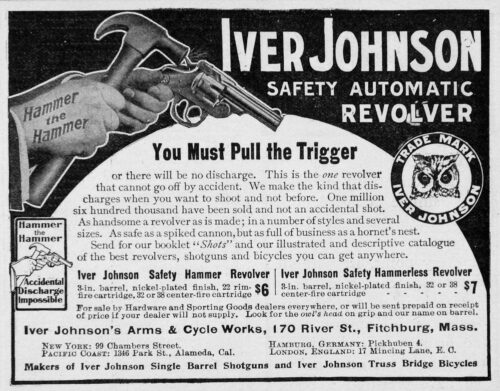
1907 gun safety marketing boldly claied zero accidental shots with 1.6 million sold.
An old saw in America is that gun manufacturers are never to blame for anything, ever. Usually it’s phrased cynically as “guns don’t kill people”.
However, a growing number of highly trained and proficient shooters in America (e.g. the police) have been challenging that idea with… lawsuits blaming a gun manufacturer for people being shot by its guns.
The lawsuit comes after the Milwaukee Police Department reported on Sept. 10 that an officer’s holstered gun fired “inadvertently” as he searched a vehicle and injured another officer nearby. It’s the third time since July 2020 that a Milwaukee police officer’s gun fired without the trigger being pulled, according to Andrew Wagner, president of the Milwaukee Police Association. And it’s not the first time safety concerns have been raised about the model of firearm in question — the Sig Sauer P320. […] At least 22 lawsuits have been filed against Sig Sauer since 2018 alleging the P320 fired without anyone pulling the trigger. The lawsuits originate from Missouri, Massachusetts, Kentucky, Georgia and elsewhere. Eighteen have been filed since 2020.
It recently became the official sidearm of Canada’s elite military unit, Joint Task Force 2, that is until one of the new guns fired on its own and shot a soldier…
“One of the new guns fired on its own” report coming from the Joint Task Force 2 certainly throws cold water on a “guns don’t kill people” theory.
…there was no evidence introduced at trial to show that SIG Sauer was aware of the Roscommon incident at the relevant time: in December 2016, when Guay purchased his P320 in reliance upon the advertisement. The evidence only established that SIG Sauer had seen the Roscommon video by January 10, 2019, more than three years after Guay purchased his gun.” In his lawsuit, Guay — who said he has “substantial firearms experience” — claims he was taking off his SIG Sauer holster with his SIG P320 secured in it on Jan. 28, 2020, “when the pistol fired and hit him in the right thigh without him ever touching the trigger. The hollow point bullet it discharged left a gaping wound…”
The last sentence brings up a small point (pun intended). Proponents of a hollow point bullet call for maximum possible damage, as if every round must be lethal. This expectation to cause extreme suffering was probably NOT meant for those being shot by their own P320 still in their holster. In context of predictable self-harm a hollow point seems rather… unnecessary and unwise.
A far bigger point obviously is that this unfortunate incident was in 2020, and the victim proved Sig Sauer was well aware of the problem since at least 2019. The court used a technicality to rule instead the victim couldn’t prove Sig Sauer knew about this problem way back in 2016 when he purchased the gun. Despite him not providing this evidence, it seems to be trivial to find.
What was the judge thinking?
The case somehow fixated on whether Sig Sauer knew about just one incident in particular at a very particular time. It reads like a very unintelligent and narrow burden, given what that case was really about.
Sig Sauer clearly knew at least since mid 2016 of Roscommon-like incidents given broad “class action” announcements in the news such as this one.
A prominent Kansas City plaintiffs attorney seeks class-action status for a lawsuit claiming that a Sig Sauer Inc. pistol has a defective design that creates a potentially lethal safety issue because it can fire when dropped. […] Sig Sauer already faces several other lawsuits related to premature discharge, including one by a sheriff’s deputy in Virginia, who claims her fully holstered Sig Sauer P320 discharged a bullet into her leg, even though she never touched the trigger. In addition, a lawsuit in Connecticut alleges that a police officer was shot [January 2017] when his P320 pistol fell as he loaded equipment into a vehicle. The pistol discharged when it hit the ground, and he was shot in the leg and knee.
Sig Sauer allegedly was knowingly misleading people with false advertising about safety in mid 2016, which many lawsuits seem to confirm repeatedly.
So again, what was the judge thinking?
Her ruling in 2022 that the plaintiff/victim couldn’t prove Sig Sauer was aware ten months later about a serious failure seems overly pedantic and disconnected from any reality of product safety.
Even though the Roscommon incident occurred in February 2016, there was no evidence that SIG Sauer became aware of the incident (or saw the video) close in time to the incident,” writes McCafferty in her ruling. …evidence at trial did not establish the date on which SIG Sauer first became aware of the incident, McCafferty writes.
Does this judge really want us all to believe that it’s up in the air whether Sig Sauer knew in 2016 their gun had shot a police officer?
In February 2017, Sig Sauer sent an employee to Roscommon, Michigan, to investigate a possible defective discharge.
They knew. They knew in 2016.
In another 2021 very high-profile lawsuit, Sig Sauer gets called out for sticking their head in the sand for five years (e.g. since 2016) — very aware their marketing was false.
“Gun owners don’t want to think that their gun can just go off without the trigger being pulled. I picked up my bag, my keys were on top,” she said. “As I walked around my desk, my purse swings out and it shoots out the bottom of my bag.” […] Hilton’s $15 million lawsuit said, “there have been 54 reported uncommanded discharges of the P320,” meaning the gun went off by itself, over the last five years in 22 states and Washington, D.C.. […] “It’s not credible to claim that people with this amount of training, this amount of skill are all shooting themselves,” Bagnell said. “These are experts. It’s happening all over the country. … you would have to conclude there’s a problem with the product, not with the people.”
The very controversial phrase “guns kill people” apparently becomes more palatable among gun advocates if you say “there’s a problem with the product, not with the people”.
Ok, so clearly Sig Sauer knew they had a “problem with the product” by December 2016 despite the judge ruling it wasn’t obvious enough to her.
While Sig Sauer has continued to dispute that there is anything wrong with the P320, the company offered what it called a “voluntary upgrade” in 2017, saying, “These upgrades will enhance the protection against unintended discharges if the pistol is dropped.”
The protection should have been designed better and also should have been mandatory. Asking for volunteers to upgrade while saying there’s no need to upgrade makes zero sense. Even more to the point such an expensive upgrade in 2017 couldn’t have been on the books if the manufacturer hadn’t known by that time about the serious safety defect.
In late 2017, SIG SAUER implemented an upgraded design of the P320 pistol to enhance the safety and performance of its P320 model pistol. […] The SIG SAUER P320 pistol continues to meet and exceed all industry safety standards, and it is safe to carry and use in both the pre- and post-upgrade versions…
They released an enhanced safety fix while “all U.S. safety standards” say this fix isn’t needed to enhance safety.
…the firearms industry self-polices its products, establishing its own design standards and initiating its own voluntary recalls…
And if that’s not proof enough for the court system to step up here and hold the manufacturer liable, the U.S. Army ran the P320 through significant testing (e.g. acted as a federal safety regulator) and by mid-2016 reported a major defect — discharge without trigger pull. BEFORE DECEMBER.
A modified trigger mechanism was implemented only for military sales, sending allegedly known defective guns into the general market exactly like all these lawsuits have been saying.
During its internal testing on April 20, 2016, the U.S. Army discovered that the SIG P320 pistol would fire unintentionally on its own when dropped, which the Army deemed to be a “deficiency.” […] The U.S. Department of Defense traced this “deficiency” to an issue with the trigger and sear. Recognizing the dangerous nature of the defect, the Department of Defense required SIG to correct the issue before continuing with the M17 / M18 contract (which it did successfully)
The Army’s M17 pistols, which came out of the Modular Handgun System trials, already have these upgrades and SIG reiterated that they were always planning to roll them out in the commercial P320s soon as well. […] SIG showed us high-speed footage of both the current commercial P320 version and the upgraded trigger version impacting the concrete. The difference was night and day.
You’d think regulators would step in at some point here, especially given how judges seem confused.
Going back to that small point above about packing hollow point bullets, lobbyists have refused all and any “safety” regulations in order to keep gun manufacturers unrestricted from selling maximum harm as a feature.
In reality gun products are exempted from regulation under the Consumer Product Safety Commission (CPSC), no matter how stupid that sounds. Gun safety is meant to be an absolutely critical step prior to owning and operating one, yet there are absolutely no safety standards for gun products. None.
The Remington 700 bolt-action rifle, the company’s most popular product, has been reported to fire without the trigger being pulled, which has resulted in the deaths of two dozen people and injuries to at least 100 others. The incidents spurred more than 75 lawsuits. Remington executives were reportedly made aware of the defects by engineers, but according to CNBC, the company held off on replacing the faulty trigger because it feared such a design change might be viewed as “an admission of guilt.” …a judge in 1983 found Remington in contempt of court, calling the company’s secrecy a “flagrant disregard of the law” and “obstructive and offensive … to justice.” Even a significant jury verdict can’t convince a manufacturer to fix a malfunctioning weapon [and] …even though an estimated 7 million defective firearms were sold, only 2,327 gun owners have submitted claims to Remington. The company’s recall process stands in stark contrast to how the federal government recalls dangerous products. For instance, the CPSC can mandate a recall of toy guns or crossbows that malfunction even if only one complaint has been filed with the agency.
No claims about product safety in Remington ads, just hints about murdering the safety regulators
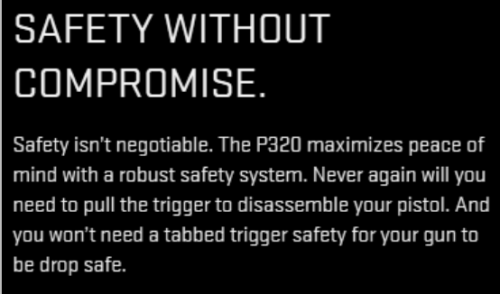
In conclusion, this is a much wider problem than just one manufacturer. But Sig is an especially toxic brand as it markets their product specifically on the premise “safety isn’t negotiable”, which presumably is meant to taunt regulators.
Sig Sauer’s marketing has flagrantly contradicted its actual product safety record since 2016.
When their gun is repeatedly found to be unsafe in multiple complaints over multiple years Sig negotiates through settlements and court battles in an attempt to destroy any true standard of product safety.
The answer to this problem is obvious. Lawsuits and settlements aren’t even close to sufficient. Can you believe a lawsuit over the resale value for a used P320 (someone argued Sig’s poor product quality deflated profits in the $28bn gun market) was shot down by a judge?
Guns, especially those made by brands peddling “safety isn’t negotiable” as their message, need to go under federal safety regulation. The U.S. Army has already proven how well it works (for them).
I realized with the latest news stories, now might be a good time to poke this bear a little more.
We have to begin by admitting the term hacker sadly has come to mean computer crime. I hate that as much as anyone, but it’s a reality of the times. When someone uses even authorized access to misuse or abuse data protection (e.g. Snowden), then some or even most camps throw around the word hacker.
In that sense, I’m putting the phrase “patriot hackers” in quotes because I’m unconvinced people hitting the news today really are either, let alone both. But for the sake of argument please hear this out. I hope you appreciate where I’m going.
This is even worse than the hacker definition one above. Yet it’s obviously taken seriously by Yale and I’ve seen it cited downstream by people trying to influence or set government policy on hacking. Thus I’m using it because it’s been used by others.
Now I’ll give two examples from current news to show how the phrase “patriot hacker” can play out in the present, as well as compare it with the past.
First, Jamie Lee Henry and Anna Gabrielian were just charged with conspiracy to disclose American health information to Russia. Check out some of the buried ledes in their wacky story:
Gabrielian told the FBI agent “she was motivated by patriotism toward Russia to provide any assistance she could to Russia, even if it meant being fired or going to jail,” the indictment says. […] Gabrielian told the agent that “though [U.S. Army Major] Henry was a ‘coward’ and concerned about violating HIPAA by providing records” to the agent, “Gabrielian had no such concerns and violated HIPAA ‘all the time.’
Ouch. “Violated HIPAA all the time”.
We’re hearing from the FBI that an American couple, one in active duty with secret security clearance, were motivated to steal and forward medical records… allegedly due to their patriotism toward Russia.
That’s not their own country, right?
And I can’t leave out this detail.
Gabrielian texted the undercover agent using coded language on August 25, according to the indictment, saying, “Jamie might have samples of his poetry laying around. He says he will look for them and decide if he has the bandwidth for another project over the weekend. I think it would be good for him to at least show you examples of his past work.”
Poetry. Why does it always have to be poetry?
Second, a former NSA staffer said he had an itch to treat Russia as his “own” country while trying to break American laws and stir up trouble
In his communications with the FBI’s undercover employee, Dalke allegedly reached out to what he thought was a Russian agent, saying he, “recently learned that my heritage ties back to your country, which is part of why I have come to you.” He goes on to explain his reasoning for wanting to share documents from the NSA and at least two other American federal agencies, saying he, “questioned our role in damage to the world in the past and by mixture of curiosity for secrets and a desire to cause change.”
Dalke clumsily admitted he wanted money in exchange for his Russian patriotism, but don’t let that distract from a core premise for all three people. They intentionally bypassed controls (computer crime — hacking) to serve a particular country that they only had a distant/romanticized affinity towards.
Again, to be fair to myself because I hate these definitions, these people seem about as patriotic as they are capable of hacking anything (not much, yet clearly enough to be willfully breaking laws). These stories are about “patriot hackers” being arrested because our definitions of those terms make it so.
And with that being the case, we should think back to the news of Hagbard’s death in 1989.
His role allegedly was to take the information stolen in Germany by three others and give it to the KGB on floppy discs. After he and the others were caught (Cuckoo’s Egg), Hagbard mysteriously died in a fire. It was called a suicide yet who really believes that?
History could be written about Hagbard had a drug habit (or any other habit really), that he was in need of money, or that he was curious about secrets and desiring to cause change. And that’s where many people leave things when talking about the 1989 hackers, omitting their sense of duty or affinity.
However, beneath the more superficial layers of human interest (e.g. highest bidder wins) is a more troubling connection to identity and power. A young German walked with floppy disks in hand to the KGB because, why?
We may never know whether Hagbard held affinity towards Russians when he went out of his way to meet with them, I mean more or less than Snowden does today.
Edward Snowden has been granted Russian citizenship. The news was confirmed in a decree by Russian President Vladimir Putin posted Monday to the Kremlin’s website.
Right under that decree it must also have some kind of poetry like “you too can call Russia your own if you question America’s role in the world and think you can hack to extend the tyranny of Putin”.
In conclusion, patriotic hacking as a phrase could be a LOT older than many people in U.S. government advisory roles are allowing themselves to think about. Patriotism is certainly more than a narrow sense of own country, which opens the discussion to many more hacking incidents.
After all, if we use this blog post as a lens to reconsider Robert Lee Johnson’s attacks in 1961, patriotic hacking may be as old as hacking itself.
a blog about the poetry of information security, since 1995