Category Archives: Security

Mosquito Attack Path Analysis

Ugh. Any angler knows that a fish circling a lure is ready to bite. It is the most important moment in the sequence. It’s not hesitation. It’s the last check before commitment. A better lure doesn’t make fish circle more when they already circle. You need the lure to reduce circle to less time, because it passes final inspection sooner.

With that in mind, a whole study just released about mosquito flight path analysis reads wrong to me.

Deciphering mosquito host-seeking behavior is essential to prevent disease transmission through mosquito capture and surveillance. Despite recent substantial progress, we still lack a comprehensive quantitative understanding of how visual and other sensory cues guide mosquitoes to their targets.

They built a model that predicts flight paths. What they should have built is a model that predicts target rejection. The circle is the authentication window. Every mosquito that circles and leaves is telling you exactly which credential your trap failed to present. CO2 got them to the door. The silhouette got them to slow down. Something in the final check bounced them.

Why?

That’s why the flight path geometry is the least interesting part of their own data. The interesting data is the authentication failure rate and what correlates with it.

Which mosquitoes completed the approach and which ones broke off? At what point in the circle? Facing which part of the target? That’s where the species-level targeting logic lives.

Maybe I need to fish less but the parallel goes further. Nobody studies the shape of a fish’s approach path to improve lure design. We study what makes a fish strike or turn away. The strike-to-rejection ratio is the metric. Everything else is circular.

Twenty million mosquito data points? That’s a lot of circles for nothing.

Palantir is Full of Karp: Humanities Protect Against His AI

Palantir has a serious problem. You can tell by the way their CEO Alex Karp just positioned AI as threatening humanities-trained workers and empowering vocational ones.

That’s exactly backwards. And it’s political. He’s trying to prevent people from pulling the curtain back on his mistakes.

Here’s one. Palantir will tell you they committed an extra-judicial assassination of the man in a purple hat at the crack of dawn. What they can’t tell you is that man was innocent and was wearing a white hat that simply reflected the purple hue of a rising sun.

True story. The humanities-trained analyst catches that. The machine doesn’t. The customer who’s been told humanities are for losers never even thinks to check.

AI is a text machine. It generates competent prose, summarizes arguments, produces passable analysis. Someone with weak humanities skills can now produce humanities-grade output with minimal effort. The floor rises. A trades worker who could never write a policy memo can now generate one. That’s genuine empowerment, and it flows toward exactly the people Karp claims to champion, pulling them toward humanities rather than away from it.

Meanwhile, the skilled knowledge workers whose value proposition was “I think clearly and write well” discover that the market price for clear thinking and good writing just collapsed. AI doesn’t do higher-order thought. And most knowledge work hasn’t been higher-order thought. It was competent pattern execution dressed up as expertise. AI exposes that gap brutally.

So the real disruption runs directly opposite to Karp’s pitch. The humanities-trained workers doing low-level routine cognitive labor lose. The vocationally-trained workers who adopt AI as a literacy tool gain. The technology is fundamentally a language democratizer because humanities become more important, not less.

But here’s what Karp will never say: the democratization only works when someone trains on how to evaluate what comes out.

Garbage Business

AI output without humanities judgment is fluent garbage. It reads smoothly. It sounds authoritative. It is, on average, very wrong in ways that require trained critical thinking to detect. The humanities aren’t threatened by AI. They’re the quality control layer. Editorial judgment, contextual reasoning, the ability to distinguish a coherent argument from a plausible-sounding one: these are the skills that make AI output worth anything at all.

By positioning humanities as the enemy of the working class, Karp ensures they never develop the critical framework to evaluate what AI gives them. They get the tool but not the judgment. Which means they need Palantir to be the judgment layer, with no accountability. That’s not a side effect. That’s the low quality product known as Palantir.

They will tell you to bomb 1,000s of high-value targets 24/7 and when the fog clears shrug at a closed strait and a triple-tapped school full of dead children.

Imagine a steam engine manufacturer who campaigns against thermodynamics education because physicists vote for the wrong party. The engine still runs. It just runs very badly, exploding and killing workers, and only the manufacturer knows why. They’ll sell you the fix instead of reducing the need for fixes.

The steam engine didn’t become transformative because miners got better at mining. It became transformative when social scientists understood labor, markets, thermodynamics, systems. The resistance to change came from mine owners who liked their workers poor, ignorant and dependent. Karp deflates and blocks the necessary science to make workers better. He actively degrades the input that makes his own technology functional, then positions himself as the indispensable intermediary. The cage is tracking workers and keeping them illiterate in the one discipline that would let them see the cage.

Radically Wrong

Thomas Impelluso writing in The Humanist catches the surface move: Karp promises working-class people economic power, delivers employment under total surveillance. He frames it as gender war, misogyny as bait, misandry as extraction. That’s radical politics as far as it goes. But the deeper tell is the specific target. Karp attacked humanities because they’re the disciplines that teach people to recognize that what he’s doing is wrong.

A working-class person with a strong humanities education is Palantir’s worst customer. Imagine someone who can read the output, spot the errors, question the framing, and ask who benefits. A working-class person told that humanities are for Democratic women because real skills don’t need higher education? That’s a cog who takes what the machine gives and is grateful because they don’t know better.

The technology democratizes language. Karp is selling a flawed engine, burning the manuals, and planning to get rich on cleaning up the disasters he creates.

Why Women Invented Dice 12,000 Years Ago in America

A new paper in American Antiquity has just pushed the origin of dice back 6,000 years further than anyone expected. Robert Madden’s “Probability in the Pleistocene” identifies 659 prehistoric Native American dice across 57 archaeological sites spanning 12,000 years, from Late Pleistocene Folsom deposits in Wyoming, Colorado, and New Mexico all the way to the present. The earliest specimens predate the oldest known Old World dice by more than six millennia.

The paper gets attention for a probability angle. Ok, ancient Native Americans were generating controlled random outcomes and using the probabilistic regularities embedded in them thousands of years before Mesopotamia. I get it. That’s significant.

David Attenborough voice: but it’s not the most important finding in the paper.

The most important finding is buried at the end and never developed. Warren DeBoer’s analysis of 131 ethnographic accounts of Native American dice games, drawn from the historic and contact periods, found that 81% were played exclusively by women. Only 7% were played by men only. Madden notes this and moves on.

He shouldn’t have. The archaeological record preserves the dice far better than the players. Did this gendered pattern hold across all the years? That is an inference, projected backward by the same ethnographic analogy that Madden uses throughout the paper. A strong inference. It’s grounded in the same continuous cultural tradition, in the same geographic corridor, using the same artifact type. And nobody has proposed an alternative.

Randomness Solves a Problem

The paper’s strongest analytical move comes from Marshall Sahlins. In traditional societies, exchange is embedded in preexisting social relationships. You trade with people you already know, through channels structured by kinship, reciprocity, and obligation. Exchange, as Sahlins put it, “is usually a momentary episode in a continuous social relation.” If you have no relationship, you have no channel. If you have no channel, you cannot trade.

This creates a structural problem for anyone outside the dominant exchange networks. Many of the heaviest dice-using groups in Madden’s record, including Puebloan, Basketmaker, and Mandan cultures, were matrilineal. Women already controlled property, lineage, and household economies. But matrilineal authority stopped at the boundary of your own kinship system. On a territorial frontier, facing strangers from a different culture, your clan status meant nothing. Dice gave women an instrument for conducting exchange where their domestic authority had no jurisdiction.

The mechanism is simple. Two strangers sit down. They agree on stakes. They throw dice. The outcome is determined by chance. No prior relationship required. No hierarchical permission needed. No obligation structure to navigate. As James Woodburn observed of exchange among Hadza hunter-gatherers, “the transactions are neutralized and depersonalized by being passed through the game.”

Randomness is the enforcement mechanism. Equal conditions. Gerolamo Cardano, the sixteenth-century mathematician and gambler, articulated the principle:

the most fundamental principle of all in gambling is simply equal conditions.

You don’t need to trust the other player. You don’t need to know them. You need to trust the dice.

Protocol Not Play

Read the paper with this in mind and the picture changes entirely. Dice were far more than entertainment. They were a form of infrastructure.

Madden documents that dice appear at sites associated with 22 distinct cultural complexes over 12,000 years. Mobile hunter-gatherers, semisedentary groups, sedentary agriculturalists. Clovis, Folsom, Desert, McKean, Basketmaker, Fremont, Pueblo, Mandan. The practice crossed every linguistic, ethnic, and subsistence boundary in western North America. Gabriel Yanicki calls this:

a shared fluency of gambling games that transcends barriers of language and ethnicity.

That’s a protocol. A universally understood system for conducting fair exchange between parties who share nothing else. DeBoer found that gambling functioned as “an in-between or liminal activity” bringing together “people who were neither close friends nor complete strangers.” It operated on territorial frontiers and at large intertribal gatherings. It was, as Madden puts it, outward-directed.

What Women Built

If women were the primary operators of a 12,000-year-old fair exchange protocol that functioned beyond the reach of any group’s internal authority, the implications are far greater than the fizzle this paper ends with.

First, women were early innovators in applied probability. The law of large numbers guarantees that in a series of fair contests, wins and losses tend toward equal distribution over time. You don’t need to formalize this mathematically to rely on it operationally. You just need to play enough games to know that the system balances. Twelve thousand years of continuous practice suggests they knew.

Second, women built external exchange infrastructure. When internal exchange channels only governed members of your own kinship system and reciprocity networks, a system that bypasses those channels entirely, enforced by mathematics rather than social hierarchy, is an act of structural engineering. In matrilineal societies where women already controlled property and household economies, this wasn’t a workaround. It was an extension of existing domestic authority into intergroup space where that authority otherwise had no reach.

Third, the system was self-legitimating. Because the outcomes were visibly random, because anyone could see the dice fall, the fairness of the system required no external authority to validate it. No authority from either side needed to certify the transaction. The randomness did that work too.

Fourth, this explains the persistence. Cultural practices survive for 12,000 years because they confer adaptive advantage. A women-operated exchange protocol that enabled trade, information exchange, mate selection, and social integration across group boundaries without depending on controlled hierarchies would be enormously adaptive, particularly during periods of social disruption, migration, and contact between unfamiliar groups. The issue is that nobody’s internal authority structure governed intergroup encounters.

The Encoding

There’s a deeper layer here about what randomness does as a social technology.

In a deterministic system, outcomes reflect existing power. The person with more resources, more status, more connections wins the exchange. Determinism encodes hierarchy.

Randomness strips the encoding. It produces outcomes uncorrelated with prior status. Someone with nothing and someone with everything sit across from each other, and the dice levels the playing field. That’s not just fair exchange. That’s a temporary dissolution of the social order, conducted under rules that both parties agreed to in advance and that neither can easily manipulate.

This worked as long as the conditions stayed equal. Robert Weiner’s study of gambling at Chaco Canyon shows what happened when they didn’t. At Chaco, gambling became a mechanism through which elites integrated diverse communities but also accumulated material wealth and established social inequality. Navajo oral traditions preserve the memory: a figure called Noqoìlpi, The Gambler, who enslaved people through dice. Equal conditions in a single game don’t prevent structural inequality across hundreds of games if one party can absorb losses indefinitely. The rich player keeps playing. The poor player goes home with nothing. What women built as a fair protocol, Chacoan elites captured and weaponized. The history of randomness, like the history of most technologies, includes the history of its expropriation.

This is why Madden’s aggregation hypothesis is so important. He argues that dice may serve as an archaeological “signature of aggregation,” marking sites where normally dispersed groups came together. If that’s right, and it probably is, and if the operators of the exchange system at these aggregations were overwhelmingly women, then women were the architects of intergroup social integration on the Great Plains for at least 12,000 years.

The randomness was more than incidental. It was the point. Randomness is the only mechanism that produces equal conditions without requiring pre-existing trust, relationship, or shared authority. Women found that mechanism, built a continental exchange system on it, and ran it for longer than any civilization in recorded history has lasted.

Madden plays it academically safe and calls for further study. That probably comes with the job. But this blog has no such constraints. Did ancient dice games have a gendered component? Sure, but we really should be asking whether the entire 12,000-year history of probability in the Americas was a women’s innovation. That means women were doing applied probability first, and men much later in the sixteenth century got credit for “inventing” it because they wrote that down in European languages.
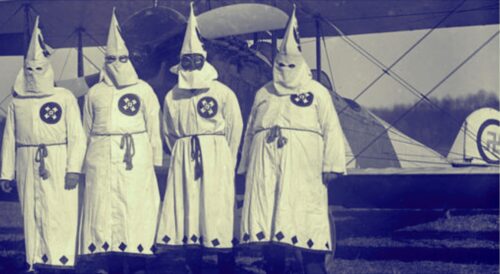

U.S. Rules KKK Ban on Black Distillers Unconstitutional, 158 Years Too Late

The KKK as “tax enforcers” who actually eliminate taxation is the real story here, which so far nobody is admitting.

The ban was part of a law passed during ⁠Reconstruction in July 1868, in part to thwart liquor tax evasion, and subjected violators ​to up to five years in prison and a $10,000 fine.

Writing for a three-judge panel, ​Circuit Judge Edith Hollan Jones said the ban actually reduced tax revenue by preventing distilling in the first place, unlike laws that regulated the manufacture and labeling of distilled spirits on which ​the government could collect taxes.

She also said that under the government’s logic, Congress could ​criminalize virtually any in-home activity that might escape notice from tax collectors, including remote work and ‌home-based ⁠businesses.

Exactly.

Who would want to criminalize “virtually any in-home activity that might escape notice from tax collectors”? The KKK. The Klan and industries aligned on the same structural goal: prevent emancipated Black workers from converting their skills into independent wealth.

The 1868 anti-distilling law provided an institutional mechanism to criminalize Black workers, raid their homes and lynch them if they showed any signs of entrepreneurship. It was not about taxes. The Klan became racist “law” enforcement. The tax rationale, which is obviously illogical, serves only as a cynical cover story, like the “X” sheets they wore.

The KKK in 1921 used bi-planes to firebomb Tulsa, OK to destroy “Black Wall Street”. They also dropped racist propaganda leaflets across America. The X (swastika) was their hate symbol.

The pattern across both distilling and tipping is identical. Take the economic activity where Black expertise and labor generate value, then restructure the rules so the value flows to white owners while Black workers are either criminalized (distilling ban) or made dependent on white discretion (tips replacing wages). Both entirely eliminate the tax relationship.

The distilling ban removed taxable production. Tipping removed taxable payroll. In both cases the stated rationale (revenue, market freedom) inverts the actual function (suppressing Black economic independence).

At slave auctions, brokers regularly noted distiller-trained enslaved people, many with Caribbean rum-making backgrounds, and these skills earned premiums for their owners. Every major early bourbon name benefited from enslaved labor: George Washington used six enslaved workers at Mount Vernon, Elijah Craig owned 32 enslaved people, the Pepper family at what is now Woodford Reserve owned 25.

Then, precisely after these men were free and in position to become successful, in July 1868 Congress banned home distilling entirely. The timing fit the Klan’s explicit goal of eliminating Black economic independence and forcing return of American Black people to patterns of economic subservience.

Simmons in 1898 … instigated the “White Supremacy Campaign” by issuing virulent addresses appealing to “Anglo-Saxon blood” and attacking “Negro domination.” During the 1898 state and local elections, Simmons promised leaders of denominational colleges no increased funding for public colleges, and told businessmen that for their support … there would be no tax increases.

No new taxes literally became the KKK political platform.

“Nightrider” domestic terror groups specifically targeted freedpeople who tried to purchase land or become too independent from former masters. The KKK functioned as a political organization aimed at destroying Reconstruction policies, and preventing economic equality for Black Americans. Taxes were framed as benefiting the race that whites should hate, and therefore taxation became a hate campaign.

So an entire class of skilled Black workers, trained across generations, whose expertise was the foundation of the American whiskey industry, reach emancipation with exactly the knowledge needed to build independent wealth. Within three years, federal law criminalizes the activity. The stated rationale is tax collection, but as Judge Jones just observed without providing context, the law eliminates the taxable activity rather than taxing it. The actual function was racist suppression.

Tipping is useful to examine because of the same “tax” elimination function. Before emancipation, waiters were mostly white men who received actual wages. Tipping existed in feudal Europe but Americans rejected it as anti-democratic. After emancipation, the restaurant industry hired newly freed Black women coming up from the South and told them they would receive no wages, only tips, eliminating tac. The railway and restaurant industries fought for the right to use tipping as full wages specifically to exploit their African American labor force, and they won.

Freed slaves who moved north were refused employment in the skilled trades they had learned as enslaved people, and were forced into cook, porter, and waiter positions entirely dependent on tips, which destroyed the tax basis.

Lawyers and judges scratching their heads today only need to learn real history to understand why the law they are overturning never made sense, except to the KKK.

President Donald Trump’s goal is to eliminate taxes…

The Economist/The New Yorker weren’t wrong