Back when I started giving regular Big Data security talks, all the rage was using Gartner’s framing of Velocity, Volume and Variety (Three Vs).
For example in a 2012 talk I called for a fourth V to be included: vulnerability (to disinformation — integrity attacks).
Now I see an attempt to reformulate Big Data platform features using Four As instead:
…aggregation, algorithms, anonymity and automation — are some of the ways contemporary technologies can contribute to the spread of harmful content online…
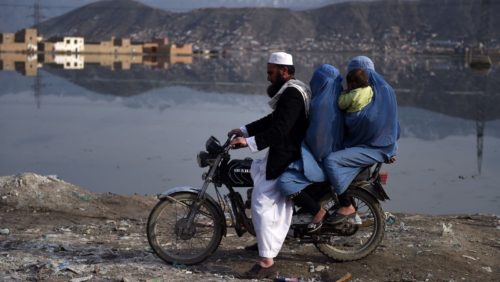
Source: NYT 2017 article “Without a Motorcycle in Kandahar, ‘You Are Like a Prisoner'”. A foreshadowing of how the Afghan war would be won and lost by distributed/localization networks, hit & run tactics, and terrain advantages.
First of all I just want to say I think a new article in The Hill is excellent.
It makes a lot of great points using sound analysis explaining how the Pentagon lost Afghanistan, such as this paragraph.
The U.S. military still lacks a comprehensive field manual and “doctrine” on how to achieve wholesale security force assistance, even though it has been core to our exit strategies in Iraq and Afghanistan for years. Why? Because our military’s identity is about assault and not occupation, and training foreign troops smells of occupation. We would rather blow up the enemy.
Second I want to say the American “occupation” of itself after Civil War could become the canonical example of why American forces have had difficulty identifying with the critical phase that comes after blowing up the enemy.
Look at the 1865 Mississippi concentration camp controversy for a fascinating and detailed case of post-war refugee crisis handling.
Consider that the American military track-record includes confronting the long history of Confederate South attempts to shame or obscure America’s most successful military leaders at nation-building as well as occupation.
Anyone who wants to speak about the American military identity being forged and focused on assault, rather than suited to an occupation, should thus consider how the 1870s and rise of lynchings and Jim Crow might be proper framing.
We could benefit from more history analysis like the following paragraph in another expert op-ed on the war in Afghanistan (which highlights just how an “occupation” phase goes missing from the American narrative):
Though the Federal Army fought the Confederate Army, both armies were composed of locally raised forces like Joshua Chamberlain’s famed 20th Maine Volunteer Infantry Regiment that was made famous for defeating the 15th Alabama Infantry Regiment at Gettysburg. Such forces fought bloody battles across America that eventually led to the standing army we have today with no such regional affiliations. But that took decades.
That’s a good telling of the assault phase, yet not exactly accurate overall. We obviously know that the standing army 150 years later still had to explicitly ban soldiers from flying the “regional affiliation” battle flag of the Confederate South. Ouch.
Third, I feel I have to point this history out because The Hill article makes an unbelievably bad error in analysis — an unforced error, a cardinal and common error in American thinking that helps highlight exactly why “our military” is so bad at occupation doctrine.
The following paragraph in The Hill is like nails on the chalkboard to me.
…conduct human-rights vetting of all candidates for the security forces, which is not just a good idea but also U.S. law (22 U.S. Code § 2378d). We would never dream of putting cops on our streets or soldiers in our military without a background check, but it’s what we did every day in Iraq and Afghanistan.
No no no no.
The history of America tell us the exact opposite. After losing the Civil War the Confederate South soldiers who had sworn to destroy America were appointed to run police… and predictably started to massacre Americans.
…summer of 1865, just after the Civil War, Union commanders in the battered port city of Wilmington, N.C., appointed a former Confederate general as police chief and former Confederate soldiers as policemen. The all-white force immediately set upon newly freed Black people. Men, women and children were beaten, clubbed and whipped indiscriminately… One of the most terrifying examples erupted more than a century ago, when white supremacist soldiers and police helped hunt down and kill at least 60 Black men in Wilmington in 1898.
…Camp Pendleton in Oceanside, California was a hotbed of KKK activity–an open secret that was tolerated or aided by Marine Corps brass… white marine Klansmen openly distributed racist literature on the base, pasted KKK stickers on barracks doors and hid illicit weapons in their quarters…
Such “background check” failures in human-rights vetting continue to this day. Here is some 2020 news!
FBI agent has documented links between serving officers and racist militant activities in more than a dozen states.
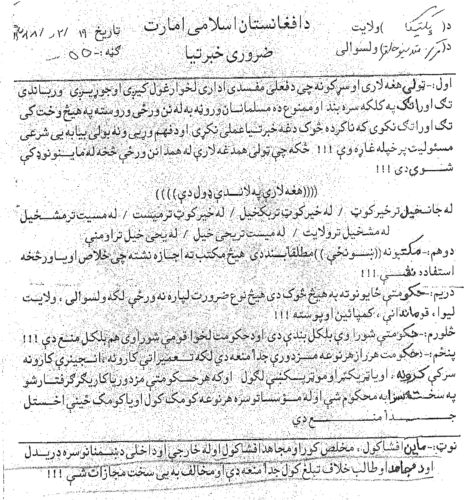
I’ve also pointed this kind of error out before with regard to Delta Force Commander memoirs — how basic ignorance about culture and history (e.g. thinking there’s no American equivalent to Afghan “night letters“) creeps into even the most elite American military narratives despite best attempts at being widely studied and not ignorant.
Source: West Point. A 2009 “night letter” advises the public to avoid roads and highways built by Coalition forces or Afghan government, avoid schools, avoid government buildings and refuse all assistance to foreign companies in Paktika Province. Perhaps comparable to how the Confederate South in America reacted to reconstruction after loss of its Civil War.
Missing these obvious parallels to American history and ongoing practices can be a form of cognitive blindness and its explanations are not pretty.
The Hill gets so much of the analysis right, yet it throws a giant wrench right in the middle of itself begging a question of how did they make such a giant error.
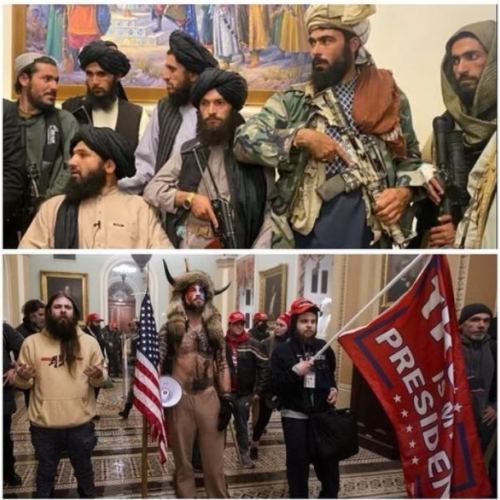
Basically American security experts regularly overlook domestic terrorism and corruption, or pretend it doesn’t exist, when it involves white insecurity groups that target people other than themselves.
I’m sure it’s a sobering thought to some, while for others in America it’s very well known.
Anyone who experiences or studies the very harsh side of cops on American streets and soldiers in American military, those studying the consequences of weak background checks, knows the “every day” failures in Iraq and Afghanistan could easily be argued to have roots… in sordid American history of human rights abuses.
Fourth, and probably superfluous to this post, is that my degrees are in this exact topic of occupation, or more formally the ethics of military intervention.
My master’s thesis focused on the Allied occupation of Ethiopia 1940-1943, which was meant to give some kind of insight into how armies best invade, hold and then release a country to self-rule.
And from that perspective, what I’m reading today reminds me a lot of the papers I used to pull out of the British archives. Unlike the frozen folders of antique yellowed and brittle documents, however, in this case I wish I had been given a chance to review or edit this article before it went to press to help eliminate such a glaring error.
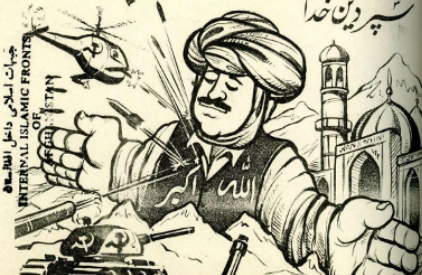
In the 1980s under Ronald Reagan American military intelligence plastered Afghanistan with posters like the following one, promoting violent religious extremism as a form of invincibility.Source: FP. “Above, a giant mujahid with ‘God is great’ written on his jacket is shown defending Islam and God from Soviet assault. The text in the top right says ‘Shield of God’s Religion,’ implying that the faith of the mujahideen will protect him from bullets. “
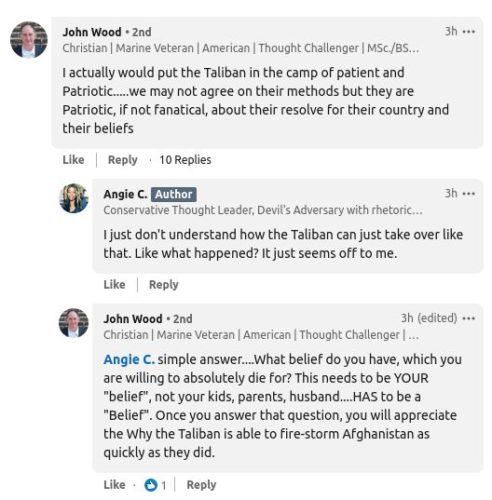
That old propaganda campaign has come full circle now, as I see very similar thinking (obviously seeded by Russian military intelligence) being propagated by posters (pun intended) on LinkedIn.
Source: LinkedIn
Doesn’t that look a lot like a clumsily-worded explanation for the cartoon above?
Is this language being used by John Wood not also terrorism recruitment? It appears to be goading people into joining a “belief” system by promising a magic ability to violently and quickly overthrow their government.
Of course no such magic exists, this is disinformation. And of course that’s not even close to the truth about Afghanistan or why the Taliban were able to roll through territory so quickly.
Even more to the point I find it infuriating to see Americans try to blame the soldier who is unfed and unpaid, lacks fuel and ammunition, and faces the very real issue of his family being unprotected at home as the Taliban advance to kill them.
People sitting in their comfy chair banging on a social media comment box, spreading toxic and cheap narratives like “they should have fought harder” are a total disgrace to humanity — an insult to the nearly 70K who sacrificed everything fighting for their country.
If anyone wants to talk about serious issues related to soldier morale, it was a US President’s flimsy negotiations with the Taliban behind the back of an elected Afghan government that set the tone from the top as a clear act of bad faith.
Speaking of Twitter, here is a more clear-eyed take on what LinkedIn should be talking about:
If the Taliban returns to power, I along with other women…will either be stoned to death or executed in a public space in front of a crowd.
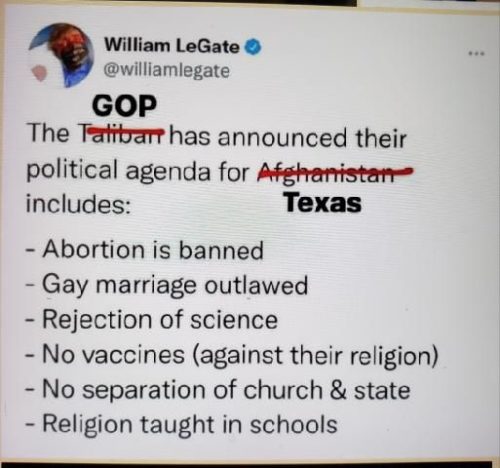
If that sounds like a foreign policy issue, in reality this is just as much a domestic one for America. Can you tell which one is which?
Now might be a great time to remember that Ronald Reagan not only as President claimed the Mujaheddin (religious extremists who violently subjugated women) were “like our founding fathers”, he also repeatedly cited a man named Winthrop in his speeches about America.
Winthrop was a religious leader who subjugated women, calling them agents of the devil.
America finally switched sides in 1996 to fight against religious extremism in Afghanistan, which is also when the discussion started to bloom about rights of women in Afghanistan despite it being obviously late.
The Mujahedeen period (1992-1996) was marked by ferocious, internecine warfare that scarred all aspects of Afghan life. Women’s rights and freedoms were severely restricted. Grave human rights abuses included extra-judicial executions, torture, sexual violence, disappearances, displacement, forced marriage, trafficking and abduction. This period represents one of the darkest chapters in the history of Afghan women. The brutality and predatory nature of the civil war, or Mujahedeen period, contributed to the emergence of the Taliban and their consolidation of power throughout much of the country after their capture of Kabul, September 1996.
It’s kind of a recent thing, in other words, for the American government to officially care about ending the oppression of women and children. Slow and late, as the author Ghost Wars explained a long time ago:
…individuals inside the US bureaucracy, at the state department, elsewhere, who began to warn that the United States needed to change its political approach to this covert [support of Mujahedeen], that they needed now to start getting involved in the messy business of Afghan politics and to start to promote more centrist factions and to negotiate compromise with the Soviet-backed communist government in Kabul to prevent Islamist extremists from coming to power as the Soviets withdrew. These warnings, when you look at them with the benefit of hindsight, are quite prescient and certainly were strongly given, but they languished in the middle of the bureaucracy and were largely ignored by both second term Reagan administration and the first Bush administration…
In September 2007 the House of Representatives Committee on Foreign Affairs held a hearing where Chairman Lantos gave a retrospective and put it like this:
America should not be in the business of arming, training and funding both sides of a religious civil war in Iraq. Did the Administration learn nothing from our country’s actions in Afghanistan two decades ago, when by supporting Islamist militants against the Soviet Union, we helped pave the way for the rise of the Taliban?
When LinkedIn posted the above propaganda it seems they are rolling back time to a genuinely awful American ignorance and flirtation with tyranny, as well as exposing the tools of Russian military intelligence today.
Neither are ok, of course.
To be fair it is being said now that neither Russia nor China are pleased by Islamic extremism taking control of Afghanistan.
They fear that a revival of the harsh Islamist code and rule by intimidation that underpinned the fundamentalist group’s government in the 1990s would lead to a resurgence of Muslim extremists.
The emerging geopolitical quagmire doesn’t mean that Russia will pass up the opportunity to use anti-democratic religious recruitment propaganda of the Taliban to destabilize America.
It’s a shame to see LinkedIn facilitating the posters. If we were talking about WWII they would most certainly be censored. Or as an article in Business Insider recently put it:
“To counter Chinese and Russian IO, we need to be aware of the threat and educate the public,” the retired special-operations PSYOP soldier said. “Americans need to understand that this is a real, ongoing threat. Sometimes war doesn’t mean gunfire and explosions.”
Nobody can own, run or use a business when they’re dead.
That’s the very simple concept that seems to be underneath Florida’s official plan to stall or even shrink its economy by making it unsafe to live or work.
According to a COVID tracker created by The New York Times, Florida is currently recording a seven-day average of 122.1 deaths in the state from the virus, a figure larger than 32 other states combined. Florida’s figure is also more than double that of the second most affected state, Texas…
Florida is so bad at basic safety necessary to do business there are 32 other states COMBINED that are better.
Imagine a headline that food poisoning cases in Florida are worse than 32 other states combined, and the governor has announced that he’s keeping poisoned fruit on shelves.
Would you really do business, have anything to do with the fruit there?
The Florida business environment, no joke, is so bad it can seriously injure or kill you.
Stay clear.
It’s made worse because the Florida government has taken an official position of trying to forcibly expose children to disease by banning even simple prevention measures:
Florida is also reporting the highest number of children currently hospitalized from COVID of any state in the country, with 172 currently being treated in medical facilities, according to data shared by the U.S. Department of Health and Human Services.
There’s no exaggeration here. The governor of Florida literally tried to ban safety and security experts from providing safety and security to children during a time of desperate need.
…several school districts have announced that they will not comply with the rule in line with advice from the Centers for Disease Control and Prevention.
Non-compliance sounds odd in this context.
It would be like saying washing and cooking your food is a form of non-compliance with this dirty politician who is known to wipe without toilet paper and fail to wash his hands before giving you a grapefruit.
Common sense is non-compliance?
The Florida governor’s rules are meant to force citizens to accept an absurdly unsafe market, one where trust is completely absent. How is such thinking not a death sentence for business?
Over 200 people died yesterday in Florida from COVID19.
Every day a new jumbo-jet sized group of people are dead in Florida from COVID19; it’s like reading daily that a major airline has a jet crash in Miami and kills all its passengers.
Would anyone who owns or operates a business seriously want to be banned from protecting their family from using basic safety measures in this context?
And who wants to pay into such a beleaguered overcrowded expensive healthcare system, struggling under preventable cases, just to watch a slow painful yet easily preventable death of their children?
In a sketch by the British comedy duo Mitchell and Webb, a government minister charged with ending a recession asks his analysts if they’ve considered “killing all the poor.” “I’m not saying do it—I’m just saying run it through the computer and see if it would work,” he tells them. (After they say it won’t, he proposes “blue-skying” an even more senseless alternative: “Raise V.A.T. and kill all the poor.”)
a blog about the poetry of information security, since 1995