I’m being told a hidden science laboratory has been revealed deep inside an American corporation, tasked with finding a final solution to the problem of staff productivity loss from illness.
As weird and twisted as this may sound for a national healthcare system to be so deficient that a self-interested empire builder has an illness laboratory, it’s entirely true.
Amazon is working on a cure for the common cold in a years-long, top secret effort called “Project Gesundheit,” according to three people familiar with the effort.
It’s secretive because a search to cure the common cold would obviously make everyone very sick if they found out, right? And these people leaking details definitely are not trying to slow or stop its progress before it’s too late.
I mean of course Amazon’s CEO dresses like the villain in an Indiana Jones movie and calls his secret research to eliminate unfit workers Gesundheit…
“Deadly Medicine” traces the history of a systematic effort by Nazis to eliminate the “unfit”. Source: DW
…[He is as or more] concerned about the political fallout of the growing number of coronavirus cases in the United States as he is about how those cases should be handled. […] {His] concern is just that numeric increase, a concern that has no other apparent root besides his insistence that his administration is keeping that particular number low.
Sounds like an obsession with appearance, and no concern for people who will die. In other words it suggests numbers everywhere are being cooked by this administration because they love power, hate science and believe gambling with other peoples’ lives has no consequences.
Some also are reporting that warnings by intelligence professionals to the White House of the pandemic risk to America… were ignored and the office leadership fired.
Stanford lecturer Brett McGurk cited a document from the office the Director of National Intelligence Dan Coats’ 2019 “Worldwide Threat Assessment,” which specifically warns of a disease like the coronavirus.
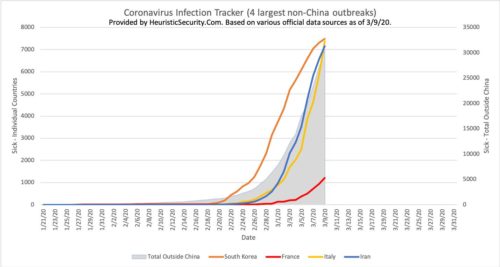
Low numbers of cases doesn’t even mean things will be better for those reporting them, since they sit on an exponential curve early in the spread cycles. Here you can see Michael Lines graphing the similarity in rates:
France replaced Japan in tracker of the 4 largest coronavirus outbreaks outside of China. US is expected next. Source: Michael Lines
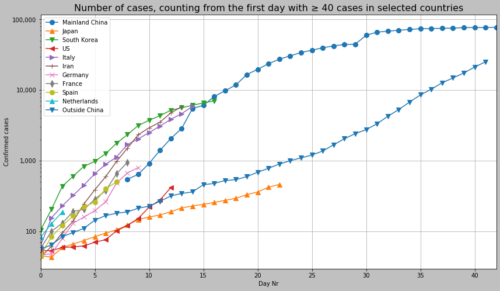
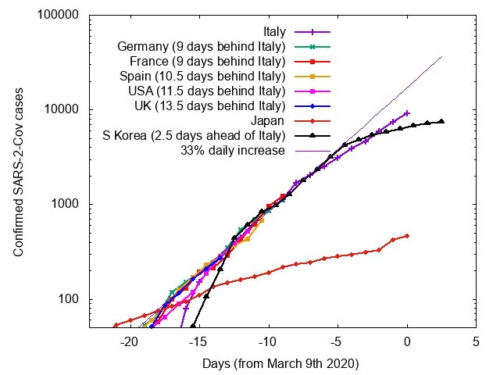
“Data is beautiful” on reddit offers this graph, which indicates the US being slow on response and failing to test means it is ramping quicker than countries that tested early and often:
“point of this is not to compare which country has or had more cases at a given date, but rather show how the virus propagates”
Any country having only 50 cases on the same day that Korea has 5,000, for example, could indicate Korea is 15 days ahead on a single contagion timeline. They’re linear numbers following the same line not running in parallel.
WHO has stated these three factors are most important to containment:
sufficient testing to identify the infected
isolation and treatment of infected once identified
tracing anyone who had contact with them
So the real questions right now are what testing capability has America demonstrated relative to number of cases it has reported on the shared timeline (sufficiency), and how early did the testing start relative to the case numbers (enabling isolation and treatment during spread to contacts).
The answers are that America’s federal government not only is intentionally cooking its numbers to artificially keep numbers reported low, it’s also been dangerously slow to deploy test kits that would be able to prevent thousands of deaths in America.
…the country’s true capacity for testing has not been made clear to its residents. This level of obfuscation is unexpected in the United States, which has long been a global leader in public-health transparency. The figures we gathered suggest that the American response to the coronavirus and the disease it causes, COVID-19, has been shockingly sluggish, especially compared with that of other developed countries. The CDC confirmed eight days ago that the virus was in community transmission in the United States—that it was infecting Americans who had neither traveled abroad nor were in contact with others who had. In South Korea, more than 66,650 people were tested within a week of its first case of community transmission, and it quickly became able to test 10,000 people a day. The United Kingdom, which has only 115 positive cases, has so far tested 18,083 people for the virus.
That’s a disaster, and it seems to be an intentional one. The US government is likely to get a lot of Americans killed. Already confirmed cases have exploded after the White House literally said (not a joke) that we should expect cases soon to go to zero.
It’s truly bizarre to run America completely blind like this, unless you think back to how badly President Reagan infamously intentionally delayed and suppressed national virus numbers and response while thousands were dying.
To be clear, scientists today refer to the COVID-19 a cross between AIDS and SARS. That makes it especially important to reflect on an American President in the 1980s who intentionally hamstrung the CDC and blocked scientific response to AIDS.
I’ve written about this before, in context of the “executive privilege” stain from anti-science extremists in American politics (including present Supreme Court Justice Roberts, adviser to Reagan during the AIDS crisis):
One of the most prominent stains on the…Reagan administration was its response, or lack of response, to the AIDS crisis as it began to ravage American cities in the early and mid-1980s. President Reagan famously…didn’t himself publicly mention AIDS until [Sept 17th] 1985, when more than 5,000 people, most of them gay men, had already been killed by the disease.
Reagan’s first public address on the subject came even later, captured in a story about the White House turning down pleas for help from political backers with the virus.
President Reagan did not give his first major public address on the disease until …May 31, 1987 — well after the number of AIDS deaths in the United States topped 25,000.
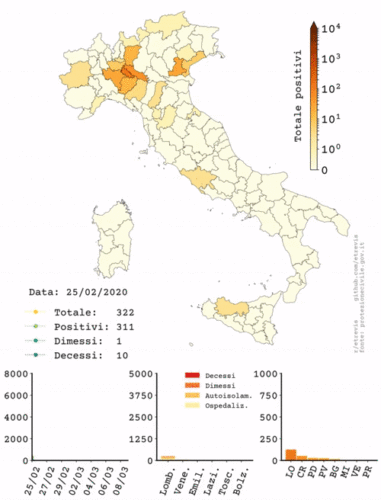
Italy, with its high fatality numbers serves for most countries as a foreshadowing of what’s to come with COVID-19. That country is now predicting 18,000 people hospitalized in Lombardy region in a few weeks, of which they expect 3,000 will require intensive care (that’s 10 times Italy’s current capacity).
Diffusion of SARS-CoV-2 (COVID-19) in Italy. Source data: https://github.com/pcm-dpc/COVID-19
However, Ronald Reagan and Justice Roberts perhaps are an even better foreshadowing of what’s to come with COVID-19 in terms of America’s lack of transparency and overly political approach to healthcare, downplaying fatalities or even ignoring them altogether.
In the early stages of the AIDS virus thousands were dead and yet the Reagan Administration sat opaquely disbelieving, refusing to give scientists a voice and devaluing American lives. Cooking the numbers during that crisis quickly resulted in high fatality rates into the tens of thousands, with nearly 700,000 Americans in total killed since the virus was first reported.
The very telling history of virus response in America is captured especially well by the documentary “When AIDS Was Funny”
“…these ‘experts’ have no real evidence that what they say is true…”
“I support any disease that thins out the heard. Especially liberals and filthy Democrats.”
“I am sorry but all you Democrats and socialists will rot slowly as the disease consumes you then its time for the eternal lake of fire.”
And as Sue Turner has pointed out, here’s how the UK government used its office of information in 1987 to counteract these kinds of ignorant and harmful comments.
Only a day or so ago I posted a list of coronavirus maps. Within 24 hours of that post, some maps changed dramatically.
The worst map (CDC) became marginally better, while the best map (nCoV2019.live) wiped its details and suddenly became one of the worst.
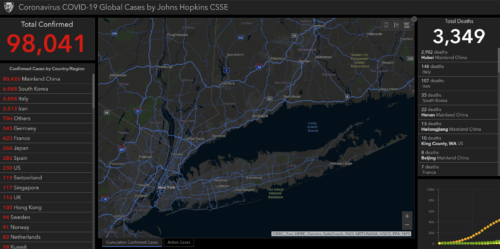
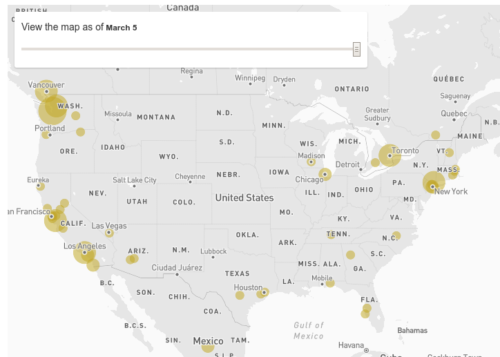
Neither of those changes probably mattered to most people as the one I keep hearing about from people is the Johns Hopkins CCSE, which I already warned had problems. It’s now March 5th, do you see a problem with this map?
Here’s a big clue about this empty view of New York: news stories running at the same time offer some very precise numbers that should be visible.
New York’s race to quarantine thousands of people potentially exposed to coronavirus is testing the limits of public health responses to the COVID-19 outbreak spreading across the U.S., experts said. In a matter of 48 hours, what began as one Westchester County man’s COVID-19 infection spiraled into a community quarantine disrupting countless lives [as] …disease detectives worked to track the movements of 22 confirmed cases in New York so far, authorities said Thursday.
My next step was to search for anyone reporting this in their bug tracker (nope) and then dump the Johns Hopkins CSSE map raw data. They make it available as a daily CSV.
Their data clearly has 23 cases for NY, based on a simple query.
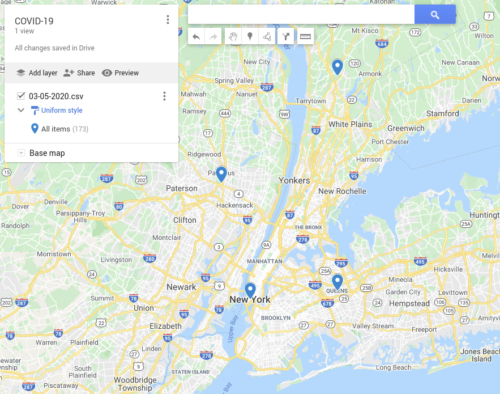
Then I loaded their raw data into a generic Google map and here you can see the pins show up where there were none in the Johns Hopkins map:
Unless I can find someone else reporting this, I will have to file the bug. However, it also seems kind of pointless when newer and better maps are emerging.
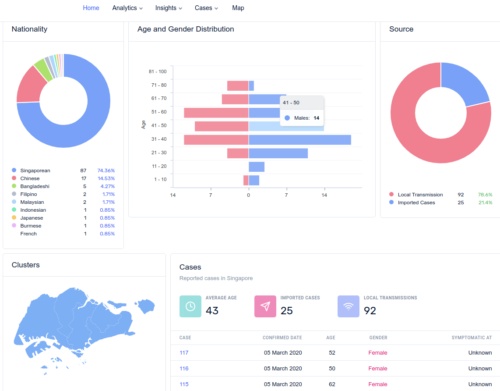
There is nobody in the world doing a better job than Singapore right now, for example. Their Kibana-looking co.vid19.sg dashboard is phenomenally useful, with graphs of demographics as well as geolocation over time (spread).
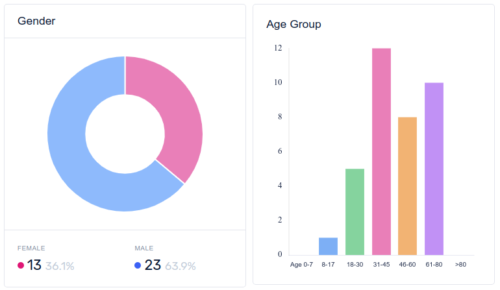
It can be frustrating after seeing this to look at other sites and find similar demographic details missing, such as in the Hong Kong map.
One thing that really popped out for me in the Singapore data, to be clear, is how the virus spreads without symptoms and has predominantly hit men older than 18 and is disabling them for a week or two.
That combination of factors are so eerily similar to historic bio-weapon research objectives (years ago I often gave talks about Cold War attempts to weaponize rabbit-flu, and it’s in my new book about big data security)… so I’ll just say here it’s hard to not to call out the military and political implications of what the data is revealing.
For perspective, I’ve been writing pandemic response policies for years, as a function of business continuity, and the FEMA definitions that were recommended to trigger a policy used to be “…30 percent or higher in the overall population during the pandemic. Illness rates will be highest among school-aged children (about 40 percent) and decline with age…”.
Given the healthcare crisis in Russia and reports of a 75% drop in available health facilities between 2005 and 2013, such that only 20% of the population even has healthcare… I’m going to guess they’re completely blind.
Back to speaking about maps with geolocation over time, I also just noticed that NY itself has launched a great map called the NYDatabases.com site by Ithaca Journal
Unsurprisingly it gives the best representation so far of the situation in NY. My only issue is the bland color theme that makes it hard to see any hot spots on zoom. That’s still an error in my book, but I’ll gladly take a quick theme adjustment over data never making it to the map.
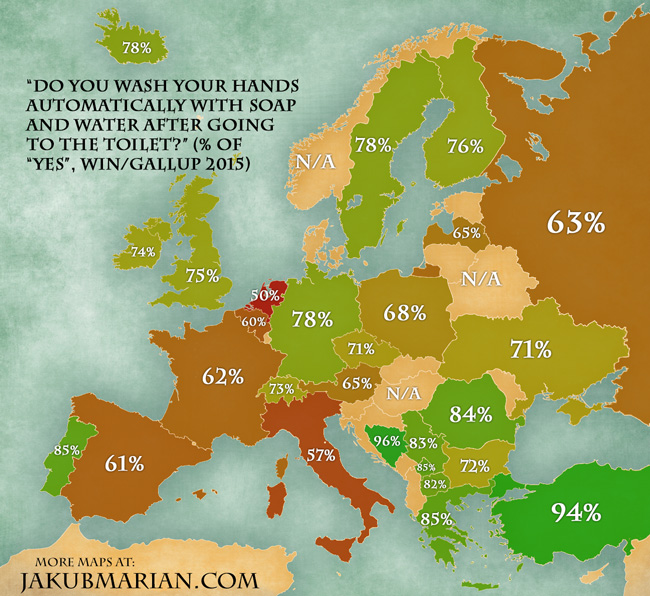
One thing I haven’t see anyone do yet, despite hand-washing frequency at the top of mind, is represent counter-measures in virus maps. Closest thing so far is a 2015 survey showing Italians near bottom of the list.
In most contemporary articles the future of collaboration is remote workplaces and more natural space, no longer industrial-era centralized brick-and-mortar for assembly-lines and escalators.
However, Berkeley is proudly announcing without any sense of impact at all that they will pave the forest and replace quickly shrinking natural environment in the Bay Area with yet another big building.
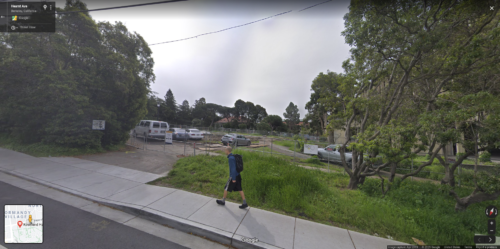
Berkeley student contemplates the hundreds of millions given anonymously to pave over paradise for a new building where he soon can discuss the ethics of having just paved over paradise.
What’s even more bizarre, is despite the ever-growing crowd of scientists demanding transparency in data, an absurdly large $252 million in funds to be spent on a building is being announced as… anonymous.
The Division of Computing, Data Science, and Society (CDSS) will soon have a brick-and-mortar home, thanks to an anonymous $252 million gift to seed the construction of a new “data hub” on the open space… “To ensure these systems and tools are used ethically and responsibly, experts in computing and data science must work closely with ethicists, sociologists, legal scholars and others at every step of the process,” Chayes said. “And for these collaborations to happen, these disparate groups need a space to work together.”
Is the donor Putin? Zuckerberg? A construction company, or an architecture firm?
Nothing so far about the announcement suggests anything close to being ethical or responsible. Did I miss a clue?
I wish it were an article from the Onion, but alas it is real.
a blog about the poetry of information security, since 1995