One of the lesser known stories in the American mobile technology space is Sailfish OS by Jolla. For whatever reason it never seems to get any press, unless you count this sideways glance in ZDnet
I have seen all too many failed attempts to compete with Android and iOS. But I’m impressed by Duval’s privacy-first approach, which builds on the existing successful Android platform. Instead of trying to replace it, he’s making the best of it. I think with privacy being more of a concern for users and hardware vendors looking for Google-free operating systems, /e/ may be successful where so many others have failed.
Ok, first of all to be fair, I am assuming these non-specific phrases include Sailfish OS. It is a Linux-based OS (i.e. Meego derivation, following N9 Linux-based phones from 2011) that successfully replaced Android in 2013 and ran an emulation engine for Android. Does the author believe it failed?
Despite being in America I’ve used it since basically v1.0.1 (called an “Android love fest” by TheReg) on dedicated Jolla hardware as well as Sony phones and it’s great! One of the amazing things about the Android emulation was how it allowed app stores to be multi-master.
It wasn’t as slick as the Nokia firmware-based regional packages that came before it, but Jolla allowed users to choose apps from stores completely disconnected from Google, never touching American soil for that matter.
Second, there’s some kind of weird thing going on at Google where in 2017 their HTC-based phone was codename Sailfish. This new /e/ OS lists Sailfish as one of the phones it will run on already. Perhaps you could call this some kind of coincidence but it’s hard to believe it is random since…
Third, in 2016 the Russian government announced Sailfish was their preferred platform. At that time the name only referred to one thing:
…after a thorough review of several open source based options, the Ministry publicly expressed support for Sailfish OS, which was chosen as the platform for further development.
Trumpin tullimullistus: Androidista tuli pelinappula… ”Kohta mennään kuilun reunan jälkeen lujaa alas” (Trump customs shock: Android became a pawn… “Soon we’ll go down the edge of the abyss”)
And fourth, if success is based on users making privacy a concern, then surely Sailfish (the non-Google one) should already have registered as a win. And that’s not even to mention that it was Linux from the start.
In other words, I appreciate that there’s another Android Appstore non-Android phone with privacy in mind, being developed by the Mandrake founder. More options sounds great to me! Although his sense of history does worry me.
“The 80s have been the most exciting period in computing so far, in my opinion,” he said. “Well, I can’t talk about the 60s and 70s period.”
However, at this point I’d like to see a simple comparison table with Sailfish: Ideas stolen by Google? Endorsed by Russian government? Runs on OEM hardware that Google resells?
Finally, the article on /e/ also mentioned how it would run on Samsung devices. If that’s a goal, I figured I should pull out this history chart showing the development of Samsung’s non-Android OS that their mobile devices can run already:
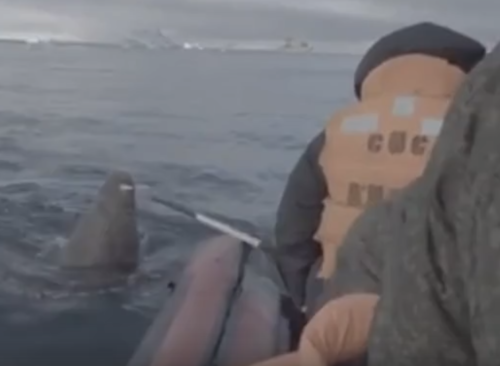
Russian Geographical Society used one of its modern landing crafts in a way a mother walrus didn’t appreciate, so most news outlets are describing how she attacked their boat, sinking it and sending the Russian military running for their lives.
Naturally the Russian military made a statement that reported the opposite:
“Serious troubles were avoided thanks to the clear and well co-ordinated actions of the Northern Fleet servicemen, who were able to take the boat away from the animals without harming them.”
Definitely avoided any serious troubles there. “Able to take the boat away” from threats is double-speak for sinking. Aha, you can’t attack Russian boat, because there is no boat. Troubles avoided! Swim faster comrades, it is very cold.
Maybe something was lost in translation when Russians said they thought they were up to the tusk (pun intended).
A first-person account in Russian media said their boat was done in and a video shows them trying to poke the walrus with a gaff, which probably just made her more angry.
“The walrus was not injured. We just shoved her off. Our boat was damaged – sections three and five. Barely made it to shore” said Leonid. (Морж не пострадал. Мы его просто отпихнули. А лодка пробита — три секции и пяти. Еле доплыли до берега, сообщает Леонид.)
Speaking of being lost…
The area in question supposedly is on Wilczek Island, (Остров Вильчека) in the southeastern end of Franz Josef Land, Arkhangelsk Oblast, Russia. Maybe it’s somewhere else?
I have yet to find a western map anywhere listing a “Cape Geller” (мысе Геллера). Who was Geller?
GPS has been known unreliable for a very long time. Ten years ago I wrote about it here, and more recently participated in tests that successfully fooled Tesla navigation systems such that it made a car drive erratically and abruptly exit a highway.
Trouble in navigation probably is why the USAF is announcing new technology on bombs that optimistically gets described as the kind of cutting-edge millimeter waves and lasers you might find on driver-less-cars.
While the GBU-39 used Global Positioning System (GPS) satellites as the guidance method, the StormBreaker when operational will use GPS plus a millimeter wave radar and a semi-active laser as a seeker package.
Stormbreaker bomb (arguably a drone) after launch from USAF jet. Claimed by Raytheon to maintain target accuracy even during inclement weather or GPS failures
I’ll wager the backstory here is that GPS bombs were being not-so-smart after all (mass civilian casualties). Terms like “smart” and “seeker” only go so far when the things dropped from a plane, or flying themselves, blow up the wrong people.
Who can forget the 1950s version of pin point accuracy on bombs intended to destroy North Korea that killed USAF crews instead? And let’s not forget Igloo White bombing in the 1970s that not only missed targets but also cooked the books to be considered a success.
More to the point (pun not intended), Human Rights Watch (HRW) in 2017 launched investigations and lodged formal complaints about the GBU-39
“They told us it was a mistake by the coalition, and after the war we will talk about it,” Hasan said of Iraqi officials whom he contacted for help. “Why would they make a mistake like this? They have all the technology. This is not a small mistake.”
Another east Mosul resident, Jasim Mohammed Ali, said his son and six grandsons were killed by what he believes was a coalition airstrike that destroyed his home on Nov. 17.
The coalition is still investigating the strike based on a complaint by Human Rights Watch, which — along with other experts The Times consulted — identified munition parts in the wreckage of Ali’s house as a GBU-39 small-diameter bomb, a guided munition used by coalition forces.
So the good news might be that bombs are going to be far more accurate and kill the right targets.
“An increase of 82 percent in child casualties compared with the previous four years” has been linked in Afghanistan to aerial attacks and remnant explosives.
I haven’t found yet that kind of reference in the USAF press release on why they felt the need to improve “smart” bomb targeting systems. It just seems like a logical jump from the HRW criticisms.
Also consider the USAF and other customers of US arms still have a lot of GBU-39 left to drop (as HRW reported again this year) so maybe they want to wait 30-40 years before declassifying real reasons as some rappers already have guessed.
The pilots said their bombs lit Baghdad like a Christmas tree
It was the Christian thing to do you see
they didn’t mention any casualties
no distinction between the real and the proxy
only football analogies
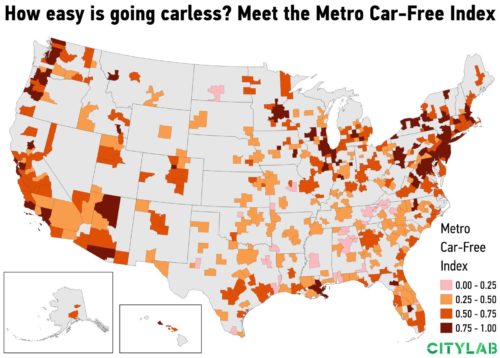
While the Dutch claim their density is what causes their cycling safety, there’s no such effect in the US. San Francisco is far less dense than NYC yet far more progressive in terms of cycling safety.
San Francisco tops the ranking of large metros in the index, followed by Boston and New York. What’s interesting is that the New York metro leads on three of the four variables of the index. It has far and away the largest share of households who report no access to a vehicle, 22 percent. (That’s more than three times the share in both San Francisco and Boston.) New York is also the clear leader in the share of commuters who use transit to get to work, with more than 30 percent, almost double San Francisco’s share. And it has the edge on the share of commuters who walk to work, roughly 6 percent.
But New York has a far smaller share of commuters who bike to work. It even fails to crack the top 10 on this metric, coming 101st out of 382 metros, or 22nd out of 53 large metros.
Full disclosure: I have commuted by bicycle in cities around the world all year through wind, rain, snow, sleet…up hills and down.
The reasons against cycling to work in NYC definitely are not topographical or weather related. San Francisco obviously is hilly and many other cities have comparable temperatures and precipitation than NYC.
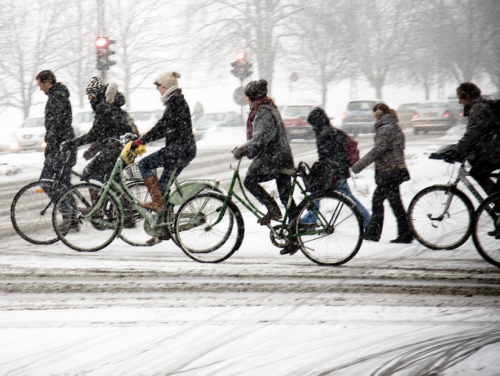
56% of Copenhageners ride a bicycle for transport daily. 75% cycle all winter.
“Rush Hour Copenhagen” by Mikael Colville-Andersen
The core reason, I believe, is the politics of NYC and how they perceive personal power accumulation measured by dollar bills in their bank accounts to be inversely related to the health of the environment they commute in/through.
The city has a pollution-loving history with a huge “we’re busy trying to get rich/famous, leave us alone” lobby that claims doing the right thing for “others” is economically unfeasible in their list of priorities.
The term “economic feasibility” has been subject to debate in the past. When the city banned styrofoam, it said that recycling the stuff was not economically or environmentally feasible. Restaurants and other industry sued in disagreement — and it took several more years and some back-and-forth in the courtroom before the ban was finalized.
The typical NYC powerful resident would go to the gym and spin to look “better than others” in work or personal life, but has little interest in getting on a bike for the same workout when told it results in making the city a better place to live for others.
The city’s Five Borough Bike Tour shows how good-intentioned people of the city are so disenfranchised they have exactly the wrong attitude, marketing safe cycling as some kind of weird special event:
The idea of seeing all five boroughs in one day and seeing the streets shut down is such a unique opportunity
First, the streets aren’t shut down. They are being used more effectively. Stop calling proper use of streets to maximize throughput a shutdown.
Second, people are restricting their movements because cars make it so painful to go any distance let alone the magic 30 minute commute in a city that’s pushing a sad 40 minute average. Five boroughs is not actually much distance to cover in a day.
Third, this should not be seen as a unique experience. It needs to be a monthly event if not weekly. A single day for cycling to be made safe is pathetic in a city that claims it wants always to be “on” and alive.
I’ve written before about the benefits of cycling in cities and the bottom line is the economics are clear and simple. What’s unclear is who in NYC has the political power and sense to do the right thing?
The real story presented by Citylab data is bicyclists must find a LaGuardia-like talent to overcome NYC power culture now rooted in the self-gain mindset of cars that brings willful disregard for others’ safety and health.
…what is really tedious is that we are not allowed to drive, but you expect money from motorists…
That’s crazy talk (absolutism and a fallacy), given how redirection from one street in an entire city doesn’t mean cars are being banned from all streets.
Think about what the motorist association is claiming: a single person who pays any amount of money demands that they are entitled to blockade hundreds or even thousands of others on the street just because they like to sit in public inside a private inconvenience box.
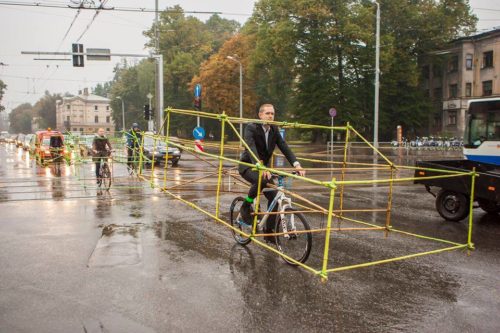
Thinking inside the box. Cyclists demonstrate the stupidity of cars
Drivers were being told they would have to avoid a street (small inconvenience) where a dedicated bus lane was being created for greater good… and that car association said no way would they allow smarter traffic planning if it takes away one inch of asphalt for them to generate harms, because they’re wealthy.
This is not an isolated case according to repeated psychological studies of motorists:
Psychologists Dacher Keltner and Paul Piff monitored intersections with four-way stop signs and found that people in expensive cars were four times more likely to cut in front of other drivers, compared to folks in more modest vehicles. …expensive cars drove right on by 46.2 percent of the time, even when they’d made eye contact with the pedestrians waiting to cross. Other studies by the same team showed that wealthier subjects were more likely to cheat…
If I were the city, I’d point out that motorists are heavily subsidized already and thus stealing from others by not paying nearly enough for the damage to infrastructure they cause:
American Infrastructure is crumbling. The ASCE has given American infrastructure a “D+”. It could cost almost $5 trillion to fully fix and upgrade American infrastructure. Congestion charging systems could potentially raise billions of dollars per year.
Here, let me frame (pun not intended) this another way: if a car is on the street then that street in NYC should be declared shut down.
I mean if we use that first point of the Five Borough Bike Tour properly, when cars use the streets the streets are effectively shut down and highly polluted (from brake dust to exhaust it’s a huge mess with slow cleanup).
People forget how influential and successful LaGuardia was dealing with the predatory and selfish mindset in NYC, and that his rural experiences and humanitarian values arguably are what made his vision of the city so great.
When will the next LaGuardia ride into town?
a blog about the poetry of information security, since 1995